eBook - ePub
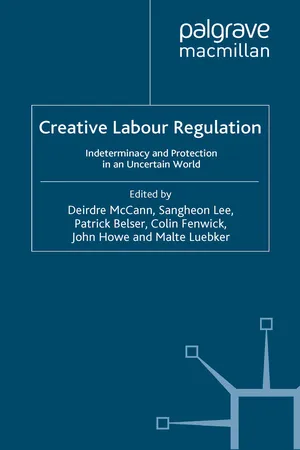
Creative Labour Regulation
Indeterminacy and Protection in an Uncertain World
- English
- ePUB (mobile friendly)
- Available on iOS & Android
eBook - ePub
Creative Labour Regulation
Indeterminacy and Protection in an Uncertain World
About this book
The volume is at the forefront of the academic and policy debates on effective labour regulation, offering innovative approaches to research and policy. It is an interdisciplinary response to the central challenges that face modern labour regulation and draws on contributions by leading experts in a range of disciplines.
Information
Part I
Introduction
1
Regulatory Indeterminacy and Protection in Contemporary Labour Markets: Innovation in Research and Policy
Introduction
The first volume drawn from the work of the Regulating for Decent Work network, Regulating for Decent Work: New Directions in Labour Market Regulation, responded to the simplistic empirical studies on the economic impact of labour regulations that have become increasingly influential since the 1990s (Lee and McCann 2011a). That volume identified the use of indicator-based methodologies to quantify and compare labour regulations, most prominently in the World Bank’s Doing Business project, as a key evolution in the deregulatory project that has been associated with Washington consensus policy agendas and fuelled by the neoclassical economic tradition (Lee and McCann 2011b). This empirical work, and its absorption into policy discourses, was argued to significantly expand the deregulatory narrative along two axes: (1) to extend the preoccupation with minimum wage and employment protection laws to other facets of labour law; and (2) to reach beyond the advanced industrialized economies more firmly to embrace the regulatory frameworks of the developing world (Lee and McCann 2008).
The earlier volume exposed a set of assumptions about the nature and functioning of legal rules that is embedded in these theoretical and policy literatures. Deakin’s (2011) critique of neoclassical economic analysis laid bare the theory of the operation of regulatory frameworks that underpins this work. He singled out two related assumptions: that legal rules are exogenous to market relations (and so operate as an external imposition) and that they are ‘complete’ (in the sense of being certain in scope and self-executing). The literature on the economic impact of labour laws was identified by Lee and McCann (2011c) as harbouring two apparently contradictory accounts of legal regulation. A ‘formalist’ narrative, characteristic of the most prominent legal indices, assumes labour regulations to be comprehensive (protecting all workers within their formal ambit) and complete (workers are entitled to the full array of legal protections, to the maximum permissible extent). The policy discourse, however, simultaneously harbours a pessimistic account of legal regulation, which implicitly depicts labour laws as largely irrelevant to a large segment of the developing world labour force. This latter account hinges on a clear-cut dichotomy between the ‘formal’ and ‘informal’ economies, in which labour standards emerge as unknown in, or entirely irrelevant to, the latter (see, e.g., World Bank 2005).
Many of the papers in the earlier volume, in contrast, implicitly adopted a neo-institutional account of legal regulation, in which legal rules are endogenous to market processes (Deakin 2011) and in which political structures and laws are neither self-executing nor operate by enforcement alone (see Frey’s (2011) elaboration of a diagnostic methodology for improving labour market regulation and Lee and McCann (2011c) on the awareness of statutory standards in Tanzania). Drawing on this model, labour regulations can be understood as the outcomes of evolutionary processes that hinge on a wide range of contextual factors (Deakin 2011). As a consequence, similar regulatory frameworks, even of the same ‘legal origin’, can generate diverse economic outcomes.
Subsequent advances in both empirical and theoretical studies have confirmed that the impacts of labour regulation are difficult to predict a priori. Since the previous Regulating for Decent Work volume, there have been signs of progress in the economic research towards more rigorous and contextual thinking about the operation of labour market regulations. A series of empirical studies has generated outcomes at odds with the theoretical predictions of standard textbook economics. A recent survey by MacLeod (2011) of empirical evidence on the impacts of employment protection laws, for instance, concluded that theoretical predictions about negative employment impacts lack empirical grounding (table 2).2 Similar conclusions have been reached with respect to minimum wage laws (see ILO 2010 for a review and Groisman in this volume on Argentina).
It can be hoped that this growing body of empirical research will sustain a reconsideration of the theoretical framework that guides most of the empirical studies, and perhaps trigger a quest for a more suitable theory. This development is crucial, in that policy decisions in the area of labour regulation are often driven by theory (the assumption, for example, that any form of ‘non-market’ intervention generates distortions and inefficiencies). As Deakin has noted,
[M]ore constraining is the role that theory, relatively uninformed by empirical work, plays in shaping policy perceptions … Refutation of the theory will not occur through new empirical findings alone. However, empirical work may play a role in shifting some of the theoretical underpinnings of the model. This is beginning to happen with the growing use of transaction economics and behavioural approaches to theorize labour market institutions, but the process is slow. (2011, p. 53)
More recent work has produced significant improvements in the conceptualization of legal regulation in economic theory, primarily from within the traditions identified by Deakin. This contention is illustrated by a number of contributions to the Handbook of Labor Economics (2011). Charness and Kuhn (2011) review recent studies grounded in behavioural economics and laboratory experiments, which explore the relationship between worker and firm and its productivity outcomes. This research demonstrates the worker/firm relationship to be far more complex than is typically assumed in conventional theory, allowing a role for fairness, trust and institutions. Boeri (2011) also argues that studies on regulatory impacts in Europe have paid insufficient attention to institutional interactions and enforcement, calling for a ‘more realistic theory of the effects of institutional reforms on the labor market’ (p. 1222).
In the field of transaction economics, the employment contract is recognized to be incomplete, leaving space for discretion and uncertainty. Within this tradition, MacLeod (2011) has highlighted the importance of regulatory design, which is often neglected in economic empirical research. Taking the example of employment protection laws he concludes that,
[E]conomic research uses a relatively crude representation of the law. We know virtually nothing about how specific legal rules interact with different types of worker-firm matches. At a policy level, employment protection entails changes to specific rules, such as the number of days’ notice for a dismissal, mandatory dismissal payments, and specification of the conditions under which a protected employee may be dismissed. At the moment, policymakers have little guidance on how to set these parameters, aside from the blanket recommendation to reduce them all. (p. 1685)
Similarly, Manning (2011) questions the relevance of the perfect labour market assumption that underpins both theory and empirical models. Realistic modifications to the assumption of imperfect competition in the labour market, he demonstrates, generate different predictions about the impacts of labour regulation on labour market outcomes. In line with MacLeod’s review (2011), Manning argues that the imperfect labour market creates ‘rents’ within the employment relationship, estimated to range from 15–30 per cent. He further notes that ‘it is the very existence of rents that gives the “breathing-space” in the determination of wages in which the observed multiplicity of institutions can survive’ (pp. 995–6) This observation implies that institutional interventions in wage determination, notably through legal regulation and collective bargaining, could have positive outcomes in terms of wages, employment and productivity (as has been demonstrated in numerous empirical studies; see further MacLeod 2011).
The difficulties, highlighted by these studies, of establishing a clear linkage between labour regulations and labour market performance effects was noted in the first Regulating for Decent Work volume, by drawing on the notion of ‘regulatory indeterminacy’. This notion emerged in Deakin and Sarkar (2008) as a critique of standard economic analysis, to convey that the economic effects of a labour law reform project are a priori indeterminate. It has since been extended by Lee and McCann (2011b) to capture uncertainty in the protective capacities of labour law – distinct from, although related to, its economic impacts.
The repercussions of recognizing regulatory indeterminacy have been suggested to be wide-ranging: to imply, for example, efforts to craft economic models that capture the intricacies of regulatory design and implementation; to embed in legal indictors a more complex grasp of the regulatory subject and of legal effectiveness; to design research and policy interventions beyond indicator-based strategies; and to discard any assumed irrelevance of state norms in low-income settings (Lee and McCann 2011b). It is now of some urgency to elaborate with more precision the pressures that drive and underpin regulatory indeterminacy. That task is the central aim of this volume.
Regulatory indeterminacy, in its extended elaboration, has implicitly been attributed to a number of factors. Context-specific origins are the most prominent suggestion. The ‘legal origins’ thesis associated with the indicators project offers as its central claim that the legal family to which a given system belongs has outcomes in both regulatory style and economic impacts (Botero et al. 2004). Indicator-based strategies, however, have since been deployed to test this hypothesis, and have revealed it to be unconvincing. A longitudinal labour law index developed at the Cambridge Centre for Business Research (CBR) to measure the convergence of labour law systems found an absence of a consistent legal origins effect (Deakin, Lele and Siems 2007). This work has been extended to Australia by Mitchell et al. (2011) with similar outcomes.
In contrast, institutional and regulatory design is clearly crucial in shaping the effects of labour regulation. ‘Human error’ in the drafting of legal provisions, for example, tends to generate legislative instruments that do not function as expected. This phenomenon is relatively common in low-income countries, especially when legal reforms are carried out in a hasty manner under political pressure. In a study of wage protection laws in Africa, for example, Ghosheh (2012) found many of the countries in the region to have legislation of fundamentally sound design. Frequently, however, these laws were found to lack one of the essential components of wage protection frameworks, namely an explicit definition of ‘wages’. They also often contained insufficiently detailed guidance on the role of enforcement mechanisms, and in particular labour inspectorates. As a result, African labour law frameworks, although commonly equated in labour law indices with ‘rigid’ regulation (see, e.g., World Bank 2011), in reality often have negligible effects on the practice of working relations. On a more positive note, this insight also implies that potentially negative impacts of legal reforms can be alleviated, or even removed, through skilful and creative legal design (see Belser and Sobeck 2012; Lee 2012).
This volume, however, centres on three other of the drivers of regulatory indeterminacy: (1) the accelerating fragmentation of labour markets into diverse forms of employment; (2) the complex interactions between labour market institutions; and (3) the impediments to effective implementation of labour norms. These factors are posited as the key variables that generate regulatory indeterminacy in contemporary labour markets. As such, they are contended to be essential to scholarly and policy projects that aim properly to understand and to realize the demands of effective legal regulation. These factors are discussed in turn in the following sections. The aim is to highlight the significance of each component of indeterminacy, and to indicate how the available knowledge on these factors is advanced by the chapters in this volume. Research and policy responses are suggested in the Conclusions.
A broader aim, shared with the first Regulating for Decent Work volume, is to bring to bear the preoccupations, concepts and methodologies of a range of academic disciplines to the complexities of labour market regulation. An intuition that the proximity of discrete scholarly fields and traditions will generate useful insights is borne out in this volume. This interdisciplinary ethos serves to highlight urgent research themes, air new findings and offer novel concepts, theories and methodologies. Contributions to the volume also confirm the faith in comparative international research that lies at the heart of the Regulating for Decent Work project. The book addresses countries and regions of diverse socio-economic contexts and institutional traditions (Argentina, Cambodia, Europe, South Africa, the United States and Vietnam). The chapters that follow examine regulatory strategy in these different settings to produce findings that both enrich and challenge the global debates.
Regulating the fragmented labour market: theory, doctrine and enforcement
Labour market fragmentation unleashes the potential for divergent application of legal entitlements and obligations across a range of regulatory subjects. It is therefore an essential element of any typology of the components of regulatory indeterminacy. Fragmentation is associated with a range of processes, centrally the heightened recourse to ‘non-standard’ working arrangements that has characterized hiring strategy in recent decades, and the intersecting pressures that generate informality (see, e.g., Vosko 2000; Fudge and Owens 2006; Stone 2013). Labour market fragmentation therefore triggers substantial variation in the effectiveness of regulatory frameworks. Yet these variations are proving difficult to conceptualize in labour regulation research, and in particular to capture through the use of empirical methods, inhibiting the accurate understanding of the nature and influence of labour regulation.
This point can be illustrated by considering the indicators project. Indices-based research has been expanded to cover a wider range of countries and regulatory sub-fields. The ‘leximetric’ methodology developed by the CBR (Deakin, Lele and Siems 2007) has recently been extended to Australia (Mitchell et al. 2011) and India (Gahan et al. 2012) and a labour market regulation index has been developed for the International Monetary Fund (IMF) by Aleksynska and Schindler (2011). Legal indictors have also been designed that gauge not only intensity of regulation but also the effectiveness of regulatory interventions (the influence of regulatory frameworks on the practices of working life) (Lee and McCann 2008; Sari and Kucera 2011).
Yet the most prominent indicators are ill-attuned to capturing the range of work relations that either entirely elude legal regulation or are subject to diminished standards. To do so, legal indices must accurately incorporate exceptions to, and permissible derogations from, regulatory instruments. In particular, exclusions – of sectors, occupations, small firms, agency work and other ‘dispatched’ relationships etc. – must be accounted for. Indeed, it can be contended that measurement projects that lack such a component have a potential risk of bias, and may even be misleading. These features are measured by the CBR indices (Deakin, Lele and Siems 2007). Their absence is most transparent in the indicator devised by Botero et al. (2004), and subsequently adapted in the World Bank’s Doing Business index, which is explicitly concerned with the application of regulatory frameworks to the ‘standard’ model of both worker and employer.3 This limitation reflects a broader deficiency of the indicators research that impedes the project of clarifying the regulatory effects of fragmentation.
In this volume, fragmentation is pursued in two of its dimensions: by Weil, centring on enforcement (Chapter 2) and by Freedland, at the level of theory and legal doctrine (Chapter 3). Both Freedland and Weil examine, through different frames of reference, the continuing disintegration of the employment relationship. Weil points to an acceleration in this disintegration process: an enduring and expanding fragmentation of employing entities. He characterizes the phenomenon as a ‘fissuring’ ...
Table of contents
- Cover
- Title
- Copyright
- Contents
- List of Figures and Tables
- Preface and Acknowledgements
- Notes on Contributors
- Part I Introduction
- Part II Regulating the Fragmented Labour Market: Empirical and Doctrinal Insights
- Part III Institutional Interactions: The Case of Minimum Wage Regulation
- Part IV New Approaches to Enforcement Indeterminacy: Theoretical and Empirical Investigations
- Part V New Approaches to Enforcement Indeterminacy: Investigating Hybrid Models
- Index
Trusted by 375,005 students
Access to over 1.5 million titles for a fair monthly price.
Study more efficiently using our study tools.
Frequently asked questions
Yes, you can cancel anytime from the Subscription tab in your account settings on the Perlego website. Your subscription will stay active until the end of your current billing period. Learn how to cancel your subscription
No, books cannot be downloaded as external files, such as PDFs, for use outside of Perlego. However, you can download books within the Perlego app for offline reading on mobile or tablet. Learn how to download books offline
Perlego offers two plans: Essential and Complete
- Essential is ideal for learners and professionals who enjoy exploring a wide range of subjects. Access the Essential Library with 800,000+ trusted titles and best-sellers across business, personal growth, and the humanities. Includes unlimited reading time and Standard Read Aloud voice.
- Complete: Perfect for advanced learners and researchers needing full, unrestricted access. Unlock 1.5M+ books across hundreds of subjects, including academic and specialized titles. The Complete Plan also includes advanced features like Premium Read Aloud and Research Assistant.
We are an online textbook subscription service, where you can get access to an entire online library for less than the price of a single book per month. With over 1.5 million books across 990+ topics, we’ve got you covered! Learn about our mission
Look out for the read-aloud symbol on your next book to see if you can listen to it. The read-aloud tool reads text aloud for you, highlighting the text as it is being read. You can pause it, speed it up and slow it down. Learn more about Read Aloud
Yes! You can use the Perlego app on both iOS and Android devices to read anytime, anywhere — even offline. Perfect for commutes or when you’re on the go.
Please note we cannot support devices running on iOS 13 and Android 7 or earlier. Learn more about using the app
Please note we cannot support devices running on iOS 13 and Android 7 or earlier. Learn more about using the app
Yes, you can access Creative Labour Regulation by D. McCann, S. Lee, P. Belser, C. Fenwick, J. Howe, M. Luebker, D. McCann,S. Lee,P. Belser,C. Fenwick,J. Howe,M. Luebker in PDF and/or ePUB format, as well as other popular books in Economics & Human Resource Management. We have over 1.5 million books available in our catalogue for you to explore.