eBook - ePub
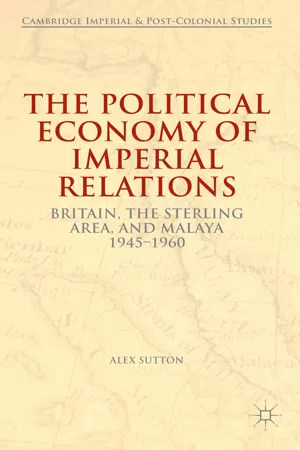
The Political Economy of Imperial Relations
Britain, the Sterling Area, and Malaya 1945-1960
- English
- ePUB (mobile friendly)
- Available on iOS & Android
eBook - ePub
The Political Economy of Imperial Relations
Britain, the Sterling Area, and Malaya 1945-1960
About this book
The Political Economy of Imperial Relations offers a much needed historical and theoretical intervention into the relationship between Britain and Malaya after the Second World War. It challenges existing accounts and details a strong continuity in this relationship from 1945 until 1960.
Information
1
Conceptualising British Imperialism
This chapter establishes the theoretical framework for the analysis of Britain’s relationship with Malaya. It accomplishes this by first providing an assessment of the current scholarship on British imperial economic relations. These accounts are argued to be problematic and an alternative, open Marxist approach is developed. This approach argues that imperialism is a relationship between two states, undertaken as part of a strategy designed by state managers of the dominant state with a view to achieving adequate conditions for the reproduction of capitalist social relations.
British imperial economic relations
The literature on British imperial economic relations can be categorised according to focus, as well as approach. This section distinguishes between the literature on the Sterling Area, the British Empire and on Malaya. However, these literature groups suffer from similar problems.
The literature on the Sterling Area summarises the operations of the Area in a discrete or continuous historical moment.1 Accounts of the Area take the operation of the trading bloc as a whole unit, examining the behaviours of the institutions and practices within the Area, rather than by looking at specific bilateral relations within the Area.2 As such, while they do provide excellent analyses of the Sterling Area from an institutional perspective, there is little theoretical scope beyond this and certainly none that applies to any of the specific relationships Britain maintained within the Sterling Area.
The general consensus of this literature has been that the Sterling Area was partly responsible for continued British relative economic decline (Schenk 1994:6–7). While there are notable exceptions to this consensus, this literature is characterised by that view.3 Schenk’s argument (ibid.:136) runs counter to the majority of literature on the Sterling Area in that it rejects the notion that the Sterling Area was responsible for the myriad of economic problems that plagued Britain from the end of the Second World War until 1960. Indeed, while the majority of scholars argue that the only purpose of the Sterling Area was to generate a sense of international prestige for Britain and sterling, she dismisses this claim. Schenk (ibid.) points out, citing archival evidence, that both the Treasury and the Bank of England knew that the Sterling Area “did not always generate prestige for the British economy and that the controls on the use of sterling which defined the system often brought sterling into disrepute” (ibid.:136).
Schenk (1994:7) recognises the value of approaches that analyse in specific detail bilateral relationships within the Sterling Area. Further, while acknowledging it as beyond the scope of her book, Schenk recognises “research into the experiences of the [Sterling Area] members will provide some interesting insights into the functioning of the sterling area in this period” (ibid.:135).4 She remarks that the general consensus within the Sterling Area literature is that the Sterling Area was a net burden on the British economy; however, this consensus has been maintained despite the lack of substantial scholarship on the relationships within the Sterling Area. That is, the Sterling Area, in the literature on the topic, is taken as a unit and the complex of relationships within it are neglected to favour the notion of the bloc itself. Schenk (1994) does make the point that specific bilateral relationships between Britain and the members of the Sterling Area have not been provided any scholarly attention.5
The literature on the Sterling Area then can be understood as providing an overview of the workings of the Area as a trading mechanism and means of implementing British international monetary policy. While most literature on the Sterling Area was written during the 1950s and 1960s, some modern scholarship has tended to reject the tendency of these earlier authors to condemn the Area as a British folly. However, modern scholarship too is generally limited in scope. The literature’s focus on the broader nature of the Sterling Area means that specific bilateral relationships within the Area are neglected. While accounts of specific relationships within the Area do exist, they provide no archival evidence that might elucidate these relationships in any great depth; they are in fact used to describe the workings of the Sterling Area as a currency area rather than to understand the relationships themselves. Indeed, notable authors in this field make clear that analysis of bilateral relationships within the Sterling Area is specifically lacking in the literature and is necessary in order to fully understand British post-war external economic policy.6 Finally, these accounts also lack explicit theoretical engagement and tend to understand the Sterling Area in terms of its own particular institutional arrangements and mechanisms. There is, again, no theorisation of imperialism and no specific relationship within the literature upon which to apply it.
The literature to date on the economic and financial relations within the British Empire has followed a similar pattern to that of the literature on the Sterling Area, focusing on the empire as an institution for the management of these relations. This is a valuable and important focus for research, the principal feature of which is the institutional nature of the British Empire and the Sterling Area as a means of regulating British international financial and economic policy. However, what these authors do not provide is an analysis of the particular contours of specific relationships within the British Empire, and, furthermore, they provide only limited theoretical analysis of the nature of imperial relations.
The two major works on British post-war imperial economic relations were published at the same time and largely overlap, providing very similar approaches, analysis and conclusions: Hinds (2001) and Krozewski (2001). This is an amusing coincidence also pointed out by Darwin (2002:1177).
Krozewski (2001:191–193) identifies four stages of the post-war British Empire. Firstly, a juncture in 1947 with a shift towards the empire away from liberalisation due to the Convertibility Crisis. Secondly, in 1949, with the devaluation of Sterling and the Korean War, Britain became even closer to the empire. Thirdly, 1953 saw “the economic relationship between Britain and the empire diverge”. And, finally, 1957 saw the end of any meaningful relationship between Britain and its empire (ibid.:194). Indeed, as Krozewski (ibid.:196) notes, “British policy forged an imperial protectionist bloc between 1947 and 1953 as an alternative to a closer association with the United States or Europe. From the early 1950s, Britain moved deliberately towards convertibility and a liberalised Sterling Area.”7 However, what Krozewski’s analysis fails to identify is that the British state had no easy alternative, due to its choices in the pre-war years, but to rely on an imperial strategy following convertibility. Actual alternatives that were considered, such as ROBOT, were believed so radical as to be not worth serious consideration.
Krozewski’s (2001:209) central point is that economic and financial relationships between Britain and its empire are “placed at the centre of studies of the international relations of the end of empire”. His central argument is that the financial relationship between Britain and its empire, based upon sterling, first led to strengthening of ties and then to their rejection, and ultimately to the end of the British Empire (Krozewski 2001:186). Certainly, Krozewski’s point is a laudable one: the role of political economy is essential in understanding international relations. However, Schenk (1996:869) makes two criticisms of Krozewski’s (1996a) analysis of British imperial monetary policy in the 1950s, which are both present in his later work. Firstly, she points out that Krozewski conflates the issue of the sterling balances with Britain’s commitment to convertibility and the liberalisation of trade, arguing that the sterling balances posed a serious constraint on the policy of liberalisation undertaken in the 1950s (Schenk 1996:869).8 However, the convertibility to which Krozewski refers is not “full convertibility” but only the convertibility of current account transactions. “Full convertibility”, total freedom of payments and for movement of capital to outside of the Sterling Area, was not considered by the British state (ibid.). Convertibility also referred to extra-Area convertibility (i.e. “external convertibility”) – available for those outside of the Sterling Area but not those within it (ibid.).
Schenk’s second criticism of Krozewski lies in his characterisation that this conception of convertibility actually occurred in 1958, pointing out that controls on sterling were gradually removed between 1953 and 1955, leading to a de facto convertibility in 1955 (Schenk 1994:128; Schenk 1996:870). De jure convertibility, as Schenk refers to the move towards official convertibility in unison with European states in late 1958, merely “formalised the status quo” (ibid.).
To Schenk, these two confusions about the nature and timing of convertibility crucially undermine Krozewski’s argument that the issue of the sterling balances had a significant impact upon the policy and process of trade and payments liberalisation in the Sterling Area. Schenk (ibid.) points out that if the freedom to convert sterling balances was not affected by the gradual shift to convertibility in 1955, then how was it possible that the liberalisation of trade in the 1950s rested on the reduction of the sterling balances? To Schenk, these create neither a contradiction nor a dilemma for British state managers.
Schenk raises one further problem with Krozewski’s article, noting that there is an implicit assumption in his work that Britain forced the Sterling Area countries to act against their own interests by requiring them to maintain their sterling balances, and to keep their link with sterling. However, as Schenk (ibid.:871) adroitly points out, independent countries within the Sterling Area had limited choices: either stay with the Sterling Area or shift to another reserve currency, the only alternative being the US dollar. However, shifting allegiance was by no means a reasonable alternative since US investment in colonial markets was not forthcoming; thus the only viable choice was to maintain reserves in sterling because investment and capital were only likely to come from the UK and Europe.
Krozewski (1997:850), in direct response to Schenk’s criticisms, identifies a cleavage in the literature between two separate explanatory aims. Both Krozewski and Hinds seek to understand post-war inter-state relations, while Schenk’s work belongs to a desire to understand British economic performance. This cleavage, he proffers, explains why he places such importance upon the 1958 date, and Schenk on the 1955 date (ibid.). It seems particularly unusual that these two explanatory goals are separated in the literature, given the obvious relevance of one to the other. It is crucial that these two explanatory aims be unified. Britain’s relations with other states cannot be understood without also understanding Britain’s economic performance, nor can Britain’s economic performance be understood without understanding Britain’s relations with other states, particularly the Sterling Area, an imperial institution intended to manage the external economic policies of its constituent states to the benefit of the British economy. The acceptance of this distinction broadly maps on to the dichotomy between states and markets, politics and economics. From this distinction derives a capacity to accept at face value cleavages and discontinuities in economic relations and political relations, and indeed Krozewski and Hinds argue that a number of cleavages occur in the relationship between Britain and its empire.
Hinds’ argument is perhaps even stronger than Krozewski’s in that he disregards the continuity provided by the Sterling Area with regard to Malayan independence.
By 1954 it was clear that Britain had become resigned to the independence of Ghana, Nigeria and Malaya. These were still its three most important dollar-earning colonies. As a result, Britain accepted the destruction of a critical part of the structure upon which it had built its economic relations with its colonial territories in the postwar era. The economic questions governing colonial preparedness for independence were now totally irrelevant to political reform. However, without Ghana, Malaya and Nigeria, the colonial surplus in transactions with the Dollar Area was not very substantial. The independence of these states therefore was going to leave Britain with an empire devoid of its most valuable assets.
(Hinds 2001:200)
Factually speaking, Malaya’s independence had no impact whatsoever on its contribution to the Sterling Area dollar pool, to which it continued to contribute even after 1957. Where Krozewski, Hinds and Schenk all agree is that there is a distinct moment of change in British imperial relations in the Sterling Area. While Schenk states that this is in 1955, de facto convertibility, Krozewski (2001:186) and Hinds (2001:200) argue that this occurs throughout the 1950s and particularly in 1958, with de jure convertibility. This approach is best understood in terms of historical contingency; while this literature provides an excellent historical basis for understanding how and when this occurred, it does not provide an account of why this occurred. To elaborate, while this literature explains, delineates and analyses the events of themes of imperial relations and the Sterling Area in this period, it does not provide an account of these relations in terms of a theoretical understanding of the state, the market or imperialism. Certainly, these themes are implied in their work but they are not made explicit and their analysis suffers as a result. In making these themes explicit, we can question whether these apparent discontinuities in British imperial relations are just that, or is there, in fact, a stronger continuity running beneath them to which these cleavages are mere contingency and, therefore, not to be given analytical precedence?
Krozewski and Hinds’ understanding of the state and imperialism seems broadly similar. However, where Hinds’ understanding of the state, empire and imperialism is not given any explicit critical analysis, Krozewski’s conception of empire undergoes limited theorisation. Indeed, he argues in support of his broad approach that “imperial relationships hinged on the nature of the imperial state … The British empire … showed remarkable coherence in terms of economic institutions” (Krozewski 2001:7). There is a level of homogeneity to Krozewski’s argument concerning his understanding of imperialism; this is also apparent in his characterisation of Britain and its colonies according to “core” and “periphery” positions in the international economy (ibid.:8). Certainly, this characterisation of imperialism is evident in his analysis of British imperial relations as featuring moments of holistic discontinuity, which is to say that discontinuity affected the whole empire simultaneously and that Britain had a broad and all-encompassing understanding and approach to its entire empire.
While Krozewski does analyse the relationship Britain had with its empire, his analysis seems peculiar in some regards. While he argues that a discontinuity occurs in 1957, with the move to sterling convertibility, and this marks a genuine caesura in imperial economic relations, he also notes how Britain continued to rely on its former empire to support its external economic policy, and the viability of sterling as an international currency. Particularly, he makes mention of how Britain continued to rely on the allegiance of the political elites in newly independent territories, such as Malaya and Ghana, to support British international economic policy (ibid.:201). However, this then raises the question: what is the fundamental difference in a relationship prior to and then after 1957, when both states seek to perform in the same fashion relative to each other, to the same end? Certainly, the imperial relationship needs to be analysed and theorised before an adequate assessment of such a relationship can occur, for which Krozewski provides no account. Furthermore, Krozewski’s point about the role of elites in the relationship between Britain and Malaya is problematic. This obfuscates the historically developed relationship between Britain and Malaya and leaves neglected an analysis of the social conditions within which this relationship existed, and instead invokes an idea that the state is a mere instrument of an elite with a specific agenda and ignores other structural considerations.
Indeed, analysis of Britain’s economic and financial relations with its empire is very much a “political economic” analysis. There is little sense of the interaction and relationship between Britain and its colonies in any specific sense, and as such Schenk, Hinds and Krozewski reify the broader relationship and tend to ignore the fact that the empire itself was not an institution in any meaningful sense but a term used to describe an aggregate of relationships between Britain and a number of other states. This literature then, while extremely valuable in characterising the key moments and events of British post-war imperial economic policy, provides little scope towards understanding the relationships between Britain and its imperial possessions as fundamentally and essentially relationships between states.
Given the nature of this analysis, the conclusions they reach t...
Table of contents
- Cover
- Title Page
- Copyright
- Contents
- List of Figures and Tables
- Acknowledgements
- List of Abbreviations
- Introduction
- 1. Conceptualising British Imperialism
- 2. British Relative Economic Decline
- 3. The Dollar Drain and Colonial Import Policy (1945–1950)
- 4. The Dollar Deficit Continues (1950–1955)
- 5. Malayan Independence and the Sterling Area (1955–1960)
- Concluding Remarks
- Appendices
- Notes
- Bibliography
- Index
Trusted by 375,005 students
Access to over 1.5 million titles for a fair monthly price.
Study more efficiently using our study tools.
Frequently asked questions
Yes, you can cancel anytime from the Subscription tab in your account settings on the Perlego website. Your subscription will stay active until the end of your current billing period. Learn how to cancel your subscription
No, books cannot be downloaded as external files, such as PDFs, for use outside of Perlego. However, you can download books within the Perlego app for offline reading on mobile or tablet. Learn how to download books offline
Perlego offers two plans: Essential and Complete
- Essential is ideal for learners and professionals who enjoy exploring a wide range of subjects. Access the Essential Library with 800,000+ trusted titles and best-sellers across business, personal growth, and the humanities. Includes unlimited reading time and Standard Read Aloud voice.
- Complete: Perfect for advanced learners and researchers needing full, unrestricted access. Unlock 1.5M+ books across hundreds of subjects, including academic and specialized titles. The Complete Plan also includes advanced features like Premium Read Aloud and Research Assistant.
We are an online textbook subscription service, where you can get access to an entire online library for less than the price of a single book per month. With over 1.5 million books across 990+ topics, we’ve got you covered! Learn about our mission
Look out for the read-aloud symbol on your next book to see if you can listen to it. The read-aloud tool reads text aloud for you, highlighting the text as it is being read. You can pause it, speed it up and slow it down. Learn more about Read Aloud
Yes! You can use the Perlego app on both iOS and Android devices to read anytime, anywhere — even offline. Perfect for commutes or when you’re on the go.
Please note we cannot support devices running on iOS 13 and Android 7 or earlier. Learn more about using the app
Please note we cannot support devices running on iOS 13 and Android 7 or earlier. Learn more about using the app
Yes, you can access The Political Economy of Imperial Relations by Alex Sutton in PDF and/or ePUB format, as well as other popular books in History & Economic History. We have over 1.5 million books available in our catalogue for you to explore.