eBook - ePub
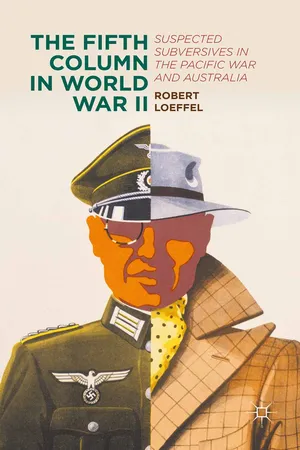
The Fifth Column in World War II
Suspected Subversives in the Pacific War and Australia
- English
- ePUB (mobile friendly)
- Available on iOS & Android
eBook - ePub
The Fifth Column in World War II
Suspected Subversives in the Pacific War and Australia
About this book
Alarming levels of fear and suspicion developed in Australia following the German victories in Europe of 1940. It was believed the Nazis had prepared an army of subversives a Fifth Column to undermine the war effort. These suspicions plagued the Australian home front for much of the war.
Information
Topic
Geschichte1
The Shape of Fear: Background to the Fifth Column Scare
Australia’s experiences with subversion and war
All wars contain an element of subversion. In the 20th century undercover activities became more evident as home fronts were increasingly involved in war efforts; the conflicts Australia was involved in since nationhood were no different. In the Boer War, enemy subversion played a part in the experiences of the Australian troops; in World War I, fears of spying and sabotage expanded and was evident both amongst the troops fighting overseas and on the home front. In both these conflicts the novelty of soldiers’ letters published in newspapers helped to spread dramatic stories of spies amongst the public back home. In World War I the fear of spies on the home front was enhanced by the large German population in Australia and served a useful ongoing purpose to the authorities, justifying internment policies, while promoting war-mindedness and enlistment in the absence of conscription.1
Before the Boer War began in October 1899 and while Australian troops were still being assembled for embarkation, the Sydney Morning Herald reported that Boer spies were ‘active’.2 The early encounters of Australian troops in South Africa confirmed such an assessment. A letter from Trooper J. H. Peek from West Maitland reported that Boer spies were being captured daily. Peek described how ‘One was seen cutting the telegraph wires and was shot like a lark in a tree’, while in another example, ‘A stationmaster was caught sending wires to the Boers. He was taken out and promptly shot’.3 In February 1900 it was claimed that the Ladysmith garrison in Natal had captured two armed German spies bearing the Geneva Royal Cross. The men had asked a native for information about the town and its defences.4 Australia’s most infamous soldier from that conflict, Lieutenant Harry ‘Breaker’ Morant, was charged with the murder of a German missionary who he suspected was acting as a spy and passing information on to the Boers. Although there were no direct references to fears of Boer spies back in Australia, attempts were made to link the home front directly with the war and to identify the enemy at home. In December 1899 it was reported that a disturbance occurred when an anti-Boer mob of about 150 ‘patriots’ attacked the Broken Hill German Club. A battle was only narrowly avoided when the police drew their guns.5
From the beginning of World War I fears of subversion by the German population existed in Australia. In 1914 a strict policy required all German nationals to report to police. Later on, they were interned on a significant scale.6 Despite the liberal use of internment, fears of enemy subversive activities on the home front remained. The fact that a counter-espionage agency was not established until midway through the war does not reflect the amount of spy stories circulating amongst the public. Some of these suspicions were not wholly without foundation. Early in the war a letter by a German national discovered by the censor said, ‘we Germans would help [Germany] all we could and had plenty of guns and ammunition planted if the German Government could send out warships’.7 Ernest Scott, in his Official Australian War History, recorded that a German scientist in Australia for a conference in 1914 was discovered to have concealed information about the surrender of German New Guinea in his socks.8 The press indulged in repeating spy stories and rumours, some of which were quite fanciful. In August 1914 it was reported that two German suspects were arrested in Sydney moments before they boarded a ship for the United States. The men were accused of communicating details of Australia’s defences including the movements of warships and other vessels to the enemy. Naval authorities were said to have information ‘to the effect that a private wireless set was used by the spies, whose leader was an ex-lieutenant in the German Navy, and who had obtained entrance to the Australian Naval Brigade’.9 In October 1914 the Sydney Morning Herald put the question in the minds of its readers, ‘If spies [are] in England, in India, in Canada, why not spies in Australia?’10
When Australian troops began to see action overseas stories of subversion were transmitted back to Australia. The distance between Australia and the front line in Europe contributed to creating some wildly fictitious stories involving espionage. In January 1915 a letter from Corporal Rowlands that was published in the Kalgoorlie Western Argus contained a rollicking tale of German spies behind the Allied lines in France. Rowlands reported: ‘The Germans have an enormous number of spies about, and it is generally admitted that there is at least one in every English camp’.11 He said that one of these spies was dressed as an English nurse and, using a motor car with a Red Cross flag on it, had managed to get through the lines several times in the previous week.12 He also claimed to have personally nearly caught a spy dressed as an Australian soldier, while another German dressed as a Scottish soldier complete with kilt was only discovered when his jacket came undone to reveal a tattoo of the Kaiser on his chest. A shootout resulted in his death.13
Even in theatres of operation where it would seem that sophisticated espionage was not really possible, spy stories and rumours were evident amongst the Australian troops. Bill Gammage described how, in the Middle East and Gallipoli, the Australians were affected by a ‘spy mania’, with fears of subversives amongst the populations they encountered but also within their own ranks.14 In July 1915 a Reuters correspondent in Cairo made extraordinary accusations about potential traitors within the ranks of the Australian troops at Gallipoli. He reported that a German in Australian uniform who had been moving about freely amongst the Australians for some days had recently been shot in the trenches on the Sari Bair Hills.15 Another story related to an Australian soldier who gained a reputation as a first-class sniper. He was reported to have gone out every day on his own to snipe the enemy until suspicions were finally aroused against him. One day he was secretly followed and was discovered sniping his own officers.16 Making clear the reason for his deceit, the article claimed that he was born in Australia but his parents were Germans. Further to this example, it was also reported that the Australian headquarters at Cape Helles had to be removed from the beach to a neighbouring gully on account of shelling from the enemy. The next day the Turkish fire was concentrated on the new position in the gully, which apparently showed that information was being passed to the enemy through spies.17 Fears of treachery even reached to senior commanders of the AIF. At the end of July 1915, rumours were evident in Cairo, London and Melbourne that the recently promoted Brigadier-General John Monash, who was fighting at Gallipoli, had been shot as a German spy. Truth was lent to this story by men who claimed to have witnessed his execution.18 Suspicions involving Australians were encouraged from various quarters. Amongst British units, rumours of German spies included that they were passing themselves off as Australian officers.19 Reports such as these, especially from Gallipoli, can be explained in terms similar to circumstances encountered during World War II: in the midst of a failing campaign, it was more comforting to blame espionage for setbacks rather than poor planning or the superiority of the enemy.
Back in Australia the anti-German feelings of the general public were sustained by fear of German subversive activity. In June 1916 a number of anti-German League meetings were held around the country with the proceedings focused on the possibility of German spies operating in Australia. Amongst the ‘evidence’ discussed was that sightings had been made of Germans with telescopes directed on naval works.20 At the Bondi Junction Anti-German League meeting in Sydney an appeal was made to ‘all loyal Britons to stand solidly in their determination to overthrow the alien enemy, as well as the enemies within our midst’.21 However, notwithstanding the apparent seriousness of the threat of German agents and sympathisers on the Australian home front, the authorities did not organise a counter-espionage bureau until January 1916. This bureau was concerned with ‘the tracing and recording of the personal histories of aliens, enemy agents, and suspects, and the investigation of cases of espionage’.22 Internal national security remained the responsibility of the Commonwealth Police Force; this body was only created under the War Precautions Regulations in December 1917.
Suspicions of subversion continued throughout the war, despite the absence of any instances of sabotage occurring on the Australian home front. Many of these suspicions swirled around doubts about the Germans in Australia even though the majority had been interned. On 2 April 1917 the Sydney Morning Herald proclaimed, ‘German spy system in Melbourne’.23 Later that same week another article reported that it was officially admitted by the Department of Defence that the ‘pest of the German spy system had overrun Australia before the war’ and claimed that German spies were prominent amongst German pastors. It identified ‘so-called Australians’ who were acting as German agents and the extent of their subversive activities:
The German spy system in Australia still goes on. The Defence Department has unearthed many spies and interned them, but others doubtless remain undiscovered. The Commonwealth Government has absolute proof of a conspiracy, actively going forward just before the war, for the German occupation of the north-west. It becomes abundantly plain that had the German war scheme succeeded, Australia would have been the first outpost of Empire to fall into the German maw.24
In other cases, and in circumstance similar to those encountered in World War II, fears of socialism were enlarged into suspicions of German sabotage on the home front. They alerted Australian society not only to the danger of German spies but also to the possibility of Australian sympathisers. The most serious or at least the most publicised threat to Australia’s homeland security came from the ‘International Workers of the World’ (IWW), who had long been regarded as a danger to Australian society. This came to a head with the arrest and trial of 12 of its members on 23 September 1916. The 12, none of whom were German by birth, were convicted on evidence provided by an informer. He claimed that they had ‘conspired to raise, make, and levy insurrection and rebellion against the King’, by manufacturing chemicals with the intent to firebomb buildings and shops across New South Wales.25
Besides the obvious political nature of their activities, these men were also accused of conspiring with the Germans. It was reported that a German national who had escaped from internment was harboured by the 12 and this coincided with the fires that they were accused of starting. This led to questions in the press about how far these acts were due to German influence.26 Reports of the activities of the 12 were real cloak and dagger material, as it was claimed that in order to disguise the German escapee, they had surgically removed his identifying marks.27 The 12 members of the IWW were all found guilty and sentenced to between five and 15 years in gaol, although the evidence used to convict them was later found to be dubious.
Shipping in Australian waters was another area of suspicion that surfaced in World War I and reappeared as a threat in World War II. Shipping was regarded as particularly vulnerable as a means of harming the Allied war effort, and became even more so with news of a German naval presence in Australian waters. In April 1916 in Wyndham, northern Western Australia, local Aboriginal people reported seeing a vessel that could travel under the water. This was interpreted as being a German submarine. The fact that two foreign Church missions were in the vicinity also made these suspicions worse. The Royal Australian Navy (RAN) dispatched the cruiser HMAS Encounter, two schooners and a lugger to investigate but they found no evidence of submarines or landings.28 The following year, enemy action in Australian waters was confirmed when on 5 July 1917 the steamship SS Cumberland was sunk off the New South Wales coast near the Victorian border. Although it was quickly evident that the ship had struck a mine laid by the German raider SMS Wolf (known to be operating in Australian waters) the authorities decided that it was dockyard saboteurs who had placed a time bomb on the ship. Two weeks after the sinking the Federal government offered a reward of £2000 (later increased by various state government contributions) for information concerning the saboteurs’ identity.29 The Sunday Times newspaper made no bones about how the ship was lost in an article with the headline, ‘The Lost Cumberland: who packed the bombs in the hold? Australia’s Fools’ Paradise’. The article laid blame firmly at the door of unionist and communist sympathisers, who were ‘almost certainly in the pay of the Germans’.30 For nearly two months afterwards numerous newspaper articles suggested the involvement of German spies in the sinking.31 For the authorities such stories were fuelled by the intelligence reports sent by the English. In October 1917 the British alerted the Australian authorities that small transportable time bombs specifically for use against shipping were found in the possession of a German agent in a neutral country.32 In July 1918 it was reported that a Swedish merchant vessel, the SS Hellenic, which had departed from Australia carrying flour for Panama, arrived in Tahiti with a fire raging in the forward bunkers and cargo holds. After a few days the fire was put out, but not before causing considerable damage to the ship. The French authorities believed that the fire was caused by ‘someone acting on behalf of the enemy’.33
The power and influence of rumours and stories certainly were evident on the Australian home front during World War I although, in fact, there were no examples of enemy subversion. Besides sensationalised newspaper reports, early films had a significant impact, creating an awareness of...
Table of contents
- Cover
- Title Page
- Copyright
- Contents
- List of Plates
- Preface and Acknowledgements
- List of Abbreviations
- Introduction
- 1. The Shape of Fear: Background to the Fifth Column Scare
- 2. Before the Storm: The Beginning of World War II
- 3. June 1940: The Fifth Column Triumphant
- 4. The War and the Fifth Column Arrive in Australia
- 5. Australia under Attack: The Fifth Column and the Pacific War
- 6. The Myth Continues: Lingering Fears and Prejudices
- Conclusion
- Notes
- Bibliography
- Index
Trusted by 375,005 students
Access to over 1.5 million titles for a fair monthly price.
Study more efficiently using our study tools.
Frequently asked questions
Yes, you can cancel anytime from the Subscription tab in your account settings on the Perlego website. Your subscription will stay active until the end of your current billing period. Learn how to cancel your subscription
No, books cannot be downloaded as external files, such as PDFs, for use outside of Perlego. However, you can download books within the Perlego app for offline reading on mobile or tablet. Learn how to download books offline
Perlego offers two plans: Essential and Complete
- Essential is ideal for learners and professionals who enjoy exploring a wide range of subjects. Access the Essential Library with 800,000+ trusted titles and best-sellers across business, personal growth, and the humanities. Includes unlimited reading time and Standard Read Aloud voice.
- Complete: Perfect for advanced learners and researchers needing full, unrestricted access. Unlock 1.5M+ books across hundreds of subjects, including academic and specialized titles. The Complete Plan also includes advanced features like Premium Read Aloud and Research Assistant.
We are an online textbook subscription service, where you can get access to an entire online library for less than the price of a single book per month. With over 1.5 million books across 990+ topics, we’ve got you covered! Learn about our mission
Look out for the read-aloud symbol on your next book to see if you can listen to it. The read-aloud tool reads text aloud for you, highlighting the text as it is being read. You can pause it, speed it up and slow it down. Learn more about Read Aloud
Yes! You can use the Perlego app on both iOS and Android devices to read anytime, anywhere — even offline. Perfect for commutes or when you’re on the go.
Please note we cannot support devices running on iOS 13 and Android 7 or earlier. Learn more about using the app
Please note we cannot support devices running on iOS 13 and Android 7 or earlier. Learn more about using the app
Yes, you can access The Fifth Column in World War II by Robert Loeffel in PDF and/or ePUB format, as well as other popular books in Geschichte & Australische & ozeanische Geschichte. We have over 1.5 million books available in our catalogue for you to explore.