eBook - ePub
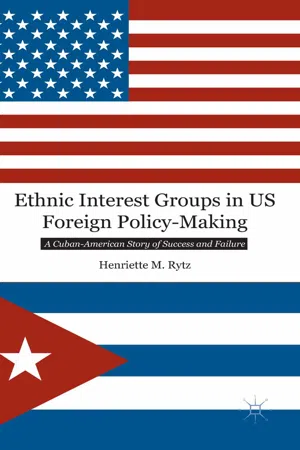
Ethnic Interest Groups in US Foreign Policy-Making
A Cuban-American Story of Success and Failure
- English
- ePUB (mobile friendly)
- Available on iOS & Android
eBook - ePub
Ethnic Interest Groups in US Foreign Policy-Making
A Cuban-American Story of Success and Failure
About this book
This book comprises the first systematic study on the impact of ethnic interest groups on US foreign policy, using the case study of how the Cuban?American National Foundation (CANF) influenced the outcome of three different legislatives debates that directly affected US Cuba policy.
Information
1
THE DEBATE OVER ETHNIC INTEREST GROUP INFLUENCE
This chapter lays the ground for the construction of the framework of analysis by reviewing the current research on ethnic interest groups from the angle of International Relations (IR) theory and with a particular focus on the major empirical puzzle—the puzzle of influence. The different conditions of influence identified in the literature on the subject were gathered, organized, and compared as the first step toward the framework. A comparison with interest groups in general disclosed the unique feature of ethnic interest groups—their collective ethnic identity.
ETHNIC INTEREST GROUPS AS FOREIGN POLICY ACTORS
Ethnic interest groups are a relevant subject for IR research due to both their engagement in foreign policy–making and their transnational identities and networks. They link three different levels of international politics: the political system of the country they originate from (country of origin), the political system of the country they reside in (country of settlement), and the international system. Yet, surprisingly, IR theory has paid little attention to ethnic interest groups. This chapter introduces the key terms of the debate and reviews the state of the art. Following the argument that ethnic interest groups are like any other organized interest, except for their collective ethnic identity as a motivating force and resource, this chapter’s focus lies on the definition of this particular type of identity.
Key Terms
Ethnic interest groups are institutionalized, nongovernmental political actors whose members share a collective cultural identity, to which belonging to the same immigrant community is central.1 While not denying the existence of ethnic interest groups that are but loosely organized or that focus on domestic policy issues, this book addresses those groups whose political activism is institutionalized and directed at influencing US foreign policy toward their country of origin. In the following, the genesis of the term “ethnic interest group” is analyzed by discussing one element of the term at a time. Several related terms, such as diaspora, will also be discussed briefly.
The debate over ethnicity can be roughly divided into two camps—the primordialists and the social constructivists. While the former regard identities as a priori given and static, the proponents of the latter approach assume that identities are socially constructed and hence reliant on perception rather than ancestry (e.g., Moore 2002: 78–79). This book adopts a constructivist notion of ethnicity, opening up space for the diversity, dynamics, and mobilization of ethnic identities. Therefore, it uses the definition by Jolle Demmers (2007: 8) who defines ethnic groups as “imagined (transnational) communities,” paraphrasing Benedict Anderson’s (1991) “imagined community” (cf. Glazer and Moynihan 1975: 4; Cederman 2002: 411).
Ethnicity is a subcategory of the extraordinarily broad notion of culture, which this book defines as a system of norms, values, beliefs, and interests that can be of a normative, ethnic, religious, linguistic, political, historical, or/and descent-related character. Based on a social constructivist understanding, culture is assumed to be heterogeneous, pluralistic, and dynamic in character. It does not designate monolithic blocs but multifaceted phenomena (it is hence heterogeneous); it may include different subgroups with differing, competing, or even contradictory interests and agendas (hence pluralistic); and it is constantly subject to change caused by internal factors (e.g., fluctuating membership), external factors (e.g., socioeconomic and political factors), and the intersubjective processes of social constructions through which it becomes a social reality (hence dynamic).2
Collective identities, including ethnic identities, always require recognition as a group by both insiders and outsiders (e.g., very early, Bentley 1908: 217, but also Elwert 1989 and 1996; Demmers 2007: 8). The social constructivist concept of “intersubjective understanding” is hence a prerequisite for the formation and functioning of an ethnic identity (e.g., Adler 2002: 100).3 However, that does not mean that no preconditions need to be met for an identity to form. For example, it would be difficult if not impossible to identify oneself and be identified by others as “Italian,“ if one were not born in Italy, had lived there for a considerable amount of time, or had been raised by an Italian parent abroad. In sum, although the collective identity of members of an ethnic group is defined by certain exclusive characteristics, group membership is an ever-changing, socially constructed, deliberately chosen, and heterogeneous means of identification.
The book prefers to use the term “ethnic” over “cultural” as it evokes political activism.4 The social anthropologist Jack Eller (1999: 9) argues that “mobilization around difference—a camaraderie with or preference for socially similar others” is a distinct feature of ethnicity. Tony Smith, one of the most prominent researchers of ethnic interest groups, also alludes to political mobilization by framing ethnicity as “a voluntary organization of people with a collective identity based on an intellectually formulated and emotionally felt assertion of their distinctiveness from other peoples“ (Smith 2000: 21). Hence, when people assert a collective ethnic identity, they are but a few steps away from formulating collective interests and claiming collective rights.
Unlike a nation, however, an ethnic interest group does not claim rights over a certain territory. Its special relationship with the country of origin—be it a factual or a primarily cultural homeland (as in the case of Israel and the Jewish American community)—undeniably implies a particular emotional attachment to a certain territory. Yet, given the explicit reference to an immigrant background, the territorial attachment is always characterized by geographical distance. The term “ethnic” as in “ethnic interest group” is hence not to be equated with national. Instead, it is inherently transnational.
Although an ethnic identity indicates political mobilization, an immigrant community per se is not an ethnic interest group. The latter is the institutionalized political representation of an immigrant community respectively certain segments of it. The emphasis on institutionalization narrows down the scope of ethnic political activism. Unlike Anderson’s (1992) “long-distance nationalism,” which relates to any kind of political activity by an individual immigrant with regard to his or her country of origin,5 this book’s concept of ethnic interest groups focuses on collective and institutionalized political activism within the political system of the country of settlement.
The institutionalization of political activism also clearly distinguishes an ethnic interest group from a diaspora. As the two terms are often wrongly used synonymously, their differences will be briefly discussed here.
The first misunderstanding regarding the use of the term “diaspora” in political science is to overlook the term’s omission of political activity. Yossi Shain, one of the most prominent scholars in the field, rightly defines a diaspora as “a people with a common origin who reside, more or less on a permanent basis, outside the borders of their ethnoreligious homeland” (Shain and Barth 2003: 452; Shain 2007: 130). While this definition arguably would have to be altered as to refer to a group of people rather than “a people” (because a displaced group is highly unlikely to comprise an entire people), it certainly does not imply any political activity.6
The second source of confusion relates to the sense of transience evoked by “diaspora.” The term’s etymological origins reach back to Ancient Greece, where it literally meant to “to sow widely” and was used with reference to the colonization of Asia Minor and the Mediterranean. Over time, it became widely associated with the centuries-long Jewish suffering in exile (Cohen 1996: 507–508). As a result, diasporas are believed to strive for eventual return to their countries of origin, in order to overcome the trauma of being sent into exile and the discriminatory treatment by host societies. However, members of contemporary diasporas are likely to deny any notion of being in exile and/or any intention of returning “home” one day.
Third, the connotation of eventual return also implies that members feel a stronger emotional attachment to their country of origin than to their country of settlement. However, as integration and assimilation progress, ties with the country of origin may loosen, while discrimination or other hardship experienced in the country of settlement might also strengthen ties.7 Hyphenated or hybrid identities, which express the double identification of their bearers, do not imply a preference for one identity over the other.
Therefore, this book does not use the term diaspora. Instead, it uses the term immigrant community when speaking about a cultural community and the term “ethnic interest group” with reference to the political actor. Another important distinction is drawn between “immigrant community“ and “ethnic group,” depending on whether a migrant background exists or not. The reference to a migrant background further allows for distinction between immigrant communities and other culturally defined groups who, for instance, mobilize around a racial category or a pannational identity, such as “Latino.”8
Finally, a few more problematic terms commonly used in the debate are worth addressing. Speaking of “home countries” and “host countries” (e.g., Shain 2007: 11; Fullilove 2008: 3) also misleadingly implies an eventual return to the country of origin. Furthermore, what one considers as “home” is a private decision based on emotions and could plausibly refer to the current country of settlement. Therefore, the term “home country” and “homeland” should preferably be qualified by adjectives like “former” or “current” or be replaced by the terms “country of origin” and “country of settlement.”9
Likewise, the widely used terms “sending” and “receiving countries” require thoughtful handling. They imply circumstances that do not necessarily propel the migration process. Socioeconomic and political conditions are the regular push-and-pull factors of migration; state actors usually do not actively “send” or “receive” migrants—with the exception of expulsion and guest worker programs.
The Role of Ethnic Interest Groups in International Relations Theory
IR research has only very slowly developed an interest in the phenomenon of ethnic interest groups, that is non-state actors characterized by a collective ethnic identity.10 Despite the growing recognition of societal actors and ideational factors in foreign policy–making, theoretically guided and conceptional work on ethnic interest groups remains rare. In the following, the state of the art is being discussed as are avenues for enhancing integration into IR theory, the most apt of which are research on culture, globalization and transnationalism, and diasporas.
Culture and International Relations
While the study of culture has generally been on the margins of political science, in the late 1990s Anja Jetschke and Andrea Liese still called IR the discipline’s most “culture-averse [kulturscheu]” subfield (Jetschke and Liese 1999: 286). Today, researchers continue to speak of the “marginalization” of culture within IR (e.g., Sandal and James 2010: 4).11
Cultural approaches in IR have often been inspired by other social science disciplines, which more readily integrated a cultural dimension, in particular political sociology, but also, among others, political psychology and social anthropology. The “cultural turn,” which the social sciences experienced in the 1980s (cf. Schwelling 2004a), did not reach IR theory until the 1990s, closely linked to the concurrent “constructivist turn” (Checkel 1998). After the end of the Cold War, the prevalent IR theories no longer provided satisfactory explanations for the composition and dynamics of the international system. Culture, especially cultural identities, emerged as an alternative explanation (cf. Hurrell 2002: 148). In empirical research, the comeback of culture12 was reflected by the broad body of literature on ethnopolitical conflicts produced in the 1990s (see, for example, Cederman 2002). Since the 1990s, culture has been anchored in virtually all IR debates:
A constant feature seemingly uniting most, if not all, of these disparate debates in the 1990s has been the realization that issues of (international) politics are less easily distinguishable from matters of culture a...
Table of contents
- Cover
- Title
- Introduction
- 1 The Debate over Ethnic Interest Group Influence
- 2 The Analysis of Ethnic Interest Group Influence
- 3 Cuban-American Influence on US Cuba Policy
- 4 Conclusion
- Epilogue: The Legacy of the Cuban American National Foundation
- Appendix
- Notes
- Bibliography
- Index
Trusted by 375,005 students
Access to over 1.5 million titles for a fair monthly price.
Study more efficiently using our study tools.
Frequently asked questions
Yes, you can cancel anytime from the Subscription tab in your account settings on the Perlego website. Your subscription will stay active until the end of your current billing period. Learn how to cancel your subscription
No, books cannot be downloaded as external files, such as PDFs, for use outside of Perlego. However, you can download books within the Perlego app for offline reading on mobile or tablet. Learn how to download books offline
Perlego offers two plans: Essential and Complete
- Essential is ideal for learners and professionals who enjoy exploring a wide range of subjects. Access the Essential Library with 800,000+ trusted titles and best-sellers across business, personal growth, and the humanities. Includes unlimited reading time and Standard Read Aloud voice.
- Complete: Perfect for advanced learners and researchers needing full, unrestricted access. Unlock 1.5M+ books across hundreds of subjects, including academic and specialized titles. The Complete Plan also includes advanced features like Premium Read Aloud and Research Assistant.
We are an online textbook subscription service, where you can get access to an entire online library for less than the price of a single book per month. With over 1.5 million books across 990+ topics, we’ve got you covered! Learn about our mission
Look out for the read-aloud symbol on your next book to see if you can listen to it. The read-aloud tool reads text aloud for you, highlighting the text as it is being read. You can pause it, speed it up and slow it down. Learn more about Read Aloud
Yes! You can use the Perlego app on both iOS and Android devices to read anytime, anywhere — even offline. Perfect for commutes or when you’re on the go.
Please note we cannot support devices running on iOS 13 and Android 7 or earlier. Learn more about using the app
Please note we cannot support devices running on iOS 13 and Android 7 or earlier. Learn more about using the app
Yes, you can access Ethnic Interest Groups in US Foreign Policy-Making by H. Rytz in PDF and/or ePUB format, as well as other popular books in Politics & International Relations & Political Philosophy. We have over 1.5 million books available in our catalogue for you to explore.