Winner of the 2015 Juridical Book of the Year in the category of 'Essay Promoting Critical Thinking and Analysis of Juridical and Social Issues.'
- English
- ePUB (mobile friendly)
- Available on iOS & Android
eBook - ePub
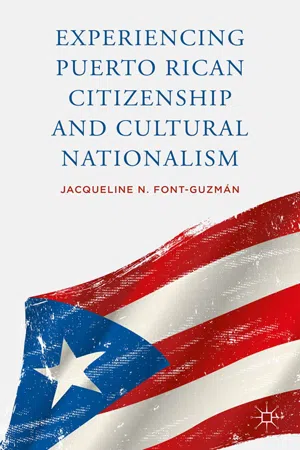
Experiencing Puerto Rican Citizenship and Cultural Nationalism
About this book
Drawing from in-depth interviews with a group of Puerto Ricans who requested a certificate of Puerto Rican citizenship, legal and historical documents, and official reports not publicly accessible, Jacqueline Font-Guzmán shares how some Puerto Ricans construct and experience their citizenship and national identity at the margins of the US nation.
Information
CHAPTER 1
The Subjective Experience of Citizenship and National Identity: An Introduction
Introduction
On July 11, 1994, Juan Mari Brás, a prominent pro-independence activist and attorney born in Puerto Rico, flew from Puerto Rico to Venezuela, and legally renounced his US citizenship at the United States Embassy in Caracas. He flew back to Puerto Rico, without confronting immigration obstacles, and demanded a certificate of Puerto Rican citizenship from the Puerto Rico Department of State. He also refused to leave Puerto Rico because it was “his nation.” Mari Brás was asserting his national identity as a Puerto Rican by renouncing his US citizenship; he was also making a political statement. For many, Mari Brás’s actions, and those of the few who followed in his footsteps, were absurd and futile. However, where many people saw futility and absurdity, I saw agency, resiliency, national identity assertion, redefinition of citizenship, peaceful rebellion, and an interesting conundrum that needed to be addressed. How do Puerto Ricans requesting this certificate of citizenship issued by a non-sovereign territory experience their citizenship and their national identity?
Also, if the certificate is so insignificant, as many have argued, then why did it make headlines, and why did so many top-level directors of federal agencies, such as the US Department of State and the US Citizenship and Immigration Services (USCIS), involve themselves in trying to stop this process?1 Could it be that, as argued by Appadurai (2006, 53), the more fragile and powerless the minority is perceived to be, the more it threatens the majority’s feeling of being an uncontested and cohesive group. In this book, I demonstrate how fear of minorities can culminate not in crude force or genocide, but rather in more “subtle” forms of violence that render their victims invisible and create complex issues of cultural national identity, belonging, and citizenship.
By cultural national identity, I mean “a self-defined community of people who share a sense of solidarity based on a belief in a common heritage and who claim political rights that may include self-determination [although not necessarily a sovereign state as traditionally defined]” (Morris 1995, 12).2 Duany (2002, 4–5) makes a distinction between political nationalism (all nations should have their own sovereign state) and cultural nationalism (which privileges a collective consciousness of a common past, culture, and strong spiritual autonomy). However, as evidenced by the narratives shared in this book, this distinction is blurred when cultural nationalism becomes a catalyst for political nationalism.
Furthermore, I explore the Puerto Ricans’ subjective experience of citizenship and nationalism from the bottom-up through face-to-face and in-depth interviews with a group of Puerto Ricans who were issued certificates of Puerto Rican citizenship by the Puerto Rico Department of State. In most citizenship studies, we hear the voices of experts on the subject matter (e.g., attorneys, lawyers, politicians, and academicians); rarely do we hear the voices of the citizens themselves. Interviewing the Puerto Ricans on the meaning of their citizenship creates a space for them to raise their voices and be heard. The action of Puerto Ricans constructing their own citizenship provides a unique window through which we can explore how legal categories are redefined from below. The narratives shared by the citizens in this study help us understand how citizenship construction can assert cultural national identity in a nonviolent manner within unequal colonial relationships.
In Puerto Rico discussions of national identity and citizenship always elicit passionate emotions. In spite of more than 500 years of colonialism and limited democratic participation, Puerto Ricans have been able to develop and maintain a strong sense of cultural national identity. I show that the strategies chosen by Puerto Ricans to assert their cultural national identity and preserve their cultural symbols are motivated in part by the way in which they experience, interpret, and redefine concepts such as nationalism and citizenship. Contributors to this study choose to exercise agency and combat these fears through what appear to be insignificant actions that result in disturbing the unincorporated territory frame and asserting cultural national identity. I strive to move people away from the story of Puerto Ricans as either lacking agency and being docile or favoring independence and being dangerously subversive, to an alternative story of Puerto Ricans exercising agency and resiliency within their available options.
I submit that in the dialogue between the legal and social space, the interplay between different agencies works to create and recreate nationalism and citizenship. After all, these are terms that arouse great passion, but elicit great confusion as to what they mean. The meaning-making process of citizenship and its interplay with law and cultural nationalism are important because it is through meaning and sense-making that action (or inaction) is shaped (see Lincoln and Guba 2003, 264).
Specifically, this book explores how those who were granted certificates of Puerto Rican citizenship experience and assign meaning to citizenship and cultural national identity within the context of an unincorporated territory in which they have limited participation in the laws that govern them.3 What meaning do Puerto Ricans ascribe to these experiences in particular? How do Puerto Ricans imagine and experience their non-sovereign nation?4 How do they perform citizenship, belonging, and cultural national identity within an unincorporated territory? How do these experiences lead to actions that reshape the legal order (and vice versa), altering the meaning of the unincorporated territory frame? How does law shape collective and individual identity?
A second set of questions relates to resistance and counterstrategies. How do counter-narratives make their way into the unincorporated territory’s legal framework? How do individuals create sites of resistance through the very same laws that they perceive as being designed to oppress them? How does meaning-making create sites of resistance within and outside the legal system?
Moreover, discussing Puerto Rican identity as a necessity calls into the spotlight a discussion of the identity of US citizens. What type of “Other” have US citizens become? What does it mean for a US citizen to be seen as the “Other”? What is the role of a US citizen in allowing issues such as colonialism, expansionism, and undemocratic practices to be reframed into “special,” “peculiar,” and “unparalleled relationships” that seem to indicate that the hegemonic power has succeeded?
In this chapter, I provide a brief historical background on Puerto Rico’s colonial status to contextualize the study, a definition of citizenship and nation as used in this book, and an overview of how this study was conducted. I also draw from the history of and experiences with citizenship and national identity of other US territories, other colonized Caribbean islands, and Indian nations. The intent is to explore commonalities and open a much-needed dialogue among scholars who work on these topics. Through this approach, I aim to counterweigh what Edouard Glissant (1999, 222) has labeled the “balkanization” of the Caribbean islands. If we are to discover the hidden meanings of Puerto Rican citizenship and cultural nationalism, it must be done within larger debates rooted in the Caribbean community, unincorporated territories, and Indian nations.
Puerto Rico’s Colonial Relationship with the United States
Puerto Rico’s legal status has been defined as an unincorporated territory “belonging to but not being part of” the United States (Downes v. Bidwell, 184 U.S. 244, 287 [1901]). An “unincorporated territory” is a possession of the United States that is not expected to become a future state and in which the US Constitution does not apply in full (Granville-Smith v. Granville-Smith, 349 U.S. 1, 5 (1955); see also, Boumediene v. Bush, 553 U.S. 723, 757 [2008]).5
In essence, the concept of being an “unincorporated territory” became a euphemism for being enmeshed in a colonial relationship (Font-Guzmán and Alemán 2010, 107; see also Burnett and Marshall 2001; Cabranes 1978; Rivera Ramos 2001; and Trías Monge 1999). Here I define colonialism as a “relationship between a powerful metropolitan state and a poor overseas dependency that does not participate meaningfully in the formal lawmaking that shapes the daily lives of its people” (Cabranes 2001, 41). This participation is not meaningful because sovereignty over Puerto Rico resides in the US Congress, and local legislation and government can be changed at their whim (see Román 2010, 97–118). Additionally, and glaringly, Puerto Rico is not fully represented in the US Congress.
In the era of postcolonialism, Puerto Rico is a “postcolonial colony” or a “lite colony” in the sense that the majority of Puerto Ricans identify strongly with the Puerto Rican nation, although they do not aspire for a sovereign nation-state (Duany 2002, 4; Flores 2000, 36–37). “Postcolonial colonies” continue under the yoke of colonial rule, but are granted limited political autonomy. Puerto Rico is a “modern colony” in the sense that the United States dominates without having a colonial administrator (Grosfoguel 2003, 4–6). If there were any doubts regarding Puerto Rico’s colonial status and US domination, these were clearly put to rest by the 2005 White House Report on Puerto Rico’s status. Therein, it was stated that Congress not only had total power to legislate over local matters, but it could also “cede” Puerto Rico to another nation if it so desired (White House 2005, 5–6).
Puerto Rico’s political status and relationship with the United States is ambiguous and unequal. Puerto Ricans have experienced firsthand a limited, and many times nonexistent, participation in the laws that govern them. I have referred to this situation elsewhere as a system of partial inclusion and rewards (Font-Guzmán and Alemán 2010, 148). Other scholars, such as Rivera Ramos (2001, 230), have called this limited participation in government a “partial democracy.”
Other US Territories
This system of partial democracy is not uncommon in the US territories. Territories can be organized or unorganized. An organized territory is one that has its own local government as determined by the US Congress through a federal statute or an Organic Act, while an unorganized territory is governed directly by the US government (Serrano Geyls 2004, 40). The United States currently holds five inhabited unincorporated territories: Guam, Northern Mariana, Puerto Rico, and the US Virgin Islands (all organized territories) and American Samoa (an unorganized territory).6 Residents of American Samoa are considered US nationals, and those who live in other unincorporated territories are considered US citizens who do not enjoy all the rights of those US citizens born and residing in the United States. In practice, there is not much difference between a US national and a US citizen born and residing in an unincorporated territory. During the political and legal discussions that led to the United States granting Northern Mariana US citizenship, the US delegates stated that in the context of unincorporated territories the distinction between citizen and national is of “little practical significance” (Leibowitz 1989, 560). The main difference is that nationals are precluded from voting in federal elections and holding Federal public office (Leibowitz 1989, 560).
The degree of sovereignty and political arrangements between the unincorporated territories and the United States do not follow a distinct pattern and vary among the territories. However, they all have in common a de jure subordinate status with the United States. De jure, the US Supreme Court has consistently held that the unincorporated territories are “foreign in a domestic sense” and are not part of the United States;7 do not enjoy full US citizenship rights;8 do not have voting representation in the US Congress and cannot vote in US national elections in spite of being subjected to federal laws;9 and although they can elect their own local governments and legislate, US Congress has the power to take these rights away and enact federal legislation that affects local government.
Redefining Puerto Rican Citizenship
Historically, citizenship has been conceptualized as belonging to the political community known as a nation-state (Nordberg 2006, 523). The state is usually associated with the “ruling apparatus” or institutions that rule the territory, while the nation is typically associated with a sense of attachment and shared culture, race, territory, or ethnicity, among others (Miller-Idriss 2006, 542). As will become evident throughout this book, some Puerto Ricans have decoupled the nation-state.
Theories of citizenship can be grouped into two different concepts: citizenship as a “legal status” and citizenship as a “desirable activity” (Kymlicka and Norman 1995, 284 quoted in Amit 2001, 565). For some citizens, the tension between citizenship as a legal status and citizenship as a desirable activity becomes a source of agency that leads to resisting the status quo. Through the exercise of “desirable activity,” as performed and experienced by citizens rather than as defined by institutions, legal status and citizenship are redefined. I put forward this argument by analyzing the narratives shared by the contributors to this study on how they experience their citizenship within their socio-legal historical context and by doing so exercise agency in shaping their destiny and identity. By taking this approach, I define citizenship as a sociocultural process that is negotiated, and experienced, in a web of power relations produced through the structure and action of government as discussed by Foucault (i.e., rules that produce consent) and people’s resistance to government regulation (Ong 1999, 263–264). Through citizenship, government produces and regulates people by assigning them identities that they experience and internalize as representations of who they are so that they can mold their conduct (see Inda 2005, 10; Sarat and Kearns 1993, 29). However, as discussed in this book, some subjects reject their assigned identities.
The modern conception of citizenship is no longer necessarily limited to the sovereign state or the “ruling apparatus” (Amit 2001; Isin and Turner 2002, 5; Maurer 1993, 1997). Citizenship is a subjective experience as much as it is a legal construct. Citizenship has become much more than the possession of legal rights and has been said to be “a social process through which individuals and social groups engage in claiming, expanding or losing rights” (Isin and Turner 2002, 4; see also Flores and Benmayor 1997). This social process may be organized through cultural citizenship, in which people demand rights rooted in their feelings of cultural belonging instead of their legal status as citizens of a sovereign nation (Silvestrini 1997, 44). Although some scholars are studying how diverse cultural citizenships can coexist within the nation-state, and how the state can be more flexible in accommodating differences and expanding rights (e.g., Flores and Benmayor 1997; Rosaldo 1997), this framework is not helpful for those groups of people, such as some Puerto Ricans, who demand to be accommodated by the state (Simpson 2004, 271). Building on Simpson’s (2004) work, my thesis is...
Table of contents
- Cover
- Title
- 1 The Subjective Experience of Citizenship and National Identity: An Introduction
- 2 A Socio-legal History of Puerto Rico: An Account of Repression, Limited Democratic Participation, and Partial Rewards
- 3 The Power of Not Wanting: Renouncing US Citizenship
- 4 Puerto Rican Citizenship and Construction of Counter-Narratives: Ramírez de Ferrer v. Mari Brás 144 D.P.R. 141, 1997
- 5 Experiencing Puertorriqueñidad through Citizenship
- 6 The Performativity of Puertorriqueñidad and Citizenship
- 7 Final Comments
- Notes
- Glossary
- Bibliography
- Index
Trusted by 375,005 students
Access to over 1.5 million titles for a fair monthly price.
Study more efficiently using our study tools.
Frequently asked questions
Yes, you can cancel anytime from the Subscription tab in your account settings on the Perlego website. Your subscription will stay active until the end of your current billing period. Learn how to cancel your subscription
No, books cannot be downloaded as external files, such as PDFs, for use outside of Perlego. However, you can download books within the Perlego app for offline reading on mobile or tablet. Learn how to download books offline
Perlego offers two plans: Essential and Complete
- Essential is ideal for learners and professionals who enjoy exploring a wide range of subjects. Access the Essential Library with 800,000+ trusted titles and best-sellers across business, personal growth, and the humanities. Includes unlimited reading time and Standard Read Aloud voice.
- Complete: Perfect for advanced learners and researchers needing full, unrestricted access. Unlock 1.5M+ books across hundreds of subjects, including academic and specialized titles. The Complete Plan also includes advanced features like Premium Read Aloud and Research Assistant.
We are an online textbook subscription service, where you can get access to an entire online library for less than the price of a single book per month. With over 1.5 million books across 990+ topics, we’ve got you covered! Learn about our mission
Look out for the read-aloud symbol on your next book to see if you can listen to it. The read-aloud tool reads text aloud for you, highlighting the text as it is being read. You can pause it, speed it up and slow it down. Learn more about Read Aloud
Yes! You can use the Perlego app on both iOS and Android devices to read anytime, anywhere — even offline. Perfect for commutes or when you’re on the go.
Please note we cannot support devices running on iOS 13 and Android 7 or earlier. Learn more about using the app
Please note we cannot support devices running on iOS 13 and Android 7 or earlier. Learn more about using the app
Yes, you can access Experiencing Puerto Rican Citizenship and Cultural Nationalism by J. Font-Guzmán in PDF and/or ePUB format, as well as other popular books in Politics & International Relations & North American History. We have over 1.5 million books available in our catalogue for you to explore.