- English
- ePUB (mobile friendly)
- Available on iOS & Android
eBook - ePub
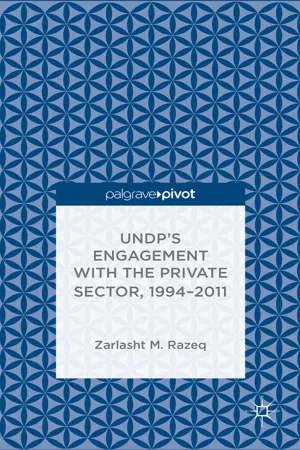
UNDP's Engagement with the Private Sector, 1994-2011
About this book
An engaging explanation and unique analysis of the increased involvement of the private sector in one of the world's most influential development organizations, the United Nations Development Programme.
Information
1
International Organizations and the Private Sector for Development
Abstract: Contractual relations between IOs and the private sector for project execution are not a new phenomenon. What is new in the character of IOs’ engagement with the private sector in recent years is the quality and purpose of their partnerships that build upon common objectives for poverty reduction and development by promoting CSR and sustainable development. As a relatively new area in the study of IOs, theories of IR, and development policy, the conceptualization and analysis of these changes present some challenges in theoretical, analytical, and empirical terms. This introductory chapter highlights these challenges and introduces the steps that this research undertakes to conceptualize and analyze the case.
Keywords: UNDP, theory-guided process tracing, business, CSR, partnerships, development
Razeq, Zarlasht M. UNDP’s Engagement with the Private Sector, 1994–2011. New York: Palgrave Macmillan, 2014. DOI: 10.1057/9781137449207.0008.
Defining the research agenda
Although IOs have been launching partnerships with the private sector for development for over a decade, there is very little known about the factors and processes that have caused the recent changes in their policies. The subject becomes particularly intriguing if the fundamental differences between the development mandates of IOs and the interests of the private sector are taken into account. Presumably, IOs, as global public institutions, are designed and mandated collectively by their members to perform certain tasks for the benefit of all member countries. Their policies are subject to revisions and formal approvals, as they are expected to demonstrate some degree of compliance with their mandates. The private sector, on the other hand, pursues its own interests in undertaking new projects and partnerships, which may not always be compatible with the priorities of public entities. Hypothetically, this contrast would put the interests and values of IOs and business on the different ends of the inclusive and sustainable development spectrum. However, recent practices show that the opposite has occurred: values have been accepted and interests converged. How and why?
Despite the objective importance of these questions to our understanding of contemporary development policy and practices, their systematic conceptualization and analysis in the studies of IOs, IR theories, development, or similar fields have not been attempted. In this respect, how the role of the private sector in development was accepted and its interests converged with those of IOs, present some gaps and challenges in empirical, theoretical, and analytical terms.
Empirically, studies conducted on the process of policymaking within IOs do not focus on their changing relationships and collaboration with business for development. In many notable studies, policy change is normally examined in the context of IOs’ interactions with member states in the area of macroeconomic policy or development finance (Park & Vetterlein, 2010; Hawkins, Lake, Nielson & Tierney, 2006; Nielson, Tierney & Weaver, 2006). The role of the private sector in development has been the subject of extensive ideological debates and empirical investigations for almost half a century. However, in many occasions, this role is framed in the context of global governance and international politics, where the emphasis is put on the increasing material power and influence of the private sector on global agendas (Ougaard & Leander, 2010; Bull & McNeill, 2007). In recent years, a number of IOs-endorsed reports and academic sources make a notable contribution by taking the first steps to map and document the changing landscape of development practice and the new dynamics of partnerships (Lodge & Wilson, 2006; Nelson & Prescott, 2008; Nelson, 2002; Hopkins, 2007; Witte & Reinicke, 2005 among others). However, these also remain largely descriptive and focus only on the outcomes of the private sector’s engagement in development and the character of partnerships. The motive for partnerships between the private sector and public entities (at the global and local levels) in these studies is conceptualized as need-based choice. Apparently, states and non-states actors seek to engage the private sector in partnerships because the latter can offer much needed technical and financial resources, which others do not have or find it difficult to mobilize. This is essentially a rational choice argument, in which the motive of the global public sector in collaborating with business is justified based on financial needs, and resource mobilization is framed as the dominant (if not the only) factor of change in policies.
Theoretically, however, the evolving role of the private sector in development in the past decade has been much more complex. While it is true that efficiency is always at stake in any cooperative arrangement, the qualitative transformation of complex social relations can hardly be explained only in terms of rationality. Member states, for instance, may significantly divert agendas in pursuit of their own interests (collectively or individually) by tasking the organization to launch new initiatives. They may exert such influence over agenda collectively by using as leverage their financial contributions or decision-making power at the executive board (EB) or board of directors (Hawkins et al., 2006; Nielson & Tierney, 2003). In the chain of delegation, executives and staff members can also initiate new policies and shape agendas autonomously in the absence of any directives from member states. As the recent studies of the IFIs show, executives’ and staff-members’ expertise and leadership can be crucial in challenging the conventional practices of an organization and incorporating new norms and ideas into the agendas for change (Chwieroth, 2008; Weaver, 2008).
Moreover, in the study of norms, constructivist theories of IR have historically examined IOs as entities for norm development and diffusion among member states. However, as some recent efforts in this area show, norms may also influence IOs’ policies and strategies (Park, 2006). The constitutive impact of norms may influence not only those for whom norms and standards are developed but also IOs, who are involved in the development, dissemination, and internalization of those norms and standards. As the liberal variant of constructivism (henceforth constructivism, see Chapter 2) suggests, norms have a determining impact on decisions, preferences, and outcomes. They can meddle in the process between the initial conditions and outcomes and redefine meanings. They obtain an intersubjective quality through interactions, engagement in dialogue, and exchange of ideas and concerns, change preferences and agendas, and define ‘shared social purposes’ (Ruggie, 1998b, p. 84; Ruggie, 2003). Hence, the increased involvement of IOs in the discussion of sustainability, the development of standards and blueprints for responsible business conduct, and the diffusion of norms and best practices of CSR could not happen without a reinterpretation of the way that IOs define the role of the private sector in the context of their objectives. If we consider policies as dependent variables in the process of norms development and diffusion, we should expect then to see this process having an intervening impact gradually on the policies and character of the IOs’ engagement with the private sector. This intervention must be even more evident if the change correlates with an increased involvement of IOs in the evolving network of sustainability standards.
Therefore, while functional interpretations of the private sector’s engagement with IOs present a compelling hypothesis, they offer limited insights into the process through which the constellation and convergence of objectives (Martin, 1992) for development obtain the quality of ‘collective intentionality’ in a particular period of time (Ruggie, 1998a, p. 862; Kratochwil & Ruggie, 1986). This argument is further strengthened if the fundamental differences between the IOs’ mandates and the private sector’s interests are considered. On the one hand, efficiency, wealth creation, and innovation for market expansion have always been the core competencies of business. As many key informants in this project have emphasised, the private sector has historically been an integral force of wealth and employment creation in the developing world, without being formally defined by IOs as a partner in development. On the other hand, as the case of the UNDP demonstrates, IOs have been facing challenges in meeting their financial, technical, and operational targets in developing countries since the 1980s. However, the mechanisms and processes through which these two dynamics have entered agendas and become compatible and acceptable in the past few years are not evident from current studies. As a result, it is not clear whether the observable change across IOs was only a rational choice to solve operational problems? Was it enforced by member states? Was it influenced by other internal dynamics? Or was it driven by mechanisms such as the impact of norms through reasoning and dialogue?
Analytically, the challenge is to deal with the ambiguity of methodologies that have been applied to examine the process of policy innovation. In many cases where process tracing is applied, researchers tend to treat the process of policymaking as a linear and complete process. It is normally assumed that the causal impact of possible factors of policy change have a constant influence throughout the process; this means that if certain factors, such as power and interest of member states, influence decisions at the beginning, they preserve their strength until the end without any change. However, this might not always be the case, as the causal claims of hypotheses may vary throughout the process. Some factors and events may have a strong impact on policies and their design at the beginning, while others may be more important at the end. In addition, the causal impact of possible factors of policy change does not shape in an institutional and regime void, and can be (in its turn) subject to transformation over time, especially when the process of policy change extends over several years. Therefore, the consideration of variations in the causal strength of possible triggers and factors of policy innovation at different stages of policymaking can allow a more nuanced and precise assessment of hypotheses and analysis of policies. For this purpose, by drawing from methodological tools widely applied in policy sciences (Howlett & Ramesh, 2003, p. 13), this study disaggregates the process of policymaking into constituent and consecutive elements of agenda setting, policy formulation, and launch of initiatives.1
Why the United Nations Development Programme?
The UNDP, as a state-centered and highly bureaucratized organization with a history of resentment towards the private sector, is a hard test to analyze the causes and mechanisms of policy change at IOs. As the history of the UN reveals, the UN and private sector relationship has undergone an uneven transformation in the past decades, osci...
Table of contents
- Cover
- Title
- Introduction
- 1 International Organizations and the Private Sector for Development
- 2 International Organizations and Policy Innovation in the Theories of International Relations
- 3 The United Nations Development Programme and the Private Sector for Development
- 4 Explaining the Causes of Policy Innovation
- Conclusions
- Bibliography
- The UNs and UNDPs Official Documents
- Index
Trusted by 375,005 students
Access to over 1.5 million titles for a fair monthly price.
Study more efficiently using our study tools.
Frequently asked questions
Yes, you can cancel anytime from the Subscription tab in your account settings on the Perlego website. Your subscription will stay active until the end of your current billing period. Learn how to cancel your subscription
No, books cannot be downloaded as external files, such as PDFs, for use outside of Perlego. However, you can download books within the Perlego app for offline reading on mobile or tablet. Learn how to download books offline
Perlego offers two plans: Essential and Complete
- Essential is ideal for learners and professionals who enjoy exploring a wide range of subjects. Access the Essential Library with 800,000+ trusted titles and best-sellers across business, personal growth, and the humanities. Includes unlimited reading time and Standard Read Aloud voice.
- Complete: Perfect for advanced learners and researchers needing full, unrestricted access. Unlock 1.5M+ books across hundreds of subjects, including academic and specialized titles. The Complete Plan also includes advanced features like Premium Read Aloud and Research Assistant.
We are an online textbook subscription service, where you can get access to an entire online library for less than the price of a single book per month. With over 1.5 million books across 990+ topics, we’ve got you covered! Learn about our mission
Look out for the read-aloud symbol on your next book to see if you can listen to it. The read-aloud tool reads text aloud for you, highlighting the text as it is being read. You can pause it, speed it up and slow it down. Learn more about Read Aloud
Yes! You can use the Perlego app on both iOS and Android devices to read anytime, anywhere — even offline. Perfect for commutes or when you’re on the go.
Please note we cannot support devices running on iOS 13 and Android 7 or earlier. Learn more about using the app
Please note we cannot support devices running on iOS 13 and Android 7 or earlier. Learn more about using the app
Yes, you can access UNDP's Engagement with the Private Sector, 1994-2011 by Z. Razeq in PDF and/or ePUB format, as well as other popular books in Social Sciences & Political Philosophy. We have over 1.5 million books available in our catalogue for you to explore.