- English
- ePUB (mobile friendly)
- Available on iOS & Android
eBook - ePub
About this book
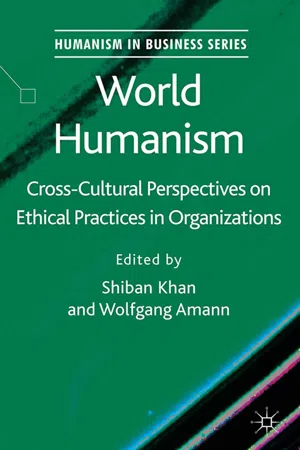
The purpose of World Humanism: Cross-cultural Perspectives on Ethical Practices in Organizations is to discover what is distinctive about humanistic management practices around the world. It examines the nature and occurrence of humanistic management practices within businesses and other organizations across the world.
Information
1
Towards a Better Understanding of World Humanism
Shiban Khan and Wolfgang Amann
What is the purpose of this book?
The main purpose of this book is twofold. First, together with our fellow authors, we want to mirror and embrace the complexity inherent in the different shades and ways of understanding humanism in business. It is very tempting to ignore this phenomenon and simply let it lie, as the local idiosyncrasies we have experienced during our research, teaching, and consulting projects around the world is bewildering. These local elements often present themselves quite distinctly, while at other times they are less noticeable. Overall, the sheer plethora of shades eventually leads to a rather fascinating kaleidoscope. The second purpose of this book, therefore, is to endeavour to capture this kaleidoscope.
The book follows other prominent business challenges’ in research and practice: the decades-long discussion about culture-bound versus culture-free management, on the one hand, and the dire need to better match concepts and semantics to reality. Regarding the culture-free versus culture-bound management debate, the emerging interim conclusion sees elements of universalism, convergence, and divergence in different fields. Our call for more humanism in business, which grants human dignity a centre stage position in the business world, for more balanced goals than merely maximizing profits and shareholder value shows a universalist trait. We must acknowledge that the past and current developments as well as the future avenues of making progress were, are, and will all be different. Deducting or inducting theories, concepts, and solutions will be rendered more difficult because the environment in which they have to be applied may differ – and change over time.
A case in point is the Peoples Republic of China. Through our practice, research, and teaching projects over the last 17 years, we have noticed several major shifts in the managerial orientations in this country. At first, Western management models, styles, skills, and solutions were ignored, then embraced, almost blindly sought after, and then mimetically copied. Subsequently, these increasingly showed and continue to show severe limitations on the conceptual and, thus, the desirability side as well as the transferability and, thus, the feasibility side regarding the adoption of Western management in China. The success of Chinese companies has also entailed much stronger confidence in their own approaches and management styles. We want to illustrate this increased confidencs in the following: For years, we have run top executive educational programs in Germany. The Chinese delegations we encountered at first chose a business school in Germany as it seemed to take a clear position against Anglo-Saxon institutions and because Germany seemed to be a more balanced economy and more resistant to financial crises than most other countries. In addition, Germany had a key position among the world’s export champions, although it had only a fourth of US population, all of which strengthened the Chinese’s quest to move away from Anglo-Saxon system thinking. This last switch we noticed when delivering programs for hundreds of senior leaders, for example, from the China Development Bank, which sets the standard for projects with their numerous clients. The development can best be described as a move away from ‘you have to teach us the right way to do it’ to ‘inspire us to support the development of own solutions’. Management in China thus has undergone major shifts in less than two decades, evidencing dynamics. The latter apply to other rapidly developing countries as well. This complicates the understanding of the glass splinters of the world humanism kaleidoscope as they are a moving target.
Besides the culture-free versus culture-bound debate, the other ‘evergreen’ that has inspired this book is our desperate need to enrich our vocabulary and, of course, to improve our ability to cope with it more adequately. The Sami people living in the northern parts of Scandinavia and Russia have at least 180 words related to snow and ice and as many as 1,000 words for reindeer (Robson 2013). Both of these are key for their survival, and the vocabulary matches the diversity encountered. Do we use the same vocabulary for and have an identical understanding of sustainability, or social and environmental sustainability? Is there a global understanding of how to achieve these? Do international managers know, for example, about ubuntu, which is so important in Africa? This book postulates that we, the researchers and the practitioners, have for too long not actively developed the proper semantics to depict reality. We obviously do not see salvation in creating 1,000 words for sustainability to convey progress. But we do see the necessity to diverge first in order to increase our awareness of what the notions comprise and, thus, capture the long-ignored diversity. Only then can we achieve convergence of the most suitable typologies and semantics, and tackle the next crucial question.
Why do we need more humanism in the world?
We are not arguing against the invaluable assistance that companies can provide us in satisfying our needs and aspirations as human beings. In contrast with planned economies, which various countries experimented with, market forces and a business motor built to solving problems tends to produce better results sooner. Our discussion at this point omits – for focus reasons – the role and impact of ideologies and religion, which have their own dynamics.
Our discussion does not omit the severe repercussions businesses have. Deregulation and deteriorating values promote negative forces against which our economies have to be protected. Environmental degradation, evaporating trust in business, increasing inequality, cocoonism, and financial crises at regular intervals indicate that we are not making as much progress as we can and should. Black sheep in every industry cause headlines with such a frequency that newspaper editors must start wondering how many scandals, for example, involving Goldman Sachs and Deutsche Bank, they can print before their readers reach a saturation point. The Deutsche Bank has been embroiled in scandals regarding their manipulation of the LIBOR in an industry-wide collusion, shady real estate investment deals in slums, bets on harvests, etc. The latter scandal truly reveals the bank’s real face while internal papers warn of the deadly consequences. The six main betters and gamblers involved in speculations on harvests drove an additional 44 million people to starvation, six million of whom died. Yet, the bank’s PR department issues statements confirming that, contrary to their own internal studies, no such link can be established. Furthermore, the former head of the investment division, Anshuk Jain, who was formally in charge of the investment strategy and portfolio activities, had no knowledge of the details. He is currently the co-CEO but no one knows in which directions he will navigate the company. Interestingly enough, his predecessor Josef Ackermann wrote his doctorate on ethics, which neither seemed to have prevented the Bank from indulging in questionable deals, nor did he manage to achieve any of his own and publicly stated financial goals in his ten year reign!
The banking sector is not the only industry where black sheep or bad apples seem to have taken over, as we have outlined before (Amann and Stachowicz-Stanusch 2012a). Therefore, it is no longer possible to only blame the harsh and impatient investment community for pressurizing companies so much that they start to cheat or adopt questionable, short-term practices. The downsides of shareholder value orientation and profit maximization became increasingly unquestioned and pervasive. Deregulation and strong lobbies accelerate the progress down a negative path. As we outlined before, business schools and executive education institutions play a crucial role as well, and they are certainly not fully tapping into their positive potentials (Amann et al. 2013a; Amann et al. 2013b; Amann et al. 2012; Amann and Khan 2011). We, therefore, do not merely point fingers or aim to seek attention through scandalous accusations. Au contraire, we have suggested an integrated solution for the perfect business school in the form of our HUBS concept (Amann et al. 2011). We have outlined the foundations of humanism (Spitzeck et al. 2009). We have illustrated sound humanism in practice (von Kimakowitz 2010). In our book series, we published hands-on solutions from inspiring industry leaders, including in the banking industry (Spitzeck et al. 2011). We have also outlined the paths to build humanistic organizations, thus not only clarifying in general what needs to be done, but clarifying how to constructively make progress as well (Amann and Stachowicz-Stanusch 2012a; Amann and Stachowicz-Stanusch 2012b). Our quest to publish analyses and solutions addresses the need to help steer our economies, businesses, executives, and managers, and also our business schools in different directions. If ignored, the downsides will worsen and entail even more financial and societal crises. This is why we need more humanism in business – badly.
What is humanism?
We believe that humanism in business is best characterized and defined with the help of the following five features:
•A new goal in a more balanced goals system: As the core of humanism, human dignity is fostered as an end in of itself. Humanism in business thus represents a broadened and more balanced goal system for business entities that goes beyond responsible business practices. Humanism in business attempts at more than just balancing financial, social, and environmental aims – it grants human beings a centre stage position. Humanism in business demands a drastic shift from the view of ‘human resources’ to the human purpose of businesses.
•A universal guiding star that is viewed from different positions: All business decisions must integrate ethical reflections, which are the guiding principles. Absolutes do not do justice to reality. Since human beings reflect different cultures, their developmental needs and human dignity should be understood in relative terms. This will prevent any form of prescription or value imposition without due diligence regarding what needs to be ruled on or organized. Degrees of vulnerability, emancipation, freedom, and information endowment differ – and so should the way we bring the concept to life in a specific setting at a concrete point in time to discuss temporary solutions.
•A new way of legitimization: The above defining criteria are in line with a more reasonable legitimacy logic beyond the corporate level, which therefore links business and society. Michael Porter (2011) suggests succinct wording by positing that, in the old thinking, what is good for business is good for society. This old train of thought needs to be replaced with the perspective that what is good for society is good for business. We posit that humanism and discourse on the above criteria help to legitimize and categorize people and their motives, actions, and results as good.
•A construct for a learning and evolutionary approach: We are currently enhancing our available body of knowledge at a tremendous speed. The related sciences from psychology, sociology, anthropology, pedagogy, and andragogy, to name but a few, exponentially increase what we know at short intervals. The interdisciplinary nature of business administration must be brought to life more extensively. This enables us to understand human beings more holistically – not merely as human resources – and to create with them, not at their cost. There is a likelihood that we may discover and develop newer and better solutions of a higher quality. It is also likely that we may learn more effectively about how solutions work and how they can be designed and implemented in specific settings. Therefore, we need the zeal and skills to rapidly develop versions 2, 3, and 4 of a once developed solution in order to continuously improve it.
•Pairing the ideal with pragmatic results: As far as actionable knowledge is concerned, we take a clear position that pragmatic, yet tangible, results today are worth more than the utopist, perfect solution which may actually never even emerge. Proclaiming the highest standards with little regards to feasibility, ignoring resource constraints, inertia in systems, and lacking the skills to produce the most perfect and, therefore, the most likely complex solutions can only serve to be self-deceptive.
The approach of this book
It is the responsibility of the editors to ensure that the most suitable approach is chosen when compiling an interesting learning journey for the reader. As we have already experienced the diversity of the global kaleidoscope with regard to humanism, the underlying question for this book is not whether there are differences, instead, we focus on the question of what these differences comprise of. We thus focus more on an inductive approach. While implementing this approach, we fully incorporate the readers in the sense-making progress. We compile a variety of impressions which are substantiated with historical reviews, current practices, and developments. At this point in time, we are aware of many international and intercultural differences. Since we do not know what we do not know, and thus have blind spots, we acknowledge that the chapters are a selection – a snapshot. We explicitly encourage further research into the practices and regions, as well as into those we could not include due to space constraints. As outlined above, we adhere to a learning approach, which means our knowledge will evolve – either through our future efforts or through those of our colleagues and peers.
In compiling this book, we have put together a buffet of ideas. There is no restrictive dogma with ready answers already in place. We encourage the reader to read selectively and choose freely from the available selection the parts which seem most attractive. The choice is yours. Learn new flavours, or reinventions, and new approaches to what you have already experienced.
The structure of the book
The book chapters are pretty straightforward. We start our learning journey with Western management and move on to what the Americas have to offer. We progress to the Pan-European and African illustrations, before approaching the Near and Middle East. Subsequently, we embrace and explore the insights we derive from Asian regions, countries, and economies, before we offer our conclusions. More specifically, we cordially invite the readers to ‘taste’ the following morsels.
Sigmund Wagner-Tsukamoto from the University of Leicester is the first of the authors who contribute to this volume. In his chapter, he contrasts the concept of economic humanism with behavioural concepts of humanistic management, as they tend to be informed by sociology, psychology, and anthropology, for example. Wagner-Tsukamoto critically questions whether conventionally understood economics and management practice that builds on conventional economic teaching and research are non-humanistic and that their views of human nature are in any respect ‘dehumanizing’. The author suggests that this behavioural humanistic criticism be taken more seriously. The chapter stresses that a humanistic dimension of economics-based management differs from behaviourally oriented humanistic management.
Beyond this introductory chapter outlining classic and modern Western management thinking on humanism in business, Joseph Petrick from Wright State University delves deep into humanistic management in the light of North America’s prevalent business ethics. This chapter’s critical review covers Canada, the United States, and Mexico. It sharpens our view of world humanism by sharing the past and current developments in a region which – according to the author – has been the most productive global region for business ethics research, teaching, and training during the covered period. The author bases his insights on a survey and uses as evidence two North American business ethics trends relating to management. Petrick elaborates on corporate and economic practices that reinforce humanistic management principles. Furthermore, he places humanistic management in the context of sustainable stakeholder capitalism. The author’s chapter is an important addition to the exploration of world humanism as we find substantial alternatives even within North America, with its high emphasis on financial outcomes. The question therefore is no longer what the alternatives might look like, but how they can be achieved before an extreme capitalism demonstrates all its downsides even more frequently.
The United States is under heavy scrutiny. Media coverage and considerable research are available on the degree of progress being made. Practices in Mexico and Canada seem to have converged. Carlos Largacha-Martínez of Universidad EAN adds a different viewpoint. In an ambitious endeavour, he explores the concept of alterity and otherness within the body of knowledge on humanistic management. His regional focus is on Latin America. The author believes that the Argentinean philosopher Enrique Dussel and the way we build self-identity in relation with and through others had an important impact. He substantiates his observations and claims with the help of two case studies from Columbia, providing deeper insights into two specific settings. Furthermore, he mentions Eugene Gogol, another philosopher, who emphasizes the importance of liberation when it comes to increasing the respect of dignity. The path dependency and interdependency in the country’s history is highlighted in this chapter.
Turning our attention to a different part of the world, Robert Strand from the Copenhagen Business School reflects critically on the Scandinavian understanding of humanism in business. The...
Table of contents
- Cover
- Title
- 1 Towards a Better Understanding of World Humanism
- 2 Economic Humanism and Western Management: Theory and Practice
- 3 Humanistic Management and North American Business Ethics
- 4 Alterity, Otherness and Humanistic Management in Latin America: Bancoldex and Views as Two Colombian Case Studies
- 5 Scandinavian Cooperative Advantage: The Case of IKEA
- 6 Humanistic Management and Sustainable Transformation with Regional Scope on Germany, Austria and Switzerland
- 7 Corporate Social Responsibility Management in Poland
- 8 The Italian Way to Humanistic Management 2.0
- 9 Towards a Humanistic and Responsible Managerial Decision Making Model: The Corporate Ubuntu Approach
- 10 Business Ethics Practices in Israel: Jewish Ethical Traditions and Management Behaviour
- 11 The Islamic Paradigm of Morality: Toward a Humanism Approach
- 12 Antecedents to Humanistic Management Approach in India: The Role of Family Businesses
- 13 Indian Ethos as Humanistic Management Principles: A Case Study of a Family Business Organization
- 14 The Ethical Background of Business in China An Outline
- 15 Business Ethics and Corporate System in Japan
- 16 Emerging Insights on World Humanism
- Index
Trusted by 375,005 students
Access to over 1.5 million titles for a fair monthly price.
Study more efficiently using our study tools.
Frequently asked questions
Yes, you can cancel anytime from the Subscription tab in your account settings on the Perlego website. Your subscription will stay active until the end of your current billing period. Learn how to cancel your subscription
No, books cannot be downloaded as external files, such as PDFs, for use outside of Perlego. However, you can download books within the Perlego app for offline reading on mobile or tablet. Learn how to download books offline
Perlego offers two plans: Essential and Complete
- Essential is ideal for learners and professionals who enjoy exploring a wide range of subjects. Access the Essential Library with 800,000+ trusted titles and best-sellers across business, personal growth, and the humanities. Includes unlimited reading time and Standard Read Aloud voice.
- Complete: Perfect for advanced learners and researchers needing full, unrestricted access. Unlock 1.5M+ books across hundreds of subjects, including academic and specialized titles. The Complete Plan also includes advanced features like Premium Read Aloud and Research Assistant.
We are an online textbook subscription service, where you can get access to an entire online library for less than the price of a single book per month. With over 1.5 million books across 990+ topics, we’ve got you covered! Learn about our mission
Look out for the read-aloud symbol on your next book to see if you can listen to it. The read-aloud tool reads text aloud for you, highlighting the text as it is being read. You can pause it, speed it up and slow it down. Learn more about Read Aloud
Yes! You can use the Perlego app on both iOS and Android devices to read anytime, anywhere — even offline. Perfect for commutes or when you’re on the go.
Please note we cannot support devices running on iOS 13 and Android 7 or earlier. Learn more about using the app
Please note we cannot support devices running on iOS 13 and Android 7 or earlier. Learn more about using the app
Yes, you can access World Humanism by S. Khan, W. Amann, S. Khan,W. Amann in PDF and/or ePUB format, as well as other popular books in Business & Business Communication. We have over 1.5 million books available in our catalogue for you to explore.