eBook - ePub
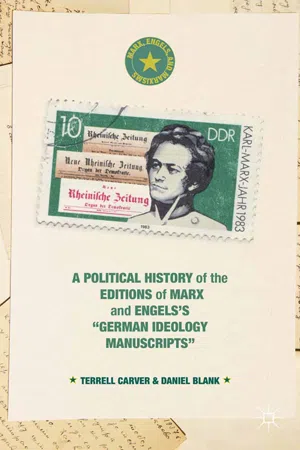
A Political History of the Editions of Marx and Engels’s “German ideology Manuscripts”
- English
- ePUB (mobile friendly)
- Available on iOS & Android
eBook - ePub
A Political History of the Editions of Marx and Engels’s “German ideology Manuscripts”
About this book
Since the 1920s, scholars have promoted a set of manuscripts, long abandoned by Marx and Engels, to canonical status in book form as The German Ideology, and in particular its 'first chapter,' known as 'I. Feuerbach.' Part one of this revolutionary study relates in detail the political history through which these manuscripts were editorially fabricated into editions and translations, so that they could represent an important exposition of Marx's 'theory of history.' Part two presents a wholly-original view of the so-called 'Feuerbach' manuscripts in a page-by-page English-language rendition of these discontinuous fragments. By including the hitherto devalued corrections that each author made in draft, the new text invites the reader into a unique laboratory for their collaborative work. An 'Analytical Introduction' shows how Marx's and Engels's thinking developed in duologue as they altered individual words and phrases on these 'left-over' polemical pages.
Information
CHAPTER THREE
THE STALIN ERA AND THE CONSTRUCTION OF A FEUERBACH CHAPTER IN VOLUME I/5 OF MEGA1
The Fate of David Ryazanov and Political Developments in the 1930s
Although the fate of Ryazanov was closely linked to the political history of the editions of The German Ideology, it is not the primary task of this research to trace every detail of his biography up to his death sentence in 1938. Nor should his fate be interpreted solely through the history of the editions of The German Ideology in the 1930s. The first approach would mean putting too much emphasis on personal affairs, whereas a wider historical process should be invoked. The second approach would overemphasize the significance of The German Ideology with respect to the tragic death of a well-known scholar.
There have been quite a few recent publications focusing on the life of Ryazanov and, moreover, providing compilations of historical documents of the time (see Külow and Jaroslawski, 1993; Kolpinskij, 1997; Vollgraf, Sperl, and Hecker, 2001). However, we will only use biographical data in the following historical-political analysis if a direct connection between the editorial history of what is known to us as The German Ideology and the fate of Ryazanov can be assumed. It is more important to understand that Ryazanov was simply a well-known exponent of a much wider theoretical struggle and that his personal fate exemplifies the fate of a whole school of theorists within the Soviet Union in the late 1920s and throughout the 1930s. After all, there is no argument over the question that Ryazanov and his Marx-Engels Institute (MEI), which existed for ten years under his directorship, was in firm opposition to the political line of the Central Committee of the All-Union Communist Party (Bolsheviks) (AUCP(b)).
In his essay “Die ‘Säuberung’—Übernahme des Rjazanov-Instituts durch Adoratskij” (The “Purge”—Adoratskii’s takeover of the Ryazanov-Institute), Jakov Rokityanskii described Ryazanov as an “influential” but “irksome” party functionary. Ryazanov made overt use of his position by employing people in his institute, who, according to the Communist Party, had highly questionable political backgrounds. And the well-known German “renegade” Karl Johann Kautsky (1854–1938) characterized the institute as one “of the few pleasing creations of Soviet Russia.” Ryazanov often and openly polemicized against the general secretary of the party, J. V. Stalin (1879–1953), and maintained close contacts with Mensheviks and Trotskyists, who were in fundamental opposition to the party line after Lenin’s death in January 1924. Ryazanov allegedly supported victims of political persecution by using funds from the MEI and by providing further employment for them even though they had been sent into exile.
At first the Central Committee tried to keep Ryazanov out of active politics as much as possible, mainly by loading enormous amounts of work onto his shoulders, but the institute, with its 257 members, increasingly developed into a secluded refuge for the anti-Stalin opposition within Russia (Rokitjanskij, 2001: 13–14). The Central Committee attempted to deal with Ryazanov by trying to turn this rather withdrawn institute, which had, however, cultivated many links with scientists abroad, into an institution that would directly serve the domestic propaganda interests of the AUCP(b). It was in the interest of the party to make sure that the large sums of money allocated to the MEI were being used to support the AUCP(b)’s position within society.
Ryazanov admitted in a report, which he gave in a meeting of the Institute at the end of September or at the beginning of October 1930, that the accusation of running an institute that was not taking part in current political activities was not groundless. He then promised that he would set up a “propaganda-commission,” following a resolution by the Central Committee of the AUCP(b). The main activity of the “propaganda-commission” was supposed to be that of systematically establishing close links between the Institute and the broad scientific public at home. From now on the MEI was forced to report on its activities to the Russian public and to organize lectures and symposia (Rjazanov, 1997: 119–20). The Institute was also forced to support actively the “building of socialism in one country,” to support the theory of “Marxism-Leninism” and to redefine its editorial activities so they would serve the immediate propaganda interests of the AUCP(b).
At this point it must have been obvious to many within the MEI, including its director Ryazanov, that their time at the institute was coming to an end. In a letter written to the Central Committee of the Communist Party of Germany (KPD) in March 1931, Wilhelm Pieck (1876–1960; 1993: 251) (who later became the first president of the German Democratic Republic) said that they all knew “Ryazanov did not love the Bolsheviks and that he always very purposefully declared that he is not a Leninist, but a Marxist.” In a next step the Central Committee of the AUCP(b) sent “trustworthy” party members to the MEI in order to change its “right-wing” political line from the inside.
However, in 1931, the leadership of the Soviet Union finally seized the time to use peaceful methods to bring the MEI under its direct control. This “island of persistent resistance within the ocean of social-sciences,” as Rokityanskii (2001) calls the Ryazanov Institute, could only be conquered by getting rid of its director completely. Ryazanov was arrested on February 15, 1931, after being confronted with allegations that he had been actively engaged in counterrevolutionary activities committed by the Menshevik opposition (15–7; IMES, 2004: 13*).
It certainly did not help Ryazanov much that the “arch-enemy” of J. V. Stalin, the “opportunist” Leon Davidovich Trotsky (1879–1940), had started to write articles in defense of Ryazanov (see Trotzki, 1993a: 236–42; 1993b: 242–5). Shortly after the arrest of Ryazanov, the whole leadership of the MEI was dissolved, and 131 members had to leave the institute. Most of them were officially dismissed, but members of the AUCP(b) were assigned to other workplaces. On February 20, 1931, the politburo gave orders to appoint Vladimir Viktorovich Adoratskii (1878–1945) to be the new director of the institute.
Adoratskii himself had a personal interest in keeping as many experts employed in the MEI as possible, and he even gave some jobs back to scholars who had been discharged only weeks before. How was all of this reflected in the publications of the MEI in general and in the publication of what has become known to us as The German Ideology in particular? It is interesting to note at this point that the commission that had been assigned to oversee the completion of the publications and also the board of directors of the institute had no objection to including former employees in finishing the editions. It was probably thanks to Adoratskii himself that this became possible, and one could argue that the Ryazanov Institute lived on even under its new directorship (Rokitjanskij, 2001: 20–1). But on the other hand, even though many of the old experts stayed on, the whole concept of publishing the works and manuscripts of Marx and Engels then changed completely.
These different approaches become immediately visible by comparing two important documents of the time. The first document, by Ryazanov himself, was published as a “Vorwort zur Gesamtausgabe” (Preface to the complete edition) in the first volume of MEGA1 in 1927. In his preface, Ryazanov provided a short overview of the contents of the first volume and, furthermore, informed the reader about the planned sequence of future editions. The first and second volumes (in “Division I”) of the “historical-critical” MEGA1 edition were supposed to contain works and manuscripts up to the Deutsch-Französische Jahrbücher (German-French Annals) of 1844. Interestingly enough, the works of Marx and Engels would not be presented together in a single volume, but rather separated into volumes one and two. Only from the third volume onward would the texts of the two authors be presented together. The planned third volume was supposed to comprise manuscripts and works written between the Deutsch-Französische Jahrbücher and the spring of 1845. Among these works would be famous writings such as Die Heilige Familie, the first jointly written work by Engels and Marx (published names in that order), and Die Lage der arbeitenden Klasse in England (The Condition of the Working Class in England) by Engels alone.
Consequently, the fourth volume of MEGA1 “Division I” would be solely dedicated to the manuscripts of 1845 to 1846. Ryazanov justified the edition of what he called The German Ideology by referring to its practical use for scholars who are engaged in historical studies on ideology. According to Ryazanov (1993: 150–1), the text would allow these scholars to follow Marx and Engels through all the stages of their intellectual development up to that time: from Hegel to Feuerbach, taking in aspects of French socialism, and from their perception of the developing proletarian class struggle to “dialectical materialism.” The planned MEGA1 edition of The German Ideology should, therefore, be judged as an edition that predominantly serves scholarly interests, and Ryazanov stressed this many times in his preface when he talked about MEGA1 in general:
Our edition offers most of all an objective basis for all research on Marx and Engels, i.e. reproducing the whole intellectual estate of Marx and Engels clearly arranged . . . Since the main purpose of our edition lies in making the whole complex of ideas by Marx and Engels, in all its distinctiveness, available to scientific research, we placed the main emphasis on reproducing the text in an exact manner—free of all subjective interference and interpretation. (148, 153)
The second document that provides an insight into rapidly changing views on why and how the manuscripts known to us as The German Ideology should be published is a report by Ryazanov’s successor Adoratskii. He gave this report on the occasion of the XI. Plenary Assembly of the Executive Committee of the Communist International (ECCI) on April 1, 1931, shortly after Ryazanov had been arrested. This report was entitled “Statement on the Lenin-Institute and the Marx and Engels-Institute.” Adoratskii starts out by putting particular emphasis on what he called the “theoretical weapon of Marxism-Leninism” and its enormous significance for the “great struggle” for communism. In the name of the two institutions, which were dedicated entirely to research on “Marxist-Leninist theory,” he proclaimed emphatically that the works of Marx, Engels, and Lenin need to find the widest circulation. However, one must, according to Adoratskii, confess that these works had not yet found adequate circulation among the proletarian masses and working people in general.
Adoratskii’s reason for disseminating the works of Marx, Engels and Lenin as widely as possible among the working masses was simple. By allowing them to familiarize themselves with the ideas of “revolutionary theory,” they would be able to expose the falsity of the phrases used by the “disgraceful traitors of the revolutionary workers’ movement.” These “traitors,” namely, Philipp Scheidemann (1865–1939) and Karl Kautsky and social democracy in general, were allegedly tampering with “Marxism” while embellishing their counterrevolutionary theories, used only to dull the minds of the working class, and thus dignifying these banal theories with the names of the “greatest revolutionaries.” Their “castration” of revolutionary theory was thus serving objectively as a means to consolidate the rule of the bourgeoisie, and this in turn would be a “defence of Fascism” (Adoratskij, 2001: 107–8). Adoratskii said:
For our part we must oppose these methods with the revolutionary propaganda of Marxist-Leninist theory, we must undertake the widest activity in circulating popular editions of the works by Marx, Engels and Lenin among the masses . . . Concerning the Marx-Engels-Institute, it will, over the next period of time, centre its attention on working for the publication of a popular mass-edition [Massenausgabe] of the works of Marx and Engels. (108, 117)
Confronted with the rise of Fascist movements in several West European countries and the alleged “impotence” of social democratic parties in those countries, the Soviet Union abandoned the idea of supporting a long-term project such as the MEGA1 edition. Instead, the “theoretical weapons of Marxism-Leninism” would have to be strengthened through immediate mass printing of “popular editions” to make the works of Marx, Engels, and Lenin directly available to working-class readers within and, perhaps more importantly, outside the Soviet Union. These editions were supposed to help the working classes solve the “daily questions” of their struggle for emancipation (109).
Here the political history of the editions of The German Ideology takes another decisive turn. Just as Ryazanov had accused Mayer in 1925 of being a “bourgeois writer,” it was only six years later that Adoratskii criticized Ryazanov for very similar reasons. Adoratskii claimed that during all the time that Ryazanov had acted as director of the MEI, he had not led the necessary struggle against social democracy. Furthermore, in his forewords to the works of Marx and Engels, Ryazanov had supposedly cultivated an “academicism, an abstract and unpolitical erudition,” which could only be interpreted as a “direct betrayal” of the cause of the proletariat. This must be seen as one of the most severe offenses allegedly committed by Ryazanov, that he had “sabotaged” an “international-popular edition” of the works by Marx and Engels.
In the eyes of Adoratskii a new and popular edition should also comprise a very different selection of writings. Ryazanov had focused too much on the “early works” of Marx and Engels, when they were still “Idealist-Hegelians” or when their transition to “dialectical materialism” was just taking place as they were taking the “first steps into the new world view.” Although Adoratskii admitted that these writings are very important for the study of the intellectual development of the authors, they are, in his view, not of the same importance to the daily struggle of the working classes as the later ones. Indirectly referring to what is now known as The German Ideology, he said that these works and manuscripts are full of “literary polemic” against former “kindred spirits,” the left-Hegelians, but hardly accessible for study in the present time. Of the writings, which would be of great value for the current struggle being undertaken by the proletariat, only a very few had been published by the MEI. Moreover, Adoratskii pointed out that no effort had been made to produce the most important economic works by Marx. None of the materials referring to the First International and to the period of the 1870s and 1880s, a time when Marx and Engels were “leading the international workers’ movement,” had been made available to the public either.
Adoratskii (2001) then outlined his plans for a “popular peoples-edition” of the writings by Marx and Engels in 10–11 volumes. Two of the volumes were to incorporate the “philosophical works,” and these had to be taken mainly from Engels’s writings. As one could expect, the ma...
Table of contents
- Cover
- Title
- One Manuscripts and Politics
- Two The 1920s: Early Political Disputes over The German Ideology
- Three The Stalin Era and the Construction of a Feuerbach Chapter in Volume I/5 of MEGA1
- Four Two Popular Study Editions at the Beginning of the “Cold War”
- Five The Turbulent 1960s: The Publication of Long-Lost Pages of the 1845–46 Manuscripts
- Six The Historical Origins of the 1845–46 Manuscripts
- Seven The End of East European Communism and Its Impact on the Preparation of Volume I/5 of MEGA2
- Eight The Marx-Engels-Jahrbuch 2003 Edition of The German Ideology
- Nine Summary, Conclusions, and Ideas on How to Publish the So-Called “German ideology” Manuscripts in Future
- Appendix A Select Bibliography of Editions of The German Ideology
- Appendix B The Genealogy of Editions of The German Ideology
- Appendix C A Brief Outline of the Content of a Future “Contextual Edition” of The German Ideology
- Notes on Research Methods and Source Materials
- Methodological Excursus
- Abbreviations and Bibliography
- Index
Trusted by 375,005 students
Access to over 1.5 million titles for a fair monthly price.
Study more efficiently using our study tools.
Frequently asked questions
Yes, you can cancel anytime from the Subscription tab in your account settings on the Perlego website. Your subscription will stay active until the end of your current billing period. Learn how to cancel your subscription
No, books cannot be downloaded as external files, such as PDFs, for use outside of Perlego. However, you can download books within the Perlego app for offline reading on mobile or tablet. Learn how to download books offline
Perlego offers two plans: Essential and Complete
- Essential is ideal for learners and professionals who enjoy exploring a wide range of subjects. Access the Essential Library with 800,000+ trusted titles and best-sellers across business, personal growth, and the humanities. Includes unlimited reading time and Standard Read Aloud voice.
- Complete: Perfect for advanced learners and researchers needing full, unrestricted access. Unlock 1.5M+ books across hundreds of subjects, including academic and specialized titles. The Complete Plan also includes advanced features like Premium Read Aloud and Research Assistant.
We are an online textbook subscription service, where you can get access to an entire online library for less than the price of a single book per month. With over 1.5 million books across 990+ topics, we’ve got you covered! Learn about our mission
Look out for the read-aloud symbol on your next book to see if you can listen to it. The read-aloud tool reads text aloud for you, highlighting the text as it is being read. You can pause it, speed it up and slow it down. Learn more about Read Aloud
Yes! You can use the Perlego app on both iOS and Android devices to read anytime, anywhere — even offline. Perfect for commutes or when you’re on the go.
Please note we cannot support devices running on iOS 13 and Android 7 or earlier. Learn more about using the app
Please note we cannot support devices running on iOS 13 and Android 7 or earlier. Learn more about using the app
Yes, you can access A Political History of the Editions of Marx and Engels’s “German ideology Manuscripts” by Terrell Carver,Daniel Blank in PDF and/or ePUB format, as well as other popular books in Politics & International Relations & Political History & Theory. We have over 1.5 million books available in our catalogue for you to explore.