- English
- ePUB (mobile friendly)
- Available on iOS & Android
eBook - ePub
About this book
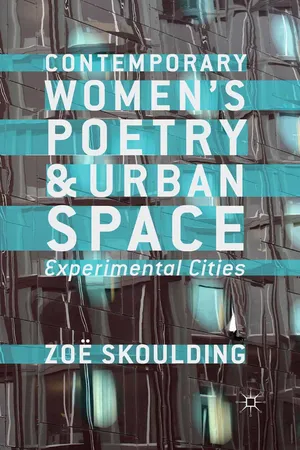
This book focuses on the role of the city, and its processes of mutual transformation, in poetry by experimental women writers. Readings of their work are placed in the context of theories of urban space, while new visions of the contemporary city and its global relationships are drawn from their innovations in language and form.
Information
Part I
Location
1
Address and Rhythm
The various meanings of ‘address’, which encompass both the naming of specific locations and the manner of speaking to particular groups or individuals, provide an understanding of the different ways in which a poem may be said to be ‘about’ a city, or otherwise responsive to urban experience. A poem may mention particular addresses in a city, but it may also enact forms of address, placing less emphasis on static representation than on engagement in the dynamic relations that constitute social spaces. A consideration of both aspects broadens the scope of poetry’s concern with the city, which has often been more narrowly defined. Commenting on why he has discussed comparatively few women poets in Contemporary British Poetry and the City (2000), Peter Barry offers the following explanation:
[…] for many women poets geography is ‘always already’ psychic geography, place is already space. Naming public spaces, like streets, squares and locales is an act which proclaims ownership and identification, and it may be that poets who are women feel less confident of such ownership, and are therefore less likely to name hotels, pubs, workplaces and public buildings than male poets. (Barry, 2000, pp. 16–17)
Such a statement is, of course, an invitation to seek out exceptions, and my initial research began from this interest. However, another avenue is suggested by Barry’s use of Denise Riley’s poem ‘Knowing in the real world’ as an example of an ‘urban generic’ rather than ‘urban specific’ poetry that would name clearly defined locations. He sees in the poem’s cuts across time and space ‘a denial of the efficacy of any kind of normative locatory process at all’ and ‘a much more radical series of doubts about place and identities than are encountered, by and large, in contemporary male poets’ (Barry, 2000, pp. 16–19). I have not chosen here to pursue a comparison between male and female poets that would quickly become reductive; nevertheless, these comments raise useful questions, not so much about how certain writers who happen to be women have written about cities, but about the relationship between experimental feminist poetics such as Riley’s and theoretical understandings of urban space. If place is structured in and by language, the critical interrogation of language brings, in turn, new perspectives on the city. The city, for Barry, is both a lived political space and a referent to which poetry may or may not point with various degrees of clarity. Yet in many cases, poets I discuss choose to disrupt or critique the referential character of language, refusing to take for granted the ways in which names fix external locations as isolated entities distinct from the processes and relationships that form both subjects and cities. I will consider some cases in which this applies to the use of place names in poems, before moving on to discuss alternative means of considering subjectivity in city space through dialogic address and rhythm.
Naming the city
Naming places, or choosing not to name them, is a significant gesture, and one to which poets on both sides of the Atlantic have taken different approaches in the years following the publication of Barry’s book. I argue in Chapter 4 that naming is a central issue in Geraldine Monk’s Escafeld Hangings, the title of which refers to an old name for Sheffield, where she currently lives. Destabilizing names by re-routing them through their etymologies reveals the discursive, historical formations that constitute the identities of places. Monk’s page of scattered place names from the outskirts of Sheffield (Monk, 2005, p. 12) reveals a rich layering of associations with place that is subsumed into the singularity of the city – a singularity that has come about because of particular power relationships sustained by class and gender.
As Riley writes, ‘It is the misleading familiarity of “history” which can break open the daily naturalism of what surrounds us’ (1988, p. 5). The Canadian poet Meredith Quartermain’s Walking Vancouver (2005), for example, is unusual in taking a specific city as the title of a book, and the direct reference to a single city in the opening sequence of the same title recalls William Carlos Williams’ multilayered portrait of Paterson. Quartermain, like Williams and Charles Olson in The Maximus Poems, creates a collage of sense impressions, historical records, signs and letters. The intensity of information in the poems disorientates the process of naming, so that instead of a clear sense of location the impression is, rather, of continuous flux and the city’s hectic movement. In ‘Walk for beans’ (Quartermain, 2005, p. 20) the use of prepositions adds to this movement as the reader is invited to follow ‘down Victoria’s drive / a red-bricked hill in her Majesty’s / red-bricked streets’ or ‘outside again, corner of Victoria and Powell / grey brick Hamilton Building and the Princeton Hotel dock side’. Because of the emphasis on movement, names do not denote static entities but are always placed in relationships, often colonial ones. The poem moves between the British colonial history of ‘her Majesty’s / red bricked streets’ and First Nation histories: ‘khupkhahpay’ay, the Squamish called that place / on the shore of our now Vancouver / Cedar Tree’. Walking, and the sensory street-level experience of the city from a mobile viewpoint, is therefore placed in the context of larger historical movements. Fred Wah’s back-cover comment that the poems constitute ‘the kind of naming a city answers to’ highlights the reflexive relationship of the poem with the space to which it refers. The idea that the city might ‘answer’ the naming that happens in a poem depends on a notion of urban space as culturally, as well as socially and politically produced – and open to change.
History is used to confront the apparent self-evidence of names by the US poet Jena Osman, who documents the formation of Manhattan in The Network (2010). Part of the book, entitled ‘Financial District’, is headed by small map sections from which street names are picked out and forensically unravelled (Osman, 2010, pp. 42–101). ‘Cortland Street’, we discover, is named after Oloff Van Cortland, who arrived with the Dutch West India Company of 1638 and in 1655 became mayor of the slave trading port of New Amsterdam, which would be renamed New York by the British ‘in honour of the king’s brother James, the Duke of York – a major shareholder in the Royal African Company, which has a monopoly on the British slave trade’ (Osman, 2010, pp. 44–52). Even though most streets and landmarks are named after famous or infamous men, the problem is not simply one of gender, but that the structural inequalities buried deep in the formation of cities and languages persist into the present. The ‘wall’ of ‘Wall Street’ is first built to contain cattle, then
turns into a wall to protect/fortify against the British and Native Americans. But when no enemy appears, the wall falls into disrepair, the wood taken for use as firewood. With word of each new possible enemy, Stuyvesant orders the wall be refortified, and this is done with slave labor. Eventually the site of the wall becomes Wall St. (Osman, 2010, p. 52)
The inequalities perpetuated by an uncontainable, globalized banking system are made visible in these historical notes. Osman’s strategy is, following Cecilia Vicuña, ‘To enter words in order to see,’ so that ‘Financial District’ is interspersed with diagrams illustrating the etymological roots/routes of ‘finance’, ‘boss’, ‘depression’, ‘credit’, ‘money’ and other words whose history is entwined with that of the site she is investigating (Osman, 2010, pp. 3, 45, 50, 54, 60, 63). Names, strategically foregrounded and examined in this way, reveal complex histories rather than assuming shared knowledge or presenting identifiable ‘urban-specific’ images.
In the years following 2001, Manhattan has taken on a particular importance as an emblematic city space in terms of its global relationships. Juliana Spahr has written about the same area as Osman, without naming it at all, in her poetry-novel-autobiography hybrid The Transformation. It is difficult to convey the cumulative resonance of her repeated circumlocutions in a short quotation, but the World Trade Center attack is described as follows:
Then they woke up one morning and the sky was clear and the air warm and an airplane had been driven into the side of one of the tallest buildings in the world, a building that was located on the denser island in the Atlantic. (Spahr, 2007, p. 137)
Spahr’s text proposes that ‘language itself became impossible’, as the ‘blather’ of government officials disrupted expectations of clarity and communication more comprehensively than the avant-garde had ever succeeded in doing – thereby removing one of poetry’s critical tools. Her decision not to name people or places, or even to use personal pronouns other than ‘they’, is neither a vagueness nor a disruption of clarity, but a process of repeating and layering description that resists the shorthand of naming, emphasizing instead the processes and interactions through which places are inhabited, and through which power relationships are formed. The lack of names means that everything must be explained in terms of relations; no knowledge is taken for granted. Because gender is neutrally plural throughout, every assumption based on gender must equally be re-examined. The scrupulousness of Spahr’s approach highlights the significance of proper nouns and pronouns in constructing collective identifications and thus also the spaces in which they exist. The problems raised by her book in relation to naming change the terms of the question raised by Barry: it is not that women are insufficiently confident to name the city, but that naming of any kind can be a form of complicity with those who have the power to name in a process that is never politically neutral.
The relationship between naming and lived process is explored by the Irish writer Catherine Walsh, whose ‘City’ sequence from her collection City West (2005) begins with an unattributed quotation from Doris Lessing, framed by dashes and set in lines:
– the physical quality of life, that’s
living, and not the analysis
afterwards or the moments of
discord or premonition –
(Walsh, 2005, p. 9)
The sequence is set in Dublin and its emphasis on unreflecting daily experience is heightened by the use of participles and gerunds that isolate action from specific times and places. The city is patterned through ‘being in doing’ (p. 22), so that when place names do appear they are part of an overall context of movement:
walking home midnight through / over the
Islandbridge gate
cycling Sandymount breezed
face (miscellaneous wingèd insects
attached eyes streaming
(Walsh, 2005, p. 21)
Time and duration become the main focus, rather than a visual and spatial sense of the city that would give priority to names and landmarks. The attention given to physical perception fuses human and non-human elements of the city, so that the ‘wingèd insects’ are of equal importance to the named locations of Islandbridge and Sandymount. The syntactical ambiguity allows different possible relationships between places, the wind, a face and insects; what may be ‘attached’ to what, is left open. Because the implied subject is dispersed in isolated detail, place too is scattered rather than defined within a cohesive identification. The visual shaping on the page, which reads like a musical scoring, places an accent on movement rather than mapping, and it is in this rhythmic...
Table of contents
- Cover
- Title
- Introduction
- Part I Location
- Part II Vision, Power and Knowledge
- Part III Language and Locality
- Part IV Polis
- Part V Acts of Attention
- Conclusion
- Notes
- Bibliography
- Index
Trusted by 375,005 students
Access to over 1.5 million titles for a fair monthly price.
Study more efficiently using our study tools.
Frequently asked questions
Yes, you can cancel anytime from the Subscription tab in your account settings on the Perlego website. Your subscription will stay active until the end of your current billing period. Learn how to cancel your subscription
No, books cannot be downloaded as external files, such as PDFs, for use outside of Perlego. However, you can download books within the Perlego app for offline reading on mobile or tablet. Learn how to download books offline
Perlego offers two plans: Essential and Complete
- Essential is ideal for learners and professionals who enjoy exploring a wide range of subjects. Access the Essential Library with 800,000+ trusted titles and best-sellers across business, personal growth, and the humanities. Includes unlimited reading time and Standard Read Aloud voice.
- Complete: Perfect for advanced learners and researchers needing full, unrestricted access. Unlock 1.5M+ books across hundreds of subjects, including academic and specialized titles. The Complete Plan also includes advanced features like Premium Read Aloud and Research Assistant.
We are an online textbook subscription service, where you can get access to an entire online library for less than the price of a single book per month. With over 1.5 million books across 990+ topics, we’ve got you covered! Learn about our mission
Look out for the read-aloud symbol on your next book to see if you can listen to it. The read-aloud tool reads text aloud for you, highlighting the text as it is being read. You can pause it, speed it up and slow it down. Learn more about Read Aloud
Yes! You can use the Perlego app on both iOS and Android devices to read anytime, anywhere — even offline. Perfect for commutes or when you’re on the go.
Please note we cannot support devices running on iOS 13 and Android 7 or earlier. Learn more about using the app
Please note we cannot support devices running on iOS 13 and Android 7 or earlier. Learn more about using the app
Yes, you can access Contemporary Women's Poetry and Urban Space by Z. Skoulding in PDF and/or ePUB format, as well as other popular books in Social Sciences & Literary Criticism. We have over 1.5 million books available in our catalogue for you to explore.