- English
- ePUB (mobile friendly)
- Available on iOS & Android
eBook - ePub
About this book
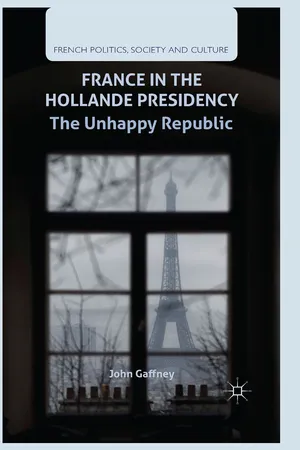
An analysis of the first half of François Hollande's five-year presidential term that examines the strengths and weaknesses of presidential politics following the Left's return to power in 2012 and puts forward an interpretation of the underlying nature of contemporary French politics, and the French Fifth Republic.
Information
1
Understanding the French Presidency
The aim of this book is, through an analysis of the first half of François Hollande’s five-year presidential term, to grasp the strengths and weaknesses of presidential politics following the left’s return to power in 2012 and, further, to understand the underlying nature of contemporary French politics, and the Fifth Republic itself. A consequent sub-theme to our analysis is to demonstrate that the Fifth Republic is ‘dysfunctional’; this in great part because of the manner in which political observers and actors have understood this singular republic and its ‘performative requirements’. We shall analyse how François Hollande, as President, acted ‘out of category’.
Our study is not focused upon a chronology of events nor upon power relations within the presidential and party political system. What we are concerned with is what the first half of the five-year term – up until the creation of the Valls government, the European elections, the publication of Valérie Trierweiler’s book (2014), and the return to frontline politics of Nicolas Sarkozy – tells us about the nature of the republic, and the way in which the left and François Hollande understood or failed to understand the politics of the Fifth Republic, in particular the notions of time, character, and what we call ‘sequencing the self’. From a theoretical point of view, therefore, we are concerned with structure and agency, context and performance: to appraise the political performance of an individual and his/her entourage within a particular configuration of institutions and expectations. Our concern is not to chronicle the fortunes and misfortunes of the Hollande presidency (Amar 2013; Baumel 2013; Bercoff 2013) but to understand them within the framework of the Fifth Republic. François Hollande won the presidential election against the incumbent President, Nicolas Sarkozy (Estier 2012; Malouines 2012); but within two-and-a-half years of his election was the most unpopular President of the Republic’s seven Presidents. By May 2014, 86% of respondents had a very negative view of Hollande’s first two years (BFMTV 5/5/14). In some polls only 1% expressed full confidence in him by this time. Our analysis aims to show how and why this happened. It is almost unavoidable being critical of Hollande himself and his team. We are not, however, concerned with his real character except in as much as it informs us about his ‘performative character’; it is the relationship of this to the configuration of institutions and to public opinion that is the central focus of this study.
We are also interested in the long-term historical success and fortunes, the ‘health’ one might say of the Fifth Republic, and the way in which – historically, culturally, institutionally, rhetorically, and performatively – its evolution has been path-dependent, while not being ‘determined’. We shall examine this in Chapter 3 when we examine how presidential ‘character’ helps us understand from the theoretical perspective how the Fifth Republic has developed. Conversely, lack of political success, misfortune, and ‘dysfunction’ raise questions of the regime’s ‘appropriateness’, of the imperatives behind the legacy of the republic itself, and how the institutions function today. Does the Fifth Republic’s presidentialism still work? And if once it did, how was this so, and what has changed? Our focus is, therefore, on the presidency in the context of its historical, cultural, and institutional conditions of performance. We shall also, perhaps paradoxically, be particularly concerned with presidential politics at the daily political level, because this is where the presidency as a perceived and symbolic institution and one that is ‘active’ in political life actually ‘performs’. It is also our conviction that, for reasons we shall discuss below, the ‘trivial’, the incidental, the apparently unimportant, and the ‘trivial unexpected’ in French politics are now in a systematic and often dysfunctional relationship to ‘real politics’, and this to the point where the trivial has become unpredictable in its effects and potentially of major political consequence. We, therefore, set our study of the presidency at the daily political level in terms of what these developments tell us about France and the presidency at an historical and theoretical level.
What is crucial to yet missing from the myriad of accounts of the ‘Mitterrand years’, the ‘Sarkozy presidency’, and so on (inter alia Berstein and Rioux 2000; Becker 1998; Favier and Martin-Roland 1990–99; Frears 1981; Frerejean 2007; Jeudy and Vigogne 2007; Lacouture 1984–86, 1998; Viansson-Ponté 1970–71), and which limits the explanatory value of these rich accounts, is a theory of the Fifth Republic and in particular a theory of the presidency and leadership within it and, more specifically, how longer-term evolutions of presidential character and contingent daily actions and developments interrelate and determine the thrust of politics in a path-dependent manner.
We have elsewhere set out a framework for the analysis of presidential performance (Gaffney 2012). It is part of our argument here or at least a contention that the Hollande presidency is an acute – although by no means the only – illustration of the dysfunction of the presidency in the Fifth Republic. The recession, the role of EU, the future of the euro, unemployment, and the developments within the political parties and public opinion are crucial to an understanding of how the Fifth Republic functions (or dysfunctions), but our analysis will be concerned with the way in which central political actors (President, government, contenders for the presidency, political leaders) address these issues, and why they address them in the way they do, and how these ‘addressings’, that is to say the ‘style’ of political action and presidential ‘image’ in the Fifth Republic, impact upon issues in turn, and influence events; how all these affect other political actors and the political parties, and the way these actions and reactions are perceived by the media and wider public, and how the latter responds to this activity, and what these interactions tell us about how French presidential politics functions. Functionally, these actions, reactions, and responses all take place within a symbolic or ideational framework (Edelman 1964, 1988), in large part related to how the Fifth Republic is perceived, and has been historically perceived, ‘imagined’ and ‘constructed’ since 1958. We shall, therefore, focus upon how the republic – for us and for the actors – functions and acts symbolically, how it ‘enacts itself’. We shall demonstrate, moreover, that for a range of historical and cultural reasons we shall identify and discuss, the Fifth Republic is one in which ‘symbolic politics’ and its related manifestations – myths, leadership, image, discourse, rhetoric, and the President as the ‘embodiment’ of politics, have taken on inordinate if not determining political significance.
Understanding and explaining politics is generally effected through an understanding of power relations, and perhaps a theory of power; by calculating the role and effects of governance through understanding how and how successfully interests compete for power and resources; how the economy and the polity interact, how goods are distributed and interests mediated; and how parties compete for power and office and for control of the legislative agenda. Understanding these issues by actors, academics, journalists, or other observers is as necessary in this regime as in all others but, in the case of France, it is necessary but not adequate. The received view is not a complete explanation of how France works for, as we shall demonstrate in this book, all of these processes are steeped – for historical and cultural reasons – in an inordinately consequent matrix of symbolic politics. This means, for example, that the ostentatious deployment not only of presidential pre-eminence but also the trivial, the fait divers, are more complex than each purports to be; their interaction has become one of the motors driving the republic. A scandal here, an act of lèse majesté there, a poor speech, a failure to return from holiday to address a crisis, these issues in other regimes give journalists something to write about in the summer recess, the ‘silly season’. We shall examine systemically how and why France is as if in a permanent but consequential relationship between presidential pretention and a kind of ‘silly season’ silliness where the incidental can have dramatic political consequences. This means that understanding France means taking all of the above into consideration while recognising that symbolic politics at a bewildering range of levels has acquired heightened status as a ‘driver’ of politics, and must be incorporated into a theory of the Fifth Republic.
Without claiming that the French presidency is a ‘French Exception’ (Chafer and Godin 2006), the history of acute personalisation in French politics, the institution of the presidency, created to solve ‘crises’, and the subsequent advent of a politically consequential ‘celebrity politics’ and ‘peopolisation’ (Charaudeau 2008; Corner 2000; Street 2004, 2012; Wheeler 2012) now characterise the French presidency, and mean that the daily, the ‘trivial’, interact with more traditional rhythms in the political process in a dynamic, consequential way, so that the clash of ‘political time’ (e.g. the elaboration of the budget) and ‘mediatic time’ (the pace and exigencies of the 24/7 media) (Pingaud 2013) or what we might call ‘performative time’ create stress within the functioning of the presidency and of politics more generally.
Much of this collision and collusion of the ‘serious political’ and the ‘trivial symbolic’ has, since 1958, focused – in an evolving variety of ways – upon the presidency of the republic, and upon leadership more generally. We shall elaborate upon this in Chapter 3. Here we can simply state that such colliding has brought to the fore the consequent significance of gesture, political image, and rhetoric, through which the President ‘displays’ his character, and with it the formative influence of presidential popularity (and unpopularity), and with that the role of ‘opinion’, and the perceived relationship between the President and opinion; ‘opinion’, in fact, does not simply reflect publicly held views but is itself a political actor. We have argued elsewhere that in the Fifth Republic ‘opinion’ has itself become a major political actor, even though at a certain level of analysis one could argue that it does not even exist in that it is an abstraction from sampled views (Gaffney 2012); but it holds a place in the political process, in particular as regards presidential popularity.
As regards the trivial symbolic, we can make an analogy here between our approach and the methodology of classical psychoanalysis. This is not to say that our approach to politics here is psychoanalytical, but the very special circumstances of French politics make the method a rewarding one to consider for its insights, for although not psychological, a central thrust of our approach is semiological in that we are concerned with eliciting the meaning of signs and signifiers, and the inordinate influence of the former on the latter, i.e. the ‘performance’ of the sign as well as what the sign signifies. In Freud’s 1901 path-breaking research (Freud 2002), deeper psychic processes can be inferred and demonstrated from the interrogative interactions of the daily and trivial between the psychoanalyst and the analysand. In French politics, because of historical and cultural circumstances and the dramatic reconfiguration of political institutions in 1958, what we might call ‘the gestures of leadership’ (Messenger 2006) in ‘everyday life’ whether skilful or clumsy, effective or inadequate, become revealing of an influential symbolism which leads us back to the fundamental structures of the republic. Our purpose here, in part, is to build a semiological understanding of presidential performance (Barthes 1957; Mayaffre 2012; Bertrand et al. 2007), and its relationship to or role within the overall political process.
Revealing the Republic
In spite of Hollande’s deep unpopularity, the first part of his presidency was not accompanied by a resurgence of the mainstream right opposition because the latter was caught in its own series of political setbacks – as with Hollande, some performative, some systemic, which we shall analyse in Chapter 5 – as it struggled with the aftermath of the 2012 presidential and parliamentary defeat, trying to come to terms with the post-Sarkozy period, and the question of succession, or of Sarkozy’s ‘return’, which took place in September 2014 when he decided to run for the leadership of the UMP. The right’s inability to respond effectively offers us semiological clues as to how the right had also not adapted properly to the Fifth Republic, how the exigencies of leadership within the republic made it dysfunctional, and that in leadership terms the Fifth Republic posed real challenges to all political parties.
The post-Sarkozy period on the right (2012–) offers insights of major theoretical significance. In the prevailing climate, along with an acute public disillusionment, with the left in particular but also with the whole established political class generally, and in a deteriorating social atmosphere, rising unemployment, and almost zero growth, only the extremes, in particular the well-organised far right National Front, seemed to profit, as its popularity, and especially that of its leader, Marine Le Pen, increased dramatically (see Chapter 5). In the period we are examining, the FN’s membership tripled, By late 2014 it stood at over 80,000, while those of the UMP and PS were falling dramatically. This phenomenon, moreover, is not simply like the appearance or resurgence of the hard right as has occurred across Europe in a variety of forms over the last 20 years (Wodak et al. 2013; Carter 2011). The specific conditions of political activity in the Fifth Republic create a complex ‘theatre’ for the playing out of political competition, the development of public policies, and so on. The ‘Marine’ phenomenon, for example (she gained over 18% in the 2012 presidential election and by 2014 was seen as a likely round two contender in 2017), is an integral feature of the Fifth Republic, whereby the personalisation of politics – in particular the myth of the politics of recours, or return of the ‘saviour’, a feature of French politics for two centuries – has been given an institutional platform by the Fifth Republic. The presidentialisation of French politics in 1958 and the constitutional reform of 1962 whereby the President would be elected by direct universal suffrage transformed French politics (Viansson-Ponté 1970–71). One of the consequences has been that the myth of recours has become a feature of French politics, culturally and historically, and is strengthened institutionally by the Fifth Republic; and hostility to personalised politics breeds another very personalised alternative politics rather than militates against it, which sends the republic stumbling from one (institutionally framed) personalised crisis to another, so that a crisis of personalised leadership does not call into question the notion itself but rather encourages the emergence of yet another contender.
How do we measure what we might call these ‘deeper structures’ of political symbolism, their political effects and evolution? How do we ‘apprécier’, appraise, and analyse this republic? From the practical point of view, we can ask a series of ‘normal’ political questions about Hollande’s presidency and his government/s: Why were they so unpopular? How do we account for the rise of all the negative indices of the regime barely four months into office? How do we account for the extremes, the surges of opinion, such as the widespread Manif pour tous or Bonnets rouges protests in 2013 (see Chapters 4 and 5)? More widely, how do we account for the general, almost clinical, depression of the whole population, the political demobilisation of the electorate, and a growing disdain for politics throughout the first two years of Hollande’s presidency? Was all of this inevitable? What should Hollande have been doing? What should he have not been doing? And an even wider question: how do we understand this profusion of surface phenomena in terms of the deeper structures? To return to our psychoanalytical analogy: gestures and actions at a daily level ‘betray’ and ‘reveal’ the fundamentals of the Fifth Republic. Extending the analogy, we can characterise, for example, the storm of trivial activity through the spring and summer of 2013 at the beginning of ‘Year II’, of gestures, actions, interventions, short holidays, media saturation of presidential and prime ministerial ‘déplacements’ during July and August 2013 as surface expressions of a kind of neurotic attempt to ‘cope with’ the barely understood exigencies of the republic which had led to the swift collapse of popularity of the executive at the beginning of ‘Year I’. We do not mean that these gestures were unconscious but that, beyond the grasp of their authors, they demonstrate, perform even, the dilemmas of the Fifth Republic, in particular the highly problematic nature of the presidency.
This raises again our puzzle or question, from the theoretical point of view: what is this regime? What might it require for the unfortunate developments that happened under François Hollande not to have happened; even for the opposite to have happened, and the Fifth Republic thrive? We shall elaborate upon all of these points in Chapters 2 and 3, from both an empirical and theoretical perspective. We place great analytical stress upon the nature of the presidency itself and its importance, for this is the way to an understanding of both the role of ‘popularity’ and the role of leadership authority in the Fifth Republic. Crucial to understanding Hollande’s presidency, for example, is the idea of knowing what was the symbolic – but very consequential – legacy of the earlier holders of the presidential office from de Gaulle to Sarkozy: what did they do to the republic for it to be as it is? How did they contribute to the ‘fashioning’ of the presidency? We shall look at this in greater detail in Chapter 3, but can say here that de Gaulle created, brought to the fore, a very singular republic based inordinately upon 1) the role of the persona of the President, the role of discourse and of personal image and gesture, and the ‘character’ of the President; and 2) the constructed, ‘imagined’ relationship between the President and people on the one hand, and the President and ‘France’ on the other (Gaffney in Gaffney and Holmes 2011). These two facets of the new republic in 1958 would have a dramatic and complex effect upon the nature of political competition, the influence of the political culture (later the role of the celebrity culture), the role of the symbolic, and the role and configuration of the institutions, in particular, the presidency, the parties, the media, and ‘opinion’.
Today, partly because so much of it chronicles politics and/or political lives, and in spite of the brilliance of many of these studies, there is a general failure in the literature to calculate these issues, the actual norms and the exigencies of this republic, and its comportmental framework (Becker 1998; Berstein 1989; Berstein 2001; Berstein and Milza 1991, 1994; Berstein et al. 2003; Berstein and Rioux 2000; Berstein and Sirinelli 2007; Chapsal and Lancelot 1975; Chevrier and Gusse 2010; Donegani and Sadoun 1998; Johnson 1981; Rioux 1983; Sirinelli 1992); and in the Hollande presidency there was a series of such fundamental and on-going miscalculations that they raise the question of whether the political actors understand the republic. Such miscalculation is itself striking, given that François Hollande had been ‘close to power’ since 1980; an advisor to Jacques Attali and Max Gallo, deeply involved with PS politics for 30 plus years, and a politician involved directly in several semi-secret ‘missions’ on behalf of President Mitterrand (1981–95). For ten years he was leader of the Socialist Party (1997–2008), and his former partner, Ségolène Royal, had been a Minister and, in 2007, the party’s presidential candidate (Amar and Hassoux 2005; Bartolone 2007; Malouines and Meeus 2006). And yet, as we shall see, simple things like an appropriate way to ‘be’ the President – how to talk, not constantly to joke, control the public comportment of his partner, and so on – betrayed a lack of sensitivity to both the exigencies of the office and the nature of the republic, even though, as we shall see in Chapter 4, he held strong views on what the presidency meant in protocolary terms.
After every interview, announcement, and press conference in his first two years, Hollande’s popularity fell significantly. In 2012, 2013, and 2014 as we shall show – and this brings us back to our earlier point about his moving ‘out of category’ – virtually no gesture, speech, or action had traction on opinion. At times, indifference seemed even to replace hostility, as if the President had become an irrelevance, as if he barely existed. In the spring and summer of 2013 (the beginning of ‘Year II’), as we have mentioned, there was a belated recognition by the presidential team of the miscalculations and, in response, a series of frantic activities around attem...
Table of contents
- Cover
- Title
- Copyright
- Contents
- Acknowledgements
- List of Abbreviations
- Chapter 1 Understanding the French Presidency
- Chapter 2 The Normal President v. the Hyper President: Self-definition as Antithesis
- Chapter 3 From the Gaullist Settlement to Celebrity Politics
- Chapter 4 The First Year. The Normal President and Time
- Chapter 5 The Second Year. Presidential Character under Siege
- Chapter 6 Conclusion: Character and Performance in French Presidentialism
- Bibliography
- Index
Trusted by 375,005 students
Access to over 1.5 million titles for a fair monthly price.
Study more efficiently using our study tools.
Frequently asked questions
Yes, you can cancel anytime from the Subscription tab in your account settings on the Perlego website. Your subscription will stay active until the end of your current billing period. Learn how to cancel your subscription
No, books cannot be downloaded as external files, such as PDFs, for use outside of Perlego. However, you can download books within the Perlego app for offline reading on mobile or tablet. Learn how to download books offline
Perlego offers two plans: Essential and Complete
- Essential is ideal for learners and professionals who enjoy exploring a wide range of subjects. Access the Essential Library with 800,000+ trusted titles and best-sellers across business, personal growth, and the humanities. Includes unlimited reading time and Standard Read Aloud voice.
- Complete: Perfect for advanced learners and researchers needing full, unrestricted access. Unlock 1.5M+ books across hundreds of subjects, including academic and specialized titles. The Complete Plan also includes advanced features like Premium Read Aloud and Research Assistant.
We are an online textbook subscription service, where you can get access to an entire online library for less than the price of a single book per month. With over 1.5 million books across 990+ topics, we’ve got you covered! Learn about our mission
Look out for the read-aloud symbol on your next book to see if you can listen to it. The read-aloud tool reads text aloud for you, highlighting the text as it is being read. You can pause it, speed it up and slow it down. Learn more about Read Aloud
Yes! You can use the Perlego app on both iOS and Android devices to read anytime, anywhere — even offline. Perfect for commutes or when you’re on the go.
Please note we cannot support devices running on iOS 13 and Android 7 or earlier. Learn more about using the app
Please note we cannot support devices running on iOS 13 and Android 7 or earlier. Learn more about using the app
Yes, you can access France in the Hollande Presidency by J. Gaffney in PDF and/or ePUB format, as well as other popular books in Politics & International Relations & European Politics. We have over 1.5 million books available in our catalogue for you to explore.