Fundamental societal changes in the globalising European countryside impact women's migration decisions. The chapters in this volume represent diverse attempts to explain women's movements from rural areas, taking prevailing labour market conditions as well as gender relations into account. Utilising empirical findings from countries including Austria, Germany, Hungary, Poland, Romania and Spain, this collection particularly aims to build bridges between research following the 'cultural turn' and functionalist explanations which refer to material and practiced ruralities.
The international range of contributors to Women and Migration in Rural Europe focus on societal constructions of gender and rurality, and in doing so, address various female perspectives on rural life. The analysis of the different working and living conditions in different parts of rural Europe reveals distinct obstacles but also prospects for young women. Importantly, the book includes policy implications withrespect to the challenges of demographic change, questions of gender equality and women's contribution to rural development.
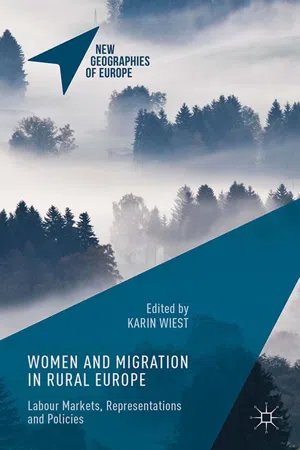
eBook - ePub
Women and Migration in Rural Europe
Labour Markets, Representations and Policies
- English
- ePUB (mobile friendly)
- Available on iOS & Android
eBook - ePub
About this book
Information
1
Introduction: Women and Migration in Rural Europe – Explanations and Implications
Karin Wiest
1 Gendered migration: an indicator for societal changes in rural Europe?
Globalisation, the advent of communication technologies and the transfer to service economies have fundamentally modified the relations that constitute rurality in contemporary Europe (Woods 2007). In conjunction, a simple categorisation of places as urban or rural does not adequately reflect social reality. Urbanisation characterised by the growth of the metropolitan population and the spread of urban lifestyles has often been related to the blurring of the dichotomy between city and countryside (Woods 2009, Zenner 2010). On the other hand social and economic disparities between urban and rural areas are rising. While capital city regions in Europe have had the fastest population growth over the last twenty years, the population development of rural Europe reveals huge discrepancies between growing and shrinking regions (ESPON and BBSR 2014). Since the outcomes of globalisation affect rural areas in many different ways, various social realities are discernible, ranging from: prosperous areas being able to attract people and capital to the countryside, focused on the tourism industry; to remote places characterised by unfavourable accessibility, or areas with persistent infrastructure problems, unable to tackle negative demographic and economic development. In the ‘globalised countryside’ gender and class relations are altering and shaping the new rural realities (Pini and Leach 2011). Migratory movements which strongly affect the development of, and the living conditions in, rural places are a key process in this context. In this respect it is not only the pure number of migrants which is worth considering, but also the question of who is migrating and for what purpose. Migration analysis reveals that mobility patterns are not only selective with regard to age and education, but also gendered, with young women leaving rural areas at higher rates than young men (Dahlström 1996, Bonifacio 2014, Corbett 2007).
1.1 Why women migrate – some explanations
Gender differences in migration behaviour have been traced back primarily to changes in the working world connected to the transition from agrarian and industrial to post-industrial labour market structures. Above others, the expanding service sector in urban centres has been considered a cause for the female move to cities. In contrast, young men are supposed to be better integrated into traditional rural labour market structures (Ní Laoire 2001, Bock 2004, Leibert 2015). Beyond regional differences in a gendered demand and supply of labour an increasing female educational orientation and labour participation have been discussed as drivers for women’s move from the countryside. Even though young men also take part in the European urbanisation process, studies have shown that women tend to move more willingly, and to migrate earlier in the life cycle. Related to this is the finding that young women in Europe are more inclined toward education, meaning that they tend to reach higher educational levels than young men and therefore often tackle modern ways of life better (Magnussen 1997, Ní Laoire and Fielding 2006, Bye 2009). In this context a growing cultural gap has been emphasised between modern, mobile young women and the rather more traditional young men (Dahlström 1996, Ní Laoire 2001). The functioning of rural communities and obsolete gender role models are regarded as significant push factors for young women in this context (Little and Panelli 2003, Little and Austin 1996). Usually, public life and local politics in rural societies are considered to appeal more strongly to traditional male networks and interests (Dahlström 1996, Grimsrud 2011, Walsh 2014). Societal expectations and values in rural communities, which are connected with the idea of subordinating a professional career to childcare responsibilities and which have a strong impact on female identities and lifestyles, have been stressed as important drivers for women to look for alternative lifestyles in an urban environment (Little 1997).
On the other hand, recent studies highlight that rural communities and social representations of rurality are changing. They show a shifting perception of the countryside related to the loss of productive land to increased housing and tourism development of the countryside. In particular, the growth of the middle classes with the influx of highly qualified and economically strong sub-groups is closely related to the emergence of new rural femininities and masculinities (Goverde et al. 2004, Baylina and Berg 2010, Forsberg and Stenbacka 2013). Forsberg and Stenbacka highlight in this context ‘that the traditional hegemonic rural femininity is challenged by a new, more publicly and economically active femininity – with a corresponding new masculinity – as the countryside is becoming increasingly residential and family oriented’ (2013: 2). In conjunction with the pluralisation of gender role models, the growing female labour force participation, and the transformation of rural functions, representations of the rural are becoming more diverse (Goverde et al. 2004). A re-feminisation of the countryside has been discussed, in particular with respect to family formation and the desire to realise a slower, less hectic lifestyle, close to nature. These imaginings of rural living are linked to the revival of the rural idyll, a representation of an undisturbed healthy environment and often associated with an escape from modernity. In turn, related representations of rurality refer to certain facets of traditional female role models (see section 2.2 in this chapter, Little and Austin 1996). However, the diversity of female biographies and lifestyles clearly reveals that women living in rural Europe assess and perceive rurality in many, seemingly contradictory and partly conflicting, ways (Wright and Annes 2014). This is to some extent reflected in the multitude of patterns of (im–)mobilities with sedentary women, women who maintain close ties with their native region or return with new lifestyles, together with their family, to rural places. Others completely turn their backs on the place they grew up in and become convinced urbanites (Leibert 2014). Taking this into account the following section identifies and describes gender differences in rural–urban migration patterns in a pan-European context as background information to the case studies presented in this volume.
1.2 Imbalanced sex ratio structures in Europe
In order to identify regional peculiarities in gendered migration behaviour, imbalances between male and female populations in a certain age group are an indirect but important indicator (Leibert 2015). Taking into account that migration directions change over the life course, the early 20s is a vital stage in life when young people tend to finish academic or vocational training and begin to enter the labour market. These key life events are often connected with migration decisions. Given that the number of women per 100 men in the 20–24 age group is determined by differences in male and female migration behaviour, the spatial pattern of unbalanced sex ratio structures illustrated in Map 1.1 points to the consequences of sex-selective migration in early adulthood. With a sex ratio below the European mean of 97 women per 100 men, young women tend to be slightly under-represented in rural areas all over Europe. Moreover, regions with a pronounced surplus of males in early adulthood tend to be rather peripheral, sparsely populated or structurally weak (ESPON and IfL 2012).1 This applies, for example, to northern and peripheral parts of the Nordic countries and for rural areas in East Germany. In these parts of Europe comparably high levels of school education and a pronounced professional orientation of women, in conjunction with modern gender roles, have fostered female migration (Wiest 2015). In contrast, women in their early 20s tend to outnumber young men in the urban core areas and their hinterland. This tendency is particularly visible in the capital regions, as in Estonia’s Harju county where the capital city of Tallinn is located, in the Stockholm region or the metropolitan area of Dublin (Map 1.1). This surplus of young women reflects, to some extent, the allocation of higher education facilities in university towns, as well as attractive employment opportunities for women and female preferences for modern ‘urban lifestyles’ (Bock 2004).
When considering the sex ratios in higher age groups, as in the early 30s, a ‘re-feminisation’ of the countryside has been reported, particularly in Western European rural regions (ESPON & IfL 2012). There is also evidence that the advantages and disadvantages of living in the countryside are perceived differently at different stages of the life course. Aspects like community cohesion, social control and tranquillity, which are often associated with living in rural communities, are supposed to be annoying for young adults in their early 20s but may gain attractiveness when starting a family (Leibert 2014).
Apart from those main patterns the unbalanced sex ratio structure does not really show a clear picture and pan-European explanations of this phenomenon are rather challenging. The difficulties of a general interpretation are related to many influencing factors on a national level, such as the labour market, gender policies and prevailing cultures and traditions. Gender regimes understood as ‘arenas of gender-differentiated participation, representation and power in social and political life’ (Morell and Bock 2008: 13) are important explanatory concepts in this context. Other explanations include the average age when young adults leave their parents’ home, which shows considerable differences between EU countries and has an impact on the distribution of young men and women. Leibert, for example, states that ‘the age of leaving home is low in the social–democratic and liberal welfare states (i.e. the Nordic countries and the UK) where the welfare regime is oriented towards the individual’ (2014: 31). In contrast, in the familialistic welfare states of Southern Europe, which are characterised by a lack of social policies and weak family policies, young people tend to leave the parental home later and the gender differences in migration behaviour remain elusive.

Map 1.1 Sex ratios in early adulthood in 2011: women per 100 men aged 20–24
Source: Leibert (2014); author’s own design.
Basically, gendered migration patterns have a stronger explanatory power at state level than from a European perspective since regional peculiarities of population development are often a result of economic disparities and urban–rural relations in a national context. Beyond that mapping unbalanced sex ratio structures as a result of selective migration clearly reveals that simple urban–rural dichotomies and the rough term ‘rural’ are much too simplistic when exploring rural living conditions and explaining the migration decisions of young people. To better understand the various coping and migration strategies of young men and women in a particular regional context it seems important to adopt a more in-depth and place-based perspective, which is also reflected in the individual case studies presented in this book. The following section presents an overview of European trends and recent debates on gender and rurality to set a frame for the diverse studies presented in this volume.
2 Approaching gender and rurality from different research perspectives
The literature review reveals that the topic ‘gender and rurality’ has received considerable attention in academic debates over the last decades (see for example Bryant and Pini 2011, Buller and Hoggart 2004, Goverde et al. 2004, Morell and Bock 2008, Pini and Leach 2011). In recent years a range of edited collections has been published analysing female and male life worlds in Western rural societies with an emphasis on different facets of rural gender issues, in particular of migration (e.g. Bock and Shortall 2006, Bonifacio 2014), power relations (Goverde et al. 2004) or gender identities and gender relations (e.g. Goverde et al., Bock and Shortall 2006). Against this backdrop this volume aims to shed light on the diversity of female living conditions and female migration decisions in the European countryside, with a particular focus on the question of how women deal with restrictive conditions in rural labour markets. Beyond that the gendered meanings of living in the countryside in post-modern societies and the significance of gender issues in the framework of regional development policies are discussed. According to which, discursive cultural and gendered constructions of the rural, as well as changing labour market conditions for women, are considered as key factors when trying to understand shifting female life worlds in a globalising rural Europe. In this context, gender represents changing social constructs of the roles and expectations of both women and men which influence how individual conceptions of life are developed in the rural settings examined. These social constructs also steer the ways in which migration decisions are made within male and female biographies. Since on the one hand functional and political explanations and on the other hand studies that focus on female life worlds as socially constructed are presented in this volume, the contributions cover very different theoretical perspectives in which recent studies about gender and rurality (e.g. Cloke 2006, Woods 2009) are conceptualised.
Functionalist approaches referring more strongly to material and practiced ruralities are presented throughout the book. These approaches explain how women live with the available options in certain rural settings, such as accessibility to workplaces, apprenticeship positions or supply of infrastructure and public services. The female labour market situation mirrors the social position of women in the respective rural context and sheds light on prevailing gender regimes is an important factor in this context. Beyond the actual living and labour market situations referring to structural characteristics and the dynamics of rural localities, societal imaginings about what rural lifestyles are considered to be and which social and cultural values women associate with rurality and rural life are an important key to understanding female migration decisions in different spatial contexts. The following section 2.1 is intended to provide an overview of the female labour market situation in rural Europe to raise consciousness of the huge differences in female employment in EU member states. Section 2.2 deals with gendered representations from a social constructivist perspective to shed light on female perceptions of rurality and to tackle how relevant discourses and local gender identities might influence female living conditions in rural Europe. Section 2.3 considers the significance of female migration and living situations in rural areas from the perspective of gender equality and regional development policies.
2.1 Gendered labour markets in rural Europe
Rural labour markets are usually considered as placing women at a disadvantage relative to men, often by marginalising women as dependent producers, unpaid family workers or holders of low paid and insecure jobs (Bock 2004, Morell and Bock 2011). Existing jobs, often primarily found in the primary and secondary sectors, for example manufacturing trade and agriculture, and are generally seen as ‘male’ fields of employment (Bye 2009). Apart from a shortage of adequate and qualified jobs, especially for highly qualified women, unfavourable conditions – like long commuting distances, poor accessibility or deficient infrastructures – often restrict female employment possibilities in rural areas, especially since the question of how to reconcile job and family is usually still considered a woman’s issue (e.g. Noack 2011, Glöckner et al. 2014). Due to these gendered obligations it has been concluded that women’s employment problems increase with an area’s remoteness (Bock 2004: 33). However, societal restrictions on women’s involvement in paid work, including the negotiation of gender roles as part of a household strategy and the local community’s social order, are supposed to constrain female employment opportunities more than structural obstacles, such as a la...
Table of contents
- Cover
- Title
- 1 Introduction: Women and Migration in Rural Europe Explanations and Implications
- Part I Gendered Representations and Perceptions of the Rural
- Part II Rural Labour Markets for Women Restrictions and Opportunities
- Part III Womens Living Situations in Rural Areas and Gender-Related Policies
- Index
Trusted by 375,005 students
Access to over 1.5 million titles for a fair monthly price.
Study more efficiently using our study tools.
Frequently asked questions
Yes, you can cancel anytime from the Subscription tab in your account settings on the Perlego website. Your subscription will stay active until the end of your current billing period. Learn how to cancel your subscription
No, books cannot be downloaded as external files, such as PDFs, for use outside of Perlego. However, you can download books within the Perlego app for offline reading on mobile or tablet. Learn how to download books offline
Perlego offers two plans: Essential and Complete
- Essential is ideal for learners and professionals who enjoy exploring a wide range of subjects. Access the Essential Library with 800,000+ trusted titles and best-sellers across business, personal growth, and the humanities. Includes unlimited reading time and Standard Read Aloud voice.
- Complete: Perfect for advanced learners and researchers needing full, unrestricted access. Unlock 1.5M+ books across hundreds of subjects, including academic and specialized titles. The Complete Plan also includes advanced features like Premium Read Aloud and Research Assistant.
We are an online textbook subscription service, where you can get access to an entire online library for less than the price of a single book per month. With over 1.5 million books across 990+ topics, we’ve got you covered! Learn about our mission
Look out for the read-aloud symbol on your next book to see if you can listen to it. The read-aloud tool reads text aloud for you, highlighting the text as it is being read. You can pause it, speed it up and slow it down. Learn more about Read Aloud
Yes! You can use the Perlego app on both iOS and Android devices to read anytime, anywhere — even offline. Perfect for commutes or when you’re on the go.
Please note we cannot support devices running on iOS 13 and Android 7 or earlier. Learn more about using the app
Please note we cannot support devices running on iOS 13 and Android 7 or earlier. Learn more about using the app
Yes, you can access Women and Migration in Rural Europe by Karin Wiest in PDF and/or ePUB format, as well as other popular books in Social Sciences & Politics. We have over 1.5 million books available in our catalogue for you to explore.