eBook - ePub
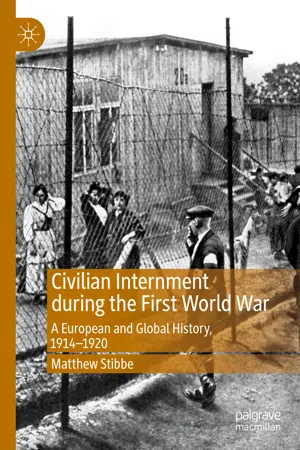
Civilian Internment during the First World War
A European and Global History, 1914—1920
- English
- ePUB (mobile friendly)
- Available on iOS & Android
eBook - ePub
Civilian Internment during the First World War
A European and Global History, 1914—1920
About this book
This book is the first major study of civilian internment during the First World War as both a European and global phenomenon. Based on research spanning twenty-eight archives in seven countries, this study explores the connections and continuities, as well as ruptures, between different internment systems at the local, national, regional and imperial levels. Arguing that the years 1914-20 mark the essential turning point in the transnational and international history of the detention camp, this book demonstrates that wartime civilian captivity was inextricably bound up with questions of power, world order and inequalities based on class, race and gender. It also contends that engagement with internees led to new forms of international activism and generated new types of transnational knowledge in the spheres of medicine, law, citizenship and neutrality. Finally, an epilogue explains how and why First World War internment is crucial to understanding the world we live in today.
Information
© The Author(s) 2019
M. StibbeCivilian Internment during the First World Warhttps://doi.org/10.1057/978-1-137-57191-5_11. Introduction
Matthew Stibbe1
(1)
Department of Humanities, Sheffield Hallam University, Sheffield, UK
Between 1914 and 1920 at least 800,000 civilians were held as prisoners of war in internment camps in Europe, and some 50,000–100,000 in the rest of the world.1 Most were men of military age, detained on enemy soil at the outbreak of war to prevent them returning home to join their respective armies. However, the victims could include women, children and older men and deportees from occupied territories as well as enemy aliens arrested on the home fronts. Some belligerent states also interned their own nationals as ‘internal enemies’ under wartime emergency powers. Conditions and length of time spent in camps varied enormously. Some civilians were detained for the full duration of the conflict and beyond, whereas others spent only a matter of weeks or months in captivity, or were released early, under local amnesties or international exchange agreements. Others still were transferred into the half-way house of captivity in neutral countries such as Switzerland and the Netherlands, or were notionally released after ‘voluntarily’ agreeing to work for the captor state as ‘free’ labourers. Some experienced internment in one place of detention only, while others could find themselves being moved not only between camps, but across international borders, empires, continents and oceans. In the case of the British empire, as Panikos Panayi and Stefan Manz have recently shown, it is even possible to identify different internment ‘hubs’ or ‘hotspots’, including in Canada, the Mediterranean, southern Africa, India, Australasia and Great Britain itself.2 For France, the equivalent ‘hubs’ were in Tahiti, Indo-China, Madagascar, Dahomey, Morocco, Tunisia and Algeria, Corsica and along parts of the French Atlantic and Mediterranean coasts.3
The diversity of internees’ experiences is a matter of established historical record. It has been further brought to light through an impressive body of academic scholarship on the First World War camp phenomenon that began in the 1990s and has recently been showcased at a major international workshop held at the German Historical Institute London.4 Some civilian prisoners of war were well supported by their home governments and families; others were not. Some camps had a high turnover of prisoners; others had a relatively stable population. Some were located in highly visible places, including in big cities, or close to important communications networks, such as major railway lines; others were established in remote areas, away from the public gaze. Islands, whether populated or not, were often favoured places for camps—as seen in the case of the Isle of Man (British Isles); Corsica (France); Sardinia (Italy); Fort Verdala (Malta); Terceira in the Azores (Portugal); Skyros (Greece); Stonecutters Island (Hong Kong); St John’s Island (Singapore); Tahiti (French Polynesia); Motuihe Island and Somes Island (New Zealand); Rottnest Island and Torrens Island (Australia); Taboga Island (Panama); and Ellis Island (New York). In the worst-case scenarios, internees might be held temporarily on abandoned prison ships or hulks, a practice going back to the early nineteenth century and briefly revived in Britain and Germany in the early months of the war.5
This book is indebted to much of the previous literature on this subject, but at the same time, it claims to break important new ground in the sense that it is the first scholarly attempt to write a European and global history of First World War internment. It combines the (slightly) more familiar cases of Imperial Britain, Imperial Germany and the United States with hitherto virtually unknown instances of civilian captivity in other parts of Europe and the wider world, including, most notably, the French, Austro-Hungarian, Ottoman and Portuguese empires as well as the Balkan nations, Bolshevik Russia, Brazil, parts of Central America, Siam and, in 1919, nationalist China. It also offers the first in-depth analysis of international activism in relation to internment, in other words of programmes designed to raise knowledge and awareness of the effects of civilian internment on individuals and families, to mitigate these effects through concerted action across political borders and/or to outlaw prison camps for non-combatants altogether. And, again for the first time, it incorporates a medical history dimension into its analysis of how contemporaries constructed and imagined internment in political and broader cultural terms.
Its starting point is a dissatisfaction with existing work on the internment phenomenon. In spite of its many valuable contributions and achievements, the current scholarship tends to see (belligerent) nation-states and empires as the only possible actors in the staging of wartime civilian captivity, thereby excluding other potentially important domestic and international players, including lower-level officials with their own local political agendas, neutral governments and diplomats, Red Cross workers, anti-internment activists and legal or medical experts. Another noticeable historiographical trend has been a pre-occupation with the internal life of the internees and the formation of ‘prison camp communities’ behind the barbed wire, following the model set by former internee John Davidson Ketchum’s 1965 socio-psychological study of the British camp at Ruhleben near Berlin.6 Interpretations of internment as a form of militarist oppression and/or state-sponsored violence against alien minorities and occupied populations in wartime are often at the heart of this type of academic investigation, as too is an understandable quest to give a voice to internees themselves.7 It relies quite heavily on the fact that for some internment camps, particularly those on the Western European, North American, Japanese and Australasian home fronts, a considerable amount of historical material in the form of ego-documents (memoirs, diaries, camp newspapers, works of art and so on) has survived.8 This has allowed us to see camps as ‘liminal spaces’ in which ‘time stood still’ and new forms of sociability, creativity, self-expression, resistance, (‘respectable’) home-making and (‘transgressive’) public performance became possible.9
Yet although it has produced some very rich findings, including in the field of memory and cultural heritage, this historiography can also fall into the trap of seeking to explain the internment phenomenon by reference to internal forces only, while ignoring the views of external decision-makers, actors and observers. In particular it is in danger of overlooking the connections—imagined and real—between the physical borders of the camp or Lager and the broader socio-economic, political, geographical, gendered and racial boundaries and hierarchies that all those caught up in the war—whether as rulers or ruled, combatants and non-combatants—encountered. Future US President Herbert Hoover, for instance, was not alone in referring to northern France and Belgium as ‘in every respect…like a vast concentration camp’.10 Internees often felt like bargaining counters in diplomatic negotiations, or as the ‘main victims’ of wartime food shortages, arbitrary police interference in private life and official indifference to suffering, but so too did populations in blockaded, occupied or colonised countries. Aerial bombing, another novel form of warfare, left nobody—not even children—feeling safe in their own houses, schools or workplaces.11
More particularly, a central thesis of this book, and a key part of its claim to originality and significance, is that we have to re-imagine First World War internment as a story about population movement as well as borders, and about the relationship between the two. Internment in the years 1914–20 was a migration-led process, even though, paradoxically, it also stemmed in a more immediate sense from wartime ‘state-of-siege’ mentalities and an inward-looking desire to draw down the hatches. In this sense, it was inextricably bound up with questions of power, and with global forms of racism and gendered violence as well as local and national manifestations of intolerance. Above all it was a political phenomenon involving the involuntary relocation of ‘suspect’ or ‘alien’ populations.12 At the same time, it had certain parallels with the recruitment of hundreds of thousands of civilian workers from Asia to work behind the lines on the western front, and equally with the new wave of ‘military migration’ as 1.2 million Indians were recruited into the British army and 607,256 non-Europeans, mainly Africans, into the French armies.13 All of these processes hinged around what by 1914 had become important transnational and international questions of the rights, obligations and boundaries of citizenship; the legal status of foreigners and non-citizens; state surveillance of ‘suspect’ groups and individuals; the formation of new subjectivities and fresh ways of ‘belonging’ or ‘not belonging’ and the desirability or otherwise of stricter forms of passport and migration controls within a newly emerging, twentieth-century world order.14
None of this means that this book regards consideration of national or imperial frameworks to be obsolete. Often they were crucial in shaping the time, manner and place in which internment measures were enacted and staged, and in co-creating the transnational and international networks that sustained the camp phenomenon at global level.15 The central place of nation-states and empires in the international system as it then existed is also indispensable in explaining the many overlapping convergences and divergences between different internment practices across Europe and the wider world. What it does mean, however, is that the national and the imperial have to be seen in a global context, and their entanglement with, and relative importance vis-a-vis other spatial levels—the regional, the local, the transnational and the international—placed under greater scrutiny. In terms of methodology, this book also takes up Heinz-Gerhard Haupt’s and Jürgen Kocka’s call for new academic approaches that ‘better combine comparative and entanglement history’ in order to create joined-up global histories (or what Caroline Douki and Philippe Minard refer to as histoires conn...
Table of contents
- Cover
- Front Matter
- 1. Introduction
- 2. First World War Internment Across the Globe
- 3. Internment and War Governance in the First World War
- 4. Imagining Internment: International Law, Social Order and National Community
- 5. Internment and International Activism: The Search for More Humane Alternatives
- 6. (Not) Ending Internment: The Years 1918–20
- 7. Conclusion and Epilogue
- Back Matter
Trusted by 375,005 students
Access to over 1.5 million titles for a fair monthly price.
Study more efficiently using our study tools.
Frequently asked questions
Yes, you can cancel anytime from the Subscription tab in your account settings on the Perlego website. Your subscription will stay active until the end of your current billing period. Learn how to cancel your subscription
No, books cannot be downloaded as external files, such as PDFs, for use outside of Perlego. However, you can download books within the Perlego app for offline reading on mobile or tablet. Learn how to download books offline
Perlego offers two plans: Essential and Complete
- Essential is ideal for learners and professionals who enjoy exploring a wide range of subjects. Access the Essential Library with 800,000+ trusted titles and best-sellers across business, personal growth, and the humanities. Includes unlimited reading time and Standard Read Aloud voice.
- Complete: Perfect for advanced learners and researchers needing full, unrestricted access. Unlock 1.5M+ books across hundreds of subjects, including academic and specialized titles. The Complete Plan also includes advanced features like Premium Read Aloud and Research Assistant.
We are an online textbook subscription service, where you can get access to an entire online library for less than the price of a single book per month. With over 1.5 million books across 990+ topics, we’ve got you covered! Learn about our mission
Look out for the read-aloud symbol on your next book to see if you can listen to it. The read-aloud tool reads text aloud for you, highlighting the text as it is being read. You can pause it, speed it up and slow it down. Learn more about Read Aloud
Yes! You can use the Perlego app on both iOS and Android devices to read anytime, anywhere — even offline. Perfect for commutes or when you’re on the go.
Please note we cannot support devices running on iOS 13 and Android 7 or earlier. Learn more about using the app
Please note we cannot support devices running on iOS 13 and Android 7 or earlier. Learn more about using the app
Yes, you can access Civilian Internment during the First World War by Matthew Stibbe in PDF and/or ePUB format, as well as other popular books in History & European History. We have over 1.5 million books available in our catalogue for you to explore.