- English
- ePUB (mobile friendly)
- Available on iOS & Android
eBook - ePub
About this book
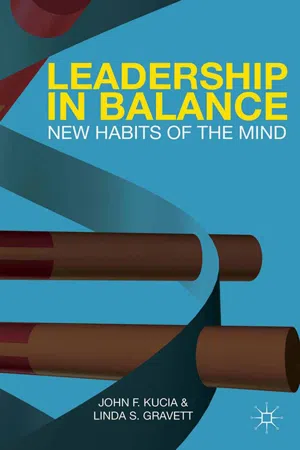
Leadership in Balance provides readers with a deeper understanding of the art, practice, and discipline of purpose-driven collaboration, and teaches them how new leadership habits of the mind will positively impact an organization's learning, growth, and change.
Information
Part I
Building the Fundamentals
Chapter 1
Leader as Brand
“Brands must deliver solutions not just benefits. They must be more than trademarks; they must be trustmarks.” These thoughts about the power of branding were expressed by A. G. Lafley, chairman and chief executive officer of Procter & Gamble (P&G), to Michael J. Graham, S. J., president of Xavier University, and a room full of Xavier vice presidents, deans, and directors during a strategy-planning session the Xavier leadership was conducting. Lafley knew that the message he was about to deliver concerning the power of a brand and the importance of trust must be heard and embraced deep into an organization. Lafley freely shared his expertise and the renowned marketing knowledge of P&G as the first of important emerging themes began to surface. He keyed in on certain realities about branding: it impacts the way others think about us; it provides an empowering way to align actions, behaviors, and choices; and inspirationally, it reflects who we are today and who we want to be in the future. Branding brings to life our unique combination of attributes for the people who find them important and compelling.
By the end of the day, the group of Xavier leaders had gained a new way of understanding the meaning and expectations created by a brand. It became clear that a brand is more than a stamp on the surface of an organization or its products or services. In short, a brand is a promise. It is essential that the brand promise is clearly understood by the people inside the organization because a brand is built from the inside out.
A few weeks later, President Graham was intrigued to receive a handwritten letter from Lafley in which he shared some observations linking strategy to execution. To Graham’s surprise, Lafley wrote that both of them are “brands” of their respective institutions. Although Lafley and Graham head very different businesses, the challenge for leading change in their respective institutions is very much alike. Both Lafley and Graham share a way of seeing—understanding their organizations as living entities—communities of talented people, rather than machines to make money; both institutions depend heavily on knowledge workers to accomplish their purpose; both are challenged to lead with a vision that will grow the business through the work of an organization of talented people with the ability to learn and build community. Both must fully engage the commitment, talents, creativity, and leadership capabilities of the organization in order to accomplish the purpose of an institution so it will continue to serve society far into the future.
The suggestion that a leader is a brand was too provocative for Graham to let go without more dialogue. Lafley and Graham asked Kucia to set up a lunch meeting with them where they could discuss the topics of brand and trust. Graham wanted to explore more about the assertion that the leader is a brand, that is, the person who embodies the institutional brand promise. Lafley wanted to consider with Graham a corollary challenge—low public trust in institutions and their leaders today. The meeting was scheduled and Kucia was present to listen and learn.
Since Graham wanted to learn, he listened as Lafley, a master leader who teaches, began to share his thoughts on a subject he knows well. Lafley began, “Like it or not, we are public figures and you and I don’t have any choice in that matter. Everybody that has any kind of interest in the university, in your case, or in the corporation, in mine—those stakeholders cannot separate us from the brand. It will be impossible for you. Even if you tell them you want to separate the two—they won’t be able to separate the two.” Graham expressed to Lafley that raising his awareness to this fundamental reality opened him to a new way of thinking about his role as a leader.
Lafley went on to explain his thinking to Graham about brand by sharing the story of the basic strategy he employed as he began his responsibilities in 2000 during a difficult time for the company. “I mean to make it real simple. I worked with customers who are our retail customers; I worked with analysts and investors; and I worked with employees. The primary objective with employees was hope and confidence. With the investors, it was trust. With retail customers it was, ‘we want to be your best supplier, offering the best brands, the best innovations, the best service, the best everything.’” Lafley described how he traveled around the world and saw every one of them face-to-face, one-on-one, with no entourage. “I wasn’t selling anything; I was listening, and I let them take their shots.” He was demonstrating to his stakeholders that they were important; that he was accessible and wanted to hear from them firsthand. That is when it became clear to Lafley that he was becoming the brand—“the promise of something to someone.” Lafley then explained how he was trying to elevate all the other “carriers or owners of the brand.” Now when he talks to employees, he tells them, “Like it or not, we are the brand.”
Lafley and Graham agreed that there are lots of risks, but that’s the way it is. “It is just their [the stakeholder’s] expectation; it’s not anything that you choose.” Graham observed that he is the current face of the university as he explained, “Although the person’s relationship is really with the university, you embody that in a way that is surprising.” Continuing to explore the challenge of addressing stakeholder expectations, Graham admitted to Lafley, “I know the promise that we make to our students. What I don’t understand is the kind of promise that the university makes externally in some unspoken way.” Graham was referring to various groups of people, stakeholders who believe the university should be making some kind of promise. He is held accountable for whatever the promise might be, whether it’s the church’s actions or inactions, the university and its position within the constellation of institutions of higher education in the area, or the university’s relationships with local neighborhoods. “What are those promises—the images or ideas in folks’ heads that are somehow focused on you? You’re never quite sure what the performance standards are, except that you’re not meeting them—like your stockholders.” Hence, in the minds of stakeholders, Graham is held responsible for fulfilling promises and meeting expectations, known and unknown.
In response to Graham, Lafley shared what he has learned. “If you don’t clarify the promise, or be clear that there isn’t a promise, they [stakeholders] are assuming that there is one.” The reality he discovered is that all stakeholders are assuming you are going to deliver something to them and for them. Lafley continued, “Unless you’re clear about what the relationship is going to be, whether there is going to be a promise and what the promise is going to be, you’re left in this situation where you don’t know what they’ve assumed at best and, at worst, they’re really disappointed in you and your institution because you’re not delivering, and half the time you don’t even know against what; for what?” That was the part Lafley said was “mind boggling.”
Lafley explained how he tries to be “very transparent about what the purpose is, what the goals are, and what the strategies are, so everybody understands that if we accomplish them, everybody will benefit. So it’s sort of, all for one, one for all.” Lafley’s strategy is to stay with one very short, relatively simple agenda that he repeats over and over again. The first few times his listeners say, “Okay, I hear you.” A few more repetitions later they say, “I think I understand you.” A few more yet and they say, “Maybe I’ll trust you; maybe I won’t.” Finally, they say, “Okay, we’ve got a deal.” With this, Lafley emphasizes the intentional process he employs to gain trust and buy-in to purpose, goals, and strategies, and the stages a stakeholder must move through—I hear, I understand, I trust—before a stakeholder’s commitment is secured.
Lafley and Graham agreed that this current time “is the most collaborative they have ever seen their organization.” This observation reflects a significant leadership and cultural change that both organizations have experienced over the years, recalling a time when “the bully boys were in power at P&G” and the president ran Xavier “like a south-side Chicago monsignor ran his parish,” observations made by longtime insiders from P&G and Xavier.
But Lafley and Graham realize they have tough acts to follow, both from the success of their predecessors and their own successful track records since assuming their leadership positions. They realize that growing the business may not only mean getting larger and increasing revenues, but it also means changing the way they work and evolving the business as influenced by the market realities of globalization. Ultimately, they think about their legacy: “How do I leave the company because of the choices I have made?”
As the conversation continued, Lafley turned their attention to the importance of organizational capabilities and competencies—as if they were “stones or bricks in the wall,” the solid foundation for an organization. The answer for “how to win is all about capabilities and competencies.” P&G leadership has identified the skills and capabilities they must have as an organization to be the best in the world at what they do. Lafley explained, “We make somebody who’s at the top of the organization responsible for developing the capabilities and then we try to measure. We try to measure how we’re doing. How good is our capability, really, versus the best that’s out there?” Lafley and Graham began to explore the questions, “What is the combination of capabilities that is Xavier and P&G, but not just isolated capabilities? They have to connect, network with each other . . . all stitched together.” Lafley continued to develop the meaning of connecting and began to integrate the concepts of this conversation to stitch them together. “I really think the difference in our world is brands, people, our capabilities and systems, and our culture because our culture comes out of what you do; it comes out of how you do what you do. Your culture is the character of the company. I don’t think the purpose, the character, the values, the principles ever change; they are sort of no compromise. Everything else changes because you need and we need different capabilities in 2008 than we did in 1977.”
Graham acknowledged, “What we’ve got to do is get much better at taking joint collective responsibility for the enterprise, but universities are highly-balkanized kinds of realities.” To this assertion, Lafley responded, “If you choose to create horizontal capabilities and strengths, you involve the entire community and organization, and then you encourage mutual collaboration, because the truth of the matter is you can’t achieve the competency or capability unless you get some level of collaboration.” That requires a very high level of integration that is more difficult to run because it’s not as clear. Who is the boss; who is in charge; who is responsible for the outcome? Lafley’s responded, “The answer is it depends on what we’re doing. The boss might be the boss in one situation; but might be support in another situation; might not even be involved in a third situation.” Both Graham and Lafley agreed that this could be accomplished in a university and a company with bright people who are well educated and who have “reasonable EQs to go with their IQs. If you can collaborate, it’s a big advantage because most organizations have difficulty doing it.” Lafley added, “The other advantage of this sort of integration is that it reinforces organizational culture and enables you to use your culture to drive collaboration. You can use it to drive capabilities that stretch across functions. So it sort of all fits.” When this kind of collaborative culture permeates the entire organization and is ...
Table of contents
- Cover
- Title
- Part I Building the Fundamentals
- Part II What Does It All Mean—Taking It to the Next Level
- Appendix 1 Self-Assessment: A Leader in Balance—The Eight Ways of Thinking
- Appendix 2 Self-Assessment: A Leader in Balance—Short Form
- Appendix 3 ANOVA Results
- Notes
- Index
- About the Authors
Trusted by 375,005 students
Access to over 1.5 million titles for a fair monthly price.
Study more efficiently using our study tools.
Frequently asked questions
Yes, you can cancel anytime from the Subscription tab in your account settings on the Perlego website. Your subscription will stay active until the end of your current billing period. Learn how to cancel your subscription
No, books cannot be downloaded as external files, such as PDFs, for use outside of Perlego. However, you can download books within the Perlego app for offline reading on mobile or tablet. Learn how to download books offline
Perlego offers two plans: Essential and Complete
- Essential is ideal for learners and professionals who enjoy exploring a wide range of subjects. Access the Essential Library with 800,000+ trusted titles and best-sellers across business, personal growth, and the humanities. Includes unlimited reading time and Standard Read Aloud voice.
- Complete: Perfect for advanced learners and researchers needing full, unrestricted access. Unlock 1.5M+ books across hundreds of subjects, including academic and specialized titles. The Complete Plan also includes advanced features like Premium Read Aloud and Research Assistant.
We are an online textbook subscription service, where you can get access to an entire online library for less than the price of a single book per month. With over 1.5 million books across 990+ topics, we’ve got you covered! Learn about our mission
Look out for the read-aloud symbol on your next book to see if you can listen to it. The read-aloud tool reads text aloud for you, highlighting the text as it is being read. You can pause it, speed it up and slow it down. Learn more about Read Aloud
Yes! You can use the Perlego app on both iOS and Android devices to read anytime, anywhere — even offline. Perfect for commutes or when you’re on the go.
Please note we cannot support devices running on iOS 13 and Android 7 or earlier. Learn more about using the app
Please note we cannot support devices running on iOS 13 and Android 7 or earlier. Learn more about using the app
Yes, you can access Leadership in Balance by J. Kucia,L. Gravett in PDF and/or ePUB format, as well as other popular books in Business & Business Strategy. We have over 1.5 million books available in our catalogue for you to explore.