eBook - ePub
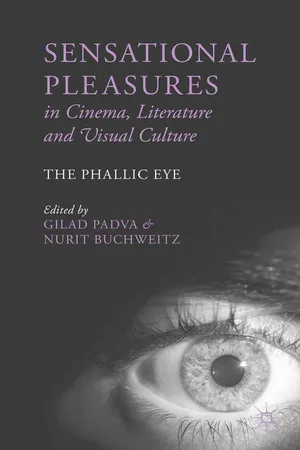
Sensational Pleasures in Cinema, Literature and Visual Culture
The Phallic Eye
- English
- ePUB (mobile friendly)
- Available on iOS & Android
eBook - ePub
Sensational Pleasures in Cinema, Literature and Visual Culture
The Phallic Eye
About this book
This international collection focuses on the phallic character of classic and contemporary literary and visual cultures and their invasive nature. It focuses on thrillers, horror cinema, sexual art and photography, erotic literature, female and male body politics, queer pleasures, gender/cross-gender/transgenderism, CCTV and phallic ethnicities.
Information
Subtopic
Film & VideoPart I
Forbidden Spectatorship and Visceral Imageries
1
The Unpardoned Gaze: Forbidden Erotic Vision in Greek Mythology
A long time ago, in a time when ancient gods roamed the earth, there lived a young Greek man named Actaeon from the city of Thebes. He was a handsome, talented and skilled hunter. One day, after a successful hunt in the forest, he came by accident upon a small river pond near a cave where to his great amazement he saw the goddess Artemis (Latin Diana) bathing with her company of nymphs in the cool waters. Artemis, a virgin goddess, patron of wild animals and small children, mistress of hunting and a major deity connected with initiation rites, noticed his forbidden gaze. First she blushed in embarrassment “as clouds bright-tinted by the slanting sun, or purple-dyed Aurora, so appeared Diana’s countenance when she was seen,”1 then she executed a punishment: she turned Actaeon into a stag and set his pack of fifty dogs to hunt and devour him.2
The Hellenistic poet Callimachus (310/305–240 BCE) who worked in the library of Alexandria is the first poet to mention this version of the myth.3 In other, earlier, versions Actaeon is killed for different reasons; in some he raped Semele, the lover of Zeus and mother of Dionysus,4 in others he boasted that he was a better hunter than the goddess Artemis, or attempted to marry Artemis in her own sanctuary.5 Greek mythology has much overlapping, corresponding and sometimes contradicting versions to myths, which reflect both different aspects of Ancient Greek society and methodological questions of dating and transmitting knowledge. In the context of our investigation we can set aside other variants of Actaeon’s myth and concentrate on the story of the disastrous glance at the naked goddess.
The story of Artemis and Actaeon, like many Greek myths, embodies references to social structures and religious practices. Artemis, the twin sister of Apollo, was the goddess of hunting and deeply connected to the initiation rituals of girls. She was one of the three goddesses, along with Athena goddess of wisdom and warfare and Hestia goddess of the hearth, who took an oath to preserve their virginity. Artemis’s virginity was unique, for unlike the highly rationalized asexual virginity of Athena or the symbolic one of Hestia, which reflected the invariability of her cult, Artemis’s celibacy was highly sexualized and erotic, just like that of a Greek maiden of a marriageable age.6 In her myths Artemis is usually accompanied by an entourage of nymphs, corresponding to her cult, which includes ceremonies of young girls, virgins, performing ritual dances in honour of the goddess.7 One can therefore interpret the myth of Actaeon as an emphasis on Artemis’s virginity, which must be cherished and guarded at all costs, just like the virginity of a young maiden before her marriage.
Another interpretation of the myth focuses on the rituals accompanying the hunt in pre-historic societies. This is based on a thesis first introduced by Walter Burkert, one of the most influential historians of Greek religion, in his book Homo Necans. Burkert contends that hunting, as a means of obtaining food, was a dominant influence on human evolution and cultural development (as opposed to gathering or scavenging). The guilt incurred in the violence of the hunt was transformed into what can be called “sacred crimes,” which through rituals of cleansing and expiation served to unite the community. Burkert (1983: 112–113) interprets the myth of Actaeon in this light and concludes: “Actaeon’s death is a sacrificial ritual of the hunt, consecrated by the mistress of the beasts (Artemis) and performed in the form that had been standard since Paleolithic timed.”
The myth of Actaeon reveals more than just social and religious practices; it also illuminates cultural notions of visual pleasure through the voyeurism that lies at its core. Poor Actaeon’s hunting excursion ends with his forbidden gaze at the goddess’s nudity, a gaze that reverses and distorts the hunt: the hunter is metamorphosed into the prey, the victimizer into the victim. The severe punishment is a result of the Greek perception of the divine. Greek mythology presents a complex and vivid picture of the relations between humans and their gods. The gods take human form (anthropomorphism), they are subjected to emotions such as love, jealousy and revenge and they constantly interfere in human affairs. There is nonetheless a clear and unambiguous line that separates gods from humans. First and most important is the fact that humans are mortal while gods are immortal; almost every aspect of the god-human relationship is shaped by this basic notion (Vernant, 1991: 27–49). The various myths telling the story of Prometheus, the Titan who stole fire from Mount Olympus and gave it to humanity, are a paradigmatic example of myths dealing with the separation between gods and mortals and the social and ritual aspects they transmit.8 Actaeon’s transformation into a stag and his death by being torn apart by his own dogs is a punishment for gazing at what must not be seen; for an unpermitted gaze at a goddess transgresses the boundary between gods and mortals.
Actaeon’s gaze can therefore be seen as a means of rebellion and supreme pride (the Greek hubris); he had challenged the cosmic order through the power of the eye.9 The gaze laid upon the goddess, though accidental, was by no means innocent for, as we shall see, the erotic gaze has a unique dominating power: it possesses and subordinates the subject. Under no condition would a powerful and vengeful goddess such as Artemis consent to this kind of erotic possessiveness. The problem with Actaeon’s gaze was not only its erotic nature, but the undermining of the authoritarian order manifested in a human gaze upon a deity. Accordingly, the punishment diminishes Actaeon’s authoritarian status. If his direct gaze at a nude deity can be seen as an attempt to enhance his status (from man to god), then the punishment of his metamorphosis into a stag embodies a reduction in status and abilities (from man to animal). Actaeon being hunted by his own dogs, which had been his absolute subjects only a few moments before the events took their tragic turn, symbolizes the downfall of the hero.
The notion of voyeurism as an undermining act against authority, and its resulting punishment, has a wide and varied presence in both ancient and modern literature. The forbidden erotic gaze has many variants in the Greek literary corpus, both mythical and other. A fascinating example is found in The Histories, written in the 5th century BCE by Herodotus. The Histories recounts the story of the war between Persia and the Greek world (499–449 BCE) and is considered to be the first historical composition. Herodotus tells us a quaint story regarding the throne of Lydia, an ancient kingdom in Asia Minor. The tale includes forbidden voyeurism, an undermining of majestic authority and an unexpected punishment. It begins with King Candaules of Lydia:
This Candaules, then, fell in love with his own wife, so much so that he believed her to be by far the most beautiful woman in the world; and believing this, he praised her beauty beyond measure to Gyges … who was his favourite among his bodyguard; for it was to Gyges that he entrusted all his most important secrets. After a little while, Candaules, doomed to misfortune, spoke to Gyges thus: “Gyges, I do not think that you believe what I say about the beauty of my wife; men trust their ears less than their eyes: so you must see her naked.” Gyges protested loudly at this. “Master,” he said, “what an unsound suggestion, that I should see my mistress naked! When a woman’s clothes come off, she dispenses with her modesty, too. Men have long ago made wise rules from which one ought to learn; one of these is that one should mind one’s own business. As for me, I believe that your queen is the most beautiful of all women, and I ask you not to ask of me what is lawless.” Candaules’ answer: “Courage, Gyges! Do not be afraid of me, that I say this to test you, or of my wife, that you will have any harm from her. I will arrange it so that she shall never know that you have seen her. I will bring you into the chamber where she and I lie and conceal you behind the open door; and after I have entered, my wife too will come to bed. There is a chair standing near the entrance of the room: on this she will lay each article of her clothing as she takes it off, and you will be able to look upon her at your leisure. Then, when she moves from the chair to the bed, turning her back on you, be careful she does not see you going out through the doorway.” As Gyges could not escape, he consented. Candaules, when he judged it to be time for bed, brought Gyges into the chamber; his wife followed presently, and when she had come in and was laying aside her garments, Gyges saw her; when she turned her back upon him to go to bed, he slipped from the room. The woman glimpsed him as he went out, and perceived what her husband had done. But though shamed, she did not cry out or let it be seen that she had perceived anything, for she meant to punish Candaules … As soon as it was day she called Gyges … When Gyges came, the lady addressed him thus: “Now, Gyges, you have two ways before you; decide which you will follow. You must either kill Candaules and take me and the throne of Lydia for your own, or be killed yourself now without more ado; that will prevent you seeing what you should not see. One of you must die: either he, the contriver of this plot, or you, who have outraged all custom by looking on me uncovered.” Gyges stood awhile astonished at this …But when he saw that dire necessity was truly upon him either to kill his master or himself be killed by others, he chose his own life … Thus he made himself master of the king’s wife and sovereignty.10
Herodotus demonstrates how the erotic-voyeuristic gaze is closely connected to questions of authority and power.11 Once Gyges had seen the naked queen he had only two options: to be killed for crossing the line between servant and master; or to realize the authority inherent in his gaze by becoming himself the master (killing the king and taking over both realm and queen). The conflict presented by Herodotus, like that found in the myth of Actaeon, is more about domination and power than about chastity and moral behaviour.
The same is true for more modern literary examples. Tess, in Thomas Hardy’s Tess of the d’Urbervilles, was raped by her master’s son Alec and paid a grave price for her futile attempt to be accepted among the aristocracy. Maslova, in Leo Tolstoy’s Resurrection, was forced into a brief affair with her master Dmitri Ivanovich Nekhlyudov. The affair resulted in her being fired, becoming a prostitute, framed for murder, convicted by mistake and sent to Siberia.12 Just as in the Greek myths, it does not make a difference that the sexual act was unwanted by the victim. In all these cases the erotic interaction between superior and inferior is perceived as an undermining of a traditional set of hierarchies and dominating structures.
Another example can be found in the myth of the blinding of Teiresias.13 The story takes place on a hot summer afternoon, when all is silent and still in the burning heat on Mount Helicon (on the modern island of Evia). Athena, goddess of wisdom and warfare, and her beloved nymph, Chariclo, have found relief from the heat in a cool fountain. They disrobe and bathe in the water. Only one man is walking on the mountain at that hour – Teiresias, the young son of Chariclo. He accidentally arrives at that very place and sees that which is not to be seen. The forbidden human gaze upon the divine nudity resolves in a cruel punishment: Athena takes away the boy’s sight and the dazzling afternoon becomes forever darkened. Athena, however, also pities the boy and gives him the gift of prophecy:
For I will make him a seer to be sung of men hereafter, yea, more excellent than any other. He shall know the birds – which is of good omen among all the countless birds that fly and what birds are of ill-omened flight … Also will I give him a great staff, which shall guide his feet as he hath need, and I will give him a long term of life. And he only, when he dies, shall walk among the dead having understanding, honored of the great Leader of Peoples.14
Athena grants Teiresias four compensations: first and most significant is his prophetic ability; Teiresias can now know the future and the true nature of things. She has given him a great staff to guide his steps, a familiar attribute of the blind, which exteriorizes his disability and marks him as a blind man. Third, Teiresias is blessed with a long life – seven generations; and he thus becomes the mythological seer of Thebes and plays a dominant part in the Theban mythical cycle, which includes the stories of Oedipus, Antigone and more. Finally, the goddess bestows upon Teiresias cognitive ability in the afterlife. The realm of the Underworld, of Hades, lies beneath the earth; this is the place in which the souls dwell after death, dispossessed of their memories, cognition and understanding. Teiresias acquires the unique ability to retain his consciousness in the afterlife.15
Greek mythology contains many stories concerned with blindness and the deprivation of sight and in many cases the blinding is a punishme...
Table of contents
- Cover
- Title
- Copyright
- Contents
- Acknowledgements
- Notes on Contributors
- Introduction The Phallic: “An Object of Terror and Delight”
- Part I Forbidden Spectatorship and Visceral Imageries
- Part II Phallic and Anti- Phallic Fantasies
- Part III Bleeding Masculinities
- Part IV Surveillance and Big Brothers
- Part V Gaps and Cracks
- Index
Trusted by 375,005 students
Access to over 1.5 million titles for a fair monthly price.
Study more efficiently using our study tools.
Frequently asked questions
Yes, you can cancel anytime from the Subscription tab in your account settings on the Perlego website. Your subscription will stay active until the end of your current billing period. Learn how to cancel your subscription
No, books cannot be downloaded as external files, such as PDFs, for use outside of Perlego. However, you can download books within the Perlego app for offline reading on mobile or tablet. Learn how to download books offline
Perlego offers two plans: Essential and Complete
- Essential is ideal for learners and professionals who enjoy exploring a wide range of subjects. Access the Essential Library with 800,000+ trusted titles and best-sellers across business, personal growth, and the humanities. Includes unlimited reading time and Standard Read Aloud voice.
- Complete: Perfect for advanced learners and researchers needing full, unrestricted access. Unlock 1.5M+ books across hundreds of subjects, including academic and specialized titles. The Complete Plan also includes advanced features like Premium Read Aloud and Research Assistant.
We are an online textbook subscription service, where you can get access to an entire online library for less than the price of a single book per month. With over 1.5 million books across 990+ topics, we’ve got you covered! Learn about our mission
Look out for the read-aloud symbol on your next book to see if you can listen to it. The read-aloud tool reads text aloud for you, highlighting the text as it is being read. You can pause it, speed it up and slow it down. Learn more about Read Aloud
Yes! You can use the Perlego app on both iOS and Android devices to read anytime, anywhere — even offline. Perfect for commutes or when you’re on the go.
Please note we cannot support devices running on iOS 13 and Android 7 or earlier. Learn more about using the app
Please note we cannot support devices running on iOS 13 and Android 7 or earlier. Learn more about using the app
Yes, you can access Sensational Pleasures in Cinema, Literature and Visual Culture by G. Padva, N. Buchweitz, G. Padva,N. Buchweitz in PDF and/or ePUB format, as well as other popular books in Media & Performing Arts & Film & Video. We have over 1.5 million books available in our catalogue for you to explore.