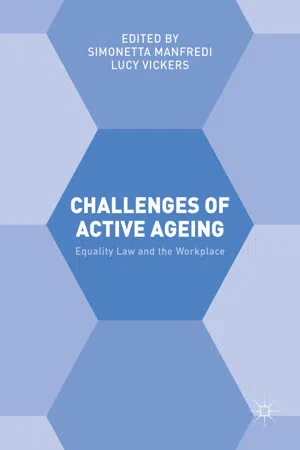
This edited collection takes a multi-disciplinary approach to the 'Active Ageing' agenda to enable readers to consider the implications of this phenomenon for the law, the workplace, and for working lives from a holistic perspective. Challenges of Active Ageing brings together academics working throughout Europe from different disciplines including law, industrial relations, human resource management and occupational psychology to explore and debate the challenges of the 'Active Ageing' agenda for equality law and management practice. Also including shorter contributions from law, human resource management, trade union and other practitioners, this book aims to fully reflect how organizations can adjust their practices to respond to the challenge of an aging population and extended working lives.
eBook - ePub
Challenges of Active Ageing
Equality Law and the Workplace
- English
- ePUB (mobile friendly)
- Available on iOS & Android
eBook - ePub
Challenges of Active Ageing
Equality Law and the Workplace
About this book
Information
The Development of the Law at EU Level
© The Editor(s) (if applicable) and The Author(s) 2016
Simonetta Manfredi and Lucy Vickers (eds.)Challenges of Active Ageing10.1057/978-1-137-53251-0_11. Setting the Scene: Development of the CJEU Jurisprudence on Age Discrimination in Employment
Frank Hendrickx1
(1)
University of Leuven, Leuven, Belgium
1 Introduction
Age discrimination law in the European Union can be understood only if the case law of the Court of Justice of the European Union (CJEU) is taken into account. Since the adoption of Directive 2000/78, many cases relating to age have come up. However, a proper understanding of age discrimination case law is not self-evident. The case law of the CJEU is quite dynamic and shows a high degree of flexibility, which leaves it difficult to predict.
This chapter draws on earlier work on the CJEU’s case law,1 which proposed that there is a ‘double bind’ in age discrimination law. On the one hand, there is an aim to establish a strong principle of non-discrimination on the basis of age, based on a fundamental rights approach to the equal treatment principle. On the other hand, the role of age in our societies and the relationship between age and ageing and the labour market, as well as the traditions and compromises made in Member States’ systems, are also reflected in age discrimination case law. This reflects the difficult balance which needs to be made between an individual and rights-based approach of age discrimination law on the one hand and a collective and interest-based approach on the other.2
The purpose of this contribution is to foster further discussion based on a case law analysis and to explore new avenues which may explain or frame the case law of the CJEU in age discrimination.
This dual aspect of age discrimination law may bring the analysis and discussion to two normative perspectives. The first could be derived from the CJEU’s perspective offered in Hörnfeldt,3 where the Court used a right to work approach and referred to an inclusion strategy for older workers on the labour market. In particular, the CJEU stated that ‘the prohibition of discrimination on grounds of age set out in Directive 2000/78 must be read in the light of the right to engage in work recognised in Article 15(1) of the Charter of Fundamental Rights of the European Union’. It also referred to the participation of older workers in the labour force, and thus in economic, cultural and social life, and mentioned the potential and the quality of life of the workers concerned.4 This normative perspective offered by the Court operates quite closely to a fundamental rights discourse which pays attention to the perspective of an individual worker potentially subject to discrimination.
The second normative perspective is related to perspectives offered in labour market and employment policy. Age discrimination case law cannot neglect the socio-economic role and impact of the age factor. The age structure of the European population is projected to change dramatically, as life expectancy at birth is anticipated to increase significantly in the next decades.5 This will have an impact on not only the labour market in the strict sense, but will also involve issues of financing of social welfare systems and solidarity between generations in terms of both work and social benefits.
The ‘active ageing’ agenda of the European Union also shows this duality. For the European Union, ‘active ageing means growing old in good health and as a full member of society, feeling more fulfilled in our jobs, more independent in our daily lives and more involved as citizens’.6 This is a quite inclusive approach for older workers. However, it is clear that active ageing strategies also imply the reconciliation of various interests and perspectives—for example, in terms of intergenerational solidarity or in terms of the socio-economic impact of ageing.7 The economic contribution to be made through ageing policies is also clear in the EU’s actual definition: ‘active ageing means helping people stay in charge of their own lives for as long as possible as they age and, where possible, to contribute to the economy and society’.8
The two mentioned normative perspectives are relevant and valid. However, the question is which deeper layers or ideas concerning age discrimination law are determining them. In this chapter, the characteristics and underlying considerations of the age discrimination concept are examined, as they influence the balancing between the two normative perspectives. They need to be made explicit, not only to understand the case law but also to provide and build up a proper synthesis. In short, it aims to take the ‘double bind’ one step further.
This chapter contains two main sections. Firstly, an overview and analysis of the case law will be provided, focusing on the cases which may be seen to be key in the development of age discrimination law in the EU and to be relevant to the normative perspectives mentioned above. Taking into account reasons of limitation, the selection is limited to retirement and pay cases. Secondly, and on the basis of this overview and analysis, a critical discussion will be undertaken whereby characteristics of the age discrimination concept and underlying considerations will be discovered. For the purposes of embedding the case law, a brief overview of the legislative provisions at EU level is provided.
2 European Age Discrimination Legislation
The principles governing age discrimination in Directive 2000/789 show a strong connection with the context and functioning of labour markets and employment policies, although the emphasis on the fundamental right to equal treatment is not overlooked.
2.1 The Preamble
The Preamble of Directive 2000/78 starts with a reference to fundamental rights but, subsequently, also refers to the employment policy objectives laid down in the European Union since the beginning of the twenty-first century.
It is provided, for example, that the European Union ‘includes among its objectives the promotion of coordination between employment policies of the Member States. To this end, a new employment chapter was incorporated in the European Commission Treaty as a means of developing a coordinated European strategy for employment to promote a skilled, trained and adaptable workforce’.10 The Preamble also states that ‘the Employment Guidelines for 2000 … emphasize the need to pay particular attention to supporting older workers, in order to increase their participation in the labour force’.11
The Preamble also seems to nuance, or stress the specificity of, the prohibition of age discrimination. It is provided that ‘the prohibition of age discrimination is an essential part of meeting the aims set out in the Employment Guidelines and encouraging diversity in the workforce. However, differences in treatment in connection with age may be justified under certain circumstances and therefore require specific provisions which may vary in accordance with the situation in Member States. It is therefore essential to distinguish between differences in treatment which are justified, in particular by legitimate employment policy, labour market and vocational training objectives, and discrimination which must be prohibited.’12
The difficult tensions underlying this approach to age discrimination are reinforced by the connection between the right to equal treatment and the right to work. This connection is supported by the Preamble of Directive 2000/78: ‘Employment and occupation are key elements in guaranteeing equal opportunities for all and contribute strongly to the full participation of citizens in economic, cultural and social life and to realising their potential.’13
2.2 The Provisions
The special position of age discrimination is also reflected in the provisions of Directive 2000/78.
According to Article 1 of Directive 2000/78, its purpose is to lay down a general framework for combating discrimination on the grounds of religion or belief, disability, age or sexual orientation as regards employment and occupation, with a view to putting into effect in the Member States the principle of equal treatment.14
The directive provides protection against direct and indirect discrimination. According to the directive, there is direct discrimination where one person in a comparable situation is, has been or would be treated less favourably than another. There is indirect discrimination where an apparently neutral provision, criterion or practice would put persons having a particular religion or belief, a particular disability, a particular age or a particular sexual orientation at a particular disadvantage in comparison to other persons.
The directive provides that differential treatment can be justified and will not amount to discrimination, under certain conditions. In principle, the possibility for differential treatment is wider for indirect than for direct discrimination. In case of indirect discrimination, a ‘provision, criterion or practice is objectively justified by a legitimate aim and the means of achieving that aim are appropriate and necessary’.15 In case of direct discrimination, the directive accepts that specific ‘occupational requirements’ may form an exception to the principle of non-discrimination. According to the directive, Member States may provide that a difference of treatment which is based on a characteristic related to any of the grounds referred to in the directive shall not constitute discrimination where, by reason of the nature of the particular occupational activities concerned or of the context in which they are carried out, such a characteristic constitutes a genuine and determining occupational requirement, provided that the objective i...
Table of contents
- Cover
- Frontmatter
- 1. The Development of the Law at EU Level
- 2. The Issue of Retirement
- 3. The Challenges of Extending Working Lives
- 4. The Perspectives of Workers
- 5. The Perspective from Practice
- Backmatter
Trusted by 375,005 students
Access to over 1.5 million titles for a fair monthly price.
Study more efficiently using our study tools.
Frequently asked questions
Yes, you can cancel anytime from the Subscription tab in your account settings on the Perlego website. Your subscription will stay active until the end of your current billing period. Learn how to cancel your subscription
No, books cannot be downloaded as external files, such as PDFs, for use outside of Perlego. However, you can download books within the Perlego app for offline reading on mobile or tablet. Learn how to download books offline
Perlego offers two plans: Essential and Complete
- Essential is ideal for learners and professionals who enjoy exploring a wide range of subjects. Access the Essential Library with 800,000+ trusted titles and best-sellers across business, personal growth, and the humanities. Includes unlimited reading time and Standard Read Aloud voice.
- Complete: Perfect for advanced learners and researchers needing full, unrestricted access. Unlock 1.5M+ books across hundreds of subjects, including academic and specialized titles. The Complete Plan also includes advanced features like Premium Read Aloud and Research Assistant.
We are an online textbook subscription service, where you can get access to an entire online library for less than the price of a single book per month. With over 1.5 million books across 990+ topics, we’ve got you covered! Learn about our mission
Look out for the read-aloud symbol on your next book to see if you can listen to it. The read-aloud tool reads text aloud for you, highlighting the text as it is being read. You can pause it, speed it up and slow it down. Learn more about Read Aloud
Yes! You can use the Perlego app on both iOS and Android devices to read anytime, anywhere — even offline. Perfect for commutes or when you’re on the go.
Please note we cannot support devices running on iOS 13 and Android 7 or earlier. Learn more about using the app
Please note we cannot support devices running on iOS 13 and Android 7 or earlier. Learn more about using the app
Yes, you can access Challenges of Active Ageing by Simonetta Manfredi, Lucy Vickers, Simonetta Manfredi,Lucy Vickers in PDF and/or ePUB format, as well as other popular books in Business & Business Ethics. We have over 1.5 million books available in our catalogue for you to explore.