- English
- ePUB (mobile friendly)
- Available on iOS & Android
eBook - ePub
About this book
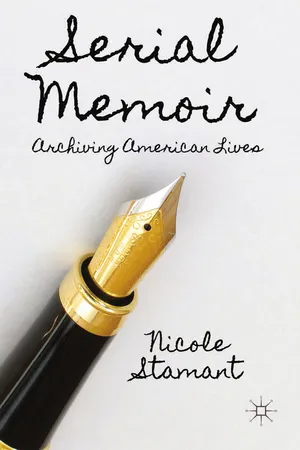
Serial Memoir chronicles the phenomenon of seriality in memoir, a transition in life writing toward repeated acts of self-representation in the later twentieth century. Such a shift demonstrates a new way to understand and represent constantly-shifting subjectivities and their ambivalent relationship to the concept and structure of the archive.
Information
Topic
LetteraturaSubtopic
Letteratura generale1
Introduction
Archiving American lives in serial memoir
In American Lives: An Anthology of Autobiographical Writing (1994), Robert F. Sayre notes that the kind of autobiographical text written, published, and read by different generations of Americans gives audiences a great deal of information about that generation’s particular experiences, values, and fears. Asserting that more than simply the content of these self-reflexive texts change, he notes that their forms, conventions, and audiences also shift in order to reflect changes in societal values (9). Margaretta Jolly echoes Sayre’s assertions as she claims that life writing presents the “self-image of a culture” (“The Exile” 496); Leigh Gilmore posits memoir as “the genre in the skittish period around the turn of the millennium” (Limits of Autobiography 1, emphasis original); and James Atlas asserts in “The Age of the Literary Memoir is Now” (1996) that, “if the moment of inception is hard to locate, the triumph of memoir is now established fact” (25). Over the last few decades, American book critics, scholars, and publishers alike observed that the genre of memoir was becoming more and more prevalent, and they quickly termed this trend the “memoir boom” or, as Michiko Kakutani called it, “the memoir craze” (cited in Eakin 19). In his examination of the cultural history of memoir, Memoir: A History (2009), Ben Yagoda further notes that memoir sales increased by more than a staggering 400% from 2004–8 alone (7). The proliferation of memoir in the second half of the twentieth century marked the rise of a particular kind of self-reflexive text that, as Sayre suggested, informs readers about the habits, desires, and hopes of contemporary writers and their readers.
More than a decade after Sayre’s observations, during the 2008 presidential election, for example, some of the critical conversation about candidates John McCain and Barack Obama centered on how they had represented themselves in their memoirs.1 One reason for this extended conversation about the self-representational strategies of the presidential candidates may be that, as Kerwin Lee Klein argues, the notion of “memory” is in the process of replacing other words that have been traditionally associated with history, like nature, culture, and language (128).2 The role of the literary memoir in that election, then, provides voters/readers with narratives of self-construction in relation to the historical moment. Its popularity increasing in tandem with the larger concept of “memory,” memoir, as Helen Buss writes, has also begun to displace the term “autobiography” to describe “any narrative or essayistic life-writing practice (excluding biography)” (7).3 And, in 2006, the National Book Critics Circle included memoir as part of an award title, “Autobiography/Memoir”;4 this category title emphasizes memoir’s place as a recognized genre, even as it also signals the genre’s frequent conflation with autobiography.
While scholarship and popular discussions of memoirs often center on the veracity of the narratives presented—readers may think of the continuing critical conversation around Mary McCarthy’s Memories of a Catholic Girlhood (1957) and Lillian Hellman’s Unfinished Woman (1969),5 or the more recent media-frenzied examples of James Frey’s A Million Little Pieces (2005)6 and Margaret B. Jones (aka Margaret Seltzer) and her faux-memoir about gang life in Los Angeles, entitled Love and Consequences (2008)—memoirists are also experimenting with innovative narrative techniques, including the publication of multiple discrete self-narratives. The practice of serial publishing represents an emerging and significant trend in memoir and illustrates a shift in the “form, emphasis, and sense of audience,” which Sayre proposes marks a transition for how a particular generation of writers understands lived experience and its textual representation. The movement in memoir to publish serial accounts of the self reflects a larger cultural or societal shift in how people interact with one another, how they see themselves and their own participation in the public sphere, and possibilities they see for effective ways to record their life narratives. The dramatic increase in authorship, publication, and consumption of serial memoir marks an important transformation for self-narrative in contemporary American strategies for self-representation.7
In Serial Memoir, I suggest that the genre of the serial memoir developed in the second half of the twentieth century in tandem with postmodern thought and the associated changes and advances in technology and media. It is a postmodern form of self-representation: relational, experimental, historical, and persistently shifting. Moreover, this is a genre that has become mainstream, taken up by such authors as bell hooks, Esmeralda Santiago, Art Spiegelman, Annie Dillard, Richard Rodriguez, Lillian Hellman, Maxine Hong Kingston, Joan Didion, Maya Angelou, Martha Gellhorn, Augusten Burroughs, Ian Frazier, Rebecca Walker, Harvey Pekar, David Sedaris, Ruth Reichl, Judith Ortiz Cofer, Alison Bechdel, and Nancy Mairs, among many others, indicating that there is something appealing and culturally significant in this particular, repetitive narrative form of self-representation. While there have been occasional moments in the history of life writing when individuals have chosen to publish multiple autobiographical texts, the rise of the memoir genre combined with postindustrial American culture allows contemporary American memoirists to think about—and then to present—self-construction and self-representation in a new way. Unlike the rare instances of multiple memoirs in the history of life writing, ours is a moment in which serial memoir is a frequent, widespread, and often expected occurrence.
Life writing scholars regularly point to the numerous autobiographical texts of Edward Gibbon, who published six versions of one text, Memoirs of My Life (1788–93), Giacomo Casanova, the author of a 12-volume set of memoirs entitled History of My Life (1826–38), and Frederick Douglass’ three volumes, The Narrative of the Life of Frederick Douglass, An American Slave: Written by Himself (1845), My Bondage and My Freedom (1855), and Life and Times of Frederick Douglass (1881, revised 1892), as evidence of earlier incarnations of serial life writing. Discussions of these texts often center on the ways in which authors provide multiple interpretations of the past. The memoirs, written at different points in the authors’ lives, thus allow readers, as life writing scholars Sidonie Smith and Julia Watson propose, to ask whether or not these varied self-reflexive performances
signal stages of, or changes in, the overall pattern of beliefs encoded in the autobiographical story, or whether changes from one text to its “sequel,” or “prequel,” signal larger cultural transformations affecting how people know themselves through stories tellable (and discourses available) to them at particular historical moments.
(Reading Autobiography 27)8
Reading these multiple autobiographical texts as relatively unique in their revisions of historical moments, or as remarkable for their frequent forays into self-narrative, is significant for this study because such techniques are considered to be extraordinary in their repeated self-presentation. In the twentieth century, however, serial self-representation is no longer an unusual way to represent selfhood; rather, contemporary memoirists frequently use the available discourse of serial narrative through which to present episodes from their lives. Serial memoir is a textual, material manifestation of a larger serial culture, marking a crucial shift in how people understand themselves and narrate their life stories.9
Historically, Roger Hagedorn points out, serial narratives have been considered inferior to unified narrative forms (“Technology” 5). The relationship between the serialized parts of a work of fiction and the unified form of the novel, or the position of the highly serialized and episodic medium of television in relation to the self-contained narrative of film, provide two examples from different media which generally bear out Hagedorn’s assertions. Since the nineteenth century, the serial has been an important mode of narrative in western culture, if not the primary form in fiction, television, radio, and film, particularly at their emergent stages. Hagedorn asserts that serials “serve to promote the medium in which they appear” (“Technology” 5, emphasis original); once the medium is established, he argues, the most significant competition an established serial will face is a serial in an emergent medium (“Doubtless” 41). Providing examples from a variety of media, including the early twentieth-century example of film, Hagedorn claims that film serials were profitable until radio serials became successful, and those radio serials gave way to television serials. In the “information age,” as extant technology develops and media corporations merge, he explains, we should see expansion and progress in mass media and in serial narrative (“Doubtless” 41). Hagedorn’s astute observations about seriality and new forms of media and communication can be linked to the “memoir boom,” as memoir, a mode with the potential for episodicity and recursivity, attempts to displace the other serialized forms of self-reflexive texts. It is this episodicity, according to Hagedorn, which is the most important trait in distinguishing the serial from the “single-unit realistic narrative,” such as book-length novels, films, and radio plays (“Doubtless” 28). In life writing genres, such single-unit forms—the autobiography, for example—must also be contrasted with the episodic potential of serial memoir, which makes the process of self-production transparent. That is, one feature of episodicity is that it shows its joins. Generically, Julie Rak suggests, autobiography “is not connected to the material conditions of its production” and does not show the processes involved in self-narration, while the memoir makes such production visible (“Are Memoirs Autobiography?” 308). The materiality of self-production and self-representation in memoir is a central focus of the genre itself, but this feature is particularly significant in serial memoir. While many authors point to the existence of the memoir boom, including Ben Yagoda, and how it is related to the publishing industry more largely, as a profitable and marketable genre as Julie Rak does in Boom!, and with the exception of one chapter on serial autobiography in Leigh Gilmore’s The Limits of Autobiography, how memoirists negotiate the larger implications of contemporary serial culture is generally ignored.10
For the purposes of this project, I examine some of the ways in which the phenomenon of serial memoir works along with other forms of seriality in postmodern American culture. Asserting the significance of reading these texts as memoir, I distinguish this genre from others in life writing, such as diary or autobiography; although self-representational texts are generically flexible, distinctions are important to the ways in which both readers and writers approach texts. One distinction involves the position of the speaking subject, as Lee Quinby asserts in “The Subject of Memoirs,” whose “I” is written against the “dominant construction of individualized selfhood, which follows the dictum to, above all else, know thy interior self. In relation to autobiography, then, memoirs function as counter-memory” (299).11 Counter-memory challenges the possibility of a unified representation of the past presented by memory and illustrates the power of collective or unofficial memory. Memories of one event are understood and constructed in various ways by different people, and these memories are subject to revision over time.12 Echoing Klein, Barbara Misztal reminds readers that the contemporary challenge posed to “theories assuming the split between history and memory reveals how complex, tense and politically charged the relationship between history and memory can be and shows that for each memory there is a counter-memory” (107). Generically providing positions of counter-memory, memoir allows for a multiplicity of subject positions which pose a challenge to the possibility of having, much less knowing, an “interior self”; the construct of the “I” exposes the idea of a cohesive, consistent “interior self” as fictive. The existence of serial memoir increases the textual spaces available to counter-memory and witnessing, allowing for repeated acts of uncovering constructs of selfhood and multiple negotiations of identity/-ies. Subjectivity is rooted in memory and serial memoir confronts traditional concepts of unified identity and history, presenting a discursive mode that embraces multiplicity, relationality, and historicity. Additionally, serial memoir allows for expansive, relational, and culturally contextualized self-representational positions, which dismantle grand autobiographical and historical narratives.
Serial self-representation is thus consistent with theories of postmodernity that appreciate the techniques of fragmentation, reflexivity, narrative discontinuity, and simultaneity as writers and artists interrogate traditional generic boundaries and categories. Jean-François Lyotard’s suggestion that the postmodern era is characterized by the move away from grand narratives to smaller narratives is clear in techniques employed by serial memoirists.13 In one way, the challenge that serial memoir poses to the possibility of self-representation in a single text imitates the move toward smaller narratives; serial memoir privileges the episodic and ex-centric as it presents the possibility of an unending system of self-representation. Media theorist Marshall McLuhan has famously suggested that “the medium is the message,” explaining that the “‘message’ of any medium or technology is the change of scale or pace or pattern that it introduces into human affairs” (8). Proposing that the content of the medium often distracts readers from the character of the medium, he argues that in order for contemporary culture to fully understand the information we receive, we must pay attention to how that information is disseminated. Serial production, market segmentation, and consumption go hand in hand, and due in part to the appearance and availability of new technologies, the medium of serial self-representation has become an undeniable and compelling reality in contemporary American life writing.
If memoir is often linked to moments of crisis, as Marcus Billson argues, “both historical crises, such as wars and revolutions, and intellectual crises, as [José] Ortega y Gasset defines them, such as periods of intellectual and spiritual transition” (280), the number of texts written and published as memoir are a testament to the many upheavals in thought, culture, and global interaction in the American twentieth century. The association of memoir with moments of crisis, memoir’s ability to provide a counter-memory to the grand narrative of history, and its investment in the ex-centric also engage with the tendency in postmodern American culture to relegate the present to the past as quickly as possible while creating some sort of record.14 This trend, argues Mark Currie in Postmodern Narrative Theory (1998), can also be understood as a way to flee from the present as we are more impatient to record current events and place moments in the past even as they are still happening; he thus suggests our impatience to record becomes “a way of remembering, of archiving, that actually displaces the experiential present tense with a historical self-consciousness” (97).15 As the twentieth century progresses, the process of immediate archivization becomes increasingly amplified by new technologies—like photography, film, television, and streaming video—whose function, it seems, is to record.16 The concept of historical self-consciousness and archival impulses are foundational for serial memoirists, in particular, as they textually and substantively engage these visual forms in their own projects to record and bear witness. Serial memoir emerges as a genre within which authors can explicitly preserve, archive, and testify to what they have seen in that turbulent and communications-based century.
Significantly, media theorist John Ellis has dubbed the twentieth century “the century of witness,” pointing to the ways in which audiences interact with the rest of the world based on the development of new communication technologies, many of which rely on the promise of instantaneous contact.17 In Seeing Things (2000), Ellis argues that, emerging from the twentieth century, it is clear that we understand the world beyond what we can immediately know in ways profoundly different from previous historical moments. “We live in an era of information,” he explains, “and photography, film and television have brought us visual evidence” (9). Ellis proposes that the amount of visual documentation available in the twentieth century—beginning with photography and photographic evidence, and continuing to include televisual documentation and the immediacy of digital images recorded and streamed in real time—changes how audiences and the public interact with global events. Examining the relationship between the medium and the message, Ellis also underscores the relationality of lived experience—indeed, the hyper-relationality of contemporary life—and his observations provide an interesting corollary to the idea that memoir is “the genre” of the twentieth century.
If the twentieth century has been the century of witness, and if we are able to perceive global events both figuratively and literally, then we have also become invested in the stories which help to contextualize what we have witnessed. The cultural impulse observed by Currie (and others) to immediately record and document ourselves or our interactions with the world is related to the notion of the twentieth century as “the century of witness” and the concept that “the medium is the message”: access to an increasing variety of digital media and technology throughout the second-half of the century has amplified the cultural impulse to self-record. Ellis argues that, emergin...
Table of contents
- Cover
- Title
- Copyright
- Contents
- Acknowledgments
- 1 Introduction: Archiving American Lives in Serial Memoir
- 2 Mary McCarthy’s Archival Performance as a “Perfect Execution of the Idea”: Reading Recursivity and Revision, Seriality and Supplementarity
- 3 Alternate Archives: Maya Angelou’s The Complete Autobiographies or the Seriality of a Life Mosaic
- 4 “Too Meta to Live”: The Materiality of Seriality from Art Spiegelman’s “Maus” to Meta Maus
- 5 Augusten Burroughs and Serial Culture
- 6 Conclusion: “Veneration of the Trace”: Archiving American Lives into the Twenty-First Century
- Notes
- Bibliography
- Index
Trusted by 375,005 students
Access to over 1.5 million titles for a fair monthly price.
Study more efficiently using our study tools.
Frequently asked questions
Yes, you can cancel anytime from the Subscription tab in your account settings on the Perlego website. Your subscription will stay active until the end of your current billing period. Learn how to cancel your subscription
No, books cannot be downloaded as external files, such as PDFs, for use outside of Perlego. However, you can download books within the Perlego app for offline reading on mobile or tablet. Learn how to download books offline
Perlego offers two plans: Essential and Complete
- Essential is ideal for learners and professionals who enjoy exploring a wide range of subjects. Access the Essential Library with 800,000+ trusted titles and best-sellers across business, personal growth, and the humanities. Includes unlimited reading time and Standard Read Aloud voice.
- Complete: Perfect for advanced learners and researchers needing full, unrestricted access. Unlock 1.5M+ books across hundreds of subjects, including academic and specialized titles. The Complete Plan also includes advanced features like Premium Read Aloud and Research Assistant.
We are an online textbook subscription service, where you can get access to an entire online library for less than the price of a single book per month. With over 1.5 million books across 990+ topics, we’ve got you covered! Learn about our mission
Look out for the read-aloud symbol on your next book to see if you can listen to it. The read-aloud tool reads text aloud for you, highlighting the text as it is being read. You can pause it, speed it up and slow it down. Learn more about Read Aloud
Yes! You can use the Perlego app on both iOS and Android devices to read anytime, anywhere — even offline. Perfect for commutes or when you’re on the go.
Please note we cannot support devices running on iOS 13 and Android 7 or earlier. Learn more about using the app
Please note we cannot support devices running on iOS 13 and Android 7 or earlier. Learn more about using the app
Yes, you can access Serial Memoir by N. Stamant in PDF and/or ePUB format, as well as other popular books in Letteratura & Letteratura generale. We have over 1.5 million books available in our catalogue for you to explore.