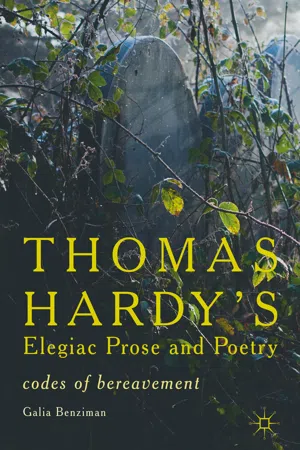
This book examines the transition from traditional to modern elegy through a close study of Thomas Hardy's oeuvre and its commitment to mourning and remembrance. Hardy is usually read as an avowed elegist who writes against the collective forgetfulness typical of the late-Victorian era. But Hardy, as argued here, is dialectically implicated in the very cultural and psychological amnesia that he resists, as her book demonstrates by expanding the corpus of study beyond the spousal elegies (the "Poems of 1912-1913") to include a wide variety of poems, novels and short stories that deal with bereavement and mourning. Locating the modern aspect of Hardy's elegiac writing in this ambivalence and in the subversion of memory as unreliable, the book explores the textual moments at which Hardy challenges binary dichotomies such as forgetting vs. remembering, narcissism vs. unselfish commitment, grief vs. betrayal, the work of mourning vs. melancholia, presence vs. absence. The book's analysisallows us to relate Hardy's elegiac poetics, and particularly his description of the mourner as a writer, to shifting late-Victorian conceptualizations of death, memory, art, science and gender relations.
- English
- ePUB (mobile friendly)
- Available on iOS & Android
eBook - ePub
About this book
Information
© The Author(s) 2018
Galia BenzimanThomas Hardy’s Elegiac Prose and Poetryhttps://doi.org/10.1057/978-1-137-50713-6_11. Introduction
Galia Benziman1
(1)
Open University, Ra’anana, Israel
As a devout preserver of personal memory , Thomas Hardy (1840–1928) devotes much of his poetry and fiction to the effect of the past upon the present. Alongside his evocation of the past in relation to Wessex, community and family life, natural scenes, architectural developments and the private and social history of individuals, Hardy’s investigation into death and bereavement is central to his work. Imagining the dead as phantoms deserving unfaltering attention, he conjures them as inscribed in the landscape, suggested to the eye and the mind through signifiers such as family vaults, portraits and statues, corners of nature filled with associations and written documents such as wills and testaments, epitaphs and posthumous letters. The prevalence of the dead in his work is the subject of numerous critical essays. J. Hillis Miller opines that in his poetry and fiction Hardy “brings the dead to life” and gives them “a permanent existence in an art which is memory embodied” (Miller 1970: 243). Tim Armstrong calls Hardy “one of the most ghost-ridden of authors” (Armstrong 2000: 1), while Catherine Robson refers to him as a “graveyard poet [who] offers up the most grave-laden poetic oeuvre in English literature” (Robson 2004: 500). DeSales Harrison goes on to maintain that the dominant figure for Hardy’s art is “the voice of the absent person, lost or dead” (Harrison 2010: 405).
In discussing his key role in the transition from traditional to modern elegy , critics underline Hardy’s strong commitment to remembrance of the dead.1 This pattern notwithstanding, the assertion in this book is that Hardy’s complex stagings of remembrance are highly ambivalent. Keenly aware of the inconsistencies and paradoxes of mourning and the inherent contradictions in its poetic expression, Hardy revises traditional elegy. His scepticism regarding the language and poetics of grief undermines the ethical requirement to remain committed to the dead. Moving away from the spousal elegies to Emma on which most discussions of Hardy as elegist focus, it becomes clear how strongly Hardy either justifies or identifies with guilt-ridden mourners who wish to forget and go on with their lives. Hardy’s codes of bereavement and especially his depiction of the mourner as writer are inherently divided. While expressing the deep value of memory, his work also manifests ongoing scepticism regarding it, suggesting that memory is often unreliable and narcissistic. This inconsistency produces a powerful, nuanced revision of basic elegiac conventions.
The omnipresence of the dead in Hardy’s work and the impression that the dead are still around us shape his representation of loss. In his constant evocation of the dead, Hardy seems to be a committed spokesman for the ethical importance of memory. He is universally acknowledged as an “avowed elegist,” one whose work constitutes “a momentary stay against amnesia ” (Ramazani 1994: 1, 12). Writing at the turn of the century, Hardy contrasts the pain of bereavement with “the modern hurry-scurry” of contemporary life “bent on regimented advancement”; he resists modern society’s attempt “to repress and silence the regressive anarchy of grief” (ibid.: 12–13). Indeed, Hardy regretted and often satirised the collective forgetfulness typical of his era, and freighted personal grief with cultural and moral value. Hence, consigning the dead to oblivion is often shown in his work to be a disrespectful oversight. Hardy critiques not only personal forgetfulness but also the broader cultural-historical process in which late-Victorians backed away from what they saw as the extravagant and persistent grief of the early nineteenth century. This change was reflected in such divergent doctrines as utilitarianism and psychoanalysis: two schools of thought that regarded prolonged mourning as respectively superfluous or pathological. Eschewing the view that we have no moral obligation to the dead, Hardy suggests that to forget them is to acquiesce to death and make its power acceptable.2 For Hardy, both the utilitarian and psychoanalytic critique of protracted mourning were at fault because the dead are permanently around us and forever in need of our care.
Yet this is only part of the picture. My book explores a different dimension of Hardy’s poetic commitment to the dead. I read his work as dialectically implicated in the very cultural and psychological “amnesia” he resists. Hardy is ambivalent towards the issue of remembrance and forgetting: although he often reacts against the late-Victorian tendency to forget the dead, he is at the same time involved in it himself.3 The wish to leave the dead behind is sometimes represented in Hardy’s work as natural and even inevitable. Hence, the moral condemnation of forgetfulness is doubly undermined. First, Hardy shows nuanced empathy towards the selfishness and inconstancy of mourners and manifests keen interest in the creative freedom of their memory to shape imagined realities. Second, his critique of forgetfulness is diminished both by his view of memory as unreliable and by the representation of excessive devotion to the dead as unreasonable, neurotic and harmful. In the following chapters I examine this pattern, with a particular interest in Hardy’s complicated, guilt-ridden vision of the writer’s role as elegist and preserver of memory—a vision that reveals also the writer’s emotional, moral and aesthetic participation in the collective cultural “amnesia” elegy openly resists.
Based upon a somewhat different corpus than the one usually read in studies of Hardy’s elegies, this book examines the historical, scientific, psychoanalytical and poetic context of traditional and modern conventions of mourning so as to illuminate Hardy’s unique role in the transition to modern elegy. In placing Hardy’s poetry and fiction alongside each other, his unconventional concept of mourning and his suspicion of memory become more apparent. Hardy’s work collapses long-standing binary distinctions: remembrance versus forgetting, grief versus consolation , faithfulness to the dead versus their selfish appropriation by the living, preservation versus betrayal, all of which have informed poetic representations and theoretical discussions of mourning for centuries. Yet, in deconstructing these dichotomies, Hardy shows these presumed opposites to be inevitably mixed.
Hardy’s textualisation of mourning and the self-reflexive nature of his elegiac writing add to his inveterate suspicion of the language of grief. Even his frequent device of speaking for the dead, for which he is taken to be a committed elegist—impersonating and giving them a voice—is ambiguous. Speaking for the dead might be exploitative and self-centred even if it is intended to convey respect.4 Prosopopeia , or the use of the dead as speakers, a device Hardy employs in numerous poems, has its parallel in Hardy’s fiction where characters appear to come back from the dead, e.g. Troy in Far from the Madding Crowd (1874), Newson in The Mayor of Casterbridge (1886) and quite a few characters in the short stories. Speaking from the grave serves to condemn the living for not acting on behalf of the deceased, for usurping their place and for giving them up far too soon. This motif, while possibly connoting support of prolonged fidelity, also expresses a desire to possess the dead, usurp their voice and use them for artistic or emotional purposes.
The following chapters discuss the breadth of Hardy’s elegiac poetry and fiction. The corpus includes many texts that are not elegies proper yet deal with bereavement and mourning, in order to broaden the almost exclusive critical focus upon the spousal “Poems of 1912–1913” in the discussion of Hardy the elegist. This larger scope enables an overview of Hardy’s revisioning of elegiac conventions. By including works of fiction along with the poems, a fuller understanding of Hardy’s elegiac mode is achieved. The two genres of his writing illuminate each other, and a combined study offers a new framework for evaluating Hardy’s treatment of remembrance, grief, betrayal, the guilt of the living and the way in which loss and mourning become texts. Given Hardy’s unique position as a Victorian novelist and modern poet, the broader corpus of works discussed leads to a richer understanding of his role in the shaping of modern elegy.
The inclusion of Hardy’s fiction in this study is part of a growing consensus that regards elegy as mode rather than form and accepts the prose elegy as characteristic of twentieth-century literary production. As Esther Schor points out, since the eighteenth century, elegiac themes and conventions have been assimilated into a variety of literary and non-literary forms including sermons and philosophical treatises. Following the growing importance of the elegy’s role in the new eighteenth-century humanistic, secular moral theory, its redefinition in non-metric terms—as mode rather than form—has prevailed (Schor 1994: 6–21, 55, 244n6).
The concept of the prose elegy has attracted growing critical attention in recent years. In fact, as John Vickery indicates in The Prose Elegy: An Exploration of Modern American and British Fiction (2009), modern elegy has turned increasingly to prose. Contemporary studies on this topic have discussed narrative elegists such as James Joyce, Virginia Woolf, Henry James, William Faulkner, Ernest Hemingway, Alice Munro, Mavis Gallant, Margaret Laurence and others in exactly these terms.5 In line with these studies, it is now acceptable to broaden the term “elegiac” and apply it to narrative representations of bereavement and mourning that push intellectual boundaries related to memory, temporality and continuity. The examination of prose works poses a different set of critical demands and expectations than do poetic elegies. Fiction’s “tra...
Table of contents
- Cover
- Front Matter
- 1. Introduction
- 2. “Hands Behind Hands”: Seeing the Dead
- 3. “Spectres that Grieve”: The Dead Speak
- 4. “Still Corporeally Imminent”: Hardy’s Revenants
- 5. “For She Won’t Know”: Utilising the Dead
- 6. “I Do but the Phantom Retain”: The Mistrust of Memory
- Back Matter
Trusted by 375,005 students
Access to over 1.5 million titles for a fair monthly price.
Study more efficiently using our study tools.
Frequently asked questions
Yes, you can cancel anytime from the Subscription tab in your account settings on the Perlego website. Your subscription will stay active until the end of your current billing period. Learn how to cancel your subscription
No, books cannot be downloaded as external files, such as PDFs, for use outside of Perlego. However, you can download books within the Perlego app for offline reading on mobile or tablet. Learn how to download books offline
Perlego offers two plans: Essential and Complete
- Essential is ideal for learners and professionals who enjoy exploring a wide range of subjects. Access the Essential Library with 800,000+ trusted titles and best-sellers across business, personal growth, and the humanities. Includes unlimited reading time and Standard Read Aloud voice.
- Complete: Perfect for advanced learners and researchers needing full, unrestricted access. Unlock 1.5M+ books across hundreds of subjects, including academic and specialized titles. The Complete Plan also includes advanced features like Premium Read Aloud and Research Assistant.
We are an online textbook subscription service, where you can get access to an entire online library for less than the price of a single book per month. With over 1.5 million books across 990+ topics, we’ve got you covered! Learn about our mission
Look out for the read-aloud symbol on your next book to see if you can listen to it. The read-aloud tool reads text aloud for you, highlighting the text as it is being read. You can pause it, speed it up and slow it down. Learn more about Read Aloud
Yes! You can use the Perlego app on both iOS and Android devices to read anytime, anywhere — even offline. Perfect for commutes or when you’re on the go.
Please note we cannot support devices running on iOS 13 and Android 7 or earlier. Learn more about using the app
Please note we cannot support devices running on iOS 13 and Android 7 or earlier. Learn more about using the app
Yes, you can access Thomas Hardy’s Elegiac Prose and Poetry by Galia Benziman in PDF and/or ePUB format, as well as other popular books in Literature & Literary Criticism in Poetry. We have over 1.5 million books available in our catalogue for you to explore.