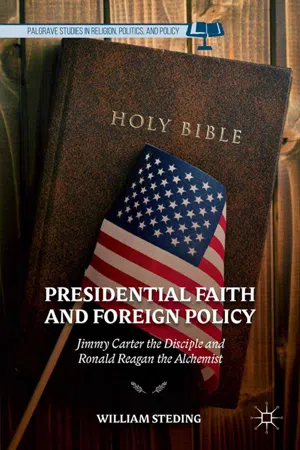
This book explores the relationship between the religious beliefs of presidents and their foreign policymaking. Through the application of a new methodological approach that provides a cognetic narrative of each president, this study reveals the significance of religion's impact on U.S. foreign policy.
eBook - ePub
Presidential Faith and Foreign Policy
Jimmy Carter the Disciple and Ronald Reagan the Alchemist
- English
- ePUB (mobile friendly)
- Available on iOS & Android
eBook - ePub
Presidential Faith and Foreign Policy
Jimmy Carter the Disciple and Ronald Reagan the Alchemist
About this book
Information
1
Religion in the American Political Sphere
Like other cultural phenomena, Christianity in America has a wide array of interpretations and a history of rising and falling in social and political significance. Yet, there are discernible and common threads that have prevailed across these varied interpretations over time.1 Before we can assess the religious heritage of Jimmy Carter and Ronald Reagan and its contribution to their respective cognetic narratives, we must identify these threads of American religious discourse and understand the importance of religion during their presidencies. Some scholars, like Denis Lacorne, have identified meta-narratives that describe broad interpretations of American Christianities throughout history; this chapter intends to take that a step further to the finer threads of religious-based narratives to enable the evaluation of presidential cognetics.2 In addition, this chapter will provide an overview of the ebb and flow of religion to and from the political sphere in American history and then a more thorough illustration of the rise of religion during the period preceding the election of Carter and Reagan.
Narrative threads of American Christian heritage
American Christians have established five principal narrative threads since landing on the shores of today’s Massachusetts in the early seventeenth century. These threads include notions of individualism, perfectibility, exceptionalism, religious liberty, and particular if not peculiar contemplations of sin and salvation. The interpretation of these threads contributed to the differentiation and proliferation of sects, or strands. The Puritanism of early colonists, which was inspired by developments during the Protestant Reformation, was followed by evangelism and periods called “Awakenings,” which were followed by the development of a third progressive theological strand after the American Civil War. As we shall see in later sections of this chapter, these puritanical, evangelical, and progressive strands of Christianity went through periods of incrementally greater expression, until, by the mid-1970s when Carter ran for president, religion was fully ensconced in the political sphere where it was waged as a source of attraction and persuasion across the entire political spectrum, from liberal to conservative.
The first two narrative threads—individualism and perfectibility—have a common heritage that began during the Protestant Reformation. As we shall see in subsequent chapters, Carter and Reagan had very different interpretations about each of these threads. In the early sixteenth century, Martin Luther, a German monk, challenged the Catholic Church to consider its practices of selling indulgences and other simony that he considered inconsistent with scripture.3 His challenge set off a period of religious reform—the Protestant Reformation—that brought renewed attention to the interpretation of scripture known as “Sola scriptura,” or the primacy of scripture over established (Catholic) traditions.4 The notion that there should be no (or limited) institutional mediation between man and his God marked the beginning of the shift in focus from institutions to the individual.5 In addition, new contemplations arose in America including the belief that Christ’s millennial reign could be assured by the progressive defeat of evil by man rather than the premillennialist tradition, which held that Christ must come to defeat evil through a second coming and rapture.6 This gave credence to the expectation of progressive perfectibility; the Kingdom of God could come, “through the efforts of enlightened and energetic women and men working together for the greater good of the social whole”7 and, together with a new orientation toward the individual, a proliferation of Christian theologies began in Europe called sects “within the wide spectrum of Christian belief . . . considered pure communities of ethics and doctrine based upon their interpretations of Scripture.”8 While the sects often differed in their interpretations and structure they, together with the Catholic Church and Church of England, were the antecedents of American Christian churches including the Puritan Congregational churches, Presbyterians, Baptists, Lutherans, Methodists, Quakers, and Episcopalians.
The third narrative thread—exceptionalism—has Puritan roots in the first American colonies begun by John Winthrop, governor of the Massachusetts Bay Colony.9 Upon reaching the shores of Massachusetts Bay in the summer of 1630 on the ship Arbella, Winthrop, echoing Jesus in the Gospel of Matthew, framed the requirements and expectations of his voyage-worn future colonists in a sermon that resonated throughout American history. His Model of Christian Charity10 articulated a sense of independence, duty, and blessings to those who honored their covenant with God. Winthrop claimed,
“The Lord hath given us leave to draw our own Articles” and that “he ratified this Covenant and sealed our Commission [and] will expect a strikt performance of the Articles” that if neglected in any way would cause “the Lord [to] surely breake out in wrath against us” but if we set the example of His Word, “hee shall make us a prayse and glory . . . for we must Consider that wee shall be as a City upon a Hill, the eies of all people are uppon us.”11
Winthrop envisioned “Massachusetts as the ideal place to build a Puritan utopia untainted by the corruptions of the Church of England and distant from a suspect English monarch.”12 It was up to the colonists to live up to the standard of the “chosen people” living in the “chosen land”—a “City upon a Hill.” He defined the Puritan ethos of the new American colonies: independence from the hierarchy of the Church of England; a constant struggle with sin, salvation, and battles against evil; and a high commitment to work and its just rewards with “attention fixed on God.”13 In so doing, he also set theological covenant as a standard of social order. Winthrop believed he could “transfer the principles of nationhood found in ancient Israel to [his] Massachusetts Bay Company with no need for explanation.”14 In the case of exceptionalism, once again, we shall see in subsequent chapters that Carter and Reagan had different interpretations that emanated from their respective religious backgrounds.
The fourth narrative thread—religious liberty—did not fare well under Winthrop’s Puritanism. Although he advocated separation from the Church of England, his colonial government continued the tradition of (effective) church authority; “New England Congregationalism came to be known as a speaking aristocracy in the face of a silent democracy.”15 It was not until Roger Williams established his separatist tradition at his Baptist Church in Rhode Island that a true doctrine of separation of church and state was born, establishing what is arguably the preeminent thread of American religious identity: freedom of religion.
Roger Williams arrived just six months after Winthrop from England in February 1631. He “was an avowed separatist: he felt no attachment whatsoever to the Church of England.”16 His sense of separation was absolute, and inconsistent with what he found Winthrop had set up at Plymouth Church in Massachusetts Bay. Unlike Winthrop, he “expressed the dangerous opinion that civil magistrates had no authority in any religious matter, that they could not even require people to keep the Sabbath.”17 Before long, Williams found himself banished from Winthrop’s realm of authority, taking up refuge in Providence in 1636. Rhode Island remained the only religiously diverse colony in New England into the eighteenth century, causing one of New England’s prominent Puritan ministers, Cotton Mather, to characterize it as a “cesspool” with “such a variety of religions together on so small a spot of ground.”18 But Williams (deceased in 1683) would undoubtedly have been pleased by the “full liberty of religious concernments” that left an indelible mark on the foundation of religious liberty in America.19
The last thread that pervades the narrative of American Christian sects is the contemplation of sin and salvation. Although the Calvinist notion of predestination—that only a few are selected by God for salvation—did not prevail in American Christian discourse that preferred the concept of free will, the Calvinist interpretation of original sin for the most part did survive as a common tradition in many American sects.20 Moreover, while American Catholics subscribed to absolution of sin granted through penance defined by their priests, American Protestants created new pathways to salvation.21 The evangelical interpretation held that salvation was possible for any Christian after redemption (assured by sacrifice), and more progressive sects subscribed to a nuance that effectively distanced sin from the individual—as a failure to love properly or to suffer self-deception—which created a condition of disindividuation22 that diminished the practicality of repentance or sacrifice.23 As we will see, each of these threads, and in particular the strands of evangelism and progressivism, are important considerations in the examination of the cognetic narratives of Carter and Reagan.
The ebb and flow of religiosity in America: From Edwards to Niebuhr
Beginning in the late 1730s, following the predominant Puritanism of early colonists, evangelical revivals in the American colonies produced a period of high religiosity that marked what historians call the “Great Awakening,” placing religion squarely in the public sphere.24 While it is impossible to definitively identify the causal factors of the Great Awakening, we can identify the principal actors: Puritan theologian Jonathan Edwards and three itinerant evangelicals from England, John and Charles Wesley (Methodists) and George Whitefield (Baptist).25 Their aim was to bring more colonists, from New England to Georgia, to “lifetimes of faithful service” and become agents “of renewal for entire communities.”26 Edwards provided the theological framework, and the Wesleys and Whitefield travelled throughout the colonies to perform conversions, including the areas Carter’s ancestors farmed in the southern colonies. While many Anglican rectors did not allow the evangelical preachers access to their churches, the reality was the crowds were too large to be held inside any contemporary structure. Whitefield drew 15,000 people in Philadelphia and New York, and 23,000 on the Common in Boston—more than the population of the city itself.27 Church membership quadrupled during revival efforts, only to return to prerevival levels within a few years.28
What was later to be referred to as the “evangelical movement” first occurred in the Great Awakening and established the “prominence and power” given to “the idea of the ‘new birth’” and the “doctrine that in order to be saved, a man must go through a change in his principles of moral action” and apply them to “exercises of which he...
Table of contents
- Cover
- Title
- Copyright
- 1 Religion in the American Political Sphere
- 2 Jimmy Carter’s Cognetic Narrative: An Evangelical Engineer
- 3 Jimmy Carter’s Evangelical Mission: Human Rights
- 4 Redemption: Jimmy Carter and the Panama Canal Treaties
- 5 Jimmy Carter’s Just Peace in the Middle East
- 6 Ronald Reagan’s Cognetic Narrative: All-American* Alchemist
- 7 Ronald Reagan’s Divine Imperium of Freedom
- 8 Ronald Reagan’s Strategic Defense Initiative
- 9 The Strategic Defense Initiative and US–Soviet Relations: 1983–1987
- Conclusion: God Is Love, God Is Power
- Notes
- Bibliography
- Index
Trusted by 375,005 students
Access to over 1.5 million titles for a fair monthly price.
Study more efficiently using our study tools.
Frequently asked questions
Yes, you can cancel anytime from the Subscription tab in your account settings on the Perlego website. Your subscription will stay active until the end of your current billing period. Learn how to cancel your subscription
No, books cannot be downloaded as external files, such as PDFs, for use outside of Perlego. However, you can download books within the Perlego app for offline reading on mobile or tablet. Learn how to download books offline
Perlego offers two plans: Essential and Complete
- Essential is ideal for learners and professionals who enjoy exploring a wide range of subjects. Access the Essential Library with 800,000+ trusted titles and best-sellers across business, personal growth, and the humanities. Includes unlimited reading time and Standard Read Aloud voice.
- Complete: Perfect for advanced learners and researchers needing full, unrestricted access. Unlock 1.5M+ books across hundreds of subjects, including academic and specialized titles. The Complete Plan also includes advanced features like Premium Read Aloud and Research Assistant.
We are an online textbook subscription service, where you can get access to an entire online library for less than the price of a single book per month. With over 1.5 million books across 990+ topics, we’ve got you covered! Learn about our mission
Look out for the read-aloud symbol on your next book to see if you can listen to it. The read-aloud tool reads text aloud for you, highlighting the text as it is being read. You can pause it, speed it up and slow it down. Learn more about Read Aloud
Yes! You can use the Perlego app on both iOS and Android devices to read anytime, anywhere — even offline. Perfect for commutes or when you’re on the go.
Please note we cannot support devices running on iOS 13 and Android 7 or earlier. Learn more about using the app
Please note we cannot support devices running on iOS 13 and Android 7 or earlier. Learn more about using the app
Yes, you can access Presidential Faith and Foreign Policy by W. Steding in PDF and/or ePUB format, as well as other popular books in Politics & International Relations & European Politics. We have over 1.5 million books available in our catalogue for you to explore.