- English
- ePUB (mobile friendly)
- Available on iOS & Android
eBook - ePub
About this book
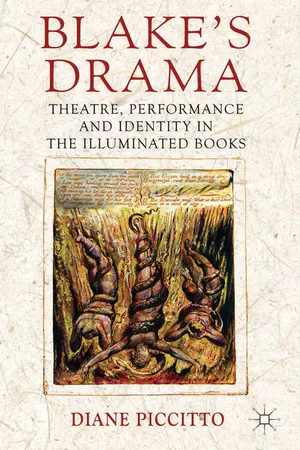
Blake's Drama challenges conventional views of William Blake's multimedia work by reinterpreting it as theatrical performance. Viewed in its dramatic contexts, this art form is shown to provoke an active spectatorship and to depict identity as paradoxically essential and constructed, revealing Blake's investments in drama, action, and the body.
Information
1
The Theatre of the Illuminated Books
The performance history of Blake’s works over the last century, with a clear spike in the past few decades, reveals an impulse to view his works dramatically and put them on the stage, an impulse sparked by the nature of the works themselves. For Blake, what he called ‘Illuminated Books’ produced in ‘Illuminated Printing’ had a visionary quality and the ability to transform the senses (‘Prospectus of 1793’, E 693). This distinct process of mixing media (engraving, painting, and poetry), produced by completely circumventing the conventional methods of commercial print publication, gave him total control over the production phase of his artistic creations. With few exceptions, Blake’s chosen medium for his artistic expression and his method of uniting art forms such as poetry, painting, and engraving make him unlike any other artists (literary and pictorial) of his day.1 Although combining texts (poems and narratives) and images (paintings and engravings) was not new – one has only to consider the commissioning of illustrated literary texts or the proliferation of prints of satirical caricatures – nothing else quite like Blake’s Illuminated Books was produced.2
More than three decades ago, W. J. T. Mitchell stated, ‘It has become superfluous to argue that Blake’s poems need to be read with their accompanying illustrations. Almost everyone would now agree with Northrop Frye’s remark that Blake perfected […] a “composite art” which must be read as a unity. It is not superfluous, however, to ask in what precise sense Blake’s poems “need” their illustrations, and vice versa’ (Blake’s Composite Art 3).3 Mitchell’s question continues to be central in considerations of the medium of the Illuminated Book. What precisely is it? How are we to engage with it? Clearly, it relates to visual art as well as literature, so how do we take both into account? What is the relationship between image and word? And, as an art form, how is it relevant to Blake’s historical period and traditions that followed?
These issues have generated varied responses. In William Blake: Poet and Painter (1964), an early study of Blake’s use of text and design, Jean Hagstrum argued, ‘Blake can be regarded as the classical embodiment of those venerable conventions of Western art, pictorial poetry and poetic painting […]. That tradition […] made the Horatian tag ut pictura poesis its motto’ (8). Mitchell countered this view in Blake’s Composite Art: A Study of the Illuminated Poetry (1978) – a title that picks up on Hagstrum, who applies the term ‘composite art’ to Blake’s form (10). What Mitchell takes issue with in the ‘ut pictura poesis’ reading is the relationship between the two forms of expression: ‘In general, however, neither the graphic nor the poetic aspect of Blake’s composite art assumes consistent predominance: their relationship is more like an energetic rivalry, a dialogue or dialectic between vigorously independent modes of expression’ (4). For him, what follows from Hagstrum’s interpretation of Blake’s works as a combination of the sister arts is a subordination of one art form to the other.
Despite the evolution of criticism with regard to the pictorial element, Stephen C. Behrendt finds that a ‘logocentric bias’ still lurks behind poststructural approaches to Blake’s art form (‘“Something in My Eye”’ 80). He points out, ‘Language of this sort implies that only a literary text can be a real “text” and that the visual text is at best the weak and subservient sister art whose function is not textually significant and whose nature as art is only minimally and marginally important in the generation of meaning’ (79). Finding a term that satisfies the many points of view involved in this discussion may be next to impossible. So how can we discuss Blake’s medium in a way that does not reduce either the poetry or the pictorial art? This problem inevitably leads to questions of what the nature of the Illuminated Book is and how we might respond to it – after all, what a thing is reveals how one can use it and how it can be productive. Such questions highlight the pivotal role of the audience in an understanding of the form.
Blake does not prioritize his poetry, and only after he had engraved his poetic works did he seem to consider them published in the same way conventional writers might have considered their works finished once printed by a press. As early as Northrop Frye, critics aligned the Illuminated Books with Blake’s categorization of particular works as complete: ‘And when these poems were once engraved Blake seldom altered anything more fundamental than the color-scheme […]. The inference is clear: the engraved poems were intended to form an exclusive and definitive canon’ (6). While I would not dismiss the importance of changes from copy to copy (from colour scheme to additions and deletions to order), the indispensability of the designs Frye points to indicates that they merit sustained attention.
As several scholars have noted (e.g., Mitchell, Behrendt, and Morris Eaves), when one picks up a work by William Blake one does not simply ‘read’ the work.4 In fact, the question of audience is as thorny as the question of genre. In The Making of English Reading Audiences, 1790–1832, Jon Klancher argues that we cannot simply dismiss the way various authors and media target and construct a particular context of reception. Even though he suggests that ‘audience-making’ at the time is a product of periodicals because they were (and still are) geared toward particular markets or groups (4), the idea is also relevant to Blake: the way he creates his art necessarily involves both reading and looking – and something more. Seeing, and not only the vision of the imagination, plays a large role in his works. The designs are not components that can be ignored; they do not simply illustrate the action defined in the poem. They both support and destabilize the narrative; they both tell the story with the poem and express their own story at the same time. As a result, they cannot be relegated to a subordinate position in the interpretive act.
Given the complex process involved in engaging with one of Blake’s illuminated works, what kind of audience is suggested by his chosen medium? Hagstrum posits one geared to multiple senses, particularly ‘ear and eye’ (139). He maintains, ‘Blake wanted his message to attack the whole man – all at once.’ Poetry alone does not accomplish what poetry and painting (and engraving) do together, primarily because separately each one does not offer as expansive a mode of engagement as they do in combination. On the one hand, as readers, we read the linguistic signifiers and focus on the narrative, diction, figurative language, and literary conventions. On the other hand, as viewers, we look at the pictorial depictions and focus on colour, size, composition, and conventions of visual art. Nevertheless, these are not two completely distinct and mutually exclusive processes we force together to form an interpretation.
With Blake, we cannot unambiguously separate the linguistic from the pictorial level because he presents the two at once. The words themselves are woven into the designs and vice versa. Behrendt explains this process as follows: ‘Blake’s illuminated poems generate what is essentially a “third text”, a meta-text that partakes of both the verbal and the visual texts, but that is neither the sum of, nor identical with either of, those two texts’ (‘“Something in My Eye”’ 81). Behrendt makes a persuasive argument concerning the ‘meta-text [which] emerges from Blake’s illuminated pages’ (94). He does not set up an opposition between the two media. Rather, he acknowledges the different responses that each can and does elicit from an audience, while stating that somehow these various responses overlap. Yet Behrendt’s positing of a ‘third text’ betrays a kind of logocentrism. My response to his ‘meta-text’ is to envision a dramatic space that the literary and pictorial elements work together to produce.
The recent surge of interest in and corresponding research on Romantic-era theatre – unexpectedly – generates new insights into the interplay of image and text in one of Blake’s key modes of artistic production by making the context of dramatic performance a viable one for analysing his works. In his time, the word ‘performance’ regularly referred to a ‘literary, artistic, or other creative work; a composition’ (Def. 1d), including poems and paintings, as well as theatrical performances – a meaning that, though obsolete today, had a history as far back as 1665 according to the OED. In his letters, Blake uses the term to refer to his own and other artists’ paintings (see, for example, E 745, 748, 759). The current rediscovery of Romantic theatricality makes it possible to push this connection even further to view the Illuminated Books – in their specific tension between the linguistic and visual realms – as producing the experience of dynamic stage performance.5 By re-examining Blake’s works in light of the dominant discourses of drama and theatre of his day, namely the theatrical and anti-theatrical debate, as well as pictorial criticism, I propose a new understanding of these works.
The Illuminated Books occupy a space in the realm of the dramatic and the theatrical. They do so by exhibiting performative aspects in their multimedia construction, their content, and in the audience interaction that they encourage. In calling Blake’s works performative, I am making a claim about them as an artistic form and about how one might work with them. This aspect has been overlooked to a large extent, other than to say that his works are dramatic or that each copy is a performance. An important exception is Susanne Sklar, for whom ‘Jerusalem is a visionary text, replete with theatrical elements’ (2). She offers a thorough analysis of Blake’s difficult epic by approaching it in the way one would ‘experience a play by attending to what is happening onstage’. Yet Sklar rejects the everyday stage: ‘Of course Blake’s Jerusalem cannot be confined to a mundane three-dimensional stage; it requires what I call visionary theatre.’ She stops just short of seeing Jerusalem as actual theatre, whatever the genre, and emphasizes that this is only ‘an approach’, ‘an imaginative way of reading’ (148). While she productively uses theatre as a framework for her close analysis of the epic, I position Blake within the historical context of the popular theatre of his day, using it as a way to revise our notions of his medium and of what theatre can be more generally. Blake’s illuminated works have an undeniable theatrical and performative energy both in their content and in the way they invite an audience to respond to them. In this chapter, I aim to broaden these observations into a more sustained analysis of the implications such labelling has for an engagement with his work.
Traces of the theatre in Blake’s life
King Edward the Third, Prologue to King Edward the Fourth, and Prologue to King John sound like a promising start to a dramatic career, but these historical plays would remain in a fragmentary state, suggesting that Blake’s attempt to be a playwright had failed. As a result, he apparently turned away from this form at which he had tried his hand in Poetical Sketches (1783), his early writing and only work to be published by conventional channels, in favour of his esoteric Illuminated Books. But is that really the end of it? What follows is an attempt to chart the biographical-historical relations between Blake and dramatic performance in order to ground my categorization of his multimedia art form as theatrical productions.
Despite its incompleteness, King Edward the Third led John Egerton to list Poetical Sketches in his 1788 volume of ‘chronicle of the drama’ (BR 49). F. R. Leavis goes so far as to say that the whole of Poetical Sketches, not just the few dramatic pieces, has a dramatic quality. Specifically, he refers to the sequence of poems entitled ‘Song’ and argues that they adapt and allude to Shakespeare’s plays in tone and topic (73–6). An Island in the Moon (1784), written on the heels of the publication of Poetical Sketches, shows continuity with the dramatic element of his previous output. Martha England has argued that this work was influenced by and even imitates Tea in the Haymarket, ‘a generic name for a variable product of the satiric personality and dramatic genius of the actor Samuel Foote’ that appeared on the Haymarket’s stage during the eighteenth century (3). Also, Steve Clark observes, ‘If regarded as comic libretto, [it] would certainly be a contender for most successful piece of romantic drama’ (‘Closet Drama’ 165).
This dramatic impulse is evident in Blake’s performances at Mrs Mathew’s literary salon, which he attended in the 1780s and where he is said to have sung his poetry in front of the gathered guests. John Thomas Smith states, ‘Blake wrote many […] songs, to which he […] composed tunes. These he would occasionally sing to his friends; and […] his ear was so good, that his tunes were sometimes most singularly beautiful, and were noted down by musical professors’ (500; and BR 120–1). The fact that he composed ‘melodies’ and sung his works out loud in front of an audience – a fact that has had little scholarly attention as Keri Davies laments (189) – suggests that he was not simply open to performance but actively engaged in it, therefore seeing his works as part of the embodied world as well as the mental sphere. Similarly, the legendary story of Blake reading Milton’s Paradise Lost out loud with his wife as they sat naked in their garden resonates with his earlier performances of his own poems and with the tendency toward dramatic expression in his art. Despite its dubious authenticity, the anecdote does fit nicely with an image of Blake who embraced performance, even getting his body into the act by ‘costuming’ himself appropriately to play the part of Adam. Indeed, ‘Another of Blake’s favourite fancies was that he could be, for the time, the historical person into whose character he projected himself: Socrates, Moses, or one of the prophets’ (Gilchrist 97). Such examples go against the traditional view of him as confined to intellectual or spiritual life and showcase his performative side.6
Although Blake’s references to and experiences with the theatre world are few and far between, even these negate any easy assumption of his general dismissal of performance. Of particular note, in an 1805 letter to his patron William Hayley, Blake dabbles in a bit of mainstream gossip about celebrity, offering his two cents on the current rage in London for a boy actor: ‘The Town is Mad Young Roscius like all Prodigies is the talk of Every Body I have not seen him & perhaps never may. I have no Curiosity to see him as I well know what is within the compass of a boy of 14. & as to Real Acting it is Like Historical Painting No Boys Work’ (E 764). The boy in question is William Henry West Betty, known as Master Betty or Young Roscius. He performed at Covent Garden Theatre for a short time in the early nineteenth century. Blake does not rule out the possibility of seeing the boy perform and does not express disdain for the stage itself. Rather, it is his youthfulness and inexperience which form the foundation of Blake’s criticism. Moreover, this comment implies respect for the profession of acting as an art form, equating it with the grand genre of ‘Historical Painting’. According to Blake, it takes someone properly trained and skilled in either profession in order to produce something of true value. These two professions can be taken up only by grown men, implying that each requires a certain maturity and mastery. This one brief digression in the letter indicates that he felt himself to be a fair and qualified judge of a boy he had not seen perform and implies that the theatre is not an unusual place for him to visit.
It is striking that Blake aligns these two vocations and makes a direct parallel between them. Janet Warner points out that Thomas Wilkes’s A General View of the Stage (1759) ‘recommended the aspiring actor to study historical paintings for character, dress and manner’ (63), and David Garrick used this genre of painting for the purposes of tableaux (Thomson, Cambridge Introduction 154). In this light, Blake’s quotation implies more than just a connection in terms of mastery between ‘Real Acting’ and ‘Historical Painting’; it also provides a link in terms of the difficulty of staging human expression in both media, thus raising dramatic performance to the level of historical painting, the most exalted of neoclassical genres. Blake himself painted dramatic scenes from Shakespeare, as well as one from Sophocles, namely Philoctetes and Neoptolemus at Lemnos (1812; see BR 382), and he engraved Hogarth’s painting depicting a performance of Gay’s The Beggar’s Opera.
The only evidence that G. E. Bentley offers for actual visits to the theatre comes late in Blake’s life, when he was often taken out by John Linnell, an artist and friend. He explains, ‘Besides artistic exhibitions, Linnell took Blake to see plays, which Blake is not known to have done much previously: “Tuesday 27 [March] … to the Theatre Drury Lane with Mr Blake” to see Sheridan’s popular Pizarro […]’ (BR 377). Bentley quotes from Linnell’s journal from 1821, six years before Blake’s death. Linnell also took Blake to see John Dryden’s Oedipus in November of the same year and they ‘were much entertained’ (380).7 Aileen Ward notes, Linnell, John Constable, and Blake ‘attended exhibitions and occasionally the theater and opera’ (32). The fact that such historical records pertain only to these late dates does not preclude the possibility of his regularly attending the theatre earlier or of its impact on his ideas of art, acting, and identity. Indeed, Blake’s response to the boy actor at the beginning of the nineteenth century – around the time he was working on Milton and Jerusalem – suggests otherwise.
More general or possible associations with theatre people include a potential meeting with playwright Thomas Holcroft in the 1780s when Blake was very near publisher Joseph Johnson’s circle (which included Fuseli, Godwin – who would go on to write plays among other genres – Wollstonecraft, and Paine) (BR 55); a confrontation (in Lambeth, where Blake lived for a time) with Philip Astley, who built and ran Astley’s Theatre, known for large-scale productions – Blake objected to Astley’s cruel punishment of a boy, but, in the end, both sides parted amicably (Tatham 507); a link to Sarah Siddons, who – at the end of the eighteenth century – lived near Blake’s friend and patron Thomas Butts, while Blake himself resided a short distance away from them (BR 90); and a possible connection ...
Table of contents
- Cover
- Title
- Copyright
- Contents
- List of Illustrations
- Acknowledgements
- List of Abbreviations
- Introduction
- 1 The Theatre of the Illuminated Books
- 2 Spectatorial Entrances: Where Brechtian Alienation Meets Medieval Presence
- 3 Staging Urizen: The Melodrama of Identity Formation
- 4 The Performativity of Inspiration: Action and Identity in Milton
- Conclusion
- Notes
- Bibliography
- Index
Trusted by 375,005 students
Access to over 1.5 million titles for a fair monthly price.
Study more efficiently using our study tools.
Frequently asked questions
Yes, you can cancel anytime from the Subscription tab in your account settings on the Perlego website. Your subscription will stay active until the end of your current billing period. Learn how to cancel your subscription
No, books cannot be downloaded as external files, such as PDFs, for use outside of Perlego. However, you can download books within the Perlego app for offline reading on mobile or tablet. Learn how to download books offline
Perlego offers two plans: Essential and Complete
- Essential is ideal for learners and professionals who enjoy exploring a wide range of subjects. Access the Essential Library with 800,000+ trusted titles and best-sellers across business, personal growth, and the humanities. Includes unlimited reading time and Standard Read Aloud voice.
- Complete: Perfect for advanced learners and researchers needing full, unrestricted access. Unlock 1.5M+ books across hundreds of subjects, including academic and specialized titles. The Complete Plan also includes advanced features like Premium Read Aloud and Research Assistant.
We are an online textbook subscription service, where you can get access to an entire online library for less than the price of a single book per month. With over 1.5 million books across 990+ topics, we’ve got you covered! Learn about our mission
Look out for the read-aloud symbol on your next book to see if you can listen to it. The read-aloud tool reads text aloud for you, highlighting the text as it is being read. You can pause it, speed it up and slow it down. Learn more about Read Aloud
Yes! You can use the Perlego app on both iOS and Android devices to read anytime, anywhere — even offline. Perfect for commutes or when you’re on the go.
Please note we cannot support devices running on iOS 13 and Android 7 or earlier. Learn more about using the app
Please note we cannot support devices running on iOS 13 and Android 7 or earlier. Learn more about using the app
Yes, you can access Blake's Drama by Diane Piccitto in PDF and/or ePUB format, as well as other popular books in Literature & European Literary Criticism. We have over 1.5 million books available in our catalogue for you to explore.