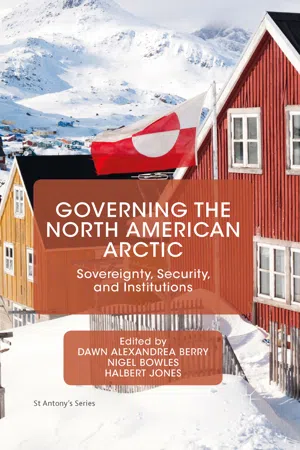
Though it has been home for centuries to indigenous peoples who have mastered its conditions, the Arctic has historically proven to be a difficult region for governments to administer. Extreme temperatures, vast distances, and widely dispersed patterns of settlement have made it impossible for bureaucracies based in far-off capitals to erect and maintain the kind of infrastructure and institutions that they have built elsewhere. As climate change transforms the polar regions, this book seeks to explore how the challenges of governance are developing and being met in Alaska, the Canadian Far North, and Greenland, while also drawing upon lessons from the region's past. Though the experience of each of these jurisdictions is unique, their place within democratic, federal systems and the prominence within each of them of issues relating to the rights of indigenous peoples situates them as part of an identifiably 'North American Arctic.' Today, as this volume shows, their institutions are evolving to address contemporary issues of security, environmental protection, indigenous rights, and economic development.
eBook - ePub
Governing the North American Arctic
Sovereignty, Security, and Institutions
- English
- ePUB (mobile friendly)
- Available on iOS & Android
eBook - ePub
Governing the North American Arctic
Sovereignty, Security, and Institutions
About this book
Information
Sovereignty
1
Arctic Governance and the Relevance of History
In discussion of current issues, the relevance of history is too often ignored or disregarded as insignificant. Yet in the case of Arctic governance in North America, there are sufficient similarities to previous challenges to warrant closer examination. A cursory glance reveals a number of circumstances which precipitated changes in ownership or authority, such as an abrupt change in climate; wars and economic adversity; technological advances and increased demand for Arctic resources. In varying degrees, all are present today. History also reveals that the greatest threat to Arctic sovereignty was loss of control over the adjacent waters and major sea routes.1 Equally significant are differences in demography, cultural traditions, local economies, and political institutions which become self-evident when comparing the histories of Alaska, Arctic Canada, and Greenland. Admittedly, there are obvious similarities in climate, geography, marine life, flora, and fauna, but human factors are critical to understanding the need for tolerance and compromise in devising policies acceptable to all regions. Although cooperation among the Arctic countries has been enhanced by success of the Arctic Council, increasing competition for the region’s resources could become a divisive factor if accompanied by a threat to authority over adjacent waters.
Arctic governance has evolved over the centuries from simple practices exercised by the first inhabitants to enable survival to more sophisticated assertions of authority adopted by European countries. By the early twentieth century, governance gained even greater significance after international law affirmed that a title based on discovery claims was only temporary or inchoate, until permanent settlements or administrative acts provided clear evidence of effective occupation. Hence, the histories of Arctic governance and Arctic sovereignty are closely connected, with some scholars suggesting they are one and the same.
In terms of historical relevance, there are a number of definitions required to set the parameters of discussion. The first relates to the meaning of Arctic sovereignty. De jure sovereignty is a phrase used in international law to refer to having supreme power or title over a region within prescribed boundaries, by political or legal right, and accepted by other nations. De facto sovereignty, on the other hand, is a generic or general term used to describe power in fact, or in real terms, but without the political or legal right inherent in de jure sovereignty. This term is often used in the negative to refer to a loss of authority or control. Thus, while titles to Greenland, Arctic Canada, and Alaska are secure, the rapid melting of the sea ice has made these coastal countries vulnerable to a ‘de facto loss’ of control over the adjacent waters.2
There are also several ways to define the Arctic. For the first inhabitants of the North American Arctic, the lands and frozen waters north of the tree line were without boundaries and known simply as their homeland. Europeans, however, adopted the Arctic Circle as a boundary, an imaginary line just north of 66° North Latitude created by ancient Greek astronomers based on the northern positions of two constellations, Ursa Major and Ursa Minor (the two bears or arctos in Greek). Regrettably, most dictionaries and encyclopedias now use this imaginary line to define the Arctic, which inadvertently excludes most of the Inuit population residing in Arctic Canada and Greenland. Scientists prefer a more appropriate designation based on climate, using the July 10°C isotherm line as the southern border. Canadian historians tend to use the tree line, as it more accurately defines the homelands of the indigenous people of the North American Arctic – the Greenlanders, Canadian Inuit, and Alaskan Eskimos. On the other hand, when the Euro-Asian and North American countries agreed to establish the Arctic Council to deal with common concerns affecting the environment, they chose the Arctic Circle to determine which states would become permanent members, a political decision which had little bearing on human geography, oceanography, or the environment. As a result, eight countries now call themselves Arctic nations, of which two, Sweden and Finland, have no coastline bordering on Arctic waters. Iceland is the only Arctic country with no indigenous population.3
Historical relevance is particularly evident in the evolution of international law, especially laws of the seas which tended to follow unilateral declarations by world powers with sufficient naval strength to defend their positions. During the seventeenth century, geo-political crosscurrents in the Arctic caused laws of the sea to collide with the law of nations which had originated in Roman law. Inevitably, the two would become closely connected in modern international law.4 Although English customary law had taken precedence over natural law by the late nineteenth century, tensions between the two concepts were still evident in negotiations leading up to the United Nations Convention on the Law of the Sea (UNCLOS), which granted the Arctic coastal states special rights and privileges to protect the fragile environment. The fact that international law is based on precedent and tacit agreement partly explains preference by modern states for negotiated agreements rather than submission of a dispute to the International Court of Justice. Negotiation and compromise may have avoided warfare in settling maritime disputes, but those countries with superior military and economic power continued to exert major influence on the outcome.5
Acquiring sovereign title in the New World has a long and complicated history, beginning with decrees set down in the 1493 Papal Bulls of the Catholic Church. When France challenged Spain’s monopoly by claiming discovery must be accompanied by permanent settlement, King Henry IV devised a plan to use profits from sale of local resources to fund colonization of New France – a strategy that was not adopted by the British in the North American Arctic. Instead, the task of building fur trading posts was left to private enterprise.6 In fact, only a few nations were willing to take direct responsibility for setting up permanent settlements in the Arctic, notably Imperial Russia, Norway, Denmark, and after 1867, the United States. By comparison, it was not until the 1920s that the Canadian government attempted to establish permanent settlements in the Arctic Islands. Not until 50 years later did Canada and the United States acknowledge that the Eskimos/Inuit might have specific rights related to their long-standing occupation of the region.
The first humans to inhabit the North American Arctic crossed the frozen Bering Strait from Siberia around 5,000 years ago. Pulling their small wooden sleds over snow and ice, family groups slowly spread eastward with some eventually reaching Greenland. Referred to as Paleo-Eskimos, they were followed over time by waves of new migrants, each with distinctive characteristics. The last to arrive were whale hunters from Alaska, who reached northern Greenland around 1250 A.D. Archaeologists refer to them as the Thule Culture, in recognition of the initial discovery of their remains near Thule, Greenland. Because of their sophisticated weapons, large skin boats, and use of dog sleds, the Thule Inuit eventually displaced the Paleo-Eskimos and are considered the ancestors of the present-day Canadian Inuit, Greenlanders, and Alaskan Eskimos.7 As the longest surviving inhabitants of the North American Arctic, their homelands are central to their cultural identity and they are determined to protect them for future generations.
Yet, long before the Thule Inuit reached Greenland, Europeans had already settled in southern portions of the island – more than 500 years before Columbus allegedly discovered America. They were Norwegian Vikings, led by Eirik the Red, who had been exiled from Iceland. In 986 A.D., he arrived at southern Greenland with 14 ships carrying cattle, sheep, supplies and roughly 300 men, women, and children. Joined by more families, the Norse established two large farm settlements which were supported by trade with Norway. At their peak, the combined population of the two colonies was estimated to be more than 3,000 – a sizeable number by New World standards. Moreover, the colony survived for over 400 years. These were Christian communities, with a resident bishop who reported to Rome. The farmers had adopted a relatively sophisticated form of government and by 1300, they were paying taxes to the King of Norway.8
The most southerly community, which was called the Eastern Settlement, was the oldest and by far the largest. The Western Settlement lay to the north and was the first to be abandoned. By 1450, however, the farmers and their families had disappeared without a trace. Scholars suggest that it was a combination of the Little Ice Age, a decline in trade, loss of their own ships, and attacks by Portuguese fishermen or perhaps by Thule Inuit who were slowly making their way southward along the west coast of Greenland. Some suggest that the Inuit survived because they were skilled at adapting to a changing environment, whereas the Norsemen attempted to change their environment to fit the traditions of their homeland. All are compelling arguments, but Inuit oral history states only one cause: the end of visits by Norwegian merchant ships, which left the farmers vulnerable to repeated, vicious attacks by foreign fishing vessels.9
Based on maps published during the next three centuries (1500– 1800), relatively little was known about the Arctic, even though European merchants with the support of their respective monarchs had financed numerous expeditions in search of a northern sea route to China. Fishermen also sailed north in search of cod and whales, but competition was fierce – initially between the Spanish, English, Portuguese, and Basques, who were joined later by the Dutch and Danes. This was also an era of larger ships, new technologies, and more sophisticated navigational aids, but the fishermen and whalers tended to keep their maps confidential to avoid competition. Significant to the relevance of history is the influence exerted by competing merchants to gain financial or political support from their respective monarchs and governments, comparable to the immense pressure currently wielded by large industries on their respective governments.
Once whalers began trading with natives for furs and ivory, royal charters were granted to claim lands and adjacent waters, such as the charter granted in 1670 by England to what became the Hudson’s Bay Company; Danish charters for Greenland trading companies beginning in 1721; and Imperial Russia’s 1799 charter for its Russian-American Trading Company in Alaska. Yet, the purpose of the British charter differed somewhat from that of the others. As the importance of Arctic resources in British trade was negligible in the eighteenth century, the chief British aim was to gain an access route to the lucrative fur resources in the interior, bypassing the French-controlled St. Lawrence waterway.
Maintaining control over the Arctic sea routes proved difficult. Forts were built at major ports, but they still required naval support. Even the large stone fortification built to protect the Hudson’s Bay Company post near Churchill fell without a single shot to the French in 1782, only to return to British hands with the signing of the 1783 Treaty of Paris. Almost continuous European wars eventually took their toll, with Spanish, Basque, and Portuguese fishermen the first to d...
Table of contents
- Cover
- Title Page
- Copyright
- Contents
- Acknowledgments
- Notes on Contributors
- Map: The Arctic Region
- Introduction
- The Arctic, North America, and the World: A Political Perspective: The Hon. William C. Graham
- Part I: Sovereignty
- Part II: Security
- Part III: Institutions
- Part IV: Official Perspectives
- Conclusion: Inuit Peoples and the Governance of the North American Arctic
- Index
Trusted by 375,005 students
Access to over 1.5 million titles for a fair monthly price.
Study more efficiently using our study tools.
Frequently asked questions
Yes, you can cancel anytime from the Subscription tab in your account settings on the Perlego website. Your subscription will stay active until the end of your current billing period. Learn how to cancel your subscription
No, books cannot be downloaded as external files, such as PDFs, for use outside of Perlego. However, you can download books within the Perlego app for offline reading on mobile or tablet. Learn how to download books offline
Perlego offers two plans: Essential and Complete
- Essential is ideal for learners and professionals who enjoy exploring a wide range of subjects. Access the Essential Library with 800,000+ trusted titles and best-sellers across business, personal growth, and the humanities. Includes unlimited reading time and Standard Read Aloud voice.
- Complete: Perfect for advanced learners and researchers needing full, unrestricted access. Unlock 1.5M+ books across hundreds of subjects, including academic and specialized titles. The Complete Plan also includes advanced features like Premium Read Aloud and Research Assistant.
We are an online textbook subscription service, where you can get access to an entire online library for less than the price of a single book per month. With over 1.5 million books across 990+ topics, we’ve got you covered! Learn about our mission
Look out for the read-aloud symbol on your next book to see if you can listen to it. The read-aloud tool reads text aloud for you, highlighting the text as it is being read. You can pause it, speed it up and slow it down. Learn more about Read Aloud
Yes! You can use the Perlego app on both iOS and Android devices to read anytime, anywhere — even offline. Perfect for commutes or when you’re on the go.
Please note we cannot support devices running on iOS 13 and Android 7 or earlier. Learn more about using the app
Please note we cannot support devices running on iOS 13 and Android 7 or earlier. Learn more about using the app
Yes, you can access Governing the North American Arctic by Dawn Alexandrea Berry, Nigel Bowles, Halbert Jones, Dawn Alexandrea Berry,Nigel Bowles,Halbert Jones in PDF and/or ePUB format, as well as other popular books in Politics & International Relations & Environment & Energy Policy. We have over 1.5 million books available in our catalogue for you to explore.