Winner of the Association for Theatre in Higher Education Excellence in Editing Award 2016
- English
- ePUB (mobile friendly)
- Available on iOS & Android
eBook - ePub
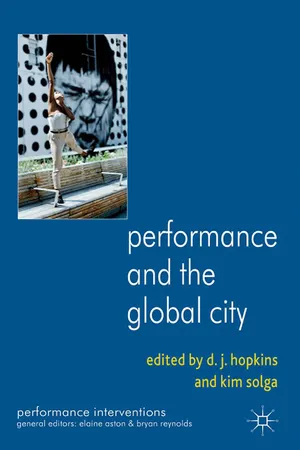
Performance and the Global City
About this book
Information
Topic
Scienze socialiSubtopic
Arte generalePart I
Mobilities and (In)Civilities: The Global Urban Borderlands
1
The Drama of Hospitality: Performance, Migration, and Urban Renewal in Johannesburg
Loren Kruger
In the dead of night an artist paints pedestrian crossings across an otherwise dangerous inner-city street and writes in them slogans like ‘to cross is to transact’ and ‘these are bridgeable divides’; by day, informal guards use these crossings to compel taxi drivers to pause for pedestrians. On a different occasion, two local white men, urged by black immigrants to turn back at the threshold of a district inhabited largely by migrants, use the process of documenting the immigrants’ journeys as an opportunity to lead other locals back into the inner city they had abandoned. A consortium of local and international artists, artisans, architects, planners, tour guides and their apprentices create a festival that combines art, performance, manufacture, and social mobilization to transform work and play into what might be called a ‘drama of hospitality’.
The agents I mention above include arts organizations Joubert Park Project and Trinity Session, as well as the public city agency Johannesburg Development Agency (JDA); their projects include Hillbrow/Dakar/Hillbrow, Pedestrian Poetry, and Welcome to our Hillbrow. Artists and activists have harnessed public and private resources in works that combine artistry and planning, play and productivity, and imaginative performance with acts of urban civility in a city that has been notorious for violent crime and a pervasive indifference to civil responsibility. These events are formal in that they choreograph particular acts and actions in specific sites, and productive in so far as artists work with planners to effect new spatial practices and reshape the urban forms that accommodate them. They are significant because they attempt to change the built environment and the social as well as aesthetic experience of participants in urban life, and to include as participants both South African citizens and migrants who live in inner-city Johannesburg. In the nearly two decades since the post-apartheid era officially began in 1994, the interventions of planners and artists have changed the former central business district (CBD) into a central administration district (CAD) made up of government, corporate, and cultural precincts. Although the reclamation of the inner city has proceeded piecemeal, zone by improvement zone, by the end of the first decade of the twenty-first century it heralded a tentative return of civility on the street, as well as cultural and social interaction that demonstrates the potential – if not the complete success – of this collaboration between art and planning.
Theoretical coordinates: play, productivity, and the meaning of modernity
Although specific to Johannesburg, these events speak to issues raised in more famous contexts. As Henri Lefebvre wrote on the eve of the ‘May events’ of 1968, at a time of brewing discontent from students and migrants on the Parisian periphery as well as at the more famous and more central Sorbonne, these and other marginalized groups claim a right to the city; the very act of inhabiting a city entails ‘play with the elements of the social whole [pièces de l’ensemble social]’, an activity that has gravity even if it is not always serious (Rights: 172; Le droit: 138). Playful practice in the city is effective not because it prettifies surface elements, but because it tests new ‘models of appropriating space and time’ and thus illuminates the intersection of the ‘city as art and the art of life’ (Rights: 173). As ‘structures of enchantment’ (Rights: 173), performances test and renegotiate the limits of social as well as imaginative exchange by marking and unmarking boundaries between extraordinary acts and ordinary activity, between precarity and endurance, between ‘locals’ and ‘migrants’, and between play and productivity.
While the gap between the potential and the pitfalls of this kind of performance may seem especially wide in Johannesburg, the insistence on an unbounded right to the city coming from Paris offers a salutary caution against treating Johannesburg and other cities of the so-called ‘global South’ as dysfunctional against supposedly normative ‘world-class’ northern cities such as Paris or New York. In Ordinary Cities (2006), Jennifer Robinson argues against the hierarchy that places northern cities on the top of the ‘global’ pyramid because this classification ignores the diversity of ‘ordinary cities’, which offer ‘sites for inventiveness and innovation’ and thus challenge rather than merely imitate norms imposed from the north (xi). Robinson joins other urbanists such as Asef Bayat, Teresa Caldeira, AbdouMaliq Simone, and Edward Soja, whose expertise in both south and north has highlighted the potential of southern urban perspectives to transform the ways in which we typically understand the notions of innovation, creativity, and cosmopolitanism as inherent to the modern northern city, while also challenging the idea that northern cities have unique status as the site of aspiration to the good life. Following these scholars, I would suggest that we should understand ‘modernity’ not only, as does Robinson, as ‘enchantment’ with the ‘production and circulation of novelty and innovation’ (7), but also, to update Weber, as ‘de-enchantment’ with the aspiration to the (northern) urban good life in the face of structural inequity in so-called ‘global’ cities of both the south and the north.1 As I will demonstrate below, southern cities’ responses to the dangers as well as the pleasures of innovation have much to teach northern cities whose authorities have often disavowed disruptions of civility – such as the Occupy movements of 2011 – as threats to social order rather than as legitimate expressions of the right to the city.
While events like those I sketched at the top of this chapter cannot alone change policy or behavior on the street, they show the value of diverse contributions, by citizens, migrants, and other urban stakeholders, to the social as well as artistic improvising of cosmopolitan agency and what I will call the drama of hospitality. The drama of hospitality includes both planned and unplanned interaction between locals and migrants but focuses above all on the borders between planned, scripted, choreographed events and the improvised spatial practices that emerge around such events, and on the blurring of formerly clear distinctions between hosts and guests, natives and foreigners, in the fluid spaces of the inner city. In a society such as South Africa, which is characterized by extreme disparities of wealth and access to education and employment, conditions of scarcity demand that practitioners, audiences, and researchers move beyond what I have called ‘theatrical exceptionalism’ (Kruger, ‘Democratic Actors’: 237) to explore the artistic and social potential of performance that breaks through the confines of formal theatrical privilege.
In Johannesburg, especially since 2000, these pedestrian enunciations, performances, and spatial practices have included collaborations across class, language, and national identities. During the apartheid period, the Market Theatre, opened in the old Fruit Market in near-west Newtown in 1976, defied apartheid laws segregating performers and audiences and became, in Johannesburg’s centennial year of 1986, the cornerstone of development in Newtown. Although viewed with ambivalence by anti-apartheid activists skeptical of liberal capital, this development became in the post-apartheid period after 1994 a central project of the Inner City Office (1999–2001) and especially the Johannesburg Development Agency (JDA 2002–), whose public–private partnerships enabled the uneven but progressively expanded revitalization of the inner city through projects dedicated to government (such as Constitution Hill), mixed-income housing (such as Brickfields in Newtown), and small retail and manufacture (such as the Garment District).
The most interesting district in this respect has also been the most intractable: Hillbrow, a district of apartments, hotels of mixed repute, retail, and a hospital complex.2 Reputedly the densest square kilometer in Africa, Hillbrow has attracted migrants since the apartment boom of the 1960s. In that period, newcomers were white and often European; by the 1980s, they were South Africans ‘of color’ with aspirations to middle-class incomes and refuge from township violence (Morris). Only in the 1990s did overcrowding, along with the illegal stripping of building assets by squatters, illegitimate ‘rent collectors’, and other racketeers, make Hillbrow in fact what it had been in rumor: a disorderly mix of seasoned and occasional criminals, with new migrants largely at their mercy. This dystopian Hillbrow inspired drama and television thrillers in the 1990s such as Brian Tilley’s mini-series The Line (1994) and Paul Slabolepszy’s play Mooi Street Moves (1992). Despite significant changes to public conduct and public spaces since 2000, anxiety about Hillbrow continues to fuel contemporary plays like those of Mpumelelo Paul Grootboom. Since 2000, however, collaboration between artists and planners in Hillbrow and contiguous districts Berea, Yeoville, and Joubert Park have led to the renovation of the built environment and of urban civility among the ‘people as infrastructure’, to revisit Simone’s phrase, inviting a critical review of this inner city (and others north and south) beyond the persistent image of the scene of crime.
To address persistent perceptions abroad about the exceptional dysfunctionality of Johannesburg (Murray) and to highlight the transnational resonance of both problems and responses, I turn briefly to a comparable southern metropolis: Bogotá, Colombia. Despite obvious geographical and cultural differences, Johannesburg was in the 1990s judged second only to Bogotá in terms of violent crime and entrenched inequality; since 2000, Bogotá has shared possible solutions with Johannesburg. In the 1990s, Bogotá mayor Antanas Mockus, an immigrant from Lithuania, tackled problems ranging from chaotic traffic to violent crime by starting with small but surprising acts, such as deploying mimes to direct traffic. We can describe these acts in the first instance as theatrical, in that they drew a crowd who applauded or booed the mimes’ playful antics, but in the last instance as performative in the efficacious sense, in that they heralded serious changes in planning priorities and practical measures to enhance the experience of public space (Lennard). These events were the first in a series organized by Mockus that drew attention to the deterioration of public space and security in Bogotá and proposed remedies such as car-free days for cycles and pedestrians, men-free nights on public transport for women alone, and payments by the city to those surrendering illegal guns. Thus, cultural agency enabled social agency (Sommer). These modest measures allowed Mockus’s successor Enrique Peñalosa to implement longer-term planning interventions, spending money that would have otherwise gone to freeways on green space, schools, and bus and cycle ways, and mandating the use of public transport by all at least one day a month. These measures have given citizens of all classes a stake in public services formerly abandoned to the poor (Peñalosa).
This combination of theatrical play and social production in Bogotá’s urban renewal is relevant to Johannesburg not only because both topped charts of violent cities in the 1990s, but also because both share significant features in their built and social environments: sprawl, sharp income inequality, and a history of planning for the rich at the expense of the poor. At the Johannesburg iteration of the Urban Age conference organized by the London School of Economics in 2006, Peñalosa contrasted Bogotá’s implementation of ‘transport as social justice’ – spending on Bus Rapid Transit (BRT) rather than on more expressways – and ‘quality of life equality’ despite income inequality – creating parks, playgrounds, and other public amenities – with Johannesburg’s struggle to meet its own goals for ‘world-class city’ status (Peñalosa).3 Despite Peñalosa’s criticism, the last decade has seen some positive developments as the JDA in partnership with private capital has begun to implement BRT systems, to renovate high-profile public spaces in the inner city, and to work on less-visible spaces such as affordable housing and neighborhood parks. Johannesburg has also added performance to its plans for ‘enhancing the urban environment, increasing the enjoyment of public space and building social cohesion’ (‘Public Performance Policy’: 2).
Cosmopolitan agency and the right to the city
Spatial practices on the street have tested new ways of seeing marginal, and especially migrant, individuals not as criminals or foreigners, but as performers of new modes of ‘belonging and becoming’ (Götz and Simone: 127) in Johannesburg, and thus begun to revise the drama of violent crime that still dominates theatre and television in and about the city. Especially in an era of intensified global migration, the improvised practices of ‘making do’ that characterize cities of the south offer an opportunity to rethink the divisions globalization discourses persistently draw between natives and foreigners, cosmopolitans and xenophobes, us and them in both northern and southern cities as the wealth gap widens even in relatively affluent places. As Loren Landau, director of the African Centre for Migration and Society (ACMS) in Johannesburg, has recently noted, the fluid populations of Johannesburg’s inner city require empirical as well as theoretical revision or received distinctions between hosts and guests, natives or/and foreigners (1–15). Johannesburg residents, among them long-term residents, include speakers of the global language English, local lingua francas like isiZulu or Afrikaans, and regional languages like xiTsonga, and Portuguese, which some perceive as foreign, since they are predominantly spoken in Mozambique, but which have been spoken in South Africa for decades. Francophone migrants from the Congo (since the 1980s) have been joined since the 1990s by French speakers from Senegal and (more or less) Anglophone migrants from Nigeria and Ghana. Although contemporary press reports focus on recent migrants from the African continent, Johannesburg has been the destination of migrants from other conflict zones such as the Balkans and of economic migrants from East and South Asia since t...
Table of contents
- Cover
- Title
- Introduction: Borders, Performance, and the Global Urban Condition
- Part I Mobilities and (In)Civilities: The Global Urban Borderlands
- Part II Transacting Bodies/Embodied Currencies: Subjects and Cities
- Part III Citizen Stages: Acts of Dissent in the Global City
- Index
Trusted by 375,005 students
Access to over 1.5 million titles for a fair monthly price.
Study more efficiently using our study tools.
Frequently asked questions
Yes, you can cancel anytime from the Subscription tab in your account settings on the Perlego website. Your subscription will stay active until the end of your current billing period. Learn how to cancel your subscription
No, books cannot be downloaded as external files, such as PDFs, for use outside of Perlego. However, you can download books within the Perlego app for offline reading on mobile or tablet. Learn how to download books offline
Perlego offers two plans: Essential and Complete
- Essential is ideal for learners and professionals who enjoy exploring a wide range of subjects. Access the Essential Library with 800,000+ trusted titles and best-sellers across business, personal growth, and the humanities. Includes unlimited reading time and Standard Read Aloud voice.
- Complete: Perfect for advanced learners and researchers needing full, unrestricted access. Unlock 1.5M+ books across hundreds of subjects, including academic and specialized titles. The Complete Plan also includes advanced features like Premium Read Aloud and Research Assistant.
We are an online textbook subscription service, where you can get access to an entire online library for less than the price of a single book per month. With over 1.5 million books across 990+ topics, we’ve got you covered! Learn about our mission
Look out for the read-aloud symbol on your next book to see if you can listen to it. The read-aloud tool reads text aloud for you, highlighting the text as it is being read. You can pause it, speed it up and slow it down. Learn more about Read Aloud
Yes! You can use the Perlego app on both iOS and Android devices to read anytime, anywhere — even offline. Perfect for commutes or when you’re on the go.
Please note we cannot support devices running on iOS 13 and Android 7 or earlier. Learn more about using the app
Please note we cannot support devices running on iOS 13 and Android 7 or earlier. Learn more about using the app
Yes, you can access Performance and the Global City by D. Hopkins, K. Solga, D. Hopkins,K. Solga in PDF and/or ePUB format, as well as other popular books in Scienze sociali & Arte generale. We have over 1.5 million books available in our catalogue for you to explore.