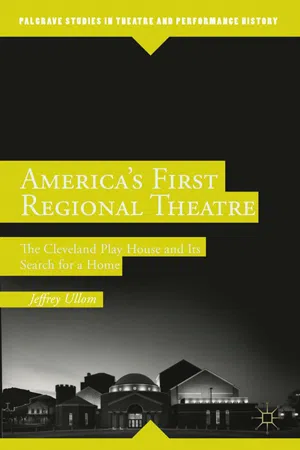
The Cleveland Play House has mirrored the achievements and struggles of both the city of Cleveland and the American theatre over the past one hundred years. This book challenges the established history (often put forward by the theatre itself) and long-held assumptions concerning the creation of the institution and its legacy.
The seminal work on the history of regional theatre remains by default Joseph Wesley Zeigler’s Regional Theater, despite the fact that it was published in 1973 and obviously fails to chart the many developments that have occurred since that time.1 Zeigler’s book is an interesting collection of research into the origins of many well-known regional theatres peppered with personal anecdotes and opinions on the various productions that he and others witnessed at these institutions. While often an insightful and amusing read, the book remains incomplete not only because of its limited information concerning contemporary developments, but also because it favors a few theatres while disregarding others that played an equally important role in the development of American theatre. In terms of charting the foundations of many of these institutions, Zeigler sufficiently details the development of the more well-known theatres by recounting the principal artists and the challenges that they faced, namely locating spaces, finding financial backers, attracting audiences, and the transition from amateur to professional status. Predictably, Zeigler recognized several of the nation’s most famous theatres—the Alley Theatre in Houston, the Arena Stage in Washington, and the Mark Taper Forum in Los Angeles, all received a detailed description of their foundations while an entire chapter was dedicated to the renowned Guthrie Theater.
It is surprising, then, that the founding of the longest-running professional theatre in America is largely ignored in this book, summarized by Zeigler in one dismissive phrase: it was “begun by ‘serious amateurs’ and still going strong to this day.”2 Insightful research into the origins of Cleveland Play House has been neglected by every publication referring to the institution’s beginnings, including Joseph Wesley Zeigler’s Regional Theatre and Cleveland’s own legendary newspaper, the Plain Dealer. When referring to the creation of the theatre (often in articles marking an anniversary), the Plain Dealer simply repeats a standard narrative first described in a book written by a participant in the Cleveland Play House’s earliest endeavors. Julia McCune Flory, wife of the organization’s influential leader and author of one of the earliest histories of the Cleveland Play House, recalled the events leading to the founding of the Cleveland Play House, unknowingly providing a brief history that would remain unexamined for decades:
In the early fall of 1915, Charles and Minerva Brooks invited eight friends to meet in their drawing room at 1598 East 115th Street to discuss the forming of an Art Theatre. Those present at this first meeting were Charles and Minerva Brooks, Raymond O’Neil, Ernest and Katharine Angell, Henry Hohnhorst and his wife Anna, George Clisbee, Grace Treat, and Marthena Barrie.3
While Flory’s account is certainly sufficient in listing the key participants, it remains an overly simplistic narrative. Scholars who research the founding of arts institutions know that such effortless descriptions gloss over the various struggles and challenges that every organization faces in order to define its own aesthetics and form a cohesive and an effective group.
The context that Flory fails to record in her brief assessment prohibits a complete understanding of the individuals involved with this landmark artistic endeavor. Even though the Cleveland Play House and the local press repeated this list of names again and again in their publications, never has a full examination been performed to identify these individuals and their connection to each other. The absence of a complete analysis infers that the foundation of the Cleveland Play House was easy, welcome, and visionary, yet nothing could be further from the truth. Questions abound: What are the events and/or circumstances that brought this specific group of people together at this specific time? How were these people associated with the various arts groups that existed in the 1910s and the larger Cleveland society? Following this initial meeting, questions concerning the theatre’s artistic goals and its place in the community lead to a reexamination of its location and the decision to move to Euclid Avenue where it remained for 84 years.
While the official history of the Cleveland Play House correctly states that the location of the theatre resulted from a generous donation from the Francis E. Drury family, an examination of the biographies of the early participants recasts the Euclid Avenue location as a metaphor for the group’s perceived place in Cleveland society (both by themselves and by others). To understand the oddity of the Euclid Avenue location, it is first important to look at the thriving theatre scene in downtown Cleveland in the early years of the twentieth century, and contrast this growth with the declining surroundings of the Cleveland Play House’s first home on Euclid Avenue. Once the dissimilarity between the two theatre environments is established, an exploration of the participants involved with the founding of the theatre leads to a better understanding of the context for the origins of the Cleveland Play House, its desired audience, and how the theatre distinguished itself through its initial offerings compared to those of other local theatrical and arts organizations.
THE BUSINESS OF THEATRE
The past, present, and future of the Play House is encompassed in two locations: downtown Cleveland with its collection of large performance houses and the mile-and-a-half stretch of roads that connect the urban center with the eastern suburbs. At the turn-of-the-century, downtown Cleveland not only served as the symbol of growth and prosperity for northeast Ohio with its grand public square and tall office buildings, but the Forest City established its reputation also as a leading theatre center outside of New York City. Many national tours including Uncle Tom’s Cabin began in Cleveland, and producers and performers alike found willing and growing audiences receptive to the populist fare streaming from the East Coast. In fact, because of the growing number of immigrants looking for work in Cleveland throughout the first decades of the twentieth century, Cleveland experienced extraordinary population growth, increasing by nearly 50 percent over a ten-year period, from 381,768 in 1900 to 560,663 in 1910.4 Captains of industry seized upon this influx by expanding their factories to accommodate the larger work force, leading to the quick construction of small homes for minority and immigrant families just outside of the city limits. Not surprisingly, downtown theatre producers took advantage of this population growth by enticing immigrants to their performance halls with spectacle-based entertainment, where an inability to understand English was not a barrier for enjoying visual splendors on stage.
While these lower-class workers found theatrical offerings geared toward their demographic, the business and civic leaders of Cleveland prospered as well, leading to an increased support for the arts and other cultural endeavors. In hopes of attracting wealthier patrons, larger audiences, and the latest shows from New York, Cleveland producers built the newest and largest theatre in a thriving downtown. These houses and other smaller theatres offered varieties of entertainment, from legitimate drama featuring Charlotte Cushman as Lady Macbeth at the Cleveland theatre or P. T. Barnum’s temperance drama The Drunkard at the Athenaeum to work of highly questionable quality offered at rundown theatres and saloons that often inspired the city council to pass ordinances to prohibit their vulgar offerings for the lower classes.5
The battle for prestige ended in 1875 with the construction of the Euclid Avenue Opera House, built by “Uncle” John A. Ellsler. Considered to be “the finest theater in the city” by the New York Times, the lavish Euclid Avenue Opera House offered over 1,600 velvet seats for its patrons, making it not only one of the most technologically advanced theatres west of New York City, but also one of the most luxurious.6 Unfortunately for Ellsler, his determination to maintain a resident company of actors at the opera house quickly forced him into debt. Furthermore, his own productions were overshadowed by the growing number of combination companies that rented his theatre or performed in competing houses. Only three years after opening the doors of the Euclid Avenue Opera House and providing the city with one of its greatest cultural landmarks, the banks foreclosed on Ellsler and auctioned his prized theatre at a sheriff’s sale.7 What makes this moment significant in the history of Cleveland theatre is not the fact that the city’s premier performance house was put on the auction block, but, instead, the surprising fact that the new owner was a renowned figure in social and political circles whose selective theatrical predilections directly influenced the creation of the Play House.
How famed politician Marcus A. Hanna found his way into show business is a curious tale. A businessman affiliated with the growing iron and coal industries in Cleveland, Hanna seemed an unlikely candidate to become a theatre owner, but, as legend has it, he bought the Euclid Avenue Opera House on a whim. Historian John Vacha recounted the events:
Hanna was walking with some friends from his office in the Warehouse District to lunch at the Union Club—or on his way back, according to a variant account. Noticing an unusual commotion in the vicinity of Sheriff Street, they went to investigate and found the opera house on the block. The bidding was already up to $40,000. On an impulse, Hanna raised it a few hundred dollars. Down banged the hammer, and Mark Hanna was suddenly in show business.8
Rumors later spread that Hanna, in fact, had designs on the opera house all along and that it was he who foreclosed on Ellsler, making the theatre available for purchase. Nevertheless, Hanna became a leading figure in the arts community, utilizing his new theatre as a status symbol.
Ironically, Hanna did not care much for art; he simply enjoyed meeting famous actors and inviting them to his palatial home for dinners, allowing him to maintain a high profile in social circles. His obsession with fame and maintaining popular attention served him well in his political pursuits, serving as campaign manager for William McKinley’s successful presidential bid in 1896 and resulting in his own election to the US Senate in March 1897. While Hanna lived many of his later years outside of Cleveland (he died in 1904), his association with high-end popular theatre made a lasting impression, partly because he frequently trusted the management of his assets (including that of the Euclid Avenue Opera House) to his sons.9 The Hanna name became a fixture in the downtown theatre scene—one that was associated with a strong preference for popular entertainments. Hanna’s Euclid Avenue Opera House continued to feature touring shows throughout the first decades of the twentieth century, hosting numerous visiting stars including Henry Irving, Ethel Barrymore, Ellen Terry, James O’Neill, and countless other actors. These famous performers attracted thousands of Cleveland’s elite to the theatre to view the crowd-pleasing melodramas and romantic spectacles that were all the rage in New York.10 Hanna himself embodied the type of work most often seen at the Euclid Avenue Opera House—his conservative viewpoint combined with his proclivity toward popular stars and frivolous entertainment meant that there was little room for the works of Ibsen, Chekhov, Strindberg, and Shaw and even less interest in the production theories currently being explored and practiced in European free theatres. The downtown theatres were business endeavors; if serious theatre artists with a penchant for experimentation wanted to find a home for modern plays, then a new theatre in a new location would be needed.
A HOME ON EUCLID AVENUE
The Play House proved an appropriate name for the new experimental theatre as their decision to create the institution occurred in one private house and they mounted their first productions in another. While the former took place in the Brooks’ home on East 115th Street in an affluent suburb now known as University Circle, the latter occurred on Euclid Avenue, one of the most famous residential streets in the world. The quick demise of the celebrated boulevard in the 1910s stood in direct contrast to the rise of the Play House that occurred in the following decade, but, in its founding, the Play House belonged on Euclid Avenue. To validate this assessment, it is necessary first to understand the history of Euclid Avenue followed by an investigation into the strange collection of “businessmen and Bohemians” who united to support the new theatre.
To drive down Euclid Avenue today gives little indication that this street, currently dominated by bus traffic and lined with dilapidated and abandoned buildings, was once home to northeast Ohio’s titans of industry, including John D. Rockefeller, Samuel Mather, and Jeptha Wade.11 Initially called Buffalo Road (until 1825) because it served as the main route to upstate New York, Euclid Avenue eventually became known as the “Millionaire’s Row” both in Cleveland and around the country. At the turn of the century, Euclid Avenue deservedly received comparisons to the Champs Elysées, Berlin’s Unter der Linden, and other grand boulevards of Europe when Cleveland’s elite “commissioned the finest architects of the period to design elegant mansions that would reflect and enhance their own economic and social positions.”12 In his biography of Rockefeller, Ron Chernow described what attracted the oil magnate to the plush location:
With the spacious grandeur of a fine Victorian street, always busy with fashionable horses and carriages, the wide avenue had a double row of elms that created a tall, shady canopy overhead. The imposing homes were deeply recessed from the street, their trimmed lawns and shapely shrubbery providing buffer zones between the houses and their distant front gates. Since few houses were separated from adjoining houses by fences, the street sometimes gave the impression of being a single, flowing park, with elegant homes standing in an unbroken expanse of greenery.13
The small stretch of road from ...
Table of contents
Cover
Title
Introduction
1. Building the House
2. Averting Disaster and Ignoring Cleveland
3. Learning Curve
4. “Catch These Vandals!”
5. Catering to Cleveland
6. Escaping No-Man’s-Land
7. The “Endangered Theatre”
8. A Place to Call Home
Conclusion: The New “No-Man’s-Land”
Notes
Bibliography
Index
Trusted by 375,005 students
Access to over 1.5 million titles for a fair monthly price.
Study more efficiently using our study tools.
Frequently asked questions
Yes, you can cancel anytime from the Subscription tab in your account settings on the Perlego website. Your subscription will stay active until the end of your current billing period. Learn how to cancel your subscription
No, books cannot be downloaded as external files, such as PDFs, for use outside of Perlego. However, you can download books within the Perlego app for offline reading on mobile or tablet. Learn how to download books offline
Perlego offers two plans: Essential and Complete
Essential is ideal for learners and professionals who enjoy exploring a wide range of subjects. Access the Essential Library with 800,000+ trusted titles and best-sellers across business, personal growth, and the humanities. Includes unlimited reading time and Standard Read Aloud voice.
Complete: Perfect for advanced learners and researchers needing full, unrestricted access. Unlock 1.5M+ books across hundreds of subjects, including academic and specialized titles. The Complete Plan also includes advanced features like Premium Read Aloud and Research Assistant.
Both plans are available with monthly, semester, or annual billing cycles.
We are an online textbook subscription service, where you can get access to an entire online library for less than the price of a single book per month. With over 1.5 million books across 990+ topics, we’ve got you covered! Learn about our mission
Look out for the read-aloud symbol on your next book to see if you can listen to it. The read-aloud tool reads text aloud for you, highlighting the text as it is being read. You can pause it, speed it up and slow it down. Learn more about Read Aloud
Yes! You can use the Perlego app on both iOS and Android devices to read anytime, anywhere — even offline. Perfect for commutes or when you’re on the go. Please note we cannot support devices running on iOS 13 and Android 7 or earlier. Learn more about using the app
Yes, you can access America’s First Regional Theatre by J. Ullom in PDF and/or ePUB format, as well as other popular books in Mezzi di comunicazione e arti performative & Arte generale. We have over 1.5 million books available in our catalogue for you to explore.