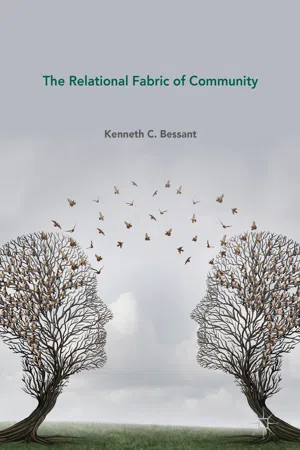
Theoretical and philosophical work on community has yielded multifold definitions and analytical frameworks. Kenneth C. Bessant reflects on the inherent complexity and diversity of this deeply intersubjective aspect of lived social experience. He explores the relational underpinnings of early and more contemporary approaches to the study of community, with a particular emphasis on their core assumptions, concepts, and tenets. Each of these perspectives offers a relatively distinct interpretation of community, while also revealing the intrinsically relational fabric of its perpetual emergence, dynamism, and transformation. The 'being-with' of relational social existence is the fundamental basis upon which all conceptions of community are built, and this is the epicenter around which the book revolves. Community is born of, exists within, and brings forth social relations. It is a living expression of relational willing, thinking, and acting.
- English
- ePUB (mobile friendly)
- Available on iOS & Android
eBook - ePub
The Relational Fabric of Community
About this book
Information
© The Author(s) 2018
Kenneth C. BessantThe Relational Fabric of Communityhttps://doi.org/10.1057/978-1-137-56042-1_11. Introduction: The Enigma of Community
Kenneth C. Bessant1
(1)
Brandon University, Brandon, MB, Canada
Community is one of the most heavily contested concepts in the social sciences (Bessant, 2015). It has been the subject of relentless debate, in part, because it is entwined with multifold themes of discourse on individual freedom, human (self) development, associational life, and collective action. Community evokes an expansive range of meanings and affective responses, alternately embraced as something intrinsically good or even utopic and, at other times, challenged in light of its potentially totalizing character. Concerns continue to resurface over the prospective emphasis on commonality and unity at the expense of diversity and difference. Hiddleston (2005) points to the mistrust and subsequent deconstruction of community proffered by authors such as Jacques Derrida , Jean-Luc Nancy , and Maurice Blanchot. As Selznick (2002) remarks, the notion of community is “frustratingly vague, elusive, even dangerous” (p. 16).
Much has been written about the impact of wide-scale transformative processes (e.g., urbanization and industrialization) on the nature of social relations. Some time ago, Warren (1978) argued that escalating extra-community institutional linkages were contributing to reduced autonomy and cohesion, otherwise known as “the great change” (p. 53). Berger (1988) similarly suggests that modernism brought about a notable decline in close-knit community relations in favor of more diffuse or partial involvements in diverse collectivities. The traditional view of localized, self-contained communities has become increasingly outmoded in light of the growing interpenetration of all sectors of organized social life. However, the claimed disintegration or loss of community has not completely eradicated the search for some deeper sense of association, relationship, or belonging (see Bauman, 2001). The convergence of contemporary change dynamics, such as social acceleration, individualization, and hypermobility, calls for a more flexible understanding of community.
The study of community languished somewhat within mainstream sociology during the 1960s and 1970s, but it continues to attract considerable attention (Day & Murdoch, 1993). Day (1998) contends that the rise of communitarianism—during the 1990s—prompted a renewed interest in community. Also, the decoupling of community from place has energized new avenues of thought and inquiry. The expansive body of social science literature on community testifies to its ubiquitous and multifaceted presence throughout the world. Notwithstanding its many meanings, community remains an important signifier of collective social life (Clark, 1973; Liepins, 2000). One of the most compelling aspects of this work concerns the “beingness” of community, most notably its treatment as an emergent entity or a collectively felt sense of “We-ness ” (see Buber, 1947/2002; Husserl, 1950/1999). The purpose of this chapter is threefold: (a) to outline some basic attributes and ambiguities associated with the community concept, (b) to contextualize the ongoing debate over the meaning of community within the broader discourse on its “loss” or “decline,” and (c) to comment on the role that theory has played in nuancing the interpretation of community.
Conceptualizing Community
Academic discussions of community commonly draw upon a primordial image of intimate social relationships, as contrasted with a more dissociative, contemporary way of life. Tönnies ’ (1887/1957) quintessential view of Gemeinschaft is often cited when authors harken back to a primordial, socially embedded mode of existence that many deem to be fundamentally lost. Delanty (2003) indicates that, from ancient Greek times to the Enlightenment, the idea of community conveyed a “lifeworld” of direct social relationships, commonality, sociality, and belonging, as distinct from the rather stark and distant state. According to Tyler (2006), one of the earliest understandings of community was that of “an organised body of people,” which shifted, in the Renaissance, to matters of relationship, shared identity, and common good (pp. 21–22). He remarks that the notion of community did not signify the members of a particular locale until the modern era. And, so, some of the complexity of the community concept stems from the accumulation of its diverse uses, as well as ongoing efforts to reframe its meaning (Tyler, 2006).
Sociological definitions of community during the mid-twentieth century typically outlined very general characteristics or inventories of dimensional criteria. Parsons (1951) refers to community as a “collectivity ” of territorially situated people and their daily activities (p. 91). He treats community as a localized context comprising actors who enter into relations with one another through social role complexes (e.g., familial or occupational). In somewhat more elaborate terms, Mercer (1956) offers a list of attributes deemed to be indicative of community: a geographical area, an agglomeration of people, a shared culture, a core set of social institutions, a structure or system, and a functionally interdependent round of existence (pp. 25–26). These and other representations of the time reflect the influence of structural-functionalist and social system -oriented thinking about community.
Hillery (1955) conducted one of the earliest meta-analytic studies aimed at assessing the level of consensus across varied (i.e., 94) definitions of community . He concludes that the most oft-mentioned aspects of community include territory or place, shared social ties, and localized interaction (Hillery, 1955, p. 118). Thus conceived, community constitutes a geospatial locale in which people meet their everyday needs, engage in sustained interaction, and act together in relation to common interests, concerns, or problems. These elements combine to form an archetypal and, for some, a largely antiquated understanding of community. Some thirty years later, Wilkinson (1986, 1991) specified similar criteria: locality , organized social life, and goal-directed collective action. He also acknowledged that contemporary change dynamics were perturbing the core elements of community in the direction of indeterminate geospatial boundaries, escalating extra-local social ties, and a reduced capacity to act together on generalized interests (Wilkinson, 1991, p. 5). Despite these observations, Wilkinson contends that people still live in shared spaces, experience larger society in and through localized social life and, periodically, engage in collective community action.
Contemporary theorists continue to revisit many of the same dimensions of community. Chaskin (2008), for instance, indicates that “local” community can be viewed as a unit of close association, belonging, and identification; a functionally integrated system of exchange and production; a network or confluence of relations; and an entity capable of collective agency (p. 67). Flora and Flora (2008) likewise define community in terms of place, social organization (or system), and shared identity, with the added caveat that these elements are becoming increasingly disconnected (p. 13). And, so, after more than a century of academic attention, the notion of community remains entwined with, but not limited to, a core set of attributes, albeit not in an integrated fashion. It is important to note that these are but a few of the many conceptions of community that will be discussed in this and the forthcoming chapters.
The effects of shifting social conditions, along with competing and emerging analytical frameworks, have prompted continued discourse on the meaning of community. Ongoing debate has been amplified by the postmodern emphasis on themes of difference, otherness , and diversity. And, furthermore, this expansive body of work has not yielded a coherent set of ideas or explanations (Summers, Clark, & Seiler, 1970), nor has it been adequately cumulative (Bell & Newby, 1972; Day, 1998). Definitional vagaries stem, in part, from an interest in the study of community across a wide range of social, political, and academic circles, not to mention its appropriation for quite varied and sometimes conflicting purposes. The term community is still used to describe everything from relatively isolated rural villages to larger urban centers, as well as neighborhoods, economic associations, groups, networks, online or virtual meeting places, geographical regions, entire nations, and beyond. And, so, despite longstanding attention, consensus has proven largely intractable. Community lacks consistent meaning in everyday conversation, as well as within and acr...
Table of contents
- Cover
- Front Matter
- 1. Introduction: The Enigma of Community
- 2. Entering into Relation: Being as Social Being
- 3. Evolving Conceptions of Community
- 4. The Field-Interactional Approach to Community
- 5. Dialogical Conceptions of the Self and Community
- 6. The Socio-symbolic Construction and Social Representation of Community
- 7. Relational Sociology and Emergent Community
- 8. Intersubjectivity, Community, and Agency
- Back Matter
Trusted by 375,005 students
Access to over 1.5 million titles for a fair monthly price.
Study more efficiently using our study tools.
Frequently asked questions
Yes, you can cancel anytime from the Subscription tab in your account settings on the Perlego website. Your subscription will stay active until the end of your current billing period. Learn how to cancel your subscription
No, books cannot be downloaded as external files, such as PDFs, for use outside of Perlego. However, you can download books within the Perlego app for offline reading on mobile or tablet. Learn how to download books offline
Perlego offers two plans: Essential and Complete
- Essential is ideal for learners and professionals who enjoy exploring a wide range of subjects. Access the Essential Library with 800,000+ trusted titles and best-sellers across business, personal growth, and the humanities. Includes unlimited reading time and Standard Read Aloud voice.
- Complete: Perfect for advanced learners and researchers needing full, unrestricted access. Unlock 1.5M+ books across hundreds of subjects, including academic and specialized titles. The Complete Plan also includes advanced features like Premium Read Aloud and Research Assistant.
We are an online textbook subscription service, where you can get access to an entire online library for less than the price of a single book per month. With over 1.5 million books across 990+ topics, we’ve got you covered! Learn about our mission
Look out for the read-aloud symbol on your next book to see if you can listen to it. The read-aloud tool reads text aloud for you, highlighting the text as it is being read. You can pause it, speed it up and slow it down. Learn more about Read Aloud
Yes! You can use the Perlego app on both iOS and Android devices to read anytime, anywhere — even offline. Perfect for commutes or when you’re on the go.
Please note we cannot support devices running on iOS 13 and Android 7 or earlier. Learn more about using the app
Please note we cannot support devices running on iOS 13 and Android 7 or earlier. Learn more about using the app
Yes, you can access The Relational Fabric of Community by Kenneth C. Bessant in PDF and/or ePUB format, as well as other popular books in Social Sciences & Developmental Psychology. We have over 1.5 million books available in our catalogue for you to explore.