eBook - ePub
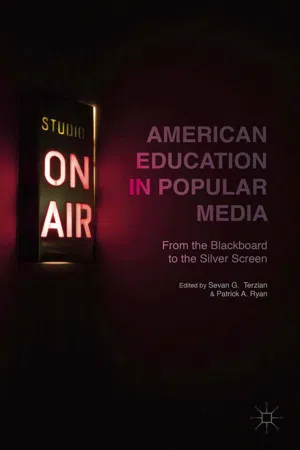
American Education in Popular Media
From the Blackboard to the Silver Screen
- English
- ePUB (mobile friendly)
- Available on iOS & Android
eBook - ePub
American Education in Popular Media
From the Blackboard to the Silver Screen
About this book
American Education in Popular Media explores how popular media has represented schooling in the United States over the course of the twentieth century. Terzian and Ryan examine prevalent portrayals of students and professional educators while addressing contested purposes of schooling in American society.
Information
Chapter 1

Popular Media Representations of American Schooling from the Past
Sevan G. Terzian and Patrick A. Ryan
Education happens everywhere. The emergence of mass media over the past century is a prime example of the ubiquity of education—often beyond the confines of schools. Lawrence Cremin had long advocated a broader scope of investigation for educational historians. He characterized the rise of news and entertainment media in the twentieth-century United States as educative as the nation emerged as a global power.1 For Joel Spring, meanwhile, movies, radio, comic books, and television have been sites of ideological conflict over the shaping of values and tastes among American youth.2 Some historians have followed these leads by studying the didactic functions of radio, film, and television in American society—and the various struggles over the content and form of their programming.3 In addition to considering the implicitly educational aspects of these popular media, a host of other historical works has considered popular media’s explicit depictions of formal education. Such studies have examined past representations of schooling and higher education in mass magazines,4 movies,5 and popular radio.6
The robust scholarly literature in cultural and media studies about popular portrayals of schooling is also instructive. As Mary M. Dalton and Laura R. Linder explain, fictional representations of educators are powerful because “[m]ost of us . . . will encounter more teacher characters over time in mediated classrooms than actual teachers in our own classrooms.”7 The repetition of key tropes about schooling in television and film, moreover, tend to reinforce such images as normal and discourage critical questioning of their veracity or desirability.8 Teacher–student relations have comprised one notable object of investigation. Such studies have examined the tendency to portray effective teachers as mavericks who gain the trust of their troubled students through unconventional methods and often without institutional support.9 Some of this scholarship has considered the recurrence of romantic themes between teachers and students as well as the pejorative implications of depicting white teachers who “save” predominantly racial minority students.10 Taken together, these works suggest that popular film and television portrayals of schooling have emphasized heroic acts of individual educators without featuring actual classroom teaching or consideration of entrenched inequalities that could warrant the systematic reform of social institutions.11
Given the emerging ubiquity of popular media in American society over the past century and the power of such images in informing public perceptions of schooling, more historians of education can benefit from enlisting aural and visual sources as objects of examination. As Sol Cohen has argued, because “all texts contribute to the construction of and provide access to reality,” historians must “go beyond the archive and monographs, textbooks, and periodicals to encompass all cultural artifacts, including the symbolic and the imaginary.”12 It is in this spirit that American Education in Popular Media: From the Blackboard to the Silver Screen aims to further these lines of scholarly inquiry and to encourage more historical investigations of the educational functions and representations of schooling through popular media.
Portraying Professional Educators
For radio and television programs, films, and popular print media to be successful, writers, directors, and producers must envision what will resonate with audiences according to their perceived values, interests, and needs. For example, television situation comedies, in which teacher images prevail, have affirmed contemporary norms that largely perpetuate middle-class values and gender role prescriptions.13 Where there is less realism and more often the use of exaggeration for humorous effect, according to Ken Kantor, audiences tend to disregard inaccuracies and to embrace these programs “if the tenor of the show is sincere, and people in schools are treated respectfully.”14 On the rare occasions when popular media depictions invite audiences to question the professional identity of educators, the quality of classroom instruction, or societal inequities, ultimately the goal remains for audiences to feel satisfied with the resolution of the narrative. Even when teacher-heroes in a film drama overcome obstacles to instruct successfully in their classrooms, they do not enact systemic change in school structures. As a result, the status quo remains without challenging the audience to consider options for educational and social transformation.15 Moreover, motivated by profit to appeal to a mass audience, producers of popular media would not be likely to offend paying customers and advertising sponsors. As the chapters of this volume reveal, popular media have frequently aligned with dominant social and political views in various ways.
Audiences, however, can derive multiple meanings from media images of educators and schooling. Because of the constructed realities created by students, parents, teachers, and administrators, the “nature of school knowledge, the organization of the school, the ideologies of teachers, indeed any educational issue, all become relative.”16 Diverse audiences will often internalize different perceptions of the same image. In viewing popular film representations, for instance, prospective teachers may evaluate their own professional identity according to images advocating nurturing and self-sacrifice.17 Although it is generally accepted among scholars that the media reflect and shape public attitudes, it is difficult to determine causal relationships. The popularity of a television program or film might have little to do with the portrayal of the teacher or the school. The genre, the fame, and likability of the actors, the other competing programs and films vying for audience attention, or the noneducational subplots may complicate audience attitudes. As a result, ratings, box office earnings, and circulation may not always be accurate indicators of public satisfaction with educator portrayals. Neither does critical acclaim always coincide with wider audience approval or disapproval. Although the prescriptive implications of these images are difficult to assess historically, this volume acknowledges the role of the audience in these representations.
While popular media depictions of professional educators were largely positive in the first half of the twentieth century, scholars have noted a shift to more negative images beginning in the 1960s and 1970s that coincided with various societal conflicts including the civil rights and feminist movements, the anti–Vietnam War demonstrations, the War on Poverty, the distrust of the government in the wake of the Watergate scandal, anti-intellectualism, and rising inflation and unemployment.18 Positive images feature teachers as moral and altruistic role models who implement student-centered instructional methods, advocate high expectations, and have friendly, supportive relationships with their students.19 Achieving success often entails confronting antagonistic, generally male, administrators,20 who could range in depictions from being the clueless bureaucrat to a tyrannical taskmaster to a comical buffoon. To highlight the teacher-hero representation, the majority of his or her colleagues are often shown as ineffectual and cynical.21 The teacher-hero is also successful without much formal preparation or experience—an accomplishment thus diminishing teacher education and professional certification standards.22 Negative images, by contrast, feature teachers as disaffected amid violent, alienated youth and as sexually deviant or depraved.23 Overall, these “mixed” depictions of educators reveal historically ambivalent popular attitudes toward teachers, who often are viewed as outsiders not fully integrated into their communities and as belonging to a “semiprofession” with varying standards of expertise, lack of autonomy, low salaries, and inferior social prestige.24 Chapters in this volume that discuss these images in various historical contexts can inform our understanding of enduring issues surrounding the teaching profession.
While the prevalence of teachers and schools in popular media attests to their significance in popular culture, certain missing elements in the depictions reflect an incomplete understanding of the professi...
Table of contents
- Cover Page
- Half Title Page
- Title Page
- Copyright
- Dedication
- Contents
- List of Figures
- Acknowledgments
- 1 Popular Media Representations of American Schooling from the Past
- 2 The College Man in Popular Fiction: American Magazines and the Vision of the Middle-Class Man, 1890–1915
- 3 “A Touch of Risquity”: Teachers, Perception, and Popular Culture in the Progressive Era
- 4 “Spirit of Education”: The Gendered Vision of Compulsory Schooling in Mass Magazine Art, 1908–1938
- 5 Chalk It Up To Experience: The Sacrificial Image of the Teacher in Popular Media, 1945–1959
- 6 Fears on Film: Representations of Juvenile Delinquency in Educational Media in Mid-Twentieth-Century America
- 7 Students without a Cause: Blackboard Jungle, High School Movies, and High School Life
- 8 The Importance of Teaching Ernest: The Fool Goes Back to School in Television and Film Comedies in the Late Twentieth Century
- 9 Prosaic, Perfunctory Pedagogy: Representations of Social Studies Teachers and Teaching in 1970s and 1980s Movies
- 10 Looking at the Man in the Principal’s Office
- Notes on Contributors
- Index
Trusted by 375,005 students
Access to over 1.5 million titles for a fair monthly price.
Study more efficiently using our study tools.
Frequently asked questions
Yes, you can cancel anytime from the Subscription tab in your account settings on the Perlego website. Your subscription will stay active until the end of your current billing period. Learn how to cancel your subscription
No, books cannot be downloaded as external files, such as PDFs, for use outside of Perlego. However, you can download books within the Perlego app for offline reading on mobile or tablet. Learn how to download books offline
Perlego offers two plans: Essential and Complete
- Essential is ideal for learners and professionals who enjoy exploring a wide range of subjects. Access the Essential Library with 800,000+ trusted titles and best-sellers across business, personal growth, and the humanities. Includes unlimited reading time and Standard Read Aloud voice.
- Complete: Perfect for advanced learners and researchers needing full, unrestricted access. Unlock 1.5M+ books across hundreds of subjects, including academic and specialized titles. The Complete Plan also includes advanced features like Premium Read Aloud and Research Assistant.
We are an online textbook subscription service, where you can get access to an entire online library for less than the price of a single book per month. With over 1.5 million books across 990+ topics, we’ve got you covered! Learn about our mission
Look out for the read-aloud symbol on your next book to see if you can listen to it. The read-aloud tool reads text aloud for you, highlighting the text as it is being read. You can pause it, speed it up and slow it down. Learn more about Read Aloud
Yes! You can use the Perlego app on both iOS and Android devices to read anytime, anywhere — even offline. Perfect for commutes or when you’re on the go.
Please note we cannot support devices running on iOS 13 and Android 7 or earlier. Learn more about using the app
Please note we cannot support devices running on iOS 13 and Android 7 or earlier. Learn more about using the app
Yes, you can access American Education in Popular Media by S. Terzian, P. Ryan, S. Terzian,P. Ryan in PDF and/or ePUB format, as well as other popular books in History & Education Theory & Practice. We have over 1.5 million books available in our catalogue for you to explore.