eBook - ePub
Media Ethics and Justice in the Age of Globalization
- English
- ePUB (mobile friendly)
- Available on iOS & Android
eBook - ePub
Media Ethics and Justice in the Age of Globalization
About this book
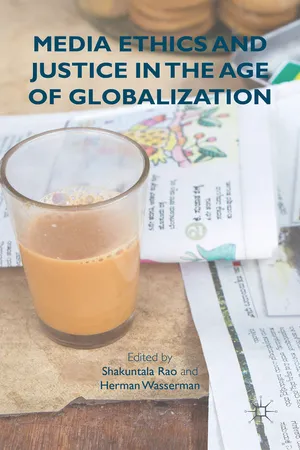
This book uses global perspectives to address questions of media ethics and justice in a local and transnational global environment, and examines the common denominator running through such disparate investigations of theories and practices of media ethics and justice in the democracies of India, South Africa, Pakistan, and the United States.
Information
Topic
Sciences socialesSubtopic
Commerce Général1
Introduction
For the past two decades, ‘globalization’ has been the buzz word within and beyond media and journalism studies. Globalization has decisively unmade the coherence that the modernist project of the 19th- and 20th-century nation-states promised to deliver – the neat marriage between territory, language, culture, and identity. As Geertz noted, ‘All modern nations – even Norway, even Japan – contradict themselves: They contain multitudes’ (Geertz 1973, p. 122). Scholars have generally acknowledged the multiple trajectories to and dimensions of globalization, as reflected in its various histories, processes, and forms of interconnectedness. The multidimensionality of media globalization was exemplified, for example, in the way in which mobile phone video footage of the execution of Saddam Hussein rapidly circulated around the world within hours of the event via a combination of mobile phone cameras, Internet access, and transnational media organizations. Audiences as far afield as Australia, Bangladesh, and Chile awoke to grainy images of the noose around Hussein’s neck as he argued with his executioners. Each media culture, however, reserved the right to disseminate the information as it saw fit: media in the United States largely shied away from showing any of the gory footage; meanwhile, media in India and Al Jazeera, broadcasting throughout the Middle East, ran the majority of the video. Other examples of globalized media content can be noted from recent years, ranging from the serious, as with the rapid spread of and widespread outcries over the ‘Muhammad Cartoons’, first published by the Danish newspaper Jyllands Posten, to the absurd, as with the misplaced melodrama of the ‘Kony 2012’ campaign, to the silliness of the light-hearted ‘Harlem Shake’ and ‘Happy’ viral videos. This book recognizes that journalism and media practice do not stand outside of such globalizing processes and, in the same vein, that processes of globalization are not immune to – in fact, are shaped by – particular journalistic and media practices. In exploring media globalization, it is important to recognize that there are multiple forms of global interconnectedness; that is, the relationship between media and globalization is reflexive and dialectical. The need to employ a contextualizing approach to the understanding of media globalization and ethics forms the basis of this book.
Global communication has been aided by a number of technological advances – in particular, fax machines, mobile phones, text messages, and the Internet – which, taken in combination, have made it easier to communicate the world over. The rapid and massive expansion of the amount of information available on the Internet has enabled unprecedented and instantaneous access and has resulted in the increased international exchange of cultural and political data. The further individualization of media reception has transformed the way people seek and process news and entertainment. In particular, young people increasingly look to sources other than the traditional mainstream media to get their news. Audiences can no longer be expected to simply read newspapers or to watch television as a one-way process in which they are and remain passive. In India, for instance, a staggering 900 million people – approximately 75% of the population – have access to mobile technology; as such, most major news outlets in the country expect high levels of interaction with their consumers. In Africa, the uptake of mobile telephones has been similarly phenomenal, with implications for the ways in which news is consumed, how people interact online, and how everyday practices such as banking and shopping are conducted. In South Africa, for instance, more people access the Internet via mobile phones than via fixed-line Internet access. The extent to which social media and mobile phones can facilitate political mobilization has been much debated, especially after the ‘Arab Spring’ uprisings of recent years in the Middle East and North Africa. In China, a GlobeScan survey found that 71% of Internet users rely on social media to access information that would otherwise not be available to them, such as information critical of the ruling Communist Party as well as information on the environmental responsibility records of private companies. In response to central authorities having banned global social media sites such as Twitter, Facebook, and YouTube, Chinese Internet users have developed their own widely used platforms for social networking and microblogging. According to this survey, China has more than double the number of Internet users than the United States and more than 300 million Chinese consumers make frequent use of some form of social media.
China’s case has shown that websites, Internet message and bulletin boards, chat rooms, instant messaging services, and blogs each make a contribution to the creation of a new public sphere for debate while also providing a forum in which ordinary citizens are able to express their views – a forum that the government has found difficult to control. New social movements and interest groups use old and new media alike to foster the development of electronic and transnational communities, with such communities also often acting as democratic forums. New technologies have helped to revive flagging democratic processes by providing additional avenues for people to participate in a democratic public sphere. In India, such participation was demonstrated in the case of organized mass protests against the corruption of the judiciary and government inaction in the face of gender-based crimes. The social media zeitgeist was captured in the reporting of the case of 19-year-old Sambhavi Saxena, who was arrested during one such protest. On her journey to and during her time at the police station, the 19-year-old tweeted to India and the world, highlighting her plight. Her tweet – ‘Illegally being held here at Parliament St Police Station Delhi w/15 other women. Terrified, pls RT’ – led more than 1,700 people to re-tweet her original message. According to Favstar, the social media analytics site, her tweets reached over 200,000 people within hours. This had the effect of galvanizing civil society, as lawyers and activists quickly arrived at the police station to offer help and advice.
Globalization, and its relationship with media, should not be viewed uncritically or celebrated as a wholly benign force. Globalization theorists such as Castells have hinted at the unevenness of globalization or the ‘imperfect globalization of the network society’, where not everyone is connected to a network (Castells 1996). Scholars like Norris (2001) have focused on the global digital divide and the question of ‘information poverty’ in the Global South, while McChesney, a political economist, argued in his most recent book, Digital Disconnect (2013), that even in media-saturated countries such as the United States the capitalist underpinnings of digital media have exerted detrimental effects on public debates and democratic life. Despite the at-times contentious debates about the impact and value of new media, even the most skeptical of scholars have had to acknowledge the reality that network societies, linked together via media, can no longer be ignored.
Often absent from debates on media globalization and from the scholarly literature that interprets contemporary media, connectivity has been a sustained discussion of ethics. While there have been discussions of the global digital divide and the fact that such a divide has led to ‘information haves and information have-nots’ (Norris 2001, p. 12), as well as examinations of the ethical dilemmas surrounding issues such as privacy, copyright, and pornography in online media (Ess 2009), discussions that connect media globalization to concerns of ethics and justice have remained marginal. We concur with those theorists who have suggested that all global interactions between peoples, nations, states, and cultures must be understood in ethical terms (Der Derian 2009). Global actors are generally concerned with acting ethically and take pains to point out, first, the ethical flaws in the actions of others and, second, their own ethical superiority. Global communication is not only about struggles of and for power, as political scientists and classical realists often argue, or the structural forces that enter into play in the domain of international interactions, as political economists assert, but it is also about the ethical element of such communication. Moreover, taking ‘the ethical turn’ also helps us achieve a more nuanced understanding of the interplay of politics and power between global communications actors, states, and cultures (Garber, Hanssen, and Walkolitz 2000, p. xii). One argument that will be put forth in this book is that the very act of analyzing media and journalism practice is itself an action that is open to ethical evaluation.
Global media ethics: Thick or thin?
In any situation in which audiences and producers participate in media, ethical considerations inform all phases of production, dissemination, and reception. This is apparent in the way in which we characterize global media, the global circumstances in which we find ourselves, reflections on how and why events have transpired as they have, and what lines of action are open to us given the circumstances. Both audiences and journalists, for instance, vigorously debated whether Libyan dictator Muammar Gaddafi’s final moments, which had been recorded using mobile phone cameras, ought to have been televised. Social media around the world lit up with questions such as ‘What constitutes privacy for the dead?’; ‘What the audiences are “authorized” to see?’; ‘What is considered gratuitous?’; and ‘Are media outlets editorially justified in showing the mutilating of his body?’
What is puzzling, however, is that despite the fact that in everyday engagement we often frame the context and our interactions with media in ethical terms, it is a common assumption that the ethical dimensions of media and journalism are, in some general sense, ‘thin’. Despite the ubiquitous use of ethical language, many persist in holding the position that ethical concerns are of minor importance in the practicing of global media and journalism, at least as compared to the pragmatic concerns of attracting an audience in a fragmented media market or the utilitarian goals of impacting political reality or facilitating social change. There is, furthermore, a widespread perception that the ethics of the media are far less important than the ethics of other actors operating in the field – such as the ethics of Gaddafi’s executioners or the ethics of the Libyan provisionary government, which could neither halt nor contain the violence. There are, too, good reasons for retaining the view that the ethical language and commitments of the global media are ‘thin’.
Many consider the following reasons to be self-evident. First, it is often said that the media merely ‘hold up a mirror’ to the reality ‘out there’, and it is a mirror of the practices and values of individual societies and states – a mirror that reflects the struggle of and for power within societies rather than the sharing of common ethical goals. Second, we often understand media in a global context, as an agent of ‘them’ whose ethical commitments are radically different from ‘ours’, rather than as a bridge between ‘us’ and ‘them’. In this view, we are, so to speak, trapped in our own ethical community with no overarching cosmopolitan ethicality to provide us with a shared framework. Media cannot, we believe, provide a forum in which we will be able to seek out, develop, and express a language of commonality. Another version of this argument can be found among those who portray the existing world order as constituting a ‘clash of civilizations’ or as a domain of cultural conflict. People formulate their ideas about their relationships with others in ethical terms, but between us and those who are ethically different there exists no mechanism that allows for the resolution of differences concerning what constitutes justice, a just society, or a good life. Third, and a factor that seems to point to the limited salience of ethics in media, is the limited time and effort that individuals, governments, media organizations, and states reserve for serious and sustained discussions of media ethics. Whereas time and money are expended on journalistic training and the acquisition of relevant skills, comparatively few resources are committed to media and journalistic ethics. When media ethics reach the public domain – as, for instance, in the crisis that erupted in the United Kingdom in the aftermath of the phone-hacking scandal that led to the Leveson inquiry – the answer seems to be to push for the implementation of procedural changes such as state-mandated laws, regulations, or legislation in lieu of drilling more deeply into the substantive values of the media’s role in a democratic society. Fourth and finally, a factor that supports the ‘thin’ view of media ethics is found in the notion that individual ethical commitments are a matter of individual choice and that, therefore, it is wrong to suppose that rational inquiry will reveal what the true ethical stance ought to be for all parties. This belief therefore bars people from considering, at any level of detail, arguments for and against rival ethical positions. If one’s ethical stance is personal, then there is no point in looking for a single overarching ethical belief system applicable to all parties, everywhere, for all time – because, by definition, there are many different individual ethical creeds. All one can and must do is select that which is most relevant to one’s self. When one applies this belief to media, almost all parochial practices take on a certain level of cultural legitimacy, as journalism is viewed as defined by self-contained professional practices that cannot extend beyond the society’s borders. In a globalized, mediated society marked by increasing cosmopolitanism and geopolitical interrelationships, such a relativist position cannot be defended.
Global media ethics are a response to the dilemmas of globalization and the need to address injustices that span national jurisdictions and spheres of influence. Globalization has created global dilemmas that require global solutions – dilemmas that cannot be addressed within individual nation-states or single jurisdictions. Environmental concerns, for instance, connect with concerns over development and economics, which in turn impact political concerns such as migration and citizenship. The water crisis in India, for example, has led to massive migration by the rural poor to cities and mass suicides by farmers, the melting of the Himalayan glaciers has led to a rise of sea levels, and drinking water scarcity caused by the worst drought in centuries is creating havoc in the impacted farming communities; as a result, India has experienced some of the worst food inflation in the world. Scientists believe that a combination and the interaction of population pressure, rapid industrial growth, and climate change are to blame for the scarcity of freshwater resources. It is important to adopt the globe as the proper frame of reference for all ethical considerations; one must remain fundamentally interdisciplinary and committed to combining theory with policy and practice.
We must reject the notion that media and journalistic ethics in a global context should be considered ‘ethics lite’. The scholars contributing to this book assume that the search for a global media ethics is fundamentally linked to the most basic of ethical principles, namely the acknowledgment that human life is sacred, that human beings have inherent dignity, and that human relations should be based on truth-telling and non-malfeasance. Christians and Nordenstreng (2004, p. 4) have referred to these assumptions as universal ‘protonorms’. The authors and editors of this book start from the assumption that key actors – media owners, journalists, media scholars, and educators – arrive at an ethical dilemma or consideration familiar with specific practices and with their own internal ethical structures and that these constitutive practices are themselves underpinned by rather thick sets of ethical values that constrain in many complex ways the potential actions of all actors. To make global media ethics ‘thick’ would require an understanding of local media and journalistic practices, their shortcomings and strengths, and their applicability in larger, global, media contexts.
Bertrand (2000), architect of the activist-motivated model of media accountability, made a passionate plea to turn what has become the usual approach to media ethics upside down, in which he reminded the reader that ‘the most important person for a newspaper is not the advertiser, the newsmaker or the shareholder: it has always been the reader’ (p. 43). In his critique of media, he asked two questions: ‘What’s wrong with media?’ and ‘What’s wrong with journalists?’ (p. 44). In his response, he asserted that commercialization, the concentration of ownership, the decline in the quality of news reporting, and incompetence, in combination with those factors described earlier in this Introduction, contributed to a general disregard for the audience. Bertrand acknowledged that ‘media ethics globally have greatly improved’, as journalists today are better educated, more diverse, and more aware of the mission of journalism; he noted, however, that breaches of journalistic ethics seem frequent. He offered a glimpse of the possible ‘thickening’ of the language of media ethics and proposed the following:
Journalists must acquire general culture, specialized knowledge, and a sense of priorities. They should be aware of the obligations of news people to the population, of the rights of readers/listeners/viewers. They must distinguish between entertainment and information, between real events and fabricated events, between interesting and important events … They must cultivate openness to, a curiosity for, new ideas, unexplored fields, foreign cultures, non-famous, non-powerful folk … Journalists must cultivate confidence and humility so as to be capable of accountability.
(Bertrand 2000, p. 230)
Like Bertrand, Ward attempted to develop a ‘thick’ language for global media ethics, writing that ‘[h]istorically, journalism ethics has been parochial with its standards applying to particular groups. Little is said about whether or not journalists have a responsibility to citizens beyond their town or country, … Journalism ethics, it seems, stops at the border’ (Ward 2010, p. 158). Cosmopolitan values should inform a discourse of journalism ethics which, for Ward, meant the ‘flourishing of humanity at large’ (p. 160) and the advocating for ‘common needs and aspirations that [journalists] share with other humans’, such as aspirations to ‘life, liberty and justice’. Ward rejected the definition of cosmopolitanism as a form of privilege, instead offering his readers a general outline as to what the cosmopolitan journalist could consider as part of his or her ethical system: she or he should promote the rational and moral dignity, investigate inequality, aid in improving the quality of social life, report on diversity and representation, assist with the developing of media literacy and the evaluation of media, and make use of global comparisons. Ward’s cosmopolitan journalist was ‘non-parochial’ and rejected ‘anti-cosmopolitan nationalism’ in order to achieve some semblance of international justice (see Ward’s chapter in this book).
Such cosmopolitan ethics, however, remain problematic if they are unable to account for, or allowed to remain ignorant of, power imbalances and social, political, and historical differences within and between cultures. Ayish (in this book), Berenger and Taha (2013), and Rao and Wasserman (2007) have pointed to the significance of including power and history in the language of global media ethics. For Rao and Wasserman, the history of oppression and colonialism in Africa and South Asia, and the suppression of indigenous knowledge systems in particular, has allowed the West ‘to go on with their work in relative ignorance of non-Western histories’, which has not seemed to have affected the quality of their work; they write, ‘This is a gesture, however, that “we” cannot return’ (p. 33). Referring to this imbalance as the ‘inequality of ignorance’ (p. 33), Rao and Wasserman problematized Western ethical theories that embrace the entirety of humanity without paying attention to the historical, cultural, and political varieties of that humanity. The search, they argued, is not for ‘endangered authenticities (the pure native and/or the pre-colonial state to which one can return)’ but f...
Table of contents
- Cover
- Title Page
- Copyright
- Contents
- Foreword
- Notes on Contributors
- 1. Introduction
- 2. The Moral Priority of Globalism in a Media-Saturated World
- 3. Global Justice and Civil Society
- 4. Social Justice and Citizenship in South Africa: The Media’s Role
- 5. Paying for Journalism: An Ethics-Based and Collaborative Business Model
- 6. News for Sale: ‘Paid News’, Media Ethics, and India’s Democratic Public Sphere
- 7. Practices of Indian Journalism: Justice, Ethics, and Globalization
- 8. Justice as an Islamic Journalistic Value and Goal
- 9. Rammohun Roy’s Idea of ‘Public Good’ in the Early Days of Journalism Ethics in India
- 10. The Chief and the Channels: How Satellite Television Sparked a Social Movement for the ‘Rule of Law’ that Is Restructuring Political Power in Pakistan
- 11. The Changing Structure of Media and Ethics in India
- Index
Trusted by 375,005 students
Access to over 1.5 million titles for a fair monthly price.
Study more efficiently using our study tools.
Frequently asked questions
Yes, you can cancel anytime from the Subscription tab in your account settings on the Perlego website. Your subscription will stay active until the end of your current billing period. Learn how to cancel your subscription
No, books cannot be downloaded as external files, such as PDFs, for use outside of Perlego. However, you can download books within the Perlego app for offline reading on mobile or tablet. Learn how to download books offline
Perlego offers two plans: Essential and Complete
- Essential is ideal for learners and professionals who enjoy exploring a wide range of subjects. Access the Essential Library with 800,000+ trusted titles and best-sellers across business, personal growth, and the humanities. Includes unlimited reading time and Standard Read Aloud voice.
- Complete: Perfect for advanced learners and researchers needing full, unrestricted access. Unlock 1.5M+ books across hundreds of subjects, including academic and specialized titles. The Complete Plan also includes advanced features like Premium Read Aloud and Research Assistant.
We are an online textbook subscription service, where you can get access to an entire online library for less than the price of a single book per month. With over 1.5 million books across 990+ topics, we’ve got you covered! Learn about our mission
Look out for the read-aloud symbol on your next book to see if you can listen to it. The read-aloud tool reads text aloud for you, highlighting the text as it is being read. You can pause it, speed it up and slow it down. Learn more about Read Aloud
Yes! You can use the Perlego app on both iOS and Android devices to read anytime, anywhere — even offline. Perfect for commutes or when you’re on the go.
Please note we cannot support devices running on iOS 13 and Android 7 or earlier. Learn more about using the app
Please note we cannot support devices running on iOS 13 and Android 7 or earlier. Learn more about using the app
Yes, you can access Media Ethics and Justice in the Age of Globalization by S. Rao, H. Wasserman, S. Rao,H. Wasserman in PDF and/or ePUB format, as well as other popular books in Sciences sociales & Commerce Général. We have over 1.5 million books available in our catalogue for you to explore.