eBook - ePub
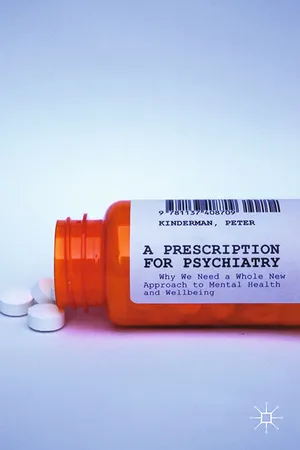
A Prescription for Psychiatry
Why We Need a Whole New Approach to Mental Health and Wellbeing
- English
- ePUB (mobile friendly)
- Available on iOS & Android
eBook - ePub
A Prescription for Psychiatry
Why We Need a Whole New Approach to Mental Health and Wellbeing
About this book
This is a manifesto for an entirely new approach to psychiatric care; one that truly offers care rather than coercion, therapy rather than medication, and a return to the common sense appreciation that distress is usually an understandable reaction to life's challenges.
Information
1
Get the Message Right: A Psychosocial Model of Mental Health and Well-being
The first step towards a humane, scientific, approach to care is to ensure that we get the message right – we need to change the framework of understanding from a ‘disease model’ to a ‘psychosocial model’. That means recognising that our mental health and well-being depends on the things happen to us, how we make sense of those events and how we respond to them. Differences between people are largely the result of social and psychological influences, rather than reflecting individual pathologies, medical or biological factors. Adopting this approach would be entirely compatible with the best traditions of psychiatry, and may even be the profession’s last chance to secure its future.
Psychiatry is a specialty within medicine, and medical thinking shapes many people’s understanding of the nature and causes of psychological distress, and of what constitutes appropriate care. We talk of being ‘ill’, of taking ‘sick leave’ from work, of retiring ‘on ill-health grounds’, of ‘diagnosis’ and of ‘treatment’. Diagnostic manuals are based on the assumption that distress can be diagnosed like any other, physical, illness. Researchers study the ‘aetiology’, or causation, of problems that are assumed to be illnesses ‘like any other’. We have become so used to thinking of psychological distress as a branch of medicine that we are in danger of no longer really challenging this assumption. But we need to start thinking differently. Real positive progress may only be possible when we realise that we are discussing a psychological and social phenomenon, not a medical one.
Reform and humanity
Textbooks of psychiatry like to present the history of the discipline as a humane progression from superstition and error through to scientific enlightenment. The 18th and 19th centuries saw the care of the ‘insane’ transferred from the responsibility of local parishes and city authorities to physicians (later alienists and psychiatrists). This is generally accepted to have led to more humane treatment and enlightened care – with Philippe Pinel’s work at the ‘Pitié-Salpêtrière Hospital’ in Paris leading the way. Quite naturally, with the medical profession having responsibility for care, a medical ethos now prevailed. And, as Richard Bentall described in his book ‘Madness Explained’,1 leading psychiatrists of the 19th century quite understandably incorporated the latest medical science into their care. So psychiatric diagnosis took hold and biomedical explanations became popular, attempting to emulate the success of similar, hugely important, developments in physical medicine.
It is very tempting to see a causal link between the undoubted progress towards humanity and the medicalisation of our understanding of psychological distress. The two developments happened at the same time, but a more humane approach towards people in distress was not dependent on developments of scientific medicine. Over a couple of hundred years, we saw the care of the ‘insane’ become the responsibility of physicians, psychiatry incorporated into medicine and simultaneously, significant improvements in the living conditions of many of the previous inmates. However ... contrary to the implicit messages offered by many, I am not at all sure that the first development was the cause of the second. So, while Pinel revolutionised care at the Parisian Pitié-Salpêtrière Hospital, in the UK we celebrate the humanity of William Tuke’s ‘York Retreat’, which was conceived of as a social, rather than a medical, initiative (and derided by the establishment of the time). The 18th and 19th centuries saw immense, revolutionary change in a swathe of social systems. Leaving aside the political revolutions of various kinds, both violent and non-violent, that swept across Europe, the past 250 years have seen reform ushering in humane care in many areas. We made impressive strides towards abolishing slavery. In the legal system, we have seen repeal of unjust laws and the development of a range of protection for defendants as well as wholesale reform of jails and regimes of punishment. We have seen the democratic enfranchising of working men and finally women, whereas political participation used to be a privilege for aristocrats and landowners. We have seen the spread of social welfare and (although we’re still waiting for the USA to catch up) the development of universal healthcare. Although each of these reforms depended on developments in our scientific and academic understanding of human nature, they did not require a ‘medical model’. Change, humane change, is clearly possible without labelling the subject matter as an ‘illness’. We can decide to give working men and women a vote without diagnosing the illness of ‘disenfranchisement’. We can offer people a decent quality of life if unemployed or retired without diagnosing an illness of ‘poverty syndrome’. And we can treat defendants in criminal proceedings with justice and humanity without necessarily invoking illness. Indeed, a churlish commentator may well point out that individual members of the medical profession have occasionally applied a medical approach to oppose rather than promote reform. In 1851, a Dr Samuel A. Cartwright proposed that the pseudo-diagnosis of ‘drapetomania’ could be used to label the supposed mental illness that caused black slaves to flee captivity. In 1946, the British Medical Association initially opposed the development of the National Health Service, primarily because it was feared it could affect their incomes as private medical practitioners.
This is significant. Enlightened, humane, progressive social services are possible without invoking a medical framework. This is not to deny or minimise the heroic work that pioneering doctors undertook in recent centuries to rescue people from horrendous ‘care’. Radical progress was needed, and physicians often led the way. But we do need to question whether a biomedical perspective is now an appropriate way to understand mental health and well-being. And dubious appeals to history are not necessarily useful guides to addressing that issue.
Debates and disagreements
Discussions about mental health and psychological well-being often unquestioningly assume that the ‘disease model’ is the only approach. But this assumption is hotly contested, and passionate debates about the essential nature of psychological distress take place even within psychiatry itself. At one end of the spectrum, many authoritative writers have argued that our psychological well-being can largely be explained in terms of brain functioning. This argument is intimately connected to the idea that problems in brain functioning can be diagnosed as ‘mental illnesses’, explained in biomedical terms, and treated using medical interventions. The ‘disease-model’ approach to psychiatry is dependent on a biomedical, reductionist view of human nature. Within modern psychiatry, there are many contrasting perspectives.
Perspective 1 ... ‘psychiatry is a medical speciality ... ’
It is abundantly clear that many (but not all, by any means) psychiatrists have always been strong proponents of both a biological explanation for mental health problems, and a biological perspective on human behaviour more generally. In 1989, the American Psychiatrist Samuel Guze published a short paper entitled ‘Biological psychiatry: is there any other kind?’2 in which he argued that, since all thoughts, all behaviours and all emotions have their origins in the brain, it is to the physical functioning of the brain that we should look for explanations and ideas for interventions. This general principle was developed by Eric Kandel in his well-written and very influential 1998 article; ‘A new intellectual framework for psychiatry’.3 For Guze and Kandel, changes in biological functioning are the ‘final common pathway’ for mental disorder and, indeed, therapy. For Kandel and Guze, all the important factors that affect our mental health do so by causing changes in biological functioning. That includes therapy; if therapy works (Guze and Kandel argue), it works by changing the biology of our brains.
More recently, in 2008, Professor Nick Craddock and 36 colleagues from the UK published an unabashed manifesto for the future of psychiatry – entitled ‘a wake-up call for British psychiatry’.4 After acknowledging that improved ‘psychosocial care ... is both understandable and welcome’, Craddock and colleagues argue that this has been accompanied by the ‘creeping devaluation of medicine’ in psychiatry. Their argument is that political forces and ‘the collusion, or at least the acquiescence, of psychiatrists’ has undermined a quintessentially medical approach to psychiatry. They argue that this ‘disadvantages patients and is very damaging to both the standing and the understanding of psychiatry in the minds of the public, fellow professionals and ... medical students’.
Craddock and colleagues’ perspective is clear. They state: ‘British psychiatry faces an identity crisis. A major contributory factor has been the recent trend to downgrade the importance of the core aspects of medical care. In many instances this has resulted in services that are better suited to delivering non-specific psychosocial support rather than a process of thorough, broad-based diagnostic assessment with formulation of aetiology, diagnosis and prognosis followed by specific treatments.’ They continue: ‘ ... Psychiatry is a medical specialty. We believe that psychiatry should behave like other medical specialties.’ This is a precise recapitulation of a medical model of psychiatry. Craddock and colleagues are also refreshingly clear in their professional or political aspirations – this is a precise recapitulation of a medical model of psychiatry.
Unlike Guze and Kandel, Craddock and colleagues advance only implicit, not explicit, arguments about biological aetiology. But those implicit references are clear. They take issue with ‘the scepticism of some psychiatrists towards biomedical explanations of illness’ and argue that there is ‘ ... a very real risk that as the understanding of complex human diseases steadily increases, recent moves away from biomedical approaches to psychiatric illness will further marginalise patients ... .’ Most tellingly, Craddock and colleagues argue that: ‘Major advances in molecular biology and neuroscience over recent years have provided psychiatry with powerful tools that help to delineate the biological systems involved in psychopathology and impairments suffered by patients. We can be optimistic that over the coming years these advances will facilitate the development of diagnostic approaches with improved biological validity and enhanced clinical utility in terms of predicting treatment response. We can expect that completely novel treatments will be developed based on detailed understanding of pathogenesis.’
In other words, Craddock and colleagues suggest that it is risky to be sceptical about biomedical explanations, that moving away from a biomedical approach would harm patients. They confidently expect that molecular biology and neuroscience will help us understand the ‘pathogenesis’ (the cause or origin of a disease) of mental health problems, confirm the value of ‘biomedical explanations of illness’ and reinforce the value of a medical psychiatric profession.
Perspective 2 ... ‘psychiatry is not a medical speciality ... ’
But that is not the only voice from within the profession and academic discipline of psychiatry. Like Nick Craddock, Pat Bracken is also a consultant psychiatrist and professor of psychiatry. He, like Craddock, was able to convene an impressive collection of like-minded psychiatrists and, like Craddock, set out their opinions in an editorial in the British Journal of Psychiatry.5 Which argued almost exactly the opposite. Pat Bracken and colleagues suggested that the vast majority of mental health problems should be understood from the perspective of social psychiatry – as normal, human responses to difficult social circumstances. And therefore Pat and colleagues argued for a social, psychosocial, empathic response.
There is some value in directly contrasting the views of Nick Craddock and colleagues with those of Pat Bracken and colleagues. Craddock and colleagues suggest that ‘ ... Psychiatry is a medical specialty. We believe that psychiatry should behave like other medical specialties’, whereas Bracken and colleagues argue that ‘Psychiatry is not neurology; it is not a medicine of the brain.’ Craddock and colleagues warn that it is ‘imperative to take action’ to address the negative consequences of ‘the scepticism of some psychiatrists towards biomedical explanations of illness’ whereas Bracken argues that ‘good psychiatry involves active engagement with the complex nature of mental health problems [and] a healthy scepticism for biological reductionism ... .’ And Craddock and colleagues are concerned that ‘ ... [recent changes have placed insufficient] ... weight on medical fundamentals ... ’, whereas Bracken and colleagues counter that ‘ ... good practice in psychiatry primarily involves engagement with the non-technical dimensions of our work such as relationships, meanings and values.’ To drive the point home: psychiatry is either a branch of biological medicine ... or it’s not, that scepticism of biological reductionism is either harmful ... or necessary, and a focus on the technical aspects of medicine is either fundamental ... or a distraction.
Perspective 3 ... ‘we’re a team ... ’
The groups led by Nick Craddock and Pat Bracken clearly have divergent views about the future of psychiatry. There is a third approach, which emerged from the multi-professional discussions of ‘New Ways of Working’,6 and has been championed by the consultant psychiatrist Christine Vize. This team-based approach argued that proper care for people in deep personal distress is a collective effort; a multi-professional effort. Since people have a range of needs, from social, through psychological to medical (and in different proportions for different people), the team requires a range of specialists who would work together (in different cases in different ways) to offer help. In this model, psychiatry would be a valuable partner, but would have an entirely different – more ‘democratic’ and much more along the lines of genuine consultancy, contributing to a multidisciplinary mental health care team’s work where necessary, rather than necessarily having authority over that team.
I can see elements of value in all three models. I strongly orientate to the third model in practice, but share Pat Bracken and colleagues’ approach in terms of ethos and framework of understanding. Perhaps surprisingly, I also think that Craddock’s appeal for psychiatrists to remember their core role as medical practitioners has some merit. But I do not believe that any of these models fully addresses the depth of psychiatry’s crisis as a profession, and none offers a fully developed solution to the failings of our mental health care system. In particular, these three perspectives together suggest that psychiatry, as it is currently constituted, does not have a coherent or valid model of why people are distressed, nor what might help, and could therefore be either largely irrelevant or actively harmful ... but yet (because the principals are psychiatrists) must conclude that psychiatry must remain the key and dominant profession. In essence, I would like to see my psychiatric colleagues hold the pride in their medical expertise that Nick Craddock espouses, adopt the ethos of Pat Bracken, and work democratically within teams as envisaged by Christine Vize.
Things are explicit for Nick Craddock and his colleagues, with a clarion call for the authority of psychiatry to follow from their expertise in biological medicine, since the problem is seen as a biological one, and to be reflected in the nature and ethos of services. It is interesting to note how Craddock and colleagues argue that ‘psychiatric services may not be best placed to manage the majority of individuals with such mild symptoms, who would be better served by other more general services. It is probably in the best interest of such individuals to avoid medicalising both the terminology and the type of help that they may require or want.’ This is fascinating, because it appears to be a recognition of the psychosocial perspective that I argue throughout this book. But the underlying message is rather darker – it suggests that ‘other services’ can deal with people with ‘mild symptoms’, but thereby implies that the medical and medicalised approach – the ‘disease model’ – remains appropriate for people with more serious problems. My argument is different; I argue that the whole system and ethos needs reform, not that the broken system needs to be retained for the most vulnerable.
Things are different for Pat Bracken and colleagues. But I remain slightly cautious. Bracken argues that ‘Psychiatry has the potential to offer leadership in this area.’ I would never argue with that, but there are subtle echoes of the idea that psychiatrists, as medical consultants, are naturally placed to lead the teams offering care. This echo can be heard in the active embrace of psychiatry for psychological therapies such as cognitive behavioural therapy (CBT). Obviously this is welcome – it is not only good news that practitioners are offering and advocating appropriate solutions, it is actually good news that people are able to understand the findings of psychological science. It also reflects a phenomenon of medicine; it’s quite often driven by ‘trial and error’ approaches. So, if an intervention ‘works’, then our clinical colleagues embrace it ... as they probably should. But this has meant that psychological approaches have often been incorporated as afterthoughts into rather conventional services. Many psychologists have expressed some concerns that interventions such as CBT are offered as if they are functionally indistinguishable from medication. That is, people are ‘diagnosed’ with (for instance) ‘mil...
Table of contents
- Cover
- Title
- Introduction: The Disease Model of Mental Health: A System in Crisis
- 1 Get the Message Right: A Psychosocial Model of Mental Health and Well-being
- 2 Understand, Dont Diagnose
- 3 The Drugs Dont Work So Offer Real Solutions
- 4 Promote Health and Well-being
- 5 Residential Care Not Medical Coercion
- 6 Teamworking
- 7 Social and Community Services in Local Authority Management
- 8 Can We Afford It?
- 9 A Manifesto for the Reform of Mental Health and Well-being Services
- Notes
- Index
Trusted by 375,005 students
Access to over 1.5 million titles for a fair monthly price.
Study more efficiently using our study tools.
Frequently asked questions
Yes, you can cancel anytime from the Subscription tab in your account settings on the Perlego website. Your subscription will stay active until the end of your current billing period. Learn how to cancel your subscription
No, books cannot be downloaded as external files, such as PDFs, for use outside of Perlego. However, you can download books within the Perlego app for offline reading on mobile or tablet. Learn how to download books offline
We are an online textbook subscription service, where you can get access to an entire online library for less than the price of a single book per month. With over 1.5 million books across 990+ topics, we’ve got you covered! Learn about our mission
Look out for the read-aloud symbol on your next book to see if you can listen to it. The read-aloud tool reads text aloud for you, highlighting the text as it is being read. You can pause it, speed it up and slow it down. Learn more about Read Aloud
Yes! You can use the Perlego app on both iOS and Android devices to read anytime, anywhere — even offline. Perfect for commutes or when you’re on the go.
Please note we cannot support devices running on iOS 13 and Android 7 or earlier. Learn more about using the app
Please note we cannot support devices running on iOS 13 and Android 7 or earlier. Learn more about using the app
Yes, you can access A Prescription for Psychiatry by P. Kinderman in PDF and/or ePUB format, as well as other popular books in Psychology & Psychiatry & Mental Health. We have over 1.5 million books available in our catalogue for you to explore.