- English
- ePUB (mobile friendly)
- Available on iOS & Android
eBook - ePub
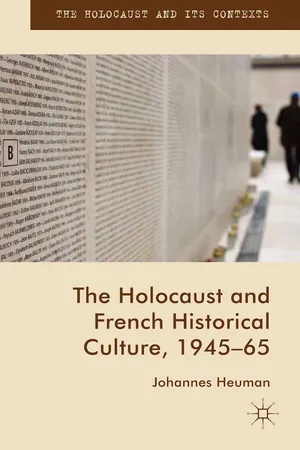
The Holocaust and French Historical Culture, 1945–65
About this book
Paris was home to one of the key European initiatives to document and commemorate the Holocaust, the Centre de documentation juive contemporaine . By analysing the earliest Holocaust narratives and their reception in France, this study provides a new understanding of the institutional development of Holocaust remembrance in France after the War.
Information
Topic
StoriaSubtopic
Storia europea1
Introduction
National historiographies and commemorations in Europe have traditionally been employed as forceful instruments in the consolidation of nation-states and to foster a belief in national homogeneity. This was particularly the case during the two decades following the Second World War, when narratives of national heroism and resistance were used to reconstruct the disastrous experiences of the recent past. In France, Charles de Gaulle, as the head of the provisional government after the Liberation, developed a memory policy that sought to heal the wounds of a divided nation by ignoring ideological conflicts, focusing on the military aspects of the war, and adopting an expansive view of the Resistance as a basis for a common identity. This well-known pattern of how the legacy of the Second World War was incorporated into national-historical culture was repeated all across Europe, mirroring how nationalism and historical narratives had strengthened nation-building projects in Europe long before the war.
In spite of the dominance of these national myths, however, the end of the Second World War also saw the rise of new approaches to the past that grew from the traumatic experience of the Holocaust. Contrary to common belief, public discussions on this genocide did not start from nearly nothing in the 1970s when the patriotic narratives of the war lost their influence in Western Europe; recent scholarship on early post-war reactions to the genocide of the Jews has shown how transnational initiatives in Europe, the US, and Israel paved the way for Holocaust studies, museums, and archive collections as early as the end of the 1940s.1 These small groups collected documents and presented alternative narratives as a corrective to national historiographies. A great deal of the literature was written in Yiddish and thus was completely disconnected from national-historical cultures, yet some of these early Holocaust historians and memorial activists did set out to insert the narratives into the history of the nations where they were working, albeit as minority voices. The Jewish Historical Institute in Warsaw, for example, published its accounts in both Polish and Yiddish. The Polish government supported its activities at first, but by the late 1940s it was already subject to increasing state control and fell victim to the official history policy.2 A more fortunate example was the Wiener Library in London, which provided a small forum for the discussion of issues related to Nazism in general, but also the Holocaust. Difficulties in travelling between East and West did not hinder international exchange and the circulation of Holocaust narratives within and outside Europe.
The recent empirical research on early reactions to the Holocaust has for the most part focused on tracing relevant actors and publications, looking for evidence of discussions of the genocide or for justification of some provocative claims that there was a ‘myth of silence’. Indeed, the rediscovery of the early efforts to document the Holocaust has resulted in a more complex picture of how perceptions of the Jewish trauma have developed over the decades. What is still missing, however, is an understanding of the impact these activities might have had, the extent to which they managed to challenge more established interpretations of the past, or how they integrated the Jewish experience into broader national debates. If the growing body of Holocaust research was indeed completely marginalised, then the notion of silence remains valid, at least on a national level. Furthermore, any attempt to consider the Holocaust was, and is, necessarily connected to fundamental issues in historical thinking; these historians sought to represent the past using new entities and new approaches that transcended merely national concerns. Their work allows us to reflect on alternative functions of history in post-war Europe. A closer look at the narratives produced by historians outside the academic establishment also exposes the difficulty of holding to an independent historical line within a strong nation-state: how far could the minority experience be separated from the national experience, and how did the majority respond?
The present book analyses the emergence of Holocaust remembrance in France by looking at the first two post-war decades, before the national and heroic myths began to tarnish, there as elsewhere in the West. During this period, minority groups within the nation still had few opportunities to claim their history and demand recognition from the state. Indeed, the Paris-based Centre de documentation juive contemporaine, or CDJC, which is the focus of this book, was one of those alternative voices that represented history in Europe in new ways. Originally founded in 1943 in Grenoble in order to collect evidence against the Nazis and their French collaborators, the centre was re-established in Paris after the Liberation in 1944. The activists associated with the CDJC – mostly immigrants from Eastern Europe who had settled in France in the interwar period – raised uncomfortable questions about French complicity in the Holocaust in books and articles, and provided documentary evidence for war crimes trials. Moreover, to create a symbolic place for the Holocaust, the Tombeau du Martyr Juif Inconnu, which is known today as the Mémorial de la Shoah, was inaugurated in Paris in 1956, integrating the CDJC with a memorial and a museum. With the construction of this building, the group sought to centralise all existing commemorative practices in France and to become more influential. The institution continues its activities until today, and the CDJC has recently changed its name to the Centre de documentation du Mémorial de la Shoah.3
Institutions such as this are obviously important if we are to understand how the preoccupation with the Holocaust in recent decades first developed immediately after the war. In France, as in most European countries, the Holocaust legacy has unsettled the public debate about the past. Firstly, the discussion of the genocide has to varying degrees been associated with the Vichy regime and the shame of wartime collaboration. While remembrance of war has traditionally served a unifying purpose, and has been cultivated in order to strengthen national unity, the existence of the Vichy regime in France has made the legacy of the Second World War far more difficult to deal with, as the historian Henry Rousso recognised in his classic account of the post-war period, terming it the ‘Vichy syndrome’.4
Secondly, the strong impact of Holocaust history has challenged the French Republic’s reluctance to differentiate between its citizens according to ethnicity or religious affiliation. Ever since the French Revolution, civil society has rejected any form of community organisation that might detract from the individual’s state allegiance. The historian Annette Wieviorka’s pioneering study of the inability of French society to recognise the particular Jewish experience in the early post-war years has stressed this point. It was this outlook that meant that soon after the war the memory of the 76,000 Jews deported from France had been diluted and assimilated into the narrative of national martyrdom.5 The construction of a separatist approach to the past, based on ethnic or religious belonging, has thus been controversial in the republican tradition, which in turn is central to French historical culture. On the whole, the significant role of the Holocaust today in educational programmes and in national commemorations and debates has been closely related to the inclusion of contested issues such as the politics of multiculturalism and communitarianism in France and in Europe. What sets France apart from most part of Europe, however, is its long-established liberal tradition of immigration, which enabled the Jewish community to become particularly strong in the decades following the Second World War.
The present book will thus consider the early post-war historical culture and the Holocaust in France by taking the CDJC and the Tombeau du Martyr Juif Inconnu (hereafter referred to as the Mémorial, responsible for commemorations and other public manifestations, or the CDJC/Mémorial when referring to the entire institution including the archive and research centre CDJC) as its starting point. During the first post-war decades, the CDJC/Mémorial was probably the most influential institution in Europe when it came to Holocaust history. Yet, equally, its existence in France was far from self-evident, and the early post-war period saw it struggle to survive.
The chronology for the present study has been chosen in order to study those first steps in coming to terms with the past, before the Holocaust became a widespread subject of academic research, before the heated public debate, and before the increasing influence of North America was felt, with historians such as Robert Paxton and Michael Marrus as well as popular representations such as the mini-series Holocaust, which was broadcast on French television in 1979. The end date of 1965 is not associated with a particular event; rather it marks a midway point, as the patriotic narratives reached a peak and then started to lose their consensual appeal. The first two post-war decades are therefore particularly interesting for the relationship between France’s national-historical culture and the initiative to explore the Holocaust, since it has previously been assumed that the patriotic line was hegemonic during this period and that any search for public perceptions of the genocide would be anachronistic.6 This book refutes such claims and contributes to a new perspective on how the awareness of the Holocaust developed.
Purpose of the book
The overall ambition of this study is to investigate how the Holocaust remembrance was institutionalised and formed within French historical culture and conversely to analyse how the representations of this genocide eventually influenced the national-historical culture in France. The starting point for this reflection is the activities of the CDJC/Mémorial in 1945–65. With this focus, the book will illuminate the position of one independent producer of historical representations, based on a minority experience, and its connection to political, moral, scholarly, and existential claims. This will contribute new insights into how French historical culture has been shaped, especially in the light of the recent re-examination of early post-war reactions to the Holocaust.
Being a study of the first major institutional expression of Holocaust remembrance, it will also chart the extent to which a separatist approach to the past has eventual challenged French republicanism and its traditional reluctance to recognise or record any religious, ethnic or cultural group identity within the nation. In this case, moreover, the particularly Jewish experience of the past was entangled with the politically charged issue of the Vichy regime, which made it even more complicated to incorporate the Holocaust into French historical culture. Although the focus is on the first two post-war decades, the origins of this enterprise to memorialise the Holocaust will be traced to a longer tradition of identity politics with roots in the Dreyfus Affair. In reviewing a national-historical culture from a minority perspective, armed with a number of theoretical concepts and tools, the book furthermore demonstrates how minority narratives can be used to study the formation of historical cultures in general.
The book addresses three main aspects of Holocaust remembrance: its construction, function, and reception.
(i) Construction
In what ways, and by which means, has the Holocaust been constructed in historical narratives? The content and form of the various representations will be analysed to see how they contributed to one or more narratives of the recent past. Two issues are central here: first, how the CDJC/Mémorial separated the Jewish experience from that of the rest of the nation and thus challenged France’s universalistic republican tradition; and, second, how the involvement of the Vichy regime in the Holocaust was treated. The study will also look at the circumstances of the production of the historical representations, anchoring them in a longer tradition of French historical culture and in post-war interpretations of Nazism and the Second World War. The past was brought to public attention in books, articles, exhibitions, and commemorative activities.
(ii) Function
To what ends has the history of the Holocaust been used in French historical culture? This question calls for a functional perspective on historical culture, with an exploration of the needs met by the Holocaust representations and their shifting functions in post-war France. It is obvious that the centrality of the Holocaust in present-day historical culture is a response to a number of interests, as individuals and groups invoke the Holocaust in order to draw attention to injustice or other moral, political, and existential issues. By approaching the question with the help of a typology described below, the book will contextualise the narratives produced by the CDJC/Mémorial in order to map the historical-cultural shifts in French attitudes to the Holocaust. The functional perspective also links construction to reception by looking both at the interests behind historical representations and what roles they fulfilled in France.
(iii) Reception
How was this history received? It is already known that institutions, groups, and individuals akin to the CDJC/Mémorial produced Holocaust narratives during the early post-war period, but still there is little research on the influence of these early initiatives outside the Jewish sphere, which is central if one is to understand the position of the Holocaust in post-war France. This will be redressed here by looking at the reception of the representations of the Holocaust in media and their possible influence on French politics and academic research. There is no way to measure exact influence, of course, but with the help of newspaper articles, official correspondence, and the minutes of meetings it is possible to evaluate the impact of the CDJC/Mémorial’s activities and see how it changed during the period. Of particular interest is the support shown by politicians for the activities of this Jewish institution.
Historical culture from a minority perspective
The project obviously calls for a constructivist approach to historical knowledge, inspired by the postmodern critique of scientific positivism in general and, more specifically, of what historians claim ‘really happened’. The linguistic turn teaches us that history is bound up with discourses or narratives shaped by cultural and linguistic conventions that determine how we represent the past. While this does not necessarily mean that all interpretations of the past are equally valid, it still provides the starting point for this investigation: the production of historical narratives constructs as much as it records the past.7 This constructivist perspective has also been influential in research on ‘collective memory’, a field that has grown significantly since the 1990s and inspired scholars of the humanities and social sciences to study a range of social practices, looking for expressions of collective memory; however, the concept has been criticised for being too static, because it reduces various representations of the past to collective experience. As far as Holocaust and genocide studies are concerned, this is evident in the way Freudian terms such as ‘trauma’ and ‘repression’ have been applied to a whole group of people or a society in order to explain the supposed silence about the Holocaust.8
The present analysis will instead look at representations of the past within a historical-cultural framework. The growth of studies about historical culture is closely associated with a theoretical school of historical thinking first developed in Germany in the late 1970s. One of its leading figures is Jörn Rüsen, who has written extensively on historiography and historical culture. The latter is here defined as the communicative and structural framework of a society’s relation to the past – or rather the aspects of culture that refer to history. Historical culture includes the whole field of representations of the past and all activities to do with processing it. The term ‘remembrance’ is here applied to social practices dealing with the past in its various form within the historical culture. A focus on historical culture is thus a way of approaching relations to the past in a broader sense than is usually seen in the history of historiography or memory studies. The concept has similarities with Jan Assmann’s notion of ‘cultural memory’, which is understood as a fixed heritage shaped over a long period of time, expressed through texts, rites, and images that create unity and function as a ‘concretisation of identity’. Yet, while Assmann distinguishes cultural memory from the daily ‘communicative memory’ – in other words, past relations expressed in daily life – and further holds it to be a separate genre, distinct from science, there is no such distinction implied in the concept of historical culture.9
In Rüsen’s view, all forms of narration of the past are part of a historical culture that can be understood as an umbrella concept or synthesis of a society’s relations to the past. The problematic ...
Table of contents
- Cover
- Title
- Copyright
- Contents
- List of Illustrations
- Acknowledgements
- 1 Introduction
- 2 French–Jewish Relations and Historical Culture
- 3 Nationalisation and Isolation
- 4 Europeanisation and Historicisation
- 5 Universalisation and Global Remembrance
- 6 The Holocaust Enters French Historical Culture
- 7 Concluding Discussion
- Notes
- Bibliography
- Index
Trusted by 375,005 students
Access to over 1.5 million titles for a fair monthly price.
Study more efficiently using our study tools.
Frequently asked questions
Yes, you can cancel anytime from the Subscription tab in your account settings on the Perlego website. Your subscription will stay active until the end of your current billing period. Learn how to cancel your subscription
No, books cannot be downloaded as external files, such as PDFs, for use outside of Perlego. However, you can download books within the Perlego app for offline reading on mobile or tablet. Learn how to download books offline
Perlego offers two plans: Essential and Complete
- Essential is ideal for learners and professionals who enjoy exploring a wide range of subjects. Access the Essential Library with 800,000+ trusted titles and best-sellers across business, personal growth, and the humanities. Includes unlimited reading time and Standard Read Aloud voice.
- Complete: Perfect for advanced learners and researchers needing full, unrestricted access. Unlock 1.5M+ books across hundreds of subjects, including academic and specialized titles. The Complete Plan also includes advanced features like Premium Read Aloud and Research Assistant.
We are an online textbook subscription service, where you can get access to an entire online library for less than the price of a single book per month. With over 1.5 million books across 990+ topics, we’ve got you covered! Learn about our mission
Look out for the read-aloud symbol on your next book to see if you can listen to it. The read-aloud tool reads text aloud for you, highlighting the text as it is being read. You can pause it, speed it up and slow it down. Learn more about Read Aloud
Yes! You can use the Perlego app on both iOS and Android devices to read anytime, anywhere — even offline. Perfect for commutes or when you’re on the go.
Please note we cannot support devices running on iOS 13 and Android 7 or earlier. Learn more about using the app
Please note we cannot support devices running on iOS 13 and Android 7 or earlier. Learn more about using the app
Yes, you can access The Holocaust and French Historical Culture, 1945–65 by Johannes Heuman in PDF and/or ePUB format, as well as other popular books in Storia & Storia europea. We have over 1.5 million books available in our catalogue for you to explore.