eBook - ePub
The Contested Identities of Ulster Protestants
- English
- ePUB (mobile friendly)
- Available on iOS & Android
eBook - ePub
The Contested Identities of Ulster Protestants
About this book
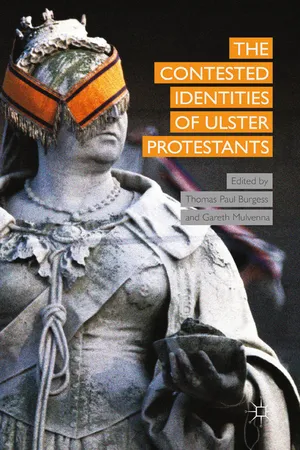
This study explores the idea voiced by journalist Henry McDonald that the Protestant, Unionist and Loyalist tribes of Ulster are '…the least fashionable community in Western Europe'. A cast of contributors including prominent politicians, academics, journalists and artists explore the reasons informing public perceptions attached to this community.
Information
1
Beginning to Talk to ‘Billy’: Revising Southern Stereotypes of Unionism
Eoghan Harris
And we are here as on a darkling plain
Swept with confused alarms of struggle and flight,
Where ignorant armies clash by night.
(Matthew Arnold, ‘Dover Beach’)
Introduction
Here’s the question. For 77 years the Irish Republic rode roughshod over the political wishes of northern unionists by persisting with a constitutional claim on Northern Ireland.1 Yet in 1998, by a massive majority of 94 per cent, those who voted for the Good Friday Agreement in the Irish Republic suddenly gave up that claim. How did such a convulsive change come about?
Controversially, I believe that change was largely driven by a small platoon of revisionists who waged a long war of political persuasion – but who only won that war because of a moral revulsion in the Irish Republic, marked by a number of milestones, which saw the South put aside its stereotypes of northern unionists and see them for the first time as fellow human beings and acceptable agents of their own history. Most southern nationalists saw revisionists as supporters of unionism, a charge that could hardly be denied since revisionists supported the principle of unionist consent and rejected the majority stereotype of unionists as suffering from false consciousness or racial hubris. But it made for a bitter war as well as a long war.
The big set-piece battles in that long war were won by a few famous revisionists, notably Conor Cruise O’ Brien (States of Ireland), Ruth Dudley Edwards (The Faithful Tribe) and John A. Murphy’s Seanad speeches of the 1970s. My own contribution was closer to that of a guerrilla, but I believe my area of operations covered a wider range of activities than almost any other participant. In support of this I would point to this far from exhaustive list of activities: revisionist pamphlets for the Workers’ Party (The Irish Industrial Revolution, 1977); stage plays on Protestant themes (Showband, 1982; Souper Sullivan, 1985); pro-unionist polemics in RTÉ (‘Television and Terrorism’, 1987); a weekly column in the Sunday Times largely addressed to northern unionists (1993–2000); pamphlets advising unionists on media (‘Selling Unionism’, 1995); contributions to David Trimble’s Nobel Prize speech (1998); contributions to a feature film (A Love Divided, 1999), three documentary films about the maltreatment of Protestants in the Irish Republic (Coolacrease, Cork’s Bloody Secret and An Tost Fada/The Long Silence, 2008–2012); and most recently a major revisionist speech entitled ‘Towards 2016’.
The Arms Trial of 1970 was my wake-up call. The spectre of sectarian strife in the form of the Provisional IRA had shown its fascist face. In common with a handful of revisionists in the Republic, I resolved to do all in my power to thwart their malign plans. From then on hardly a week passed without me taking part in some political skirmish with supporters of irredentist Irish nationalism. And that intense participation in an almost 30-year struggle gives me some authority to make three core assertions. I believe that between 1970 and 1998 the Irish Republic changed its mind about unionism because it changed its mind about unionists. I believe this change was both political and moral, but that the moral change was by far the most important. I believe the change was marked by ten milestones, some of which historians depending on documents alone might see as merely marginal events. For example, I believe the Kingsmills massacre left an indelible mark on the moral psyche of the Irish Republic, whereas rhetorical nationalist posturing, like the New Ireland Forum of 1984, left not a trace behind. Arising from that evaluation, the essay that follows has three aims.
First, to chronicle ten moral and political milestones which in my view helped push anti-unionist prejudices to the margins of public life. Second, to show that what Eamon Dunphy famously dubbed ‘Official Ireland’ – the politicians, journalists and academics of the Irish Republic – continually lagged behind some of the smaller socialist parties as well as the general public in promoting pluralism. Third, to show that even a resolute revisionist like me did not find it easy to embrace the unionist case with complete empathy.
The darkling plain of prejudice 1921–66
My own life mirrors the Irish Republic’s journey from myth to reality. I was born in Cork in March 1943. A month later, on April Fool’s Day, as millions were fighting and dying in Europe, de Valera’s Irish Press proclaimed with perfect seriousness: ‘There is no kind of oppression visited on any minority in Europe which the six-county nationalists have not also endured.’ And no, it was not an April Fool’s joke. That kind of selfish myopia was by now normal in a southern political culture that had been in retreat from reality since 1921. It was a culture marked by two distortions which might be designated the pathology of anti-partitionism and the schizophrenia of stereotypes. Let me start with the pathology, defined in psychology as an inability to either change or to see the other clearly. From the foundation of the state Irish nationalists refused to face the reality of unionist opposition to a united Ireland.2 Only 9 of the 338 published pages of debates on the Treaty of 1921 were on Northern Ireland.3 The new state publicly paid lip service to Wolfe Tone’s brotherhood of Protestant, Catholic and Dissenter, but adopted an ideology of anti-partitionism that stereotyped unionists as bigots rather than brothers.
Even a liberal republican like my father shared the general nationalist delusion that northern unionists suffered from two fundamental flaws. First, they were victims of what Marxists call ‘false consciousness’, i.e., they didn’t know what they really wanted. Second, they suffered from feelings of racial superiority – a charge that would be recycled in the 1970s by some historians calling them Herrenvolk, a reference to racist South Africans. In passing, it should be noted that southern prejudice was not confined to unionists. Publicly, northern nationalists were lauded as our lost brethren. Privately, the Free State Cabinet found them an irritating nuisance, no more than a political and rhetorical stick to reinforce the Republic’s territorial claim on Northern Ireland, later enshrined in Articles 2 and 3 of the 1937 Irish Constitution.4 A schizophrenic stereotyping of northern unionists was the close companion of pathological anti-partitionism. Southern nationalists held two totally conflicting stereotypes of unionists in their heads. The first was that of a noble Protestant patriot, whom I shall call ‘Henry’ in honour of the Presbyterian United Irishman, Henry Joy McCracken; the second was that of a sectarian Orange bigot, whom I shall call ‘Billy’ in honour of William of Orange. Although ‘Henry’ had not been seen much since 1798, Irish nationalists frequently summoned him, for purely rhetorical purposes, to take his place on southern political platforms. However, when ‘Henry’ the Republican failed to appear, southern nationalists would swiftly dump his stereotype and replace it with that of ‘Billy’ the Bigot.
Southern antipathy against ‘Billy’ was somewhat mirrored by a soft sectarianism in its treatment of ‘Billy’s’ southern cousin, ‘William’. Official Ireland claimed the Republic had always treated southern Protestants well – and what brave ‘William’ would publicly complain it did not? Accordingly, any reference to the catastrophic numerical decline of Protestants (by one third between 1911 and 1926) was totally taboo. From the early 1980s southern revisionists found that publicly admitting that some southern Protestants had suffered discrimination, however unpopular, brought two pluralist benefits. First it showed northern unionists that a few hardy souls in the Republic were ready to challenge the Catholic-nationalist narrative. Second, it subverted that most precious of southern myths: that bigotry only began at the border. Here Kevin Myers’ ‘Irishman’s Diary’ in the Irish Times made a major contribution by exposing the enforced exodus of rural Protestants during the period 1919–23. Although antipathy against ‘Billy’ was the norm among the majority of southern nationalists, a substantial minority referred to themselves as ‘real republicans’ to distinguish themselves from sectarian Catholic nationalists. For many years I saw myself as a ‘real republican’ too. Eventually, however, I could see why unionists were sceptical about the sincerity of ‘real republicans’ as long as they held onto myths like false consciousness and refused to accept the principle of consent.
My father was such a ‘real republican’. He strongly opposed the famous Fethard-on-Sea boycott of Protestant shops in Wexford in 1957. But his pluralism seemed to stop at the border. He still saw Billy as through a glass darkly. No matter how often Billy told us he rejected Irish unity, even ‘real republicans’ refused to believe him. Some day he would share our dream, Tone’s Republic of Catholics, Protestants and Dissenters. Even Conor Cruise O’Brien was not immune to ‘real republican’ rhetoric. As late as 1966, in Embers of Easter, he could write that ‘the territorial division of the island between these people [Gaels] and the children of the Scottish-settlers in Ulster, was the slightly distorted expression of a long-standing spiritual division which men like Tone and Pearse lived and died to close’.5 However that same year, 1966, marked a watershed. The dark forces of Provo nationalism would soon force O’Brien to fundamentally change his mind – and he in turn would eventually persuade the rest of us in the Irish Republic to change our minds too; but nobody in 1966 could have imagined the bloody milestones that would mark the journey across the darkling plain.
The war of ignorant armies 1966–98
In 1966, the Irish Republic celebrated the fiftieth anniversary of the 1916 Rising, with re-enactment dramas on RTÉ. The same year saw the start of the Northern Ireland Civil Rights Association. As a trainee producer in RTÉ, and also an active member of the Dublin Wolfe Tone Society, I was involved in both events. In August 1966, at a secret meeting in Maghera, attended by the left-wing leadership of the IRA, together with trade unionists and academics, I was selected to read a long document from the Dublin Wolfe Tone Society which set out the strategy for the newly formed Northern Ireland Civil Rights Association. The strategy stressed the peaceful principles that should govern the NICRA campaign. I still remember a phrase to the effect that the whole strategy would fail ‘at the first sound of a bomb or a bullet’. The founders of NICRA shared the general nationalist consensus that Billy was being manipulated by British and unionist puppeteers. But they also pragmatically believed in not provoking him with talk of Irish unity during the struggle for civil rights. That is why NICRA opposed the provocative People’s Democracy march to Burntollet. They feared it would bring out not ‘Henry’ but ‘Billy’. They were right. In 1970, the Provisional IRA stepped onto the stage, determined to force Billy to do what he did not want to do.6 The Irish Republic remained ambivalent for a few bloody years and then began the slow journey towards reality. What follows is a chronicle of ten moral and political milestones that marked that journey. They omit later atrocities like the Omagh bomb, because by then reality had kicked in.
Note: the adjective preceding the word ‘milestone’ indicates whether ‘political’ or ‘moral’ carries the most weight.
The Arms Trial of 1970 was the first political milestone. At its core was the tribal figure of Charles Haughey, who was openly contemptuous of Ulster Protestants, and seemed willing to risk civil war to promote his political career. So as early as 1970, the Republic had to take sides. By not taking Haughey’s side it took the first small step towards realism. But if Haughey was nakedly tribalist, even a liberal like Garret Fitzgerald had problems with unionists too. In his 1973 book, Towards a New Ireland, he repeats the Republic’s deep-rooted delusion that Billy suffered from false consciousness and secretly hankered after a united Ireland. ‘Even today, the deep-rooted but rarely admitted belief that ultimately Irish unity must prevail, lies at the heart of many Northern Protestant attitudes.’7 At least Fitzgerald’s delusions about ‘Billy’ were benign. That was not true of some of the most senior figures in the British politics. In 1972, while Prime Minister Harold Wilson was being filmed for an RTÉ programme on the Liverpool dock strike, he tried to ingratiate himself with the RTÉ team by making ribald off-the-record remarks about unionists. Wilson’s delinquent attitude towards Northern Ireland was confirmed by Dermot Nally, Assistant Secretary to the Irish Government. At a lunch at Downing Street in 1976 he heard Wilson ask the Irish Taoiseach, Liam Cosgrave point-blank: ‘Wouldn’t it be better for everybody if we just let them kill each other in Ulster?’8
The second political milestone was the speech in the same year as Wilson’s remark, 1972, by Tomás Mac Giolla, President of Official Sinn Féin at Carrickmore, County Tyrone. Given the different degrees of delusion about unionists held by Haughey, Fitzgerald and Wilson around the same time, Mac Giolla’s courageous speech shines like a pluralist star in the darkling plain of delusional beliefs about unionists. People have talked about the Pr...
Table of contents
- Cover
- Title
- Copyright
- Dedication
- Contents
- List of Tables
- Preface
- Acknowledgements
- Notes on Contributors
- Introduction
- 1 Beginning to Talk to ‘Billy’: Revising Southern Stereotypes of Unionism
- 2 Investigating the Protestant ‘Kaleidoscope’
- 3 Lost in Translation: Loyalism and the Media
- 4 Typical Unionists? The Politicians and their People, Past and Present
- 5 ‘Doing Their Bit’: Gendering the Constitution of Protestant, Unionist and Loyalist Identities
- 6 The Re-invention of the Orange Order: Triumphalism or Orangefest?
- 7 Loyalism On Film and Out of Context
- 8 This Sporting Life: Anything to Declare? Community Allegiance, Sports and the National Question
- 9 No One Likes Us, We Don’t Care: What Is to Be (Un) Done about Ulster Protestant Identity?
- 10 Celebration and Controversy in America: At Home with the Scots-Irish Diaspora
- 11 Convergence
- 12 Labour Aristocracies, Triumphalism and Melancholy: Misconceptions of the Protestant Working-Class and Loyalist Community
- 13 To the Beat of a Different Drum: Loyalist Youth and the Culture of Marching Bands
- 14 Blood Sacrifice for Queen and Country: Paramilitarism and Political Manoeuvrings
- Index
Trusted by 375,005 students
Access to over 1.5 million titles for a fair monthly price.
Study more efficiently using our study tools.
Frequently asked questions
Yes, you can cancel anytime from the Subscription tab in your account settings on the Perlego website. Your subscription will stay active until the end of your current billing period. Learn how to cancel your subscription
No, books cannot be downloaded as external files, such as PDFs, for use outside of Perlego. However, you can download books within the Perlego app for offline reading on mobile or tablet. Learn how to download books offline
Perlego offers two plans: Essential and Complete
- Essential is ideal for learners and professionals who enjoy exploring a wide range of subjects. Access the Essential Library with 800,000+ trusted titles and best-sellers across business, personal growth, and the humanities. Includes unlimited reading time and Standard Read Aloud voice.
- Complete: Perfect for advanced learners and researchers needing full, unrestricted access. Unlock 1.5M+ books across hundreds of subjects, including academic and specialized titles. The Complete Plan also includes advanced features like Premium Read Aloud and Research Assistant.
We are an online textbook subscription service, where you can get access to an entire online library for less than the price of a single book per month. With over 1.5 million books across 990+ topics, we’ve got you covered! Learn about our mission
Look out for the read-aloud symbol on your next book to see if you can listen to it. The read-aloud tool reads text aloud for you, highlighting the text as it is being read. You can pause it, speed it up and slow it down. Learn more about Read Aloud
Yes! You can use the Perlego app on both iOS and Android devices to read anytime, anywhere — even offline. Perfect for commutes or when you’re on the go.
Please note we cannot support devices running on iOS 13 and Android 7 or earlier. Learn more about using the app
Please note we cannot support devices running on iOS 13 and Android 7 or earlier. Learn more about using the app
Yes, you can access The Contested Identities of Ulster Protestants by T. Burgess, G. Mulvenna, T. Burgess,G. Mulvenna in PDF and/or ePUB format, as well as other popular books in Politics & International Relations & European Politics. We have over 1.5 million books available in our catalogue for you to explore.