- English
- ePUB (mobile friendly)
- Available on iOS & Android
eBook - ePub
About this book
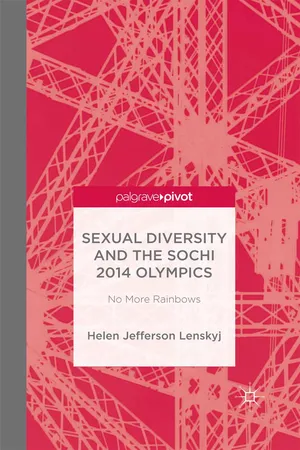
This book examines Russia's 2013 anti-gay laws and their implications for the Sochi 2014 Olympics. Lenskyj argues that Putin's Russia and the International Olympic Committee wield power in similar ways, as evident in undemocratic governance, fraudulent voting processes, hypocrisy and absence of accountability.
Information
1
Introduction and Background
Abstract: Legislation criminalizing the distribution of ‘homosexual propaganda’ to minors was first introduced in St. Petersburg in 2012, followed by national legislation in 2013. These developments were part of Russia’s president Vladimir Putin’s longstanding campaign aimed at suppressing dissident voices, eroding civil society, and upholding the traditional power and influence of the Russian Orthodox Church. These events are situated in the broader global context, and western countries’ approaches to sexual minorities and human rights are examined. An outline of the theoretical approaches, methodology and contents of the book is provided, as well as details of the author’s background.
Lenskyj, Helen Jefferson. Sexual Diversity and the Sochi 2014 Olympics: No More Rainbows. Basingstoke: Palgrave Macmillan, 2014. DOI: 10.1057/9781137399762.0003.
Introduction: St. Petersburg beginnings
In December 2012, I received an email from a university in St. Petersburg inviting me to give a presentation at an Olympic conference, all expenses paid, in March 2013. I politely declined, wondering whether the organizers had actually examined my unequivocal anti-Olympic, pro-lesbian/gay record of publications and activism before issuing the invitation. As I explained to non-gay friends who could not understand my decision, two words came to mind: Pussy Riot. In 2012, members of this feminist, pro-gay punk group had been arrested and charged with ‘hooliganism’ following an anti-Putin demonstration performed in a Russian Orthodox cathedral, resulting in two-year prison terms.
The ‘hooliganism’ charge, a relic of the Soviet era, was an umbrella term for any dissenting or non-conforming behaviour, including aspects of an individual’s lifestyle, clothing or appearance that the authorities deemed blameworthy. It proved especially useful in suppressing political dissent in Moscow in March 2012 following Vladimir Putin’s re-election as president, when mass protests and attempts to occupy public space by setting up tent cities were classified as hooliganism.1 And in October 2013, 30 Greenpeace members who tried to board an offshore oil rig owned by the state-run Gazprom company were arrested, charged initially with piracy and then with the lesser charge of hooliganism, an offence carrying a potential seven-year prison term.
Pussy Riot was also found guilty of ‘religious hatred’ and causing ‘grievous harm’ to church members. Shortly after the trial, a law criminalizing ‘religious insult’ or ‘blasphemy’ was introduced, based in part on the claim that Pussy Riot’s performance served as ‘evidence that the country’s traditional beliefs are in need of additional legislative protection.’2 Indeed, despite the official position that the country is devoutly religious, Moscow News reported a 2013 poll showing that only 64% of respondents identified as members of the Russian Orthodox Church and 24% rarely attended,3 while a 2011 survey conducted by the independent Levada Centre in Moscow found that 45% had never attended – all suggesting that fears of declining respect for traditional religious beliefs may be warranted.4 Furthermore, laws that appealed to the conservative religious sector helped boost support for Putin, and there is ample evidence of the close alliance between the Orthodox Church and the Kremlin, a relationship that entrenches the joint powers of church and state regardless of Russians’ religious self-identification.5
When I received the invitation to St. Petersburg, I was not aware that, despite its reputation as one of Russia’s more westernized and open cities, its leaders had introduced laws against promoting ‘homosexual propaganda’ to minors in February 2012.6 The city’s past and present elected officials have close ties with Putin, who served as deputy mayor in the 1990s, and media accounts of corruption related to the Sochi 2014 Olympic construction projects routinely refer to Putin’s ‘St. Petersburg cronies.’7 Shortly after the St. Petersburg law came into effect, it became clear that Russian authorities defined the concept of homosexual propaganda in broad terms. As one lesbian leader pointed out, it was ‘deliberately vague’ and its aim was to ‘drive LGBT people out of public space.’8 In May 2012, St. Petersburg police arrested 17 activists for waving rainbow flags and wearing rainbow suspenders during a May Day march.
When nation-wide anti-gay legislation was enacted, with no dissenting votes, in June 2013, ‘propaganda’ was spelled out in detail:
... activity for purposeful and uncontrollable dissemination of information capable of damaging the health, morals and spiritual development of the under-aged as well as forming a distorted understanding of the social equivalence of traditional and non-traditional marriage relations.9
Penalties for infringements included a sliding scale of fines, higher for public officials than for individuals, and highest for registered organizations, with possible 90-day suspension of operations. Foreigners can be fined, jailed and/or deported.
State Duma (Russian parliament) deputies had been discussing and revising the wording of the law for several months, claiming, too, to have considered hundreds of letters received during that period, with 25,000 opposed and the remaining unspecified number in support. According to a Freedom House report, there was no evidence that any of the opposing voices was considered.10 As noted, the final version referred to ‘non-traditional marriage relations.’ ‘This was done so that nobody accuses our law of homosexuality propaganda,’ explained Elena Mizulina, head of the State Duma’s Committee on Family, Women and Children, referring to the earlier version that had spelled out the offending sexual practices and identities: ‘sodomy, lesbianism, bisexuality, transgender.’11 Invoking the idea of tradition rather than focusing on sex achieved two purposes: it validated the wholesome, traditional Russian family and the institutions of heterosexual marriage and parenthood, and it avoided mention of explicit sexual behaviours and identities that most Russians, especially Putin’s conservative base, would find offensive. Politicians justified the law in part by invoking ‘the basic guarantees of children’s rights in the Russian Federation’ and referring to Russian and American psychological research that allegedly showed damaging effects on the health and development of children who were raised in same-sex families. An orphanage would be preferable, according to one official.12
By 2013, some western observers were expressing fears that any public behaviour that suggested homosexuality could be punished, simply because minors are usually present in public places. In September 2013, for example, a parents’ group asked Putin to stop openly gay performer Elton John from giving concerts in Moscow on the grounds that he would be promoting the rights of ‘sodomites’ and would thereby be breaking the law.13 Equally disturbing was the implicit message condoning violence that the anti-gay law conveyed to homophobic nationalist extremists and ‘skinheads,’ groups with a history of attacking lesbians and gays. The government was ‘enshrining second-class citizenship’ of sexual minorities, as Russian lesbian journalist Masha Gessen expressed it.14
Several developments in 2013 justified fears of an ‘open season’ on lesbian, gay, bisexual, transgendered (LGBT) people, including the torture and murder of a young gay man, a violent attack on a trans woman, and a Russian member of parliament’s call for public whipping of gay men. Most perpetrators were members of the national networks Occupy Gerontophilia and Occupy Paedophilia, an offensive appropriation and corruption of the socially progressive global Occupy Movements of 2012. Their purpose was to ‘reform’ homosexuals by entrapping and attacking LGBT adults and youth, filming the assaults and posting the videos on their websites; they made no attempt to conceal their own identities.15 A female leader of this vigilante group, interviewed by an Australian television journalist, claimed that her group, whose armed members boasted of going ‘on safari,’ targeted only paedophiles, not homosexuals. Like St. Petersburg mayor Vitaly Milonov, author of that city’s anti-gay law, she considered all homosexuals to be paedophiles. Milonov, a Russian Orthodox deacon who had been elected ‘as a Christian,’ defended the law and dismissed individuals and countries ‘that don’t respect us.’ ‘We are true Russians,’ he asserted when questioned about the law, blaming ‘western propaganda’ for ‘exaggerated’ media reports of increased anti-gay violence after the law was passed.16
The concept of public humiliation and punishment of homosexuals was not new. In 2006, during public outrage over planned gay pride events, Russia’s chief Muslim leader called for public flogging if ‘they [gays] come outside,’ claiming that they ‘can do whatever they like ... at home or in some secluded place in the dark.’17 In the same vein six years later, Duma minister Mizulina stated that pride events should be held ‘in a field, in a forest’ where no children were present.18 These attempts to appear ‘tolerant’ while denying full human rights and dignity to LGBT people bring to mind the implicit ‘don’t ask don’t tell’ policies of groups as diverse as the US military and professional basketball teams. In other words, so-called flaunting of sexual preference is forbidden, but only if one is a member of a sexual minority.
Homophobia – Russia and the west
When the International Olympic Committee (IOC) awarded the 2014 Winter Olympics to Sochi in 2007, issues of sexual diversity and homophobia in sport attracted little attention in the western media. Within western LGBT communities, however, it was widely known that sexual minorities in post-Soviet Russia faced significant challenges above and beyond those of their non-gay counterparts. As early as 2006, the Ryazan region of Russia had banned the promotion of ‘homosexual propaganda’ among minors, a move that marked the beginnings of a pattern that spread to a number of other Russian reg...
Table of contents
- Cover
- Title
- 1 Introduction and Background
- 2 Russia: Sex, Demographics and LGBT Activism
- 3 Sex, Gender, Sport, Politics: Russia and the West
- 4 Nationalism, Boycotts and the Olympic Industry
- 5 Conclusion: The Olympic Industry and Putins Russia
- Bibliography
- Index
Trusted by 375,005 students
Access to over 1.5 million titles for a fair monthly price.
Study more efficiently using our study tools.
Frequently asked questions
Yes, you can cancel anytime from the Subscription tab in your account settings on the Perlego website. Your subscription will stay active until the end of your current billing period. Learn how to cancel your subscription
No, books cannot be downloaded as external files, such as PDFs, for use outside of Perlego. However, you can download books within the Perlego app for offline reading on mobile or tablet. Learn how to download books offline
Perlego offers two plans: Essential and Complete
- Essential is ideal for learners and professionals who enjoy exploring a wide range of subjects. Access the Essential Library with 800,000+ trusted titles and best-sellers across business, personal growth, and the humanities. Includes unlimited reading time and Standard Read Aloud voice.
- Complete: Perfect for advanced learners and researchers needing full, unrestricted access. Unlock 1.5M+ books across hundreds of subjects, including academic and specialized titles. The Complete Plan also includes advanced features like Premium Read Aloud and Research Assistant.
We are an online textbook subscription service, where you can get access to an entire online library for less than the price of a single book per month. With over 1.5 million books across 990+ topics, we’ve got you covered! Learn about our mission
Look out for the read-aloud symbol on your next book to see if you can listen to it. The read-aloud tool reads text aloud for you, highlighting the text as it is being read. You can pause it, speed it up and slow it down. Learn more about Read Aloud
Yes! You can use the Perlego app on both iOS and Android devices to read anytime, anywhere — even offline. Perfect for commutes or when you’re on the go.
Please note we cannot support devices running on iOS 13 and Android 7 or earlier. Learn more about using the app
Please note we cannot support devices running on iOS 13 and Android 7 or earlier. Learn more about using the app
Yes, you can access Sexual Diversity and the Sochi 2014 Olympics by H. Lenskyj in PDF and/or ePUB format, as well as other popular books in Politics & International Relations & Service Industry. We have over 1.5 million books available in our catalogue for you to explore.