This book provides an original and compelling analysis of the ways in which British women's golden age crime narratives negotiate the conflicting social and cultural forces that influenced depictions of gender in popular culture in the 1920s until the late 1940s. The book explores a wide variety of texts produced both by writers who have been the focus of a relatively large amount of critical attention, such as Agatha Christie, Dorothy L. Sayers and Margery Allingham, but also those who have received comparatively little, such as Christianna Brand, Ngaio Marsh, Gladys Mitchell, Josephine Tey and Patricia Wentworth. Through its original readings, this book explores the ambivalent nature of modes of femininity depicted in golden age crime fiction, and shows that seemingly conservative resolutions are often attempts to provide a 'modern-yet-safe' solution to the conflicts raised in the texts.
- English
- ePUB (mobile friendly)
- Available on iOS & Android
eBook - ePub
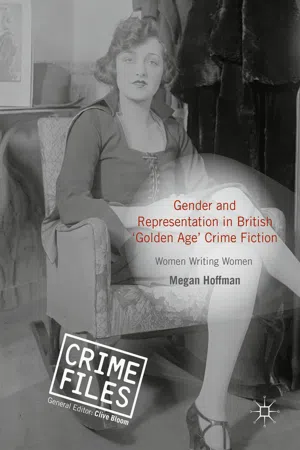
Gender and Representation in British ‘Golden Age’ Crime Fiction
About this book
Information
© The Editor(s) (if applicable) and The Author(s) 2016
Megan HoffmanGender and Representation in British ‘Golden Age’ Crime FictionCrime Files10.1057/978-1-137-53666-2_11. Introduction
Megan Hoffman1
(1)
Independant Scholar, Southsea, UK
Classic British ‘golden age’ crime fiction provides an ideal space in which to explore issues that accompany changing models of femininity. In this particular subgenre, certain elements are already required; the potential for deviance through transgressing social codes—the ‘law’—is necessary to the plot of a golden age narrative. At the same time, classic investigative crime fiction requires resolution; the break in law and order must be mended by an all-powerful detective figure.1 While predominantly conservative, this formula allows a ‘safe’ textual space for the exploration of anxieties surrounding constructions of femininity in the period during which British golden age crime fiction was being written. The first half of the twentieth century saw significant changes in the construction of gender roles in the popular consciousness, social policies regarding women and, consequently, perceptions of femininity; the inevitable anxieties that accompanied these changes are evident in portrayals of women and femininity in popular culture. The depiction of a woman in a crime novel, whether as victim, villain, suspect or detective, is loaded with social and cultural meanings as well as with expectations attached to the genre’s typical characters.2 Though inevitably contained and forced into compliance with social and genre conventions through marriage, death or occasionally the necessity of playing the detective figure’s regulatory role, female characters are nevertheless used in ways that can be read as questioning and renegotiating social, gender and genre norms.3 With its resolution, the golden age crime novel contains any deviance that might have emerged within the body of the text; however, it is often the case that this resolution is shaped in a particularly modern fashion.4 Alison Light identifies what she calls a ‘conservative modernity’ in women’s middlebrow literature of the period, pointing out that it was the cultural production of ‘a time when older forms of relationship and intimate behaviour were being recast and when even the most traditional of attitudes took new form’.5 How, then, does British women’s golden age crime fiction negotiate these shifting models through the portrayals of women and the feminine it offers?
I do not attempt to suggest either that depictions of women in golden age crime fiction written by women are unequivocally empowering, or that their conservatism is inevitably repressive. Rather, I argue that these depictions are ambivalent, advocating a modern, active model of femininity that gives agency to female characters, while also displaying with their resolutions an emphasis on domesticity and on maintaining a heteronormative order. This ambivalence provides a means to deal with anxieties about women’s place in society without advocating either a radical feminist dismissal of social conventions or a return to a Victorian ideal of submissive domesticity. The active models of femininity, including deviant femininity, provided in these novels speak to a changing society in which a woman’s place—in the home, in the workplace and in education—was continually being questioned, and the exploration that I provide of both conflict and resolution in these texts adds to the existing body of work on both the crime fiction genre and women’s middlebrow fiction in general. I shall begin with a chapter on historical context, which is vital to understanding the concerns explored in these novels. The following chapters examine issues such as sexually nonconforming women, the changing—and often conflicted—nature of gender roles in both the domestic and public spheres, and conclude with a discussion of the powerful image of the woman’s body, both dead and living, and the ways in which depictions of this body can be seen to explore and negotiate issues of gender, class and identity.
My work refers to and builds upon the varied criticism on crime fiction, particularly that produced in the last 30 years. Much critical attention has been devoted to crime fiction as a genre, and an important early critical work on the genre is Howard Haycraft’s account of the history of crime fiction, Murder for Pleasure: The Life and Times of the Detective Story (1941). Murder for Pleasure is significant because it was contemporary to many of the novels and stories I analyse in this study, so Haycraft’s identification of the genre’s popular writers, novels and themes is particularly relevant to my focus on the social and cultural forces that come into play in the production of the works examined. Haycraft is the first to attempt to identify particular movements or subgenres within the wider context of crime fiction, naming the dates of ‘The Golden Age’ as 1918–30 and ‘The Moderns’ as 1930 to the crime fiction produced up to the time of Murder for Pleasure’s publication.6 Julian Symons’ Bloody Murder (1972) is another important early work that attempts to give an historical account of the genre. Symons rather simplistically argues that the reading habits of the public shaped the plots and concerns of the crime fiction genre in the 1920s; with the increasing number of lending libraries such as Boots and W.H. Smith in Britain, Symons reasons, the preferences of the large number of women who patronised these libraries must have had an effect on the literature that was subsequently produced and consumed: ‘Supply again followed [women’s] demand for books that would reinforce their own view of the world and society, long untroubling “library novels”, light romances, detective stories. Many of the detective stories were written by women, and essentially also for women.’7 Here and throughout Bloody Murder, Symons disregards the potential for exploration and renegotiation of gender and social roles that can be found in crime fiction of the period, as well as the unsettling potential for violence that often ensues when these issues are examined. With the emerging field of middlebrow studies in the 1990s and 2000s came more complicated and useful readings of women’s middlebrow fiction, including crime fiction. Alison Light’s landmark work Forever England: Femininity, Literature, and Conservatism Between the Wars (1991) argues that:
Light’s work acknowledges the complex nature of the social influences that shaped middlebrow fiction in the period, understanding conservatism ‘not as a force which is simply “anti-change” so much as a species of restraint or “brake” … holding progress back on the leash of caution but allowing it none the less to advance’.9 As Light suggests in her chapter on Agatha Christie, and as I shall explore in the case of both Christie and other women crime writers of the period, such fiction reworks and renegotiates outdated cultural norms even while providing distinctly conservative resolutions—it ‘offers a modern sense of the unstable limits of respectability’.10by exploring the writings of middle-class women at home in the period … we can go straight to the centre of a contradictory and determining tension in English social life … which I have called a conservative modernity: Janus-faced, it could simultaneously look backwards and forwards; it could accommodate the past in the new forms of the present; it was a deferral of modernity and yet it also demanded a different sort of conservatism from that which had gone before.8
Stephen Knight’s work has also been influential in complicating the traditional view of the golden age crime novel as ‘light’ or simplistically conservative. Knight’s Form and Ideology in Crime Fiction (1980) includes a chapter on Agatha Christie’s series detectives Hercule Poirot and Miss Jane Marple in which Knight argues that in Christie’s fiction the model of the heroic masculine detective is rejected in favour of ‘a system of inquiry which is self-consciously female, and also fully rational’.11 Knight also suggests that Christie is ‘a genuine channel for the anxieties and the ultimate self-consolations of her class and sex’.12 Knight’s analysis of Christie’s fiction recognises the gendered implications of the ways in which it manipulates the crime fiction formula, and his chapter on Christie’s contribution to golden age crime fiction is one of the first critical treatments to recognise the importance of conducting a complex inquiry not only of crime fiction as a bourgeois literature but also of its construction of a gendered methodology of detection.
Published in 1981, not long after Knight’s Form and Ideology in Crime Fiction, Patricia Craig and Mary Cadogan’s The Lady Investigates: Women Detectives and Spies in Fiction is a thorough study that not only contributed to the growing body of work on gender in crime fiction but was also the first to examine extensively female characters in the genre. The Lady Investigates considers not only female protagonists in the works of well-known writers but also the female detectives created by many writers who had been critically neglected before its publication, such as Patricia Wentworth and Gladys Mitchell. It also recognises the potential complexity of social and cultural influences on depictions of women.13 Nevertheless, The Lady Investigates is a history of women detective figures that includes a list of characters and how they function in their respective narratives rather than a close reading of the factors that influenced portrayals of gender in the novels and stories examined. My own observations align more closely with Merja Makinen’s recent work on femininity in Agatha Christie’s works, Agatha Christie: Investigating Femininity (2006). Unlike much of the criticism on the genre that deals with gender, Makinen’s work recognises the potential for ambivalence in Christie’s representations of femininity. Using an historical approach similar to my own in its examination of the various culturally defined modes of femininity in Christie’s novels, Makinen argues that even though ‘Christie was writing during a period of intense gender renegotiation in relation to the modern world … a political conservatism did not necessarily rule out a questioning and even subversive attitude to cultural gender expectations’.14 Makinen also states that one of her aims is to use a wide variety of Christie’s fiction in her work in order to give her readings depth and provide a comprehensive look at the issues with which her work engages, an approach I also advocate. However, I have chosen to expand my enquiry to include a wide variety of writers and texts in order to give a more nuanced and broader perspective on the ways in which themes such as domesticity, education and sexuality are explored in women’s crime fiction of the 1920s, 1930s and 1940s.
Along similar lines, my work owes a great deal to the valuable contributions on women’s middlebrow fiction, including Nicola Humble’s The Feminine Middlebrow Novel, 1920s to 1950s: Class, Domesticity and Bohemianism (2001) and, as has already been discussed, Alison Light’s groundbreaking study Forever England. Humble and Light both include crime fiction in their studies of middlebrow literature, and their focus on how such fiction engages with concerns of the period has been crucial to crime fiction studies, including my own. Humble, for example, argues that:
Humble’s examination of themes in ‘feminine middlebrow’ fiction, particularly of representations of domesticity and the family, and her expansion of the definition of ‘interwar’ fiction to include that written both before the First World War and after the Second World War in recognition of the major cultural changes that occurred during the first half of the twentieth century, informs and corresponds with many of my own arguments.the ‘feminine middlebrow’ in this period was a powerful force in establishing and consolidating, but also in resisting, new class and gender identities … it is its paradoxical allegiance to both domesticity and a radical sophistication that makes this literary form so ideologically flexible.15
However, my study also includes elements that distinguish it from other critical works on crime fiction in general, women’s crime fiction specifically and also women’s middlebrow fiction. I have selected a wide variety of texts produced both by writers who have been the focus of a relatively large amount of critical attention, such as Agatha Christie, Dorothy L. Sayers and Margery Allingham, and by t...
Table of contents
- Cover
- Frontmatter
- 1. Introduction
- 2. Change and Anxiety: Historical Context
- 3. ‘Everybody Needs an Outlet’: Nonconforming Women
- 4. A Joint Venture?: Love, Partnership and Marriage
- 5. Ladies of a Modern World: Education and Work
- 6. Sensational Bodies: Villains and Victims
- 7. Conclusion
- Backmatter
Trusted by 375,005 students
Access to over 1.5 million titles for a fair monthly price.
Study more efficiently using our study tools.
Frequently asked questions
Yes, you can cancel anytime from the Subscription tab in your account settings on the Perlego website. Your subscription will stay active until the end of your current billing period. Learn how to cancel your subscription
No, books cannot be downloaded as external files, such as PDFs, for use outside of Perlego. However, you can download books within the Perlego app for offline reading on mobile or tablet. Learn how to download books offline
We are an online textbook subscription service, where you can get access to an entire online library for less than the price of a single book per month. With over 1.5 million books across 990+ topics, we’ve got you covered! Learn about our mission
Look out for the read-aloud symbol on your next book to see if you can listen to it. The read-aloud tool reads text aloud for you, highlighting the text as it is being read. You can pause it, speed it up and slow it down. Learn more about Read Aloud
Yes! You can use the Perlego app on both iOS and Android devices to read anytime, anywhere — even offline. Perfect for commutes or when you’re on the go.
Please note we cannot support devices running on iOS 13 and Android 7 or earlier. Learn more about using the app
Please note we cannot support devices running on iOS 13 and Android 7 or earlier. Learn more about using the app
Yes, you can access Gender and Representation in British ‘Golden Age’ Crime Fiction by Megan Hoffman in PDF and/or ePUB format, as well as other popular books in Literature & Literature General. We have over 1.5 million books available in our catalogue for you to explore.