- English
- ePUB (mobile friendly)
- Available on iOS & Android
eBook - ePub
About this book
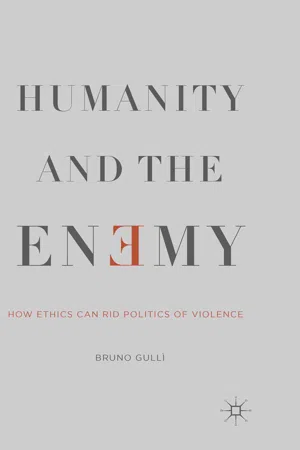
The book questions the concept of "the enemy," beginning with Carl Schmitt's famous notion that politics is the relationship of friend and enemy and that humanity is not a political concept. This book deconstructs this notion and views humanity at the center of a type of politics based on ethics.
Information
Topic
PhilosophySubtopic
Ethics & Moral PhilosophyChapter 1
Ethics and the Law
Reconsidering the Friend-and-Enemy Logic
In one of the most central moments of his Leviathan, in chapter 13 of part 1, Thomas Hobbes says, “Where there is no common power, there is no law; where no law, no injustice” (1994: 78). This statement contains the entire logic of political modernity, at least, of the dominant and institutional type of politics grounded in the theory of sovereignty formulated by Hobbes and reaching to our days. For our purposes, what is most important in this statement is the obvious exclusion of ethics from justice and the law and thus from politics. Perhaps the first thing to be noted is that in Hobbes’s statement, the final word is not “justice,” but “injustice.” Although this may at first appear too simplistic, it might be important to also note that had Hobbes said, “Where there is no law, there is no justice,” his statement would have been more immediately comprehensible and certainly unproblematic. It would have almost been a tautology, accustomed as we are to thinking of the law in terms of justice, and of justice in terms of the law. By using the word injustice, rather than justice, Hobbes is simply summing up the theory he has been formulating so far and will continue to formulate in the following chapters of Leviathan. He is simply giving an accurate and concise description of that theory based on the notion that the natural condition of humankind is a condition of war—a war of everybody against everybody. In other words, he is saying that if there is no law, anything goes. However, the idea is not that in the absence of the law all kind of injustice can take place. In fact, injustice cannot be committed at all: “Nothing can be unjust” (ibid.). Consequently, there can be no justice either. He says, “The notions of right and wrong, justice and injustice have there no place” (ibid.). Actions and situations are neither just nor unjust; they are what they are.
This is very different from the common idea according to which we need the law, because otherwise, unjust things will easily and frequently happen. In fact, the law itself determines the justness and unjustness of everything, every action and situation. Beyond the law, there is no other way to determine that. Certainly, there is no sense of ethics to distinguish between what is just and unjust, right and wrong. Indeed, there is no ethics at all. If an action is not expressly prohibited by the law, it can be performed. In the so-called state of nature, whatever can be done materially belongs in a system of rights that is absolutely open and indeterminate. The limit is only physical, material. For instance, I cannot fly because my nature is so constituted as to not allow that. But I can do everything I can materially do. In the next chapter of Leviathan, Hobbes says that “in such a condition, every man has a right to everything, even to one another’s body” (80). Obviously, this situation is unsustainable. It is because of this that people come together and decide to give up their rights and enter political society. A contract is made, which establishes the sovereign, and thus the law. From this time on, Hobbes promises, there can be some security and peace. Certainly, the condition of a war of everybody against everybody is overcome. The common power, which is coercive and keeps everybody in awe, will make sure that everybody abides by the law. This will be ensured through a system of punishment and terror (Hobbes is not afraid to use the word terror to describe the power of the state and of the law). Without this fear, which the common power instills in everybody’s heart, the original condition of war and chaos would persist. It is not because of an innate, instinctual, or natural sense of right and wrong that people respect themselves, the others, and the world. Nor is it because of something like the moral law, which we will see in Kant. There is nothing of the sort. Instead, all is selfish and actually as brutish as the condition of war and violence that needs to be overcome.
The law itself is not the manner in which people try to regulate their life on the basis of their common experience and singularity of needs; rather, it is the original violence of the state of nature institutionalized. The sovereign, who has received everybody’s unbridled freedoms and rights, now has the authority to make the law. This law is externally imposed on everybody, superimposed on them. This is truly the extent to which this law can be said to be “common.” Otherwise, this common power, which keeps everybody in awe and terror, has nothing common about itself. It is the exclusive privilege and right of the sovereign. Moreover, the sovereign cannot commit any injustice, for the sovereign is the only source of the distinction between the just and the unjust. Injustice can be committed against the sovereign; and the greatest form of injustice would obviously be a revolution. But the sovereign can do as he pleases, having—to paraphrase Hobbes—a right to everything, even to everybody’s body.
The purpose of this chapter is not simply to give an account, cursory as it might be, of Hobbes’s theory of sovereignty and the origin of the political state and the law but to highlight the fact that Hobbes’s theory is at work in our society today. The liberal and democratic world—the “free” world—likes to think differently about itself, but in reality at its core we find Hobbes’s theory of power, punishment, control, and terror. The implication is not that Hobbes is to be blamed for this. If anything, despite some serious flaws in his theory and some historical blunders, Hobbes is very straightforward and, without any hypocrisy, calls things by their names. He is very adamant about the necessity of a strong coercive power capable of ensuring what is most essential to a functioning society: security. Today we have reached a point of obsession with security. Faced with international (as well as domestic) terrorism, the security of the nation-state seems to be the most urgent aspect of political life. However, differently from Hobbes’s clarity and “honesty,” we generally like to garb this maniac drive toward a security state with the most beautiful rhetoric about democracy, freedom, and so on. Yet Hobbes was very clear: security entails the loss of all freedom and the implementation of a regime of fear and terror. For him, this was preferable to the chaos and violence of the original state of nature, the state of a war of everybody against everybody. For Hobbes, there was no alternative: either the original chaos and war or the police state of institutional politics and legality, extortion, and terror, which characterizes the modern and contemporary world.
The notion that there is no alternative has become popular with neoliberal policy-makers.1 The difference is that today instead of saying that there is no alternative to the terror of the security state, to the culture of fear that tries to make everybody obedient and docile, we are told that terror is outside the state of security and constantly threatens it, and fear is mistaken for a sense of prudence and watchfulness. Sovereign power, the true enemy of the common and good life and the true repository of terror, builds an ad hoc enemy in order to justify its sway. Everyday life is turned into a nightmare of apprehension and fear. Gog and Magog (whatever form they might take) are always about to destroy everything—above all, our identity, which is then “patriotic” to defend.
The logic of security, which requires the law as command, works through a manipulation of people’s desire. In Hobbes, we find the notion that human beings are machines of desire. In the wonderful introduction to Leviathan, he says, “For what is the heart, but a spring; and the nerves, but so many strings; and the joints, but so many wheels, giving motion to the whole body, such as was intended by the artificer?” (3; emphasis in the original). These automata, the work of nature, become the model for that artificial animal, which is the state. In truth, each human being becomes artificial insofar as he or she becomes a political and legal being. It is as if we all had two bodies: a natural body and a legal/political one. Both bodies have power in the most basic sense of having the capacity to do things. This power is also their freedom, and in the case of the natural body, it is also its right. The distinction between the two bodies not only has an analytical function but is also a real distinction. For instance, I may be sick. However, I become a patient only insofar as I seek institutional and medical care. Otherwise, I remain sick without being a patient. Indeed, the paradoxical situation may also obtain where I am a patient without being sick. I am sick insofar as I am a natural body; I become a patient with my legal/political one. The artificial (legal/political) body limits and regulates the natural body. It is characterized by a different form of power and freedom and by the exchange of what Hobbes sees as natural rights with the legal and political rights, which can be granted but can also be taken away. The natural body is unprotected and naked. It is in the condition of bare life. The artificial body is, at least in the tradition originating with Hobbes, subjected to sovereign power.
Early on in the Leviathan, in addition to the machinelike aspect of the human body, Hobbes also stresses its never-ending desire, or rather, ending only with death. In this sense, in chapter 11, he takes issue with the “old moral philosophers” (57)—first among them is Aristotle, of course, whom he does not mention—denying that there is such a thing as happiness apart from “a continual progress of the desire, from one object to another, the attaining of the former, being still but the way to the latter” (ibid.). This desire is, most essentially, a desire for power—and for a constant increase of it. This is so important that it becomes a general rule, characteristic of the human condition, or even part of human nature. Hobbes says, “So that in the first place, I put for a general inclination of all mankind, a perpetual and restless desire of power after power, that ceaseth only in death” (58). Hobbes is not speaking here of political power, but of potency. This type of power, the capacity to do things, is necessary to ensure the continuity of one’s life situation. An increase of power is necessary to that extent. Hobbes makes this very clear when he says that it “is not always that a man hopes for a more intensive delight than he has already attained to, or that he cannot be content with a moderate power, but because he cannot assure the power and means to live well, which he hath present, without the acquisition of more” (ibid.). On the one hand, we might detect here the ideology of incessant growth typical of modernity and capital; on the other, however, we can also understand that the work of maintenance itself requires an increase of power, a desire for more. So far, we have a materialist philosophy with which it is easy to agree. The point, however, is that among the many desires—and one that will become dominant—we also find the desire for security and peace. This is unproblematic in and of itself. Anyone may readily recognize how realistic it is for people to desire a situation in which—as Hobbes says in one of the most quoted pages from chapter 13 of Leviathan—they do not have to be constantly under “continual fear, and danger of violent death,” living “without other security than what their own strength and their own invention shall furnish them withal” (76). What is problematic is the solution that Hobbes gives to this problem. “Leviathan” is the name for this solution. In the either-or situation described by Hobbes, people exchange the original fear and violence of the state of nature for the institutional and sovereign terror of the political state. It is in this sense that the coming law is nothing but the original violence “refined” and institutionalized. Living in a security state is not the same as having actual existential security. As we will see in some of the next chapters, very often this formal and institutional security becomes insecurity for large sections of any given population, and in the age of globalization, it becomes global insecurity. The desire for security and peace is betrayed and replaced by the objectivity of a control or disciplinary machine, by the system of the police, and the network of surveillance. This is the way in which desire is manipulated and sidetracked. The artificial animals—the automata—that now populate the greater artificial animal (i.e., the state, the great Leviathan) represent, as Hobbes says in chapter 18 of part 2, “the confusion of a disunited multitude” (111) now united as a people and subjected to the sovereign. Desire, a subjective condition, is lost in the objectification of all subjectivities, all singularities. The desire of power and the power itself are transferred to the person of the sovereign; they become the sovereign’s exclusive privilege, and the sovereign becomes the only recognizable and recognized singularity.
I want to mention at least two problems in Hobbes’s account of the origin of political society and the law. One has to do with the transition from the state of nature to the state of political society. The former is a condition in which there is precisely “no society” (76) and thus nothing recognizably human. If we think, for instance, of Aristotle’s well-known notion that the human being is a political animal by nature, we see that being political, or social, and being human can be understood as identical. The absence of the political is the absence of the human. So much so that, parenthetically, when we are told today to leave politics out of the workplace, we are being dehumanized. Hobbes is saying the exact opposite of Aristotle, since for him there is a passage to political society, which is different from the natural condition. The human being is certainly an animal by nature, yet not a political one. This political dimension is artificial, not in the sense that it is fake or inauthentic, but in the sense that it is made. It is made by art—namely, labor and doing. It is a transformation of the original nature. Yet it is difficult to understand how these prepolitical (and thus prehuman) beings may come to grasp the benefits of leaving their natural condition behind and entering the political state. Even assuming the clarity and strength of their absolutely selfish motives, how can they arrive at the notion of a contract? It is true that for Hobbes the natural condition is only a hypothesis—though he also says that it is found in actual reality (and it is here that he commits his historical blunder, as we will see next). Yet the transition to political society and the law is not explained at all, not even at the hypothetical level. It is not explained because it cannot be. It remains pure fiction and, in truth, a flaw. It is probably much better to say, with Aristotle, that the political is natural. In other words, with respect to humanity, there is nothing prepolitical, and thus prehuman. Of course, the human being is not the only political/social animal. Nor is it important to assess the extent of this political aspect for the human animal or other nonhuman ones. Rather, what is important, in the human context, is the type of politics that is being made. Hobbes only gives us a politics completely devoid of ethics. The law as command, which is the essence of the political for Hobbes, establishes the just and the unjust, as we have seen. Beyond that horizon, beyond the legal and political frame, we only have the brutish condition of nature, which is really difficult to call human—even by Hobbes’s own standards. Perhaps “there was never such a time . . . as this” (77), Hobbes insinuates, or was there?
It is at this point that we find Hobbes’s enormous historical blunder, or perhaps an outright historical falsehood. Hobbes says, “It may peradventure be thought, there was never such a time nor condition of war as this; and I believe it was never generally so, over all the world. But there are many places, where they live so now. For the savage people of many places of America (except the government of small families, the concord whereof dependeth on natural lust) have no government at all and live at this day in that brutish manner as I said before” (ibid.). We are in the midst of the conquest: that genocidal history that began with the so-called age of discovery and continues to the present day. We know today that the savage people of America who lived in that brutish manner in fact had a much better way of life and of governing themselves and preserving the balance of the earth than the Europeans, especially in the age of the emergence of the nation-state, sovereignty, and modernity (i.e., modern politics and the modern law). However, these lines should not be taken as a perhaps inessential illustration of what the chaotic, anarchic state of nature, the war of everybody against everybody, might be in actual historical reality. What Hobbes is doing here is providing (a) a substantiation of his argument for a strong, coercive government—namely, a common power that keeps everybody under a regime of fear and terror (for “natural lust” is evidently not sufficient to keep communities together)—and (b) a justification for European genocidal policies in the newly “discovered” lands, in the “lost” worlds, or in the occupied territories. We can then go back to our initial Hobbes quote: “Where there is no common power, there is no law; where no law, no injustice.” The fact that there was, among the indigenous people of the Americas, no recognizable (in the Europeans’ eyes) common power, no government apart from that of small families, which was based on natural lust rather than on law, implied that no injustice could be committed against them. At the same time, where a common power was found, it was readily destroyed and the people protected or oppressed by that common power were brought back to the original state of war, of bare life. This type of thinking and acting continued throughout the centuries of conquest, the history of colonialism and imperialism, and it continues today as well. Iraq is a perfect example of this, and more recently, Libya. According to this type of thinking, either there is no recognizable common power and thus all is permissible or the existent common power (today named ad hoc a “rogue state”) is overthrown in order to make everything permissible. Here I am going beyond Hobbes in order to establish a link to the friend-and-enemy logic prepared by his thought. Indeed, the history of sovereignty is a history of identity, the making of identity, which occurs through violence. That means that the construction of a sovereign nation always implies the subjection or annihilation of other singularities: the construction of identity and the annihilation of difference. What is perceived as different becomes a danger, a threat: it is the enemy, which must be destroyed. The issue is obviously that of security. The security, not simply of a sovereign nation but of the sovereignty paradigm as a whole (i.e., the paradigm of the law as order and as command), is called into question by the presence of situations that resist it, say, communities organized (for Hobbes) on natural lust. When enmity, and thus war, occurs among sovereign states, there is always a process whereby the difference of the other is seen as a problem and thus as a determining factor. If it is not natural lust, it has to be something similar to it—certainly a trait of inferiority, ferocity, and so on. This usually goes under the name of dehumanization of the enemy, a process that can be more or less explicit and conscious.
This process of dehumanization is different from what Carl Schmitt claims about the political enemy. However, the question is whether his claim is convincing and correct. For Schmitt, politics is the relationship of friend and enemy. In saying this, more strongly than ever in the history of Western political thought, he establishes the autonomy of the political—autonomy from any other sphere of life but particularly from ethics. A precondition for such autonomy is that the enemy be considered a political, rather than personal, enemy. As such, the enemy is not dehumanized but is actually worthy of respect.
Schmitt goes back to the Latin and Greek words for the distinction between the political and personal enemy. He says, “The enemy is not merely any competitor or just any partner of a conflict in general. He is also not the private adversary whom one hates. An enemy exists only when, at least potentially, one fighting collectivity of people confronts a similar collectivity” (Schmitt 1996: 28). In other words, the true enemy is only political, or as Schmitt says, the “enemy is solely the public enemy” (ibid.). He explains the difference between the two notions: “The enemy is hostis, not inimicus in the broader sense; πoλέμιος, not ἐχϑρός” (ibid.).
Schmitt employs a very technical notion of the enemy. Indeed, it would be a very good thing if he were right. The true enemy would only be the public enemy, the enemy of the state, with whom a war might break out but also be avoided. The relationship with the enemy would be one without passions, feelings, and emotions. According to this notio...
Table of contents
- Title Page
- Copyright Page
- Dedication
- Contents
- Acknowledgments
- Introduction
- 1. Ethics and the Law: Reconsidering the Friend-and-Enemy Logic
- 2. The Ethical Obligation to Disobey and Resist
- 3. Deactivate Violence: Human Insecurity, the Enemy, and the Other
- 4. Labor, Poverty, and Migration: Sovereign Terror and the War against Humanity
- 5. Deactivating Terror and the Enemy Logic
- Conclusion: Humanity without the Enemy
- Notes
- References
Trusted by 375,005 students
Access to over 1.5 million titles for a fair monthly price.
Study more efficiently using our study tools.
Frequently asked questions
Yes, you can cancel anytime from the Subscription tab in your account settings on the Perlego website. Your subscription will stay active until the end of your current billing period. Learn how to cancel your subscription
No, books cannot be downloaded as external files, such as PDFs, for use outside of Perlego. However, you can download books within the Perlego app for offline reading on mobile or tablet. Learn how to download books offline
Perlego offers two plans: Essential and Complete
- Essential is ideal for learners and professionals who enjoy exploring a wide range of subjects. Access the Essential Library with 800,000+ trusted titles and best-sellers across business, personal growth, and the humanities. Includes unlimited reading time and Standard Read Aloud voice.
- Complete: Perfect for advanced learners and researchers needing full, unrestricted access. Unlock 1.5M+ books across hundreds of subjects, including academic and specialized titles. The Complete Plan also includes advanced features like Premium Read Aloud and Research Assistant.
We are an online textbook subscription service, where you can get access to an entire online library for less than the price of a single book per month. With over 1.5 million books across 990+ topics, we’ve got you covered! Learn about our mission
Look out for the read-aloud symbol on your next book to see if you can listen to it. The read-aloud tool reads text aloud for you, highlighting the text as it is being read. You can pause it, speed it up and slow it down. Learn more about Read Aloud
Yes! You can use the Perlego app on both iOS and Android devices to read anytime, anywhere — even offline. Perfect for commutes or when you’re on the go.
Please note we cannot support devices running on iOS 13 and Android 7 or earlier. Learn more about using the app
Please note we cannot support devices running on iOS 13 and Android 7 or earlier. Learn more about using the app
Yes, you can access Humanity and the Enemy by B. Gullì in PDF and/or ePUB format, as well as other popular books in Philosophy & Ethics & Moral Philosophy. We have over 1.5 million books available in our catalogue for you to explore.