eBook - ePub
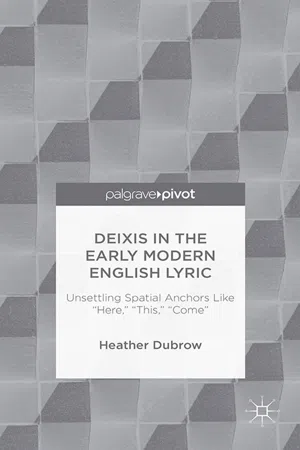
Deixis in the Early Modern English Lyric: Unsettling Spatial Anchors Like “Here,” “This,” “Come”
Unsettling Spatial Anchors Like “Here,” “This,” “Come”
- English
- ePUB (mobile friendly)
- Available on iOS & Android
eBook - ePub
Deixis in the Early Modern English Lyric: Unsettling Spatial Anchors Like “Here,” “This,” “Come”
Unsettling Spatial Anchors Like “Here,” “This,” “Come”
About this book
This book engages with deictics ('pointing' words like here/there, this/that) of space. It focuses on texts by Donne, Shakespeare, Spenser, and Wroth in particular, relating their forms of deixis to cultural and generic developments; but it also suggests parallels with both iconic and neglected texts from a range of later historical periods.
Information
1
Test-Driving Deixis: Formulating Issues, Coining Concepts
Abstract: Installation art provides intriguing parallels to deixis, especially in the relationship of “here”/”there” and issues connected with agency. A series of test cases that include periods and genres other than early modern lyric establishes characteristics of deixis that the book will explore in more detail. The chapter also establishes certain concepts for that exploration, such as convergers and the colonesque, and it borrows the theory of terroir from the study of wine.
Dubrow, Heather. Deixis in the Early Modern English Lyric: Unsettling Spatial Anchors Like “Here,” “This,” “Come.” Basingstoke: Palgrave Macmillan, 2015. DOI: 10.1057/9781137411310.0006.
Although the previous chapter concentrated on decisions about scope and methodologies, it also introduced substantive problems raised by deictic references in literary texts, such as whether those usages should be read as egocentric. Examining deixis through a compelling visual analogue and through writings from a range of eras can expand those general questions and crystallize others variously central to and specific to early modern deixis.
I Installation art as model: orientation and disorientation
The 2013 Guggenheim Museum exhibition by James Turrell, that extraordinary sculptor of light, illuminated deictic as well as artistic practices.1 The common delineations of deixis summarized in my introduction were both clarified and complicated by Turrell’s principal work in this show, called Aten Reign; and in turn, the customary preliminary definition of installation art itself as not a single object positioned within a space but, rather, a site-specific and often unsettling reconception of the entire area was aptly exemplified by the exhibition.2 Above all, its approaches to spatiality offer a new perspective on two issues that are, as I have suggested, very relevant to both deixis in early modern lyric poetry and space-place theory: the fluidity of categories like “here” and the multiplicity of agents associated with ordering space in the many and sometimes conflicting senses of “order.”
The primary installation (other work by Turrell was displayed elsewhere in the museum) involved the atrium of the Guggenheim from the ground floor to the top of the dome; onto these newly fabricated surfaces colored light was projected through an elaborate structure of concealed cones, with the colors subtly shifting as one watched.3 Parallelling the ways deixis often involves not a single temporal or spatial position but a process of changes communicated tactilely and ratiocinatively, these shifts contributed to both an immediate, visceral reaction to the glowing colors we were seeing and a cognitive anticipation of impending variations. This light show also involved a self-conscious reflexivity that mirrored the self-referentiality of many deictic constructions: the light on the walls was about light, about walls, and about the experience of viewing them, much as in literary texts the word “here” often refers to both the text itself and the process of reading it.
A reclining mat on the floor, as well as the reclining benches positioned at the perimeter of the space, invited Turrell’s viewers to look all the way up, focusing on the movements of color in the dome of the museum itself. Yet the spectators’ potential agency proved as fluid and variable as the colors themselves. Who or what determined, or at least influenced, that focus on the dome: the power of the colors, the artist and curators who arranged the mat, the visitor who chose to use it – or Frank Lloyd Wright himself, whose original vision of the museum encourages us to look upwards, a potentiality reinforced by Turrell? The curator of the show, Nat Trotman, observes, “As he has in other complex spaces, the artist designed Aten Reign around the particularities (and peculiarities) of the architecture, defining the installation’s shape and size in relation to the building’s central void.”4
Moreover, the problematical “us” in my apparently unexceptional “encourages us to look upwards” further complicates questions about agency through its implication that some visitors no doubt chose not to lie down, while others may have, for example, leaned back or lain down only very briefly, then shifted to another angle on the exhibit that bypassed the dome. And how were those choices affected by what other viewers were doing? Notice too that both sitting and standing participated in a string of actions. In any event, decisions about those positionalities embody Turrell’s expressed emphasis on how we experience the light rather than on the light per se: “I’m interested in the point where this imaginative vision meets the seeing that comes from what we want to think of as outside physical reality, because it has a lot to do with how we create reality.”5 The consequences of that mat, then, recall the contested theory, introduced in my reading of Donne’s “Flea” and repeatedly explored in more detail below, that deixis is determined in relation to and by an embodied consciousness, the epicenter.
Turrell’s work also at once exemplified and undermined the contrasts associated with verbal deictics, further emphasizing the fluidity of the very categories deixis is sometimes said to stabilize. “Nor is here one single here,” as Laurie Sheck’s epigraph to my book insists, glossing many poems within it and Turrell’s own visual lyric (“The Eleventh Remove,” 3).6 For example, in one regard this entire area was a “here,” evidently distinguished from the areas “there” in the sense of outside the installation. Yet if the walls outside the central atrium were “here” through their participation in the artistic work, they were “there” inasmuch as architecturally they represent a clearly demarcated space. Similarly, the installation continuously confounded any attempts to see such contrasts in binary terms. As the colors changed, “here” came to include a number of referents, including areas that were the color on which the viewer was currently concentrating and similar colors a little further away to which she might have turned (hence almost-here temporally and spatially), while at the same time, as noted above, the entire exhibit was a “here” in contrast to, say, the “there” of the ticket counter. In these and other ways, the very concept of immediacy, so central to phenomenological and other theories of space, was complicated and distinguished from propinquity.
Less celebrated than Turrell’s exhibit in the Guggenheim, but no less relevant to deixis, is the lobby he designed in 2011 for 505 Fifth Avenue, a New York building by the distinguished architectural firm Kohn Pedersen Fox. Entered through a revolving door, the space in question constructs its own revolving, swerving, reconstructing categories. The area of the lobby approached through that door is a granite frame, recalling its analogues in many other buildings – but succeeded immediately by walls that continually change their glowing colors. Those walls are in turn framed by a border structured through light in colors related to but different from what is on the wall: the border may be a pale blue, for example, while the walls are dark blue or mauve. Thus, if Turrell determinedly contrasts the “here” of his luminous construction with the “there” of the granite entrance and the street beyond, he also subdivides his light show into many “heres.” And of course the viewer’s vision changes as we walk through, anticipating the fact that space theorists typically emphasize the role of walking rather than its opposite, the sitting and reclining crucial to Aten Reign – the elevators, for example, provide another version of recession, but one that is not visible until one walks through the lobby.
Scott Burton’s installation in the Whitney Museum in 2009 offered different but compatible perspectives on the extent to which deictics are binary and through what agents and actions space is created and controlled. When we, the viewers, looked from another part of the gallery space at the two chairs that comprised Burton’s exhibit, in some respects we could regard them much as if they were enclosed in a frame on the wall, that is, the very approach to spatiality that installation art contests. Under those circumstances, the viewer herself was “here” and the chairs “there,” though of course, from the perspective of the curator or the material position of the chair, the viewer was “there” and the object “here.” In either instance, the binary seemed firm. But what happened when a spectator responded to the sign inviting us actually to sit in one of the chairs? Spatiality, agency, and ontology all shifted. That viewer became part of the display, the object over “there” for spectators elsewhere in the gallery. For the sedentary visitor, on the other hand, the chair being occupied became “here,” the one viewed “there” – though the two chairs were close enough in more senses than one to erode but not erase that binary distinction. On another level, the rest of the gallery was “there,” the chair on which one perched “here,” and the other chair almost-here or, to put it another way, a more distant version of “here.” These categories would of course have changed if our sitter had moved from one object to the other. Moreover, as one walked towards the chair before sitting on it, both of our apparent binaries came to involve many points.
For these and other reasons, the recurrence of seats and their analogues in so many installations – the two settle-like sofas that mirrored each other in an exhibition of the Frères Bouroullec in the Parisian Musée des Arts Decoratifs in summer 2013 or The Ego and the Id, an installation by Franz West on the edge of Central Park in 2009–2010 that included stool-like seats on its twisted loop, to select just a few examples – enjoins students of space to look further at the relationships among walking and mapping, which are frequently cited in studies of space, and sitting or leaning, which are often neglected. Michel de Certeau classifies walking, as well as enunciation, among the ways consumers can partially counter the subordinate position the culture assigns them, a model with obvious relevance to visiting an exhibition; but for the consumers of installation art, as we have seen, often sitting can serve similar functions – with the important qualification that the possibility of totally autonomous choices may be limited or obviated by prior decisions in other quarters.7 This revisionist approach to space theory can alert us to how agency may be affected or even effected by physical positions and movements between them (standing in front of a tomb, for example, or “coming” in the senses in which that deictic motion verb is used) in the poems examined in the next four chapters.
In short, these installations demonstrate how, pursuing its early agenda of developing an alternative to the static position of the painting hanging on a museum wall, installation art enacts the senses in which “here” often is not a monolithic or stable category but a fluid and shifting series of points. Above all, the distinctions between “here” and “there” may melt, in so doing compromising as well the separation of subject and object, and space and place, in the several senses of those disputed terms.8 Through such processes, the agency to affect space may be redistributed and compromised. Installation art thus invites a revisionist approach to these and many other issues, establishing museum tickets as a legitimate tax-deductible expense under the US tax code for the author of this book while encouraging ne...
Table of contents
- Cover
- Title
- Introduction: Delimitations, Definitions, Disciplines
- 1 Test-Driving Deixis: Formulating Issues, Coining Concepts
- 2 Edmund Spensers Epithalamion and Strategic Spatiality
- 3 William Shakespeares Sonnets and Deictic Textuality
- 4 Lady Mary Wroths Song 1 and Some Versions of Pastoral Deixis
- 5 John Donnes Hymne to God my God, in my Sicknesse and Prevenient Proximity
- 6 Here Today and Gone Tomorrow? Conclusions and Invitations
- Index
Trusted by 375,005 students
Access to over 1.5 million titles for a fair monthly price.
Study more efficiently using our study tools.
Frequently asked questions
Yes, you can cancel anytime from the Subscription tab in your account settings on the Perlego website. Your subscription will stay active until the end of your current billing period. Learn how to cancel your subscription
No, books cannot be downloaded as external files, such as PDFs, for use outside of Perlego. However, you can download books within the Perlego app for offline reading on mobile or tablet. Learn how to download books offline
Perlego offers two plans: Essential and Complete
- Essential is ideal for learners and professionals who enjoy exploring a wide range of subjects. Access the Essential Library with 800,000+ trusted titles and best-sellers across business, personal growth, and the humanities. Includes unlimited reading time and Standard Read Aloud voice.
- Complete: Perfect for advanced learners and researchers needing full, unrestricted access. Unlock 1.5M+ books across hundreds of subjects, including academic and specialized titles. The Complete Plan also includes advanced features like Premium Read Aloud and Research Assistant.
We are an online textbook subscription service, where you can get access to an entire online library for less than the price of a single book per month. With over 1.5 million books across 990+ topics, we’ve got you covered! Learn about our mission
Look out for the read-aloud symbol on your next book to see if you can listen to it. The read-aloud tool reads text aloud for you, highlighting the text as it is being read. You can pause it, speed it up and slow it down. Learn more about Read Aloud
Yes! You can use the Perlego app on both iOS and Android devices to read anytime, anywhere — even offline. Perfect for commutes or when you’re on the go.
Please note we cannot support devices running on iOS 13 and Android 7 or earlier. Learn more about using the app
Please note we cannot support devices running on iOS 13 and Android 7 or earlier. Learn more about using the app
Yes, you can access Deixis in the Early Modern English Lyric: Unsettling Spatial Anchors Like “Here,” “This,” “Come” by H. Dubrow in PDF and/or ePUB format, as well as other popular books in Languages & Linguistics & Linguistics. We have over 1.5 million books available in our catalogue for you to explore.