eBook - ePub
Gendered Impact of Globalization of Higher Education
Promoting Human Development in India
- English
- ePUB (mobile friendly)
- Available on iOS & Android
eBook - ePub
About this book
This book explores the significant role education plays in the promotion of human development and gender equality in India, situating this progression in relation to developed nations, the other BRIC countries and the ongoing attainment of the Millennium Development Goals.
Information
1
Introduction
Nair, Geeta. Gendered Impact of Globalization of Higher Education: Promoting Human Development in India. Basingstoke: Palgrave Macmillan, 2015. DOI: 10.1057/9781137513649.0006.
The Palgrave Pivot Project is based on re-emergence of the importance of human development that was popularized by Schultz in the 1960s for the US economy, followed by Sen and Haq for the developing world. The importance of investing in human resources via education, especially of women, holds the key to human progress. Haq rightly believed that development if not engendered, would definitely be endangered in the future, and this is supported by Kofi Annan, who felt that gender equality is more than a goal in itself. It is a precondition for meeting the challenge of reducing poverty, promoting sustainable development and building good governance. This emerging field is of topical importance in general human development parlance, as well in the specific context of emerging nations like India, for several reasons.
Millennium Development Goals
Development Goals of the United Nations Development Programme. The origins of the Human Development Index (HDI) are found in the annual Development Reports of the United Nations Development Programme (UNDP) in 1990 and had the explicit purpose ‘to shift the focus of development economics from national income accounting to people-centred policies’. Amartya Sen worked on capabilities and functioning that provided the underlying conceptual framework. Human development theories of Schultz, Sen, and Mehboob-ul-Haq enrich our theoretical understanding of the rationale of investing in people via health, education, and training that result in higher development outcomes and widen people’s choices and standards of living. The resultant developed and mature economies create better human resources that are empowered and help push economic growth to the next level. Conversely, low levels of human and gender development characterize backward or developing nations that manifest in poverty, malnutrition, inequality, and illiteracy. This can be amply studied by examples of developed and under-developed/developing nations across the world. Emerging economies like the BRICS, particularly India, face problems of lack of ‘inclusive growth’ and ‘gender equality’. These can be attained via the tool of higher education in order to promote human development in synchronization with the Millennium Development Goals.
The Major Research Project of the University Grants Commission (UGC) on which this Palgrave Pivot is based focuses on the role of education in present times in the promotion of human development in India. The researcher brings out the importance of education as a tool of empowerment.
In general, the international forums led by the UNDP champion for women’s empowerment and describe it as processes in continuum of several inter-related and mutually reinforcing components. This is seconded by the Beijing Declaration that recommends women’s empowerment and their full participation in the decision-making process and access to power as fundamental for the achievement of equality, development, and peace. This emerging field is of topical importance in general human development parlance, as well in the specific context of India, for several reasons. The World Development Report (WDR) of 2012 considers ‘Gender Equality and Development’ as its focal theme based on dramatic changes in the lives of girls and women over the past quarter century in terms of increasing figures of female literacy, longevity, and employment, particularly in the developing bloc nations. These newly mapped patterns of progress and persistence in gender equality matter for development outcomes and policy making. Models of success and shining stories of women’s empowerment matter as they help provide policy menus and lessons for laggards to emulate. Kofi Annan rightly expressed that gender equality is more than a goal in itself as it is a precondition for meeting the challenges of reducing poverty, promoting sustainable development, and building good governance. Population enumeration by gender composition is one of the basic demographic characteristics and provides meaningful demographic analysis. The Indian census has the tradition of bringing out information by gender composition on various aspects of the population. Changes in gender composition largely reflect the underlying social, economic, and cultural patterns of the society in different ways. Sex ratio is defined as the number of females per 1000 males in the population and is an important social indicator to measure the extent of prevailing equity between males and females in a society at a given point of time. It may be noted that the sex ratio is expected to be almost at parity in nature. According to experts, sex differential in mortality, sex selective outmigration, and skewed sex ratio at birth are the major contributory factors that influence changes in sex ratio. In India, sex ratio is skewed in favour of males and has continued to rise and expand in various forms. This has drawn wide attention of policy makers and planners to reverse the trend to bring it back to parity.
Four key areas that need to be stressed for a forward-looking public policy include, firstly, reducing gender gaps in human capital, particularly the ones that address female mortality and education. The second one refers to closing gender gaps in access to economic opportunities, earnings, and productivity; while the third advocates shrinking gender differences in voice and agency in society. Lastly, it recommends limiting the reproduction of gender inequality across generations. Each of these four areas can be addressed by the synergy of actions between different players at various levels like the private sector, development agencies, civil society organizations, and the public sector. This can be summed up in the words of the World Bank President Robert Zoellick as ‘Gender equality is at the heart of development’ (WDR, 2012). Gender equality matters for development as it enhances productivity as has been documented by their rising contribution of the global work force at 40%, along with more than 50% representation of University students that have resulted in improved outcomes for the next generation in terms of control over household resources and changing spending patterns that benefit children. Apart from this, women as economic, political, and social actors can change policy choices and better voice. Development has closed several gender gaps in educational enrolment, life expectancy, and labour force participation. However, other gaps like excess deaths of girls and women, disparities in girls’ schooling, unequal access to economic opportunities, and differences in voice in households and societies persist
2
Macroeconomic Scenario of India
Nair, Geeta. Gendered Impact of Globalization of Higher Education: Promoting Human Development in India. Basingstoke: Palgrave Macmillan, 2015. DOI: 10.1057/9781137513649.0007.
According to recent estimates, the population of India in 2013 is 1.27 billion, making it the second most populous country in the world, while China is on the top with more than 1,360,044,605 (1.36 billion) people. The figures show that India represents almost 17.31% of the world’s population, which means one out of six people on this planet lives in India. Although the crown of the world’s most populous country has been on China’s head for decades, India is all set to take the numero uno position by 2030. With the population growth rate at 1.58%, India is predicted to have more than 1.53 billion people by the end of 2030.
More than 50% of India’s current population is below the age of 25 and over 65% below the age of 35. About 72.2% of the population lives in some 638,000 villages and the remaining 27.8% in about 5,480 towns and urban agglomerations. The birth rate (child births per 1,000 people per year) is 22.22 (2009 est.) while death rate (deaths per 1000 individuals per year) is 6.4. The fertility rate is 2.72 children born/woman (NFHS-3, 2008) and the infant mortality rate is 30.15 deaths/1,000 live births (2009 estimated). India has the largest illiterate population in the world. The literacy rate of India as per 2011 (Population Census, 2011) is 74.04%, with male literacy rate at 82.14% and female at 65.46%. Kerala has the highest literacy rate at 93.9%, followed by Lakshadweep (92.3%) and Mizoram (91.6%).
Every year, India adds more people than any other nation in the world, and in fact the individual population of some of its states is equal to the total population of many countries. For example, the population of Uttar Pradesh (state in India) almost equals the population of Brazil. It, as per the 2001 Population Census of India, has 190 million people and the growth rate is 16.16%. The population of the second most populous state, Maharashtra, which has a growth rate of 9.42%, is equal to that of Mexico’s population. Bihar, with 8.07%, is the third most populous state in India and its population is more than Germany’s. West Bengal, with a 7.79% growth rate, Andhra Pradesh (7.41%), and Tamil Nadu (6.07%) are at fourth, fifth and sixth positions, respectively. The sex ratio of India stood at 940. Kerala with 1058 females (2001 Census), as well as 1084 (2011 Census) per 1000 males is the state with the highest female sex ratio. Madhya Pradesh has a lower number of females at 930 than the national average of 940, while Maharashtra is little above the average at 946. The Union Territory of Pondicherry also showed positive trends at a figure of 1038, next only to Kerala. On the other hand, Haryana with 861 has the lowest female sex ratio, apart from Daman and Diu at 618, Chandigarh at 818, and Andaman-Nicobar and Dadra & Nagar Haveli at 775.
The Northern States are depicting falling female-sex ratios that symbolize deteriorating gender development trends as mortality of women and girls is high.
These trends are depicted in the latest population figures of the nation as shown below.
TABLE 2.1 Current population of India, 2011
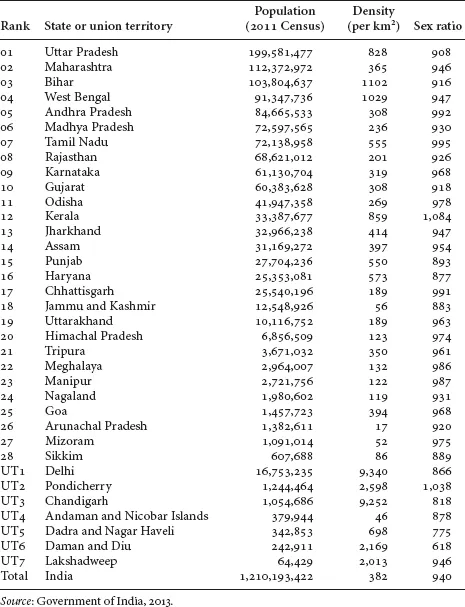
The above data clearly shows that the literacy and education have their bearings on the development indices of the nation and its constituent States. Kerala has proved to be a shining example of highest female literacy, favourable sex ratio (with higher number of women per thousand men) and HDI-GDI figures (Kerala Population Census Data, 2011). The Southern States have shown better indicators of female survival than their Northern counterparts.
India’s growth story has shown positive improvement since the economic restructuring programme was implemented by the ‘New Economic Policy’ of 1991 that helped her break away from the trap of low ‘Hindu rate of growth’ that usually did not meet the planned targets due to several causes ranging from exogenous factors such as war, Gulf crisis, and balance of payments deficits to endogenous ones like famines, droughts, low agricultural and industrial production and productivity, political mayhem, and lack of will to implement policies, along with economic causes and mismanagement.
Positive growth rates ranging from 6 to 9% were realized along the new growth trajectory that accelerated India’s transition from the first-generation reforms of the 1990s to the second-generation ones of the following decade. These were not a result of simple cyclical upturn, but had more to do with the structural transformation of the nation. This upbeat trend was also recently echoed by the 8% growth forecast in an era of sluggish growth rates portrayed by the developed nations.
Macroeconomic developments in the Indian economy witnessed during the last two decades have depicted several strengths, as well as weaknesses. The Gross Domestic Product (GDP) grew over 6% on a long-term basis over this period with stellar performances of over 8% during the period of 2003–08, making it one of the fastest growing economies in the world during the last decade. It also marks a period of global integration. However, these high growth rates are not matched by stellar performances in the arena of human development in general, and gender development in particular. Therefore, it becomes imperative to find reasons for dismal performance of these indices of development that will help make economic growth more meaningful, equitable, and sustainable. This trend reflects the general apathy of macro-level analysis echoed in neo-classical growth theories that ignored the role of human capital till recently. Only the 1960s saw the emergence of human capital variables that were taken to be important for explaining growth rate differentials across the globe. Schultz also promulgated the idea of educational capital, an offshoot of the concept of human capital, relating specifically to the investments made in education (Schultz, 1971; Romer, 1986; Lucas, 1988).
The alternative approach of ‘Human Resource Development’ propagates investments in education, training, health, and nutrition to create ‘human capital’ represented by the stock of skills and productive knowledge embodied in people in order to increase earnings and future incomes. Sen (1997) uses the accumulation of human capital and expansion of ‘human capabilities’ as important tools to understand processes of economic and social development. In the light of the new discourse on development, we shall focus on the role of education in the promotion of human development that gains particular importance for emerging economies like India.
3
Review of Growth of Higher Education System in India
Nair, Geeta. Gendered Impact of Globalization of Higher Education: Promoting Human Development in India. Basingstoke: Palgrave Macmillan, 2015. DOI: 10.1057/9781137513649.0008.
In this section, we shall first review the growth and expansion of higher education in the country in the post-Independence period which has been rapid and sizeable. India’s Higher Education System is one of the largest in the world with 611 universities, 31,324 colleges with 521,843 teachers catering to 1, 36, 41, 808 students Although the system looks outwardly humungous, it includes just 12% of the 18–24 age group, thus leaving out the mainstream of 88%; several anomalies plague the system. These range from lack of outreach to the majority, inability to meet future demands of children who are now getting compulsory schooling (under the Sarva Shiksha Abhiyan or universalization of primary education) that would require an estimated 2,000 universities and 60,000 colleges with 12 lakh teachers and 10 lakh administrative staff. These challenges magnify with rising aspirations of a burgeoning population, especially of youth.
However, it has been quite inadequate and uneven, leading to numerous access-related issues. A closer look at access-related issues of higher education in the country demonstrates the following trends as echoed by the UGC Report as under (http:www.ugc.ac.in):

Table of contents
- Cover
- Title
- 1 Introduction
- 2 Macroeconomic Scenario in India
- 3 Review of Growth of Higher Education System in India
- 4 Promotion of Human Development Indices through Higher Education
- 5 Reinforcing Micro Foundations of Macroeconomic Parameters
- 6 Concluding Remarks
- Bibliography
- Index
Trusted by 375,005 students
Access to over 1.5 million titles for a fair monthly price.
Study more efficiently using our study tools.
Frequently asked questions
Yes, you can cancel anytime from the Subscription tab in your account settings on the Perlego website. Your subscription will stay active until the end of your current billing period. Learn how to cancel your subscription
No, books cannot be downloaded as external files, such as PDFs, for use outside of Perlego. However, you can download books within the Perlego app for offline reading on mobile or tablet. Learn how to download books offline
Perlego offers two plans: Essential and Complete
- Essential is ideal for learners and professionals who enjoy exploring a wide range of subjects. Access the Essential Library with 800,000+ trusted titles and best-sellers across business, personal growth, and the humanities. Includes unlimited reading time and Standard Read Aloud voice.
- Complete: Perfect for advanced learners and researchers needing full, unrestricted access. Unlock 1.5M+ books across hundreds of subjects, including academic and specialized titles. The Complete Plan also includes advanced features like Premium Read Aloud and Research Assistant.
We are an online textbook subscription service, where you can get access to an entire online library for less than the price of a single book per month. With over 1.5 million books across 990+ topics, we’ve got you covered! Learn about our mission
Look out for the read-aloud symbol on your next book to see if you can listen to it. The read-aloud tool reads text aloud for you, highlighting the text as it is being read. You can pause it, speed it up and slow it down. Learn more about Read Aloud
Yes! You can use the Perlego app on both iOS and Android devices to read anytime, anywhere — even offline. Perfect for commutes or when you’re on the go.
Please note we cannot support devices running on iOS 13 and Android 7 or earlier. Learn more about using the app
Please note we cannot support devices running on iOS 13 and Android 7 or earlier. Learn more about using the app
Yes, you can access Gendered Impact of Globalization of Higher Education by Geeta Nair in PDF and/or ePUB format, as well as other popular books in Social Sciences & Education General. We have over 1.5 million books available in our catalogue for you to explore.