This book explores the way that culture and societal values impact the economies of eight European countries, focussing on businesses and their organisation and management processes. With contributions from skilled authors that cover Central, Eastern and Northern Europe, and particularly Russia, Germany, and Scandinavia, this collection provides a broad understanding of how business is conducted within the different countries of peripheral Europe. The book seeks to examine the influence of culture on business, and more specifically the interaction between national and corporate cultures. It will be of great interest to researchers interested in international business, cross-cultural management, and business organisation.
Russia has a long and rich history. An insight is necessary to comprehend its culture, however, several elements render its description difficult:
The absence of written language before the ninth century. Literally speaking, prehistorical Russia ended with the creation of the Cyrillic language in the ninth century by the monks Cyril and Method. No proven documents are available prior this date. The first scientifically proven document is the Priomy, which dates from the late eleventh century.
The second reason lies in the fact that Russian rulers (they were not the only ones) had a tendency to rewrite history. The chronicles were written in imperial or in Soviet Russia consequently stressed one aspect of history over another according to their then-current situation.
Finally, the remote geographical location of the country (extreme East of Europe, West of Asia and North of ancient trade routes) reduced the number of foreign travelers and ambassadors, usually a precious source of knowledge of ancient history.
The Birth of a Civilization, Kievan Rus’
While some prehistoric hunters have been traced back to 40,000 BC in the Don river region, modern Russian History begins usually with the reign of Vikings (also called Varangians) who either took power or were invited to do so (historians are still divided on the subject.).
One of the founding events is the creation of the free city of Novgorod in the late ninth century. The first cities of what was to become Russia always enjoyed a lively trading life: fur, amber, hemp, or honey were the main tradable resources of the region, which was on a trading route between the Black and Baltic Seas.
The Christian religion appeared in Russia when Prince Vladimir imposed his faith on a pagan population in a territory which represented a fraction of what Russia is today. By the middle of the twelfth century, the region was organized into principalities loosely united around the “Grand Prince of Kiev and all Rus”.
In less than 30 years, Mongol (or Tataro-mongols as referred to in Russian) fighters took over all the principalities of Kievan Rus’ in the thirteenth century. Following, their failure to take over the rest of Europe (thick forests are believed to be the most effective barriers), they retreated and kept the Rus’ lands under their yoke. Ruling indirectly, they relied on the Princes to keep order and to collect taxes.
Slowly the power of Kiev declined and the center of power moved North, to the region of Moscow, a city created in 1147. When Constantinople fell to the Turks in 1453, The Russian Orthodox Church declared Moscow the “Third Rome”, that is the center of civilization that was built after the fall of the two previous “Romes”: Rome and Constantinople. Moscow would then become the center of the country for several centuries.
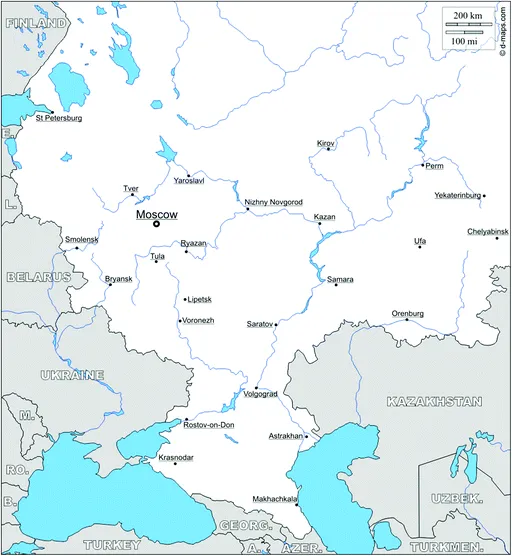
Fig. 1
Western part of Russia (http://d-maps.com/carte.php?num_car=30398&lang=fr)
Fifteenth Century—the Rule of Moscow, the End of Democracy
In 1480, almost 300 years after their conquest, the Tatars were defeated at Ugra by the troops of Ivan III, Prince of Moscow—without a battle. By the end of the fifteenth century, all but a few principalities were under the control of Moscow. With a newly united territory, Ivan III started reforms, such as the instituting of serfdom. At a time when most of Western Europe was coming out of serfdom, Russia enforced it on peasants who had enjoyed relative freedom before. In a way, this was the end of a sort of democracy in Russia (Fig. 1).
When questioned about the most democratic time in Russian History, it is tempting to point to the times of Novgorod, with cases of elected (or invited) rulers such as Alexander Nevsky. Moreover, Novgorod is not the only town in the north of Russia to have enjoyed such status, Pskov, a city near Novgorod, is another famous one.
Forceful ruling of the population is therefore not as natural in Russia as some claim. The old Russia was a country ruled by councils of representatives, free craftsmen inhabited the cities, and the villages in the countryside were organized into communes called Mir, where decision-making was collective. Once the taxes were paid to the Prince, the citizens had the possibility to keep some profits.
It all ended with the permanent linking of the peasants to the land they were cultivating. In 1646, a law forbade most of the peasants to move freely (North of European Russia, e.g., Archangelsk region, and all the territories eastwards from the Ural Mountains never had serfdom). This attachment to the land never really ended, as the serfs were still forced to reimburse their land rent after the abolition of serfdom in 1861 and subsequently forced into Kolkhoz when the Soviets took power. Only the Cossacks, known for the fighting skills, retained relative freedom until the Bolshevik revolution.
Sixteenth Century—Ivan IV, the Terrible
The grandson of Ivan III, Ivan IV, took the Russian throne in 1533 at the age of three. At 16, he crowned himself “Tsar of all the Russias,” becoming the first ruler of Russia to take this title derived from the Latin “Caesar”.
Ivan’s reign is probably one of the most famous in Russia and abroad, but also the most mysterious. Handsome and talented, he was absolutely loved by his people for clever ruling and for finishing the reconquest of Russia by taking Kazan and Astrakhan from the remaining Tatars.
He ordered the construction of St Basil’s Cathedral in front of the Kremlin to celebrate this victory, and launched the conquest of Siberia, which was until then largely an unexplored territory… But then, everything went wrong. His beloved wife died under mysterious circumstances, probably poisoned. Ivan’s reign became terrible after her death.
Tortures, persecution, and massacres became legendary and gave him his notorious nickname. He is also known to be the first ruler to create what can be called a Secret Police by forming the “Oprichnina”, a gang of thugs who took possession of an entire district outside the Kremlin and reported only to the Tsar. He remarried many times and lived a recluse, paranoid life outside the Kremlin walls, where he is believed to have killed his son, Ivan, in a fit of rage.
This image of Ivan the Terrible is the one favored by most Russians and their rulers. He incarnates the ultimate tyrant, being also the founder of Greater Russia. In order to support the theory that Russians like to be ruled by tyrants, it is often said that after abdicating in the middle of his (already terrible) reign, Ivan IV was begged by the boyars (old Russian aristocrats, advisors to the Tsar through the assembly called the Boyarskaya Duma) to come back to rule them again…
His death brought chaos to the country, known as the Time of Troubles, which saw many power struggles between the boyars (the Tsar was officially elected from among them), some adventurers such as the two false Dmitris (two usurpers, who managed to seize power in Russia, each claiming he was the son and heir of Ivan the terrible), and foreign powers such as Poland.
Finally, a people’s revolt defeated the Poles and called for an Assembly of the Land to elect a new leader. As seen later, with Napoleon’s war or WWII, it was only the first in a long list of popular uprisings that have often saved the country.
1613—The Romanov Dynasty, Peter the Great
From an influential boyar family, Mikhail Romanov was chosen in 1613 to become the new Tsar. His dynasty ended 304 years later, with the abdication of Nikolai II in 1917.
The seventeenth century was a time of territorial expansion. After the conquest of Siberia, Smolensk, and Kiev also became part of the Russian Empire, as the Russians came to help the Cossacks fight off the Poles.
Probably, the most famous member of this dynasty is Peter I, the Great. He is the true Russian monarch the population likes to remember. A giant 2 meters tall, he turned Russia for the first time into a power the world had to reckon with.
His fame is deserved as he transformed Russia into a modern state and proved to be a skilled ruler in the process. In terms of territorial expansion first: Dreaming of opening the country to the West and fascinated by the Navy, he seized the Gulf of Finland and lands on the Baltic Sea from the Swedish Empire (Treaty of Nystadt in 1721). He also took over the port of Azov from the Crimean Tatars on the Black Sea. From Tsar, the Senate named him Emperor of All the Russians after his victory over the Swedes.
Geopolitically, he engaged in active relations with the West, ending the relative isolation of the country. His culminating point was his trip to Europe, the first ever by a Muscovite Tsar. He returned from Europe with modern ideas, knowledge in shipbuilding, and more than 1000 experts from various countries.
However, his longest lasting mark on Russia stemmed from his shaping the country. He created numerous institutions, such as the Naval Academy and the Academy of Sciences. In 1703, he started the construction of a new city in the swamps between the Ladoga Lake and the mouth of the Neva, which was to become the new capital Saint Petersburg. All means were used as the city was literally built on the corpses of convicts, forced-labor peasants, and requisitioned craftsmen. An estimated 30,000 people died during the first few years of construction.
Peter’s reign, full of splendor, was not, however, an enlightened one. Fond of military order, he instituted the Table of Ranks in order to have the Nobility at his complete disposal. At that time, the only activity available to noblemen was a career in the military. They acquired title, land, and serfs through military bravery. Under such a system, the Tsar, as ultimate power, could make or destroy any career at will.
He also created his own understanding of a parliamentary monarchy by setting-up a Senate. However, democracy (as a system in which the population chooses its own ruler) was absent from this move as all the members of this Senate were appointed by the Tsar.
He also made sure that the Orthodox Church would remain under his direct influence by not replacing the Patriarch at his death and by creating a Holy Synod, also composed of members appointed by the Tsar.
This transformation of the country went so far as to modify the way people dressed and spoke. Strongly influenced by his trip to Europe, Peter ordered men to shave and to wear precisely designed German types of uniforms. Failure to shave or to have the proper number of buttons on one’s redingote was fined. (The table of ranks had 14 different levels and each had its own uniform…) Peter also strongly suggested that the nobility learn and speak European languages such as French or German. Wishing to reshape Russia according to modern standards, he introduced a new calendar in 1700 (Julian, 13 days behind the Gregorian calendar used in the Catholic part of Europe). Until the decree, the years were counted from the then-believed creation of the world, in 5509 BC. The following day of December 19, 7208 happened to be January 1, 1700!
Having decided to turn Russia into a new powerhouse, Peter subsidized many new industries using forced labor, that is, serfs, and subsequently created numerous new taxes. For instance, near St. Petersburg, the Petrodvorets factory is still operating today, making the famous Raketa watches.
Yet, maybe even more significant is the launch and support of the first Russian industrial region, the Urals. Indeed, a new country was created during his reign. However, the massive industrialization of the country, the continuous warfare and the construction of Saint Petersburg cost Russia dearly both financially and in manpower: At the end of his reign, public finances were in disarray and the population had declined by 20%…
Peter is rightfully remembered as a great ruler. However, in order to better understand Russia today, one must look not only at the results, but also the means of Peter’s reforms.
1762—Catherine II
Like the few women in present day Russian politics, Catherine II, and her historical image suffered from two handicaps: She was a woman, and she was not Russian.
She came to Russia at the age of 15, to marry future emperor Peter III. She quickly adapted to Russian life by learning the Russian language and by converting to Orthodoxy. Russia, like England, had no obligation to have men as sole rulers. Thus, Catherine seized power in 1762 at the age of 33, forcing her husband, Peter III, from the throne.
Her reign is renowned mainly for the confirmation of Russia as a world power, the expansion of the Empire, and the enlightenment of the court. The expansion of the empire led to the completion of the “gathering of Russian lands.” Belorussia was conquered from Poland while Crimea would become part of Russia in 1792 from then on, until 1954.
This period was also one of strengthening of the authoritarian regime. The Nobility received more powers over their serfs while—subsequently—the well being of the population (increasingly non-Russian) was neglected. While other powers were having their revolutions, Russia was going against the European flow, increasing serfdom among peasants. When the French revolution ended monarchy, Catherine’s Russia broke diplomatic relations.
Nineteeth Century—Alexander I, Napoleon, and the Decembrists
It is not possible to present the reign of Alexander I without talking about Napoleon’s invasion of Russia.
Alexander spent most of his reign at war against Turkey, France, England, Persia, or Poland. The decisive war, however, was against Napoleon. The two Emperors, respectful of each other, understood after Tilsit (1807) that each power could have its own destiny. Both spoke French and at that time the Russian aristocracy saw France as a model.
Therefore, when in 1812 Napoleon launched his attack on Russia, the country was literally taken aback. Despite an early advantage, Napoleon made several misjudgements: the severity of Russian winter, the determination of the Russian people and the typhus then endemic in the eastern lands of Europe. Most of the soldiers of the “Grande Armée” were not French and were not fighting for their motherland. As Napoleon found razed village after razed village (a brilliant idea of Kutuzov), the strength of his army eroded. The final act in this protracted play was Moscow. Although Napoleon did finally take the city (which was not the capital), his troops were exhausted and it took only a spark to reverse destiny.
A few Russian patriots set Moscow on fire and Napoleon had no other choice but to retreat. Amid terrible weather conditions, the “Grande Armée” started what would become the famous “Retreat from Russia”.
Later, Russian troops even stayed in Paris for more than a year before the Treaty of Paris was signed in 1814. During all this time, the officers had the opportunity to observe what a modern, enlightened (though not democratic) country looked like, even when defeated. Upon their return to Russia, a group of officers plotted to modify the regime. This small group of less than 30 officers was mainly asking for limited changes such as a stronger parliament and the emancipation of the serfs. Only a few extremists were calling for the abdication of the Tsar.
However, the victory over Napoleon was seen in Russia as symbolic of the all-mighty power of the Tsar and the Orthodox Church. These liberal ideas came to an end in December 1825 (hence the name Decembrist), when there was an attempt at revolt against the new Tsar, Nicholas I. The officers involved were executed, deported to Siberia, or deprived of their titles and estates. This reaction was enough to calm any desire for reform for quite some time.
Alexander II and Alexander III
Alexander II is a Russian Tsar who, unfortunately, is not well known abroad. He became Emp...
Table of contents
Cover
Frontmatter
Scandinavia: Europe’s Advanced North
Transformation in Society and Changes in Estonian Management and Business Thinking
Management in Germany, the Dynamo of Europe
Ukraine: Between Russia and the EU
Russia: Europe in Asia
Czech Republic: At the center of Europe
Backmatter
Trusted by 375,005 students
Access to over 1.5 million titles for a fair monthly price.
Study more efficiently using our study tools.
Frequently asked questions
Yes, you can cancel anytime from the Subscription tab in your account settings on the Perlego website. Your subscription will stay active until the end of your current billing period. Learn how to cancel your subscription
No, books cannot be downloaded as external files, such as PDFs, for use outside of Perlego. However, you can download books within the Perlego app for offline reading on mobile or tablet. Learn how to download books offline
Perlego offers two plans: Essential and Complete
Essential is ideal for learners and professionals who enjoy exploring a wide range of subjects. Access the Essential Library with 800,000+ trusted titles and best-sellers across business, personal growth, and the humanities. Includes unlimited reading time and Standard Read Aloud voice.
Complete: Perfect for advanced learners and researchers needing full, unrestricted access. Unlock 1.5M+ books across hundreds of subjects, including academic and specialized titles. The Complete Plan also includes advanced features like Premium Read Aloud and Research Assistant.
Both plans are available with monthly, semester, or annual billing cycles.
We are an online textbook subscription service, where you can get access to an entire online library for less than the price of a single book per month. With over 1.5 million books across 990+ topics, we’ve got you covered! Learn about our mission
Look out for the read-aloud symbol on your next book to see if you can listen to it. The read-aloud tool reads text aloud for you, highlighting the text as it is being read. You can pause it, speed it up and slow it down. Learn more about Read Aloud
Yes! You can use the Perlego app on both iOS and Android devices to read anytime, anywhere — even offline. Perfect for commutes or when you’re on the go. Please note we cannot support devices running on iOS 13 and Android 7 or earlier. Learn more about using the app
Yes, you can access The Influence of Business Cultures in Europe by Robert A. Crane in PDF and/or ePUB format, as well as other popular books in Business & Business Ethics. We have over 1.5 million books available in our catalogue for you to explore.