eBook - ePub
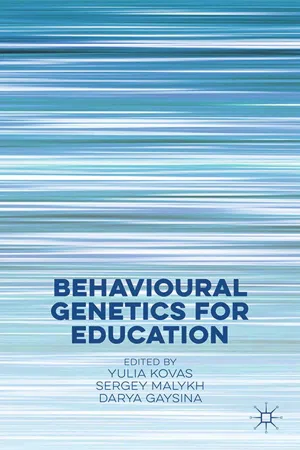
Behavioural Genetics for Education
- English
- ePUB (mobile friendly)
- Available on iOS & Android
eBook - ePub
Behavioural Genetics for Education
About this book
Information
Topic
PsychologieSubtopic
Politique d'éducation1
How Genetics Can Help Education
Yulia Kovas, Tatiana Tikhomirova, Fatos Selita, Maria G. Tosto, and Sergey Malykh
The vast individual differences observed in all educationally relevant psychological traits, such as academic achievement and cognitive, motivational and emotional characteristics, develop through complex processes of gene–environment co-action. Research suggests that educational environment interacts with unique genetic profiles of students, leading to great variability among students (see Kovas, Haworth, Dale, & Plomin, 2007).
One of the main aims of most educational systems is to raise the level of achievement of all students. Behavioural genetic investigations in education provide important insights into individual differences in academic ability and achievement. Better understanding of the aetiology of individual differences can form a foundation for developing personalized educational methods and technologies that can help improve the performance of all children.
Educational research that attempts to explain individual differences in learning abilities, often does not take into account the role of genetic factors. They are often ignored, even when complex multilevel models are applied to development, including multiple approaches and theoretical constructs (see examples in Tommerdahl, 2010). One explanation for this is that genetic research is associated with the mistaken belief that genetic information may lead to selection and increase social inequality (see examples in Pinker, 2002; Malykh, Tikhomirova, & Kovas, 2012).
Moreover, most studies in education are dedicated to the development of universal methods of education for all students, a so called “one- size-fits-all” approach. This is paradoxical, because teachers and other educational specialists know better than anyone that each student has a unique cognitive and emotional profile. Research into the effectiveness of various educational programmes and methods has shown that, irrespective of which curriculum is followed in a particular school, teachers in every class have to adapt the curriculum to the needs of individual students (Krasa & Shunkwiler, 2009). In order to increase students’ learning success, teachers are expected to take into account the profiles of individual students, such as aspects of their cognitive and metacognitive functioning. For example, in the USA, the principles and standards of school mathematics curricula, set by the National Council of Teachers of Mathematics (2008), demand that mathematics teachers possess content knowledge, pedagogical methods and the ability to identify strong and weak features of cognitive development of each student, as well as each student’s interests and motivation (Krasa & Shunkwiler, 2009).
Despite this, research that aims for development of personalized methods of teaching of academic disciplines, such as mathematics, is still in its infancy. In the USA, where there is no National curriculum, schools try to select the best programmes for their students; but, with limited understanding of the aetiology of individual differences in academic achievement, such attempts to choose and apply educational programmes are in “a state of chaos” (Krasa & Shunkwiler, 2009, p. 185). In countries with more centralized curricula, such as the UK and Russia, “chaos” is in the implementation of these centralized systems, because one programme cannot be appropriate for all students. In 2008, the US National Mathematics Advisory Panel analysed results from a large number of studies in education and concluded that no unified, ideal method, suitable for all students, exists. The results showed that the success of the educational process depends on many interacting factors, such as ability and motivation of students, personal and professional qualities of teachers, educational methods and curricula (Krasa & Shunkwiler, 2009). Therefore, in order to select the most effective methods for a specific student in a specific subject and in specific learning conditions, better understanding of the aetiology of individual differences is needed.
This chapter presents potential benefits of behavioural genetic approaches to the study of cognitive, motivational and emotional factors underlying individual differences in academic achievement in different areas of learning. In a recently published volume “Neuroscience in education. The good, the bad and the ugly.” the authors characterize the potential contribution of genetics to education as “good”; the general public’s attitude to genetics in education as “bad”; and the slow progress in identification of specific genetic factors involved in academic achievement as “ugly” (Kovas & Plomin, 2012). The present chapter demonstrates the “good”: multiple insights from behavioural genetic investigations into the aetiology of individual differences in learning and the potential of these findings for developing effective educational policies. These insights call for the change of the “bad” attitude towards behavioural genetics, by showing that all claims that genetic effects are unchangeable and deterministic are myths. The chapter also presents the results of molecular genetic investigations that attest to the gradual progress in the identification of genetic factors involved in educational processes.
Foundations of behavioural genetic research in education
Behavioural genetics is an interdisciplinary science that uses knowledge and methods of different fields, including psychology, molecular genetics and neuroscience. Behavioural genetics investigates gene–environment interplay and how it affects individual differences in psychological traits. Quantitative genetic investigations are based on comparisons between different types of family members, including twins, adoptive relatives and other types of relatives (for more detail see Plomin, DeFries, Knopik, & Neiderhiser, 2012). Molecular genetics aims to identify specific DNA markers that are involved in individual differences.
Quantitative genetic approach
The twin method is the most commonly used quantitative genetic approach that involves comparisons between monozygotic (MZ, identical) and dizygotic (DZ, fraternal) twins (see Box A.1 for details of the twin method). Twins can be considered an ideal natural experiment as MZ twins are 100% genetically similar, whereas DZ twins share on average only 50% of the segregating (changeable) DNA.
As twins grow up together they objectively share many aspects of their environment, including their parents, socio-economic conditions and often schools, classrooms, teachers and peers (Plomin et al., 2012). The twin method allows for estimation of the relative contribution of two types of environment: shared (common) environment that contributes to the similarity between the two twins in a pair on a particular trait; and non-shared (unique) environment that contributes to the dissimilarity between the two twins. The question of why children in the same family are very different from each other has been extensively researched in behavioural genetics (e.g., Plomin & Daniels, 1987; Plomin, Asbury, & Dunn, 2001). One of the findings is that objectively shared factors more often than not end up as non-shared effects. For example, socio-economic status of the family, objectively shared by the two twins, may actually lead to the differences between the twins if they perceive or respond to this status differently (Plomin, Asbury, & Dunn, 2001). A low socio-economic status may motivate one child to strive for achievement, but lead to lower motivation and achievement in another child. Such subjective reactions may form under the influence of many factors, including genetics.
Beyond the role of environment, the twin method allows for estimation of heritability – the role of genetic factors in individual differences in a particular trait in a specific population. Heritability is estimated as double the difference between MZ and DZ twin correlations for a particular trait (see Box A.1). The role of shared environment is estimated as the difference between MZ correlation and heritability. In other words, it estimates to what extent similarity between MZ twins is greater than would be expected from their genetic relatedness. In addition to comparing twin correlations, modern twin research uses structural model-fitting to provide more precise parameters (Neale, 1997; Neale & Maes, 2003; See Box A.1).
Twin registries represent a unique resource for studying genetic and environmental influences on complex psychological traits in the context of development. Special twin registries exist in many countries, including those that involve thousands of participants and those that follow the same participants for many years. In many scientific institutions of Europe, America and Asia, twin registries support interdisciplinary investigations into gene–environment interplay and its role in the variation in psychological traits, including cognitive characteristics and learning abilities and disabilities. Here we provide several examples of large-scale twin registries that have contributed to the study of psychological processes important for learning and education (also see an excellent review of twin research in Polderman et al., 2015 and a web resource Meta-Analysis of twin correlations and heritability http://match.ctglab.nl/#/home).
Twins Early Development Study (TEDS), UK. TEDS is one of the most impressive examples of a developmental twin study – a representative longitudinal study of more than 10000 twin pairs in the UK followed for 20 years, from birth to date. The main aim of this project is the study of different aspects of children’s psychological development, such as cognitive abilities, behaviour, and learning abilities and disabilities (Haworth et al., 2013).
The Quebec Newborn Twin Study (QNTS), Canada. This study is another large-scale longitudinal cohort project that has followed 662 pairs of twins, born between 1995 and 1998 in Montréal (and greater Montréal area). The aims of this twin project are: the study of individual differences in cognitive, behavioural and socio-emotional aspects of development; identification of early biosocial factors and understanding their role in the further socio-emotional adaptation to school education (Boivin et al., 2013).
The Danish Twin Registry (DTR), Denmark. This twin registry is the oldest in the world and includes 86398 twin pairs, born in Denmark between 1870 and 1996. The project studies cognitive development, aging and the aetiology of various disorders and diseases (Skytthe et al., 2013).
The German Twin Study on Cognitive Ability, Self-Reported Motivation, and School Achievement (CoSMoS), Germany. This longitudinal project follows 408 pairs of twins, investigating the nature of the links between cognitive abilities, motivation and school achievement (Hahn et al., 2013).
The Young Netherlands Twin Register (YNTR), Netherlands. This twin registry includes more than 70000 pairs of twins born in the Netherlands since 1985. The project investigates cognitive development, neurophysiological processes, physical health, learning abilities and school achievement (van Beijsterveldt et al., 2013).
The South Korean Twin Registry (SKTR), South Korea. The registry was created in 2001 and today includes approximately 10000 pairs of twins of up to 30 years of age. The research focuses on gene–environment interplay and its role in variation in psychological health, personality and cognitive abilities (Hur et al., 2013).
The Colorado Twin Registry (CTR), USA. This project includes 17136 pairs of twins, born in Colorado since 1968. The registry combines four twin samples: (1) general twin sample; (2) newborn twin sample; (3) longitudinal twin sample; and (4) early reading development study sample. The project investigates early cognitive development, early reading ability, cognitive processes and antisocial behaviour (Rhea et al., 2013).
Russian School Twin Register (RSTR), Russia. The work on the establishment of RSTR began in Russia in 2011 and the register is continuously growing (http://www.protwins.ru/). The aim of the project is to study the role of co-action between genetic and environmental factors in the development of individual differences in achievement in different academic disciplines; and in cognitive, emotional and motivational characteristics of learners (Kovas et al., 2013; Malykh, Tikhomirova, & Kovas, 2012).
These and other twin registries are an invaluable source of theoretical and practical knowledge for teachers, psychologists, parents and learners themselves. Collaborative studies on the basis of these registries form a promising new research direction – cross-cultural behavioural genetics. The use of comparable research methods and measures in twin samples from different countries allows for studying the role of different aspects of culture in the aetiology of individual differences in educationally relevant traits (Kovas, Tikhomirova, & Malykh, 2011).
Molecular genetic approach
In recent years, significant progress has been achieved in our understanding of the complex processes through which genetic factors contribute to individual differences. In this chapter we provide a brief description of how genetic variability is related to observed individual differences among people. Later in this book we provide more detailed information about molecular genetic foundations of individual differences (see Chapter 5). Here we also present several examples from molecular genetic research that demonstrate how incorrect are the myths about genetic effects as deterministic and static.
Every person has a unique genetic profile which contributes to the formation of his or her individual-specific psychological profile. A person’s unique genetic profile includes a unique DNA sequence, as well as a unique pattern of genetic expression and, consequently, a unique pattern of gene–environment co-action.
The human genome consists of 3 billion nucleotide base pairs, with only approximately 2% of the sequence constituting genes. The size of the genome, the number of genes and the sequence of base pairs are practically identical for all people, with less than 1% of the sequence varying among people. However, even this small amount of variable DNA means that there are many regions in the genome that differ across people. For example, approximately one in every thousand letters in the genomic “text” differs by one nucleotide (Single Nucleotide Polymorphism, SNP); and if rare polymorphisms are taken into account, one in every hundred letters differs across people. In addition, other types of variation occur in the genome, such as substitutions, insertions and deletions of genomic “text” (Plomin et al., 2012). This DNA variation may contribute to the observed individual differences across people.
Any of the millions of polymorphisms (variants) in the human genome may contribute to individual differences in a particular human trait. In addition, every polymorphism may contribute to a large number of psychological traits. This fact complicates the study of relations between genes and observed psychological traits. However, modern technologies make this research possible. Today, many research centres conduct molecular genetic investigations aimed at understanding the role of such genomic variation in learning abilities (Plomin et al., 2012).
In the future, the results of this research will aid implementation of early diagnosis of learning disabilities – because the unique DNA sequence of an individual does not change under the influence of de...
Table of contents
- Cover
- Title
- 1 How Genetics Can Help Education
- 2 GeneEnvironment Interplay and Individual Differences in Psychological Traits
- 3 GeneEnvironment Correlations in the Context of Parenting and Peer Relationships
- 4 Behavioural Genetic Studies of Reading and Mathematics Skills
- 5 Studying Rare Genetic Syndromes as a Method of Investigating Aetiology of Normal Variation in Educationally Relevant Traits
- 6 Self in the Mirror of Behavioural Genetics: Reflections from Twin Studies on Self-Esteem and Self-Concept
- 7 The Nature and Nurture of Wellbeing
- 8 Molecular Genetic Investigations of Personality: From Candidate Genes to Genome-wide Associations
- 9 Behavioural Genetic Studies of Child and Adolescent Psychopathology
- 10 Genetic Research on Sleep, Sleep Disturbances and Associated Difficulties
- 11 The Role of Genetic and Environmental Risk Factors in Aetiology of Suicidal Behaviour
- 12 Genetically Informative Investigations of Neurophysiological Traits
- 13 Conclusion: Behavioural Genomics and Education
- Appendix
- Glossary
- Index
Trusted by 375,005 students
Access to over 1.5 million titles for a fair monthly price.
Study more efficiently using our study tools.
Frequently asked questions
Yes, you can cancel anytime from the Subscription tab in your account settings on the Perlego website. Your subscription will stay active until the end of your current billing period. Learn how to cancel your subscription
No, books cannot be downloaded as external files, such as PDFs, for use outside of Perlego. However, you can download books within the Perlego app for offline reading on mobile or tablet. Learn how to download books offline
Perlego offers two plans: Essential and Complete
- Essential is ideal for learners and professionals who enjoy exploring a wide range of subjects. Access the Essential Library with 800,000+ trusted titles and best-sellers across business, personal growth, and the humanities. Includes unlimited reading time and Standard Read Aloud voice.
- Complete: Perfect for advanced learners and researchers needing full, unrestricted access. Unlock 1.5M+ books across hundreds of subjects, including academic and specialized titles. The Complete Plan also includes advanced features like Premium Read Aloud and Research Assistant.
We are an online textbook subscription service, where you can get access to an entire online library for less than the price of a single book per month. With over 1.5 million books across 990+ topics, we’ve got you covered! Learn about our mission
Look out for the read-aloud symbol on your next book to see if you can listen to it. The read-aloud tool reads text aloud for you, highlighting the text as it is being read. You can pause it, speed it up and slow it down. Learn more about Read Aloud
Yes! You can use the Perlego app on both iOS and Android devices to read anytime, anywhere — even offline. Perfect for commutes or when you’re on the go.
Please note we cannot support devices running on iOS 13 and Android 7 or earlier. Learn more about using the app
Please note we cannot support devices running on iOS 13 and Android 7 or earlier. Learn more about using the app
Yes, you can access Behavioural Genetics for Education by Y. Kovas, S. Malykh, D. Gaysina, Y. Kovas,S. Malykh,D. Gaysina in PDF and/or ePUB format, as well as other popular books in Psychologie & Politique d'éducation. We have over 1.5 million books available in our catalogue for you to explore.