eBook - ePub
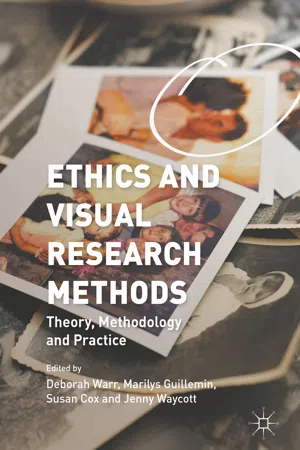
Ethics and Visual Research Methods
Theory, Methodology, and Practice
- English
- ePUB (mobile friendly)
- Available on iOS & Android
eBook - ePub
Ethics and Visual Research Methods
Theory, Methodology, and Practice
About this book
This collection presents stories from the field that were gathered from researchers using a breadth of visual methods. Visual methods refer to the use of still or moving images either as forms of data, to explore research topics and explorations of artistic practice. In addition to well-established visual methods, such as photo-voice and photo-elicitation, the possibilities for visual methods are flourishing through the proliferation of visual culture and developments in digital technologies. Methodological and ethical issues are emerging as visual methods are adapted and applied to answer new kinds of research questions, and in varied settings and populations. Authors offer practical and thoughtful discussions of emerging methodological and ethical dilemmas they encountered in innovative projects that used visual methods either in combination with other methods or as a stand-alone method. The discussions will be of interest to those seeking to understand the value, and potential ethical risks, of visual methodologies for social research.
Information
© The Author(s) 2016
Deborah Warr, Marilys Guillemin, Susan Cox and Jenny Waycott (eds.)Ethics and Visual Research Methods10.1057/978-1-137-54305-9_11. Ethical Issues in Visual Research and the Value of Stories from the Field
Deborah Warr1 , Jenny Waycott1, Marilys Guillemin1 and Susan Cox1
(1)
University of Melbourne, Melbourne, VIC, Australia
Introduction
Visual research has been gaining prominence since the 1940s. One of the best known and earliest uses of visual methods in research is Bateson and Mead’s 1942 study, Balinese Character, documenting ethnographic analyses using photographs of Balinese village life (Bateson and Mead 1942). Visual research in anthropology continued to dominate, until the rise of visual methods in sociology in the 1960s and 1970s. Prosser (1998) and Harper (1989) documented the move toward visual research in sociology during this period, highlighting the use of photographic representations of social life and social inequalities. Visual sociology is indebted to Howard Becker (1974a, b) who sought to develop the rigor of visual methodologies, including the role of theory, reliability and validity in the field of visual research. Since these early beginnings in anthropology and sociology, visual research has since been incorporated into the methodological toolboxes of many other academic disciplines including geography, cultural studies, health studies, psychology, urban studies, design, art research and performance studies. Expansion into these varied disciplines has occurred in parallel with a proliferation of approaches for conducting visual projects and visual media that can be analyzed. Visual data analyzed by contemporary researchers includes photographs, video stories, video diaries, drawings, portraits, cartoons and ‘found’ images that are generated or gathered by participants and researchers in ‘stand alone’ and mixed methods studies.
Research involving human participants is inevitably laced with issues of ethics, and social science research that probes individuals’ experiences of personal and social worlds poses particular kinds of ethical obligations. In a foreword to his collaborative book that explored situations of social and economic disenfranchisement, The Weight of the World (1999, 1), sociologist Pierre Bourdieu asks, ‘How can we not feel anxious about making private worlds public’ (emphasis in the original). For Bourdieu, social research is grounded in tacit (and therefore potentially problematic) conditions of trust between researchers and participants. Researchers bear responsibility to protect participants from the dangers of exposure and misrepresentation (Bourdieu 1999). Visual research methods that offer new modes of private expression should elicit, if not anxiety, then conscientious attention to risks that are arguably heightened by the descriptive and explicatory potential of images. It is only relatively recently, however, that attention has focussed on specific ethical dilemmas and challenges that are associated with the evolving possibilities of visual methods (e.g., see Gubrium and Harper 2013; Clark 2012; Pink 2011a; Prosser et al. 2008; Rose 2012; Wiles et al. 2008).
These discussions grapple with the ways in which visual methods are reworking familiar ethical principles and introducing new kinds of ethical risks. Following other discussions of research ethics, there is consensus that ethical issues cannot be boiled down to a set of instructions, and necessitates careful and open reflection on the practice of research, including the contexts in which it is conducted. There is also broad agreement that some ethical issues encountered by visual researchers are familiar to all social researchers. Such issues are typically framed by ethical principles that require researchers to prevent or minimize potential harms associated with participation in research, protect participants’ anonymity and confidentiality and ensure participants are able to give informed consent to participate. Other ethical issues become more prominent in visual research than they might be for other methods. They are associated with authorship and ownership of data, the circumstances of projects that have multiple and disparate aims and issues of representation and audience reception (Waycott et al. 2015). This summary of key ethical issues does not cover the gamut of ethical issues that may arise, but encapsulates sets of issues that are particularly relevant to visual research.
Ethical research builds on a professional culture that has a shared understanding of the aims and risks of research, and which generates grounded precepts that can guide its everyday practice (Kendig 1996, 143). These precepts are grounded because they crystallize insights gleaned through sharing stories from the field in ways that seek to identify common issues and effective strategies for promoting ethical research. This collection contributes to efforts to generate grounded understanding of methodological and ethical dilemmas that are encountered by visual researchers, and the practices they develop to address them. Researchers consider real-world ethical issues, explain the strategies that were used to address these issues and note those that remain unresolved. The breadth of settings and methodological approaches that are discussed reflect our conviction that visual researchers should aspire to transcend disciplinary differences and establish common understanding of what constitutes ethical practice when using visual research methods.
Ethical Regulations and Guidelines: Where Are the Gaps?
Ethical challenges arise at all stages of the visual research process: from research design, recruitment of individuals or collectives, data collection, analysis and presentation and dissemination of research findings. Guillemin and Gillam (2004) provide a helpful framework that identifies two dimensions of research ethics. The first dimension, conceptualized as ‘procedural ethics’, refers to the ways in which researchers must abide by the formal regulatory systems that guide institutionally based research. Most developed countries have research ethics boards or human research ethics committee (REBs or RECs, depending on the national or institutional context), and protocols and systems of governance that operate to review, approve and monitor the processes of procedural ethics for human research. Researchers must be able to demonstrate that they have satisfactorily addressed a number of requirements, including providing a detailed plan covering such things as how research participants will be recruited and how meaningful informed consent will be obtained, in order to gain approval to commence data collection. This process of ‘procedural ethics’ requires researchers to identify in advance, and be prepared for, ethical issues that are likely to arise. In some instances, procedural ethics requires researchers to justify why the research is needed and that it is methodologically sound.
The other dimension of research ethics is conceptualized as ‘ethics in practice’ and refers to the unanticipated and contingent ethical issues that arise in the process of conducting research in real-world settings (Guillemin and Gillam 2004). ‘Ethics in practice’ requires researchers to uphold key ethical principles while responding to ethical issues that may present in unexpected ways. Ethics in practice can be particularly fraught for researchers working at methodological frontiers where experimental research practices generate emerging and unanticipated ethical issues. As visual methodologies become established and continue to expand, both researchers and REB/REC members must learn to recognize the spectrum of potential risks and assess the adequacy of ethical responses.
The failure for REB/REC members to grasp the potential and risks of methodological innovations results in two sorts of problems in relation to procedural ethics. First, projects may gain approval to proceed although there are outstanding ethical issues that have not been considered. Conversely, worthy and rigorous studies may fail to gain approval to proceed because visual methodologies are not well understood by review board members (Daly and McDonald 1996). The latter is perceived as a widespread problem that discourages researchers from pursuing methodological innovation (Nind et al. 2012) and can foster antipathy between researchers and ethics review boards (see Cox, Chap. 19). Ethics review boards therefore need to be reassured of the value of visual methods so that they can assess relevant projects fairly. Once projects have gained ethics approval, researchers are likely to encounter issues of ethics in practice because they are operating in complex and dynamic settings. Responding appropriately to emerging ethical issues when conducting and disseminating research is enhanced through shared understanding of ethical issues among researchers using visual method sacross diverse disciplinary and research contexts, and engaging with those charged with overseeing the processes of procedural ethics.
Codes of practice and disciplinary guidelines are important resources for visual researchers, although they do not all address the specific circumstances of visual methods (see, e.g., the National Statement of Ethical Conduct in Human Research in Australia, 2007, and the Canadian Tri-Council Policy Statement, 2nd Edition). The International Visual Sociology Association (IVSA) has produced a helpful Code of Research Ethics and Guidelines (2009) which sets out general principles followed by ten statements of ethical standards that the IVSA expects of its members. Wiles et al. (2008) have also provided a review outlining key ethical issues for researchers using visual methods. These guidelines tend to be disciplinary specific. Within contexts of advancing methodological innovation and increasingly hybridized disciplinary fields of research, inclusive discussions of ethical issues are invaluable for navigating uncharted waters and cross-fertilizing good ideas. It is also useful to understand the methodological potential of visual research because this is strongly related to the ethical issues that may be encountered.
Why Use Visual Methods?
Drawn by the potential for research participants to reflect on and describe experiences in new ways, social researchers are collecting and analyzing an expanding range of visual data. Gillian Rose (2014) identifies three key claims that are made about the methodological appeal of visual methods. These are capacities to generate rich data, often in combination with other modes of data collection such as oral, textual and sensory experience; explore ‘taken-for-granted’ experience and tacit forms of knowledge; and foster participatory and support collaborative processes of knowledge creation. While it should not be assumed that these varied capacities are to be achieved simply by using visual methods, they may be realized through the skill, imagination and thoughtfulness of researchers and the involvement of interested and committed research participants.
In addition to now well-established visual methods, such as photovoice and photo-elicitation, the possibilities for visual research are flourishing through developments in, and the growing availability of, digital technologies. These technologies offer capacities for research participants to produce images and videos, sometimes independent of researchers, while geospatial mapping techniques and ‘wearable’ cameras create new forms of visual data enabling researchers to systematically collect volumes of visual data in ways that research participants may be scarcely aware of. The contemporary proliferation of visual culture is also demanding the attention of researchers who are analyzing content posted on social media, gaming sites, video blogs, online memorials and other online platforms to gain insights into transforming social worlds.
Researchers have recognized the potential of visual methods to engage populations who have been marginalized from processes of research. They can also supplement or even supplant ‘standard’ research techniques that use discursive methods, such as interviews, questionnaires and focus groups. Visual methods are increasingly being used in combination with other novel methodologies, such as mobile methods (Hall 2009; Ross et al. 2009), to generate ‘multi-sensory and multi-model’ data in the form of images, sounds and movement (Pink 2008, 2011b). This expanded expressive potential has led to visual methods being considered useful for researching experiences that participants may not be able to readily formulate and communicate in words, and for research involving participants, such as children and people with cognitive and physical disabilities, who may not always be able to articulate their thoughts and experiences in words.
The participatory possibilities of visual research methods are also of considerable interest to researchers. Participants can ...
Table of contents
- Cover
- Frontmatter
- 1. Ethical Issues in Visual Research and the Value of Stories from the Field
- 1. Intersections: Methods and Ethics
- 2. Ethical Issues in Contexts
- 3. The Ethics of Researching Art and Artful Research
- Backmatter
Trusted by 375,005 students
Access to over 1.5 million titles for a fair monthly price.
Study more efficiently using our study tools.
Frequently asked questions
Yes, you can cancel anytime from the Subscription tab in your account settings on the Perlego website. Your subscription will stay active until the end of your current billing period. Learn how to cancel your subscription
No, books cannot be downloaded as external files, such as PDFs, for use outside of Perlego. However, you can download books within the Perlego app for offline reading on mobile or tablet. Learn how to download books offline
Perlego offers two plans: Essential and Complete
- Essential is ideal for learners and professionals who enjoy exploring a wide range of subjects. Access the Essential Library with 800,000+ trusted titles and best-sellers across business, personal growth, and the humanities. Includes unlimited reading time and Standard Read Aloud voice.
- Complete: Perfect for advanced learners and researchers needing full, unrestricted access. Unlock 1.5M+ books across hundreds of subjects, including academic and specialized titles. The Complete Plan also includes advanced features like Premium Read Aloud and Research Assistant.
We are an online textbook subscription service, where you can get access to an entire online library for less than the price of a single book per month. With over 1.5 million books across 990+ topics, we’ve got you covered! Learn about our mission
Look out for the read-aloud symbol on your next book to see if you can listen to it. The read-aloud tool reads text aloud for you, highlighting the text as it is being read. You can pause it, speed it up and slow it down. Learn more about Read Aloud
Yes! You can use the Perlego app on both iOS and Android devices to read anytime, anywhere — even offline. Perfect for commutes or when you’re on the go.
Please note we cannot support devices running on iOS 13 and Android 7 or earlier. Learn more about using the app
Please note we cannot support devices running on iOS 13 and Android 7 or earlier. Learn more about using the app
Yes, you can access Ethics and Visual Research Methods by Deborah Warr, Marilys Guillemin, Susan Cox, Jenny Waycott, Deborah Warr,Marilys Guillemin,Susan Cox,Jenny Waycott in PDF and/or ePUB format, as well as other popular books in Social Sciences & Global Development Studies. We have over 1.5 million books available in our catalogue for you to explore.