eBook - ePub
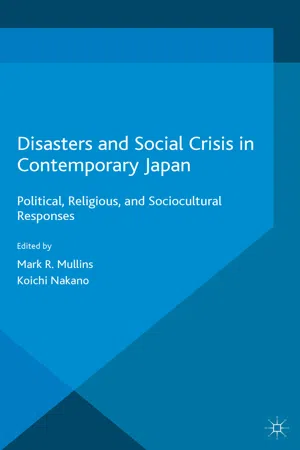
Disasters and Social Crisis in Contemporary Japan
Political, Religious, and Sociocultural Responses
- English
- ePUB (mobile friendly)
- Available on iOS & Android
eBook - ePub
Disasters and Social Crisis in Contemporary Japan
Political, Religious, and Sociocultural Responses
About this book
Japan was shaken by the 'double disaster' of earthquake and sarin gas attack in 1995, and in 2011 it was hit once again by the 'triple disaster' of earthquake, tsunami, and nuclear meltdown. This international, multi-disciplinary group of scholars examines the state and societal responses to the disasters and social crisis.
Information
Part I
Political Responses
1
New Right Transformation in Japan
This chapter explores the rightward shift in Japanese politics of recent decades, both in terms of domestic, socioeconomic policies and in terms of foreign and security policy. On a very simple level, the rightward shift has taken place because the Left collapsed. The Communists and the Socialists, who together consistently secured about 30 percent of the seats in the Diet until 20 years ago, are today down to less than 5 percent. That in itself had the effect of tilting the political spectrum to the right. With the liberal/neoliberal Democratic Party of Japan’s (DPJ) disastrous performance in recent elections, it looks as if the Liberal Democratic Party (LDP) is now truly the only game in town. It bears emphasizing that it is not as if Japan has simply reverted back to the one party dominance of the 1955 system. The fact that the LDP today faces no serious opposition to speak of is actually historically unprecedented.
This is not all, however. Japanese politics of the past couple of decades has shifted to the right also because the Right itself drifted rightward. The LDP used to be a “broad church” that included some liberals as well as “One Nation” conservatives during the period of the 1955 system. It is now a much more consistently rightwing party. It is this New Right transformation of the Right that will be the main subject of this chapter. The nature of the Right went through an important transformation with a new coalition of political illiberalism and economic liberalism replacing the Old Right that consisted of developmentalism and clientelism.
It shall also be pointed out that the rightward shift has not been a unilinear progression rightward in one stroke. Rather, it has been a lengthy process over the past couple of decades with fits and starts—and in successive waves. While the reverse waves in between led to periods of a relative opening up, as in the Murayama government of the mid-1990s and the DPJ government between 2009 and 2012 that coincided with the 1995 and 2011 disasters, they were invariably followed by yet a further shift to the right. In other words, the pendulum is not simply swinging right and left hanging from a fixed point, but instead, the supporting point too is shifting rightward each time the pendulum swings to the right. As a result, even when the pendulum swings back leftward, as was the case when the DPJ came to power, the DPJ position was considerably more to the right of the Socialist position earlier, and perhaps even that of the leftwing of the LDP in the 1955 system. Superficially, the political system may seem more pluralistic and fragmented, but in reality the ideological parameters have been shrinking and drifting to the right.
Last but not least, this chapter also makes the point that the rightward shift of Japanese politics that resulted from the New Right transformation has essentially been an elite-driven process rather than a society-driven process. Social crises, real and constructed, including those caused by the disasters in 1995 and 2011, have been exploited by the conservative political elite, but it is not as if Japanese society shifted to the right first, and then, the political elite responded and adjusted their positions accordingly.
Certain observers point to the fact that a change of government took place in 2009 as a sign that the rightward shift is merely imagined, while others point to the absence of a surge in nationalistic sentiment among the ordinary Japanese to claim that Japan is not becoming more rightwing. This chapter argues that it is precisely the shifting pendulum dynamics of the elite-driven process of the rightward shift that serves to obscure that a rightward drift is taking place.
The New Right coalition in Japan
The guiding principles of globalizing reforms—free trade, free market, small government, greater consumer choice, and so on—are commonly subsumed under the label of economic liberalism (neoliberalism) in advanced industrial democracies. Furthermore, it is crucial to note that, in practice, the most ambitious and successful globalizers maintained their power base in a coalition of “the free economy and the strong state” (Gamble 1994), or economic liberalism and political illiberalism, as I prefer to call it. Margaret Thatcher in Britain as well as Ronald Reagan in the United States are among the earliest and best-known political leaders of the New Right.
The global enthusiasts of The Economist and other mouthpieces of international financial interests constantly scold Japan for its foot-dragging inability to embrace globalization wholeheartedly. Japan, however, has had its share of neoliberal reformers, who received relatively high marks from the patronizing Western free marketeers: Nakasone Yasuhiro was the first; then, Hashimoto Ryūtarō, to an extent; and most recently and with the biggest acclaim, Koizumi Jun’ichirō. (One may include Ozawa Ichirō up to the 1990s here, although he has never had a chance to run the country as prime minister.) The Western observers who approved of these three prime ministers’ reformist ambitions, however, invariably frowned and wagged their fingers when they visited Yasukuni Shrine. Their current hope for Abe Shinzō is for him to keep up with the Koizumi reforms, but without visiting Yasukuni. The globalizers just want economic liberalism without political illiberalism, but they cannot but get both. I now turn to an analysis of this vexing relationship between economic liberalism and political illiberalism through an examination of the New Right coalition in Japan.
Given the apparent consistence with which globalizing neoliberal reforms are accompanied by intolerant assertions of state authority at home and abroad, one has reason to suspect that the two elements are bound by more than a coincidence. As Koizumi proclaimed a “structural reform with no sacred cows,” there were growing indications that political illiberalism was also on the ascendance.
Much comment has been made about the perceived rise of reactionary nationalism over the past decade or so. Yasukuni visits drew so much attention that at times observers lose sight of the fact that the issue is only one among a wider range that the reinvigorated nationalists advocate today. The so-called textbook issues and the underlying revisionist drive that seek to reclaim the grounds for a “correct” view of history untainted by the “masochism” of postwar Japanese guilt are closely associated with Yasukuni. The equivalent of what would quite simply be negationism (Holocaust denial) became disturbingly common, popular, and mainstream among the political elite and in the popular media. Political as well as commercial hate-mongering, more generally, is all over the place as China and the Koreas became the favorite targets of racist hatred. The abduction issue has been used to its maximum effects by the conservatives, and today no one can express even the slightest doubts in public—so much so that, although Nature magazine has been criticizing the Japanese government for being less scientific than the North Korean dictatorship, the Japanese media do not even report the controversy.
What is little more than internalized Orientalism passes as patriotism in this reactionary agenda. “Traditional” Japanese culture, values, and ethics are rediscovered. The national flag and anthem have become compulsory features in public schools, and teachers face disciplinary actions when students are not singing the anthem sufficiently loudly in ceremonies. The Fundamental Law of Education was revised in order to curb the excessive individualism of postwar Japan and to inculcate the love of country and, crucially, to boost the control of the government of the day over education. The prettification and beautification of war experience is also afoot. The “positive” accomplishments of the Japanese Empire are rediscovered and embraced. SDF (Self-Defense Force) troops were dispatched to Iraq without any serious attempt by the prime minister to give a proper account. Decisions were made to upgrade the Defense Agency into a full-fledged ministry. All of this is understood to be only a prelude to the revision of the constitution.
Most fundamentally, I call this current political illiberalism because in a single-minded assertion of state authority, these attitudes and practices seriously undermine the key principles of political liberalism that the government is to be kept in check and held accountable. The same government leaders who pursue the economic liberal agenda seek to purge, marginalize, negate, silence, and slander dissents from within and without.
The government behaves as if it gets to decide what is “political,” just as Koizumi, Abe, and many others pronounced repeatedly that their visits to Yasukuni “should not be politicized.” Freedom of religion, thought, and expression is no longer meant to protect the citizens from state powers, but it is evoked to allow government leaders to do as they please, just as Koizumi curtly repeated that Yasukuni is “a matter of his heart,” and the then Foreign Minister Asō Tarō and LDP policy chief Nakagawa Shōichi defended their suggestions that Japan should debate whether to go nuclear by saying “don’t we have freedom of expression?” The state elite also think that they have a monopoly control over the decision of what constitutes Japan’s national interest. The conservative elite interfere with what the public television, Nippon Hōsō Kyōkai (Japan Broadcasting Corporation, or NHK) broadcasts and, increasingly, with what is expressed in forums that receive public funding, claiming that state money should not be used to sponsor “anti-Japanese” views.
Tellingly, it took two weeks for both Koizumi and Abe (then chief government spokesman) to issue a statement of condemnation when a fellow LDP politician critical of the prime minister’s Yasukuni visits was subjected to a rightwing terrorist attack and had his mother’s house burnt down in 2006.
It is such intolerant assertions of state authority by the government of the day that seek to dismiss and undermine any institutionalized checks, critics, and opposition, in and out of the country, that I call political illiberalism. This tendency has clearly been aggravated since Abe returned to power in December 2012.
So what ties it together with economic liberalism? The basis for the alliance of economic liberalism and political illiberalism is clearly multifaceted, so I shall present my attempts at explicating the ties that hold the coalition together through the following three angles: (1) ideational affinity, (2) interest compatibility, and (3) political complementarity.
Ideational affinity
As ideologies, the two components of the New Right coalition may appear incongruent, if not downright contradictory at first glance. After all, one is called liberal, the other illiberal. Indeed, there are times when the two come in direct conflict with one another. In Japan, such tensions were most visible when Koizumi insisted on his pet project, namely, the privatization of the postal services. Indeed, Koizumi was almost alone with Takenaka Heizo within the LDP to be unequivocally convinced of the virtues of postal privatization. Many were those who sided with him only out of loyalty to the chief or careerist opportunism, while some of the rightwingers put up a loud protest out of their “One Nation” conservatism/nationalism, at times bluntly accusing the prime minister for selling out to American economic interest. As we know, Koizumi expelled the rebels from the party, but barely a year later Abe, who is more of an illiberal nationalist than an economic liberal, invited them back home. Under Abe, the tension between the two wings of his version of the New Right coalition was most apparent in his confused agenda for the much publicized educational reform. Such individualist, consumer-oriented ideas as school vouchers, numerical targets, and performance measurements sit uneasily with collectivist, authoritarian calls for more patriotism, “public-spiritedness,” and discipline in classrooms. Although combined, it seems clear that Abe wants to turn future citizens of Japan into patriotic consumers.
In spite of the obvious potential for disagreements, the two wings of the New Right coalition are held together in Japan through certain ideational affinities. We may note three common features in particular.
First, both economic liberalism and political illiberalism share a Hobbesian, micro-analytical, “realist” worldview. Just as the former is premised on the existence as well as the legitimacy of the economic man who pursues his self-interest, the latter regards interstate relations in terms of competing national interests at the same time as it assumes the unitary nature of the state. The Hobbesian world of continual war of every man against every man may sound awfully pessimistic, but this is often accompanied by an optimistic affirmation of self-interested behavior. Koizumi was a good exemplar of this mix of moral cynicism and amoral optimism. There seems to be something reassuring, liberating, and intoxicating about hearing the law of the jungle declared as it absolves individuals and individual nations alike from the onerous questions of agency and responsibility: Shikata ga nai (what can you do?), sauve qui peut for self-preservation, for the survival of one’s family, one’s nation. By presenting the “natural” conditions of men (and states) as constant, relentless competition, threats, and danger, the New Right worldview reduces human nature as well as the natural and legitimate action of companies and states to the narrow pursuit of self-interest and self-preservation. Waste is to be eliminated, costs are to be cut, dissents are not tolerated, and enemies within and without are to be eradicated. The New Right conception of human nature is both impoverished and impoverishing, but it sets in motion a forceful cycle of self-fulfilling prophecy, and in that sense, it works.
Second, the New Right coalition in Japan plays up and thrives on the communist threats. Anti-communism may appear a little outmoded in the post-Cold War world, but the Japanese Right retains an understanding of communism that is conveniently broad and flexible enough to include both China and North Korea. Although this may amuse some of the Western globalizers who regard Japan as a pseudo-socialist country, as well as annoy the domestic and foreign critics of the Japanese conservative elite who are disturbed by their illiberal values and practice, the Japanese New Right today unashamedly professes its self-image as a liberal democracy that fully shares fundamental values with the United States. In their minds, Japan has a faultless democratic government with an open, and opening, market economy—neither of which is to be found in communist China, and still less in North Korea. The mimicking of American conservative ideas and discourses by the younger generation of Japanese conservative elite today seems to derive in no small part from the fact that so many of the second- or third-generation politicians and the bureaucrats-turned-politicians have experienced living and studying in the United States when young. It is indeed hard to think of other developed countries where the ruling elite embrace so unanimously and unreservedly the American conservative values today (and where the populace is also overwhelmingly acquiescent). In Japan, where Islamic fundamentalism does not quite invoke the alarming image that it does in the United States or in Europe, communism is still abundantly referred to as a faithless, soulless menace among the religious Right (mostly but not exclusively Shintoist) supporters of the New Right.
Third, both economic liberalism and political illiberalism share a radical rhetoric and posture of “reform” and taboo-breaking. What they challenge is this amorphous entity labeled “postwar democracy” (sengo minshushugi). In the New Right portrayal, postwar democracy was politically ineffectual, economically unsound, and morally corrupting. This is the Japanese equivalent of the Thatcherite onslaught on the Keynesian consensus politics in Britain. Included in the ills of postwar democracy are rampant corruption and pork-barrel politics that Koizumi’s rival factions within the LDP led; consensus politics based on factional balance and opposition cooptation; the developmental, interventionist state bureaucracy; the “flying geese” model in the state-industry relations; “pseudo-socialist” market regulation; the lack of assertiveness in foreign and security policy; the “excesses” of individualism, feminism, egalitarianism, and “masochism” in education and in society more broadly; and so forth. Revolutionary zeal and iconoclastic theatrics were the hallmarks of Koizumi’s New Right politics. He professed to change Japan by destroying the LDP as we knew it. Abe proposes to put an end to what he calls the “postwar regime.”
Interest compatibility
Different sets of interests are behind the formation of the New Right coalition, and I shall mention here only the most powerful: the conservative political elite, the global firms, and the United States.
First, let us consider the conservative political elite, most importantly in the LDP, but also in the DPJ. There has been a significant generational turnover among the ele...
Table of contents
- Cover
- Title Page
- Copyright
- Contents
- List of Figures and Tables
- Acknowledgments
- List of Contributors
- Introduction
- Part I: Political Responses
- Part II: Religious Responses
- Part III: Social Responses
- Part IV: Cultural Responses
- Index
Trusted by 375,005 students
Access to over 1.5 million titles for a fair monthly price.
Study more efficiently using our study tools.
Frequently asked questions
Yes, you can cancel anytime from the Subscription tab in your account settings on the Perlego website. Your subscription will stay active until the end of your current billing period. Learn how to cancel your subscription
No, books cannot be downloaded as external files, such as PDFs, for use outside of Perlego. However, you can download books within the Perlego app for offline reading on mobile or tablet. Learn how to download books offline
Perlego offers two plans: Essential and Complete
- Essential is ideal for learners and professionals who enjoy exploring a wide range of subjects. Access the Essential Library with 800,000+ trusted titles and best-sellers across business, personal growth, and the humanities. Includes unlimited reading time and Standard Read Aloud voice.
- Complete: Perfect for advanced learners and researchers needing full, unrestricted access. Unlock 1.5M+ books across hundreds of subjects, including academic and specialized titles. The Complete Plan also includes advanced features like Premium Read Aloud and Research Assistant.
We are an online textbook subscription service, where you can get access to an entire online library for less than the price of a single book per month. With over 1.5 million books across 990+ topics, we’ve got you covered! Learn about our mission
Look out for the read-aloud symbol on your next book to see if you can listen to it. The read-aloud tool reads text aloud for you, highlighting the text as it is being read. You can pause it, speed it up and slow it down. Learn more about Read Aloud
Yes! You can use the Perlego app on both iOS and Android devices to read anytime, anywhere — even offline. Perfect for commutes or when you’re on the go.
Please note we cannot support devices running on iOS 13 and Android 7 or earlier. Learn more about using the app
Please note we cannot support devices running on iOS 13 and Android 7 or earlier. Learn more about using the app
Yes, you can access Disasters and Social Crisis in Contemporary Japan by Mark R. Mullins, Koichi Nakano, Mark R. Mullins,Koichi Nakano in PDF and/or ePUB format, as well as other popular books in Social Sciences & Asian Literary Criticism. We have over 1.5 million books available in our catalogue for you to explore.