eBook - ePub
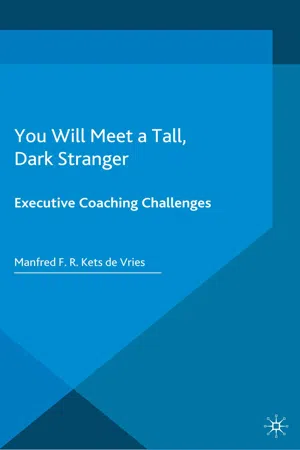
You Will Meet a Tall, Dark Stranger
Executive Coaching Challenges
- English
- ePUB (mobile friendly)
- Available on iOS & Android
eBook - ePub
You Will Meet a Tall, Dark Stranger
Executive Coaching Challenges
About this book
Kets de Vries profiles a range of toxic executives the narcissist, psychopath, cold fish, obsessive-compulsive, and many more, offering coaches examples of interventions that have worked and those that haven't, to help coaches deal with difficult people and become more effective.
Information
chapter 1
Introduction
The greatest deception men suffer is from their own opinions.
—Leonardo da Vinci
The man who never alters his opinion is like standing water, and breeds reptiles of the mind.
—William Blake
The bamboo that bends is stronger than the oak that resists.
—Japanese proverb
So you like the challenge of helping others learn and grow? You want people to be more effective and you’d like to help them change? You are seriously considering becoming an executive coach, or (to put it in a slightly different context) you’d like to be better at coaching other executives in your organization? I must warn you that you are embarking on a challenging journey. As the saying goes, “You will be living in interesting times.” Indeed, I am always amazed at the power of the coaching process—it has the potential to draw out capabilities that your clients never even knew were there. But do you understand what executive coaching requires? Do you understand the effort involved? Being an effective executive coach requires insight into human behavior and knowledge of organizations. It also involves patience, stamina, and hard work.
In simple terms, I see executive coaching as allowing clients to pick your brains—it’s about knowing how to listen and how to nudge them in the direction that makes them feel at their best. I have found (and this will come as no surprise to any experienced coach) that a great way to have an impact on people is simply by just listening to their stories. By helping your clients create a cohesive, comprehensive narrative of what is important in their lives, and what is troublesome, they will discover things about themselves that they never knew they knew. And while this work is not always a bed of roses, let me assure you that it can be extremely gratifying. To assist people on their journeys of self-discovery—helping them understand what’s important to them, what they’re good at, what they’re not good at, and the things they need to do to be even better—can be exciting. As the saying goes, a mind once stretched will never be the same.
However, you should be aware that the challenge you are up against could be daunting. Opening doors is one thing, but having clients walk through them is another. With difficult people the task can be compared to figuring out a 5,000-piece jigsaw puzzle with a lot of sky—it can be quite daunting.
You should also know that when your clients tell you they want to change, to move forward, this is often nothing more than paying lip service to an idea. They may consciously believe that they want change, but unconsciously is a different matter. They are far more likely to want other people to change.
You need to realize that a considerable part of human behavior, if not the largest part, is unconscious. Many people, without knowing it, are strangers to themselves, not really aware of why they’re doing what they’re doing. Coaches must always be sensitive to the fact that what people say they want, and what they do, are two very different things. In reality, many of the people you will be dealing with are engaged in heroic efforts at self-sabotage, in the process destroying the lives of others and even their organizations.
Many executives lead their companies to success, others drive them crazy, and some do both. As an executive coach you often have to deal with those in the latter two categories. That said, I should point out that working with executives who drive people (and companies) crazy requires great imagination and sensitivity to interpersonal relationships. Having some clinical sense is, in my view, a plus. Given the importance of unconscious processes, many of the people you encounter (including yourself) will have serious blind spots. We all have our darker sides. What we may find in the basement of our mind can be surprising. Skeletons abound. But you shouldn’t be shocked by it. It’s part of the human condition. It makes us truly human.
The word “clinical” means “at the bedside.” It is helpful to point out connections between clients’ past and present behavior—after all, the past is the lens through which we understand the present and shape the future. Cognitive behavioral theory has its place, but so has psychodynamic understanding. Good theory, without being dogmatic, will always be useful in shining light into the behavioral darkness.
Many of the people you encounter will be repeating past behavior patterns. Your challenge is to make them realize that what might have been quite useful behavior—even a survival strategy—at the age of 10, may no longer be effective at the age of 40. Your clients, however, may be blind to this. As the writer and statesman Johann Wolfgang von Goethe used to say, “The hardest thing to see is right in front of your eyes.” You need to help your clients see that they are stuck on automatic pilot. They may be suffering from developmental arrest. Only when they realize this might they be willing to consider other ways of doing things.
Another advantage would be a solid understanding of what life in organizations is all about. Organizations are complex entities. An effective executive coach needs to understand the way these entities function, know something about strategy and structure, have some familiarity with organizational group dynamics, make sense of an organization’s corporate culture, and be able to speak its language. This means that you should always have a systemic orientation when you do your work. You need to understand that organizations are made up of constellations of forces that must be aligned if your interventions are to be effective.
You should also bear in mind that, when you do this kind of work, the boundaries between consulting and coaching can become quite blurred. I believe that executive coaches should not be used in a consulting capacity to help weak CEOs. We shouldn’t be teachers, but “awakeners”—we should help executives think through and tackle their own problems. I firmly believe that senior executives need to deal with their problems on their own and not get caught up in dependency relationships.
Obviously, senior executives have a considerable influence over the health, happiness, and future of the people who work for them. They can create an environment that allows others to grow and give their best, or they can do the opposite. Indeed, some executives (consciously or unconsciously) create the kind of work environments that poison other people’s lives. When an executive’s psychological make-up is problematic—even toxic—all business plans, ideas, interactions, and even the system and structure of the organization itself, are in danger of becoming a mirror image of that negativity. Always be attuned to the possibility that a senior executive’s toxic behavior can permeate an organization’s culture so thoroughly that the people who work there get sick.
I have learned from my work as a psychoanalyst that toxic people have often had miserable experiences in childhood and afterwards that they subsequently act out in the workplace, like a repeat performance. In so doing, they make life miserable for their employees, sowing unhappiness wherever they go. They act out their private issues on a public stage, externalizing their internal world. Sadly, I regularly encounter situations where toxic bosses contribute to extreme stress and even nervous breakdowns—not exactly a prescription for high productivity and morale.
Interestingly enough, many executives are the exact opposite of the rational men and women described in management textbooks. As I have seen far too often, the gap between desired and actual behavior can be enormous. Given how destructive people can be, as an executive coach you need to understand what differentiates toxic executives from more inspirational ones. What makes them so special? What are their defining characteristics?
To help make sense of the difficult encounters you may have in executive coaching, I have put some of these toxic bosses “on the couch,” at least symbolically. In the chapters that follow, I describe some of the more puzzling executives I have encountered in my coaching work to help you gain greater insight into what they are all about. Note that this is just a sample—there are many more variants—but keep in mind that “ideal” types are the exception, not the rule. There are not many “ideal” types in our world. As you will have realized by now, Homo sapiens is a complex animal. To be fair, most of us are “hybrids.” Many of the toxic people I have encountered have the characteristics of various personality types, but are still able to cause serious trouble for themselves and others. They touch others in very negative ways. They are masters of destruction, and as such they’re not easily forgotten. They cast a dark shadow that lasts for a long time.
chapter 2
The Narcissistic Executive
For the most part people are not curious except about themselves.
—John Steinbeck
I don’t care what you think unless it is about me.
—Kurt Cobain
He who is enamored of himself will at least have the advantage of being inconvenienced by few rivals.
—G. C. Lichtenberg
The leadership style most frequently found at top management levels is the narcissist. Indeed, this kind of leader is over-represented in the higher echelons, and derailment at the top is often due to the excesses that come with this kind of behavior. In these instances, position and disposition seem to interact in mysterious ways, resulting in instability. Ultimately the rot sets in.
Narcissism is a psychological condition with a distinct etiology, ways of acting, problems, and benefits. That being said, it is not a disorder that a person either does or does not have. We all possess narcissistic characteristics, but in varying degrees. In fact, we need a modicum of narcissism to function properly—a healthy dose of narcissism is part of the body’s immune system, defending it against the vicissitudes of life. It creates the foundation of self-confidence, assertiveness, self-expression, and the proper execution of power. Narcissism enables us to do things, to feel good about ourselves, and to impose ourselves a little. But the narcissistic pendulum can swing too far to one side, creating a personality disorder. Driven by grandiose fantasies about themselves, true narcissists are selfish, inconsiderate, require excessive attention, have a sense of entitlement, and pursue power and prestige at all costs.
To assess whether someone is truly a narcissist, you need access to that person’s inner life, which (as you should know by now) is not easy. However, you can observe its behavioral manifestations—and that is something you can work with. Knowing the signs of narcissism helps you to recognize these people; it tells you what you’re up against, what contributes to their often puzzling behavior, and how to deal with them.
Children exposed to certain types of parenting—whether it is over- or under-stimulation—can become confused and destabilized. The problem is that some parents, although seemingly focused on their offspring, actually have little regard for the child in its own right; they are unable to engage with it in an emotionally adequate manner. Not surprisingly, this can cause disequilibrium and instability. Such children may become insecure and excessively needy. They do not develop the self-confidence to keep existential anxiety at bay. Instead, they may grow up feeling inadequate or inferior, feelings that will haunt them for the rest of their lives. Due to this basic sense of insecurity, a sense of deprivation, anger, emptiness, and neediness will follow them wherever they go. Hence they will be highly sensitive to any real or imagined threat to their self-esteem, and their narcissistic legacy may turn into dysfunctional behavior.
I have seen how these children hold on to fantasies of grandiosity—“I’m not just all right; I’m the greatest”—setting in motion the psychological engine that drives excessive narcissistic behavior. (You should view this behavioral pattern as a defense against inadequacy—of not feeling good enough.) Throughout childhood, these narcissists-in-the-making strive to marshal support for their grandiose (though tenuous) image of themselves by cultivating whatever good looks they have, learning to charm others, and often just by working hard. Typically, this behavior continues into adulthood, since it’s a pretty good prescription for success, but in the process they become fixated on power, status, prestige, money, superiority, and glory.
You should be sensitive to the fact that narcissists’ seductive way of operating (as they rise to power) is really pseudo-charm, only used as long as it serves the purpose of self-aggrandizement. People they encounter will be treated as pawns as they work towards success—and that will include you as an executive coach. You may feel exploited and used, but narcissists see themselves as special and consider that rules are made for others, not for them. Their sense of entitlement means that they’re prone to outbursts of rage when they do not get what they want. And as their sense of self-esteem remains fragile, it creates conscious and unconscious power dynamics.
Narcissistic executives very frequently create toxic relationships with the people who work with or for them. Their neediness evokes certain reactions from those around them. As a coach, you’ll notice that it doesn’t take long for people with a narcissistic boss to realize the need to admire and please that person. Narcissistic executives like this kind of admiration. It’s an emotional fix; without it they can’t function very well. They want others to approve of whatever they do, and they need to be in the limelight. But this form of interaction comes with the risk of creating a mutual admiration society in which everyone only hears and sees what they want.
As an executive coach you should always be sensitive to the fact that candor flees authority. Narcissistic leaders are surrounded by yes-men who quickly learn that when people are unwilling to share the leader’s way of looking at the world there is a danger of tantrums. Narcissists tend to see any form of disagreement as a personal attack. Their tantrums should be viewed as a regression to earlier feelings of helplessness and humiliation, which have turned into blind rage, a re-enactment of childhood behavior. The difference is that, given the considerable power they now wield within an organization, the impact can be devastating.
Let me tell you about Simon. When I first heard about him, Simon was regarded as one of the most promising senior executives in his company, although a number of non-executive directors had had second thoughts about whether he was the right person to succeed the current CEO. Would Simon be able to take the company to the next level? Did he have sufficient maturity to do it? Their doubts prompted Agnes, VP of Talent Management, to ask me to become Simon’s executive coach, with the aim of preparing him for possible succession.
To help me understand better what Simon was all about, Agnes shared a number of concerns. She started by telling me about a series of rash decisions he had made when first on the job, which were perceived as counter-cultural, raising questions about whether he understood what the corporate culture was all about. Was he really willing to accept their wa...
Table of contents
- Cover
- Title
- Copyright
- Contents
- Preface
- About the Author
- 1 Introduction
- 2 The Narcissistic Executive
- 3 The Detached Executive
- 4 The Paranoid Executive
- 5 The “Bipolar” Executive
- 6 The Psychopathic Executive
- 7 The “Autistic” Executive
- 8 The Passive-Aggressive Executive
- 9 The Obsessive-Compulsive Executive
- 10 Love, Play, and Work
- 11 You Will Meet a Tall, Dark Stranger
- Appendix: A Short Note on Coaching Interventions
- Bibliography
- Index
Trusted by 375,005 students
Access to over 1.5 million titles for a fair monthly price.
Study more efficiently using our study tools.
Frequently asked questions
Yes, you can cancel anytime from the Subscription tab in your account settings on the Perlego website. Your subscription will stay active until the end of your current billing period. Learn how to cancel your subscription
No, books cannot be downloaded as external files, such as PDFs, for use outside of Perlego. However, you can download books within the Perlego app for offline reading on mobile or tablet. Learn how to download books offline
Perlego offers two plans: Essential and Complete
- Essential is ideal for learners and professionals who enjoy exploring a wide range of subjects. Access the Essential Library with 800,000+ trusted titles and best-sellers across business, personal growth, and the humanities. Includes unlimited reading time and Standard Read Aloud voice.
- Complete: Perfect for advanced learners and researchers needing full, unrestricted access. Unlock 1.5M+ books across hundreds of subjects, including academic and specialized titles. The Complete Plan also includes advanced features like Premium Read Aloud and Research Assistant.
We are an online textbook subscription service, where you can get access to an entire online library for less than the price of a single book per month. With over 1.5 million books across 990+ topics, we’ve got you covered! Learn about our mission
Look out for the read-aloud symbol on your next book to see if you can listen to it. The read-aloud tool reads text aloud for you, highlighting the text as it is being read. You can pause it, speed it up and slow it down. Learn more about Read Aloud
Yes! You can use the Perlego app on both iOS and Android devices to read anytime, anywhere — even offline. Perfect for commutes or when you’re on the go.
Please note we cannot support devices running on iOS 13 and Android 7 or earlier. Learn more about using the app
Please note we cannot support devices running on iOS 13 and Android 7 or earlier. Learn more about using the app
Yes, you can access You Will Meet a Tall, Dark Stranger by Manfred F.R. Kets de Vries,Manfred F. R. Kets de Vries in PDF and/or ePUB format, as well as other popular books in Business & Business Communication. We have over 1.5 million books available in our catalogue for you to explore.