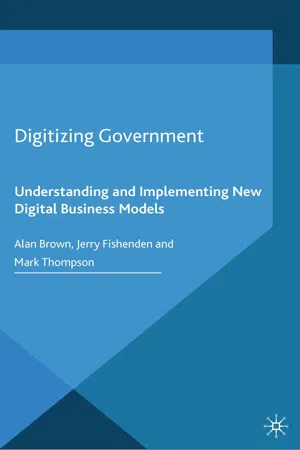
eBook - ePub
Digitizing Government
Understanding and Implementing New Digital Business Models
- English
- ePUB (mobile friendly)
- Available on iOS & Android
eBook - ePub
Digitizing Government
Understanding and Implementing New Digital Business Models
About this book
For businesses large and small, investment in digital technologies is now a priority essential for success. Digitizing Government provides practical advice for understanding and implementing digital transformation to increase business value and improve client engagement, and features case studies from the private and public sectors.
Information
Part 1
Online Services – A Road Much Travelled
Moving public services online should be a classic win–win. For government, redesigning services and operating many of them digitally will make them cheaper and more efficient. For citizens and businesses, it will provide services designed around their needs, and the convenience of 24-hour access, seven days per week. But it’s not about merely moving services on to a computer or iPhone screen: it’s about ensuring that even front-line services such as meals on wheels, care in the home and mental health can all be improved if the processes and services behind them are redesigned and optimized around the needs of citizens and those directly involved in meeting their needs.
What government would not want both to save money and to improve the quality and efficiency of public services? And what citizen would not want them to do so? The resulting savings can then be redeployed as governments and electorates see fit according to their own political, economic and social beliefs: reinvested into improved front-line services for those who most need them, or into programmes that would otherwise need to be cut – or even redistributed directly to citizens and business through tax cuts. That is the political choice – and opportunity – that digital represents.
Political interest in the role of technology in improving public services and the efficiency of their administration and operations is nothing new. Governments have seen the potential for technology-enabled change – rather than merely the automation of existing services – since at least the early 1990s. A variety of modernization and improvement initiatives have been attempted by governments over the last few decades, spurred on in particular by the game-changer of the internet. This political interest has journeyed through several successive brands with mixed results – from online government to electronic government (e-government), through transformational government (t-government) to today’s focus on digital government initiatives.
It would be easy to assume that current digital initiatives are merely the latest rebrand in this long journey. That would be a mistake: earlier online and e-government initiatives were often technology-led, focused particularly on the production of websites, and placing existing manual services online. The move to digital is about much more than this, and is not primarily about technology: it’s about the reimagining and reinvention of the way public services are conceived, designed, operated and managed. This time, it’s not simply about the window dressing – the websites and online forms – but about the complete design, from back end to front end, of public services and the organizations that deliver them: a rethinking of the very plumbing of government. Yet if the move to digital is going to succeed where previous programmes failed, it’s important to understand why the long-standing gap between the political desire to improve public services, and the challenge of delivering this vision on the ground, exists – and how best it can be overcome.
chapter 1
An International Problem
Over the past 20 years many governments have promised (often repeatedly and at great length) to use technology to modernize public services. Yet most have also struggled to make long-term improvements on anything like the scale of reinvention and innovation seen in the best of the private sector.
Amongst these early efforts was the National Partnership for Reinventing Government (NPR) in the United States, announced in 1993 as part of the Clinton administration’s attempt to reform and streamline the US federal government and its functions. Initially known as the National Performance Review, its aim was to improve government, producing one that ‘works better, costs less, and gets results Americans care about’ and to ‘invent government that puts people first, by: serving its customers, empowering its employees, and fostering excellence’.
Part of this plan involved the creation of ‘Electronic Government’, which intended to help transform government in the same way that ‘amazon.com transformed bookselling’. In 1997 it committed to the principle that ‘anyone who wants to transact business with the government electronically [will be able] to do so. By the end of FY 2000, nearly 40 million Americans will. Emerging forms of information technology will be vital tools in changing Americans’ experience with their government. They will be able to access information to solve problems themselves through the Internet, via telephones, and through neighborhood kiosks.’
More recently, President Obama announced his Technology Plan, saying at its launch in 2007: ‘Let us be the generation that reshapes our economy to compete in the digital age.’ The plan recognized that the internet and information technology can be applied to make government more effective, transparent and accessible to all US citizens. With this in mind, one of Obama’s first key actions was the appointment of Aneesh Chopra, a successful venture capital manager and technology visionary, as the nation’s first Chief Technology Officer (CTO). Once installed, Chopra sought to build on his earlier successes as CTO for the state of Virginia by advocating similar practices across federal government. In particular, his primary goal was to challenge the closed, proprietary nature of many government IT systems and move them towards adoption of open practices based on open standards and technologies.
In Canada, the government recognized early on that the internet, and technology in general, promised a significant opportunity for both businesses and citizens alike, providing convenience and 24/7 access to services. Alongside the improvement of public services, the use of technology also held out the promise of significant operational efficiencies and cost savings. As a result, Canada invested heavily in online government services and was often amongst the most highly rated countries internationally in terms of the impact that e-government had upon its services and operations. By 2005, the government had been successful in shifting transactions to the internet, providing 130 of the most important government services electronically.
In 2003 the New Zealand government set out a vision for e-government that foresaw it as ‘a way for governments to use the new technologies to provide people with more convenient access to government information and services, to improve the quality of the services and to provide greater opportunities to participate in our democratic institutions and processes. E-government presents New Zealand with some tremendous opportunities to move forward in the 21st century with higher quality, cost-effective, government services and a better relationship between New Zealanders and their government.’ In their progress report of 2007, the government recognized that: ‘The e-government programme is long term and spans multiple decades. For this reason, this review needed to recognize the 2007 milestone not as an end in itself but a stepping stone towards future transformation of government.’
In Australia, the ‘Better Services, Better Government’ strategy of 2002 set out the direction and priorities for the future of e-government, building on the earlier policy from 2000 of ‘Government Online’. The strategy aimed to require public agencies to achieve improved efficiency in the provision of public services and foresaw that e-government would deliver tangible returns (such as cost reductions, increased efficiency and productivity, or improved services to businesses and the broader community).
Similarly, in the United Kingdom, the ‘Government Direct’ report of 1996 stated that: ‘The Government is determined that the methods of direct service delivery which information technology is now making possible, should be harnessed in the UK in order to: provide better and more efficient services to businesses and to citizens; improve the efficiency and openness of government administration; and secure substantial cost savings for the taxpayer.’
It’s clear that many governments, for many years, have shared similar political aspirations for technology to help improve public services. And yet many of them have faced similar challenges in turning these worthy aspirations into meaningful and sustained improvements on the ground. Yes, there have been some successes here and there – but few, if any, of the same scale of organizational change, disruption and improvement that has been seen in other sectors.
An Australian National Audit Office report from 2004–5, for example, found that government organizations were ‘generally unable to determine whether their investments in e-government were delivering tangible returns, such as cost reductions or increased efficiency and productivity.’ Not unusually, much of the focus of the agencies was on websites – a similar focus to other governments at that time – demonstrating a fundamental misalignment between the high-level aspiration (to redesign services) and its execution (using websites to serve up existing paper transactions online). Such criticisms provide evidence of a clear distinction between earlier e-government initiatives and what a truly digital enterprise means – where the entire management, design and operation of its services becomes digital, not merely the shop window (website) at the front.
The Canadian auditor general has recently commented on the lack of ‘an overall service delivery strategy’ and the lack of an ‘overall strategy that focuses on service delivery or online services’. Such comments are not unique to Canada. They reflect what has been experienced elsewhere, such as in the UK, where early initial efforts to put services on to the internet later stalled. Many online services were little more than electronic versions of previous paper services, or, worse, merely an online PDF that could be downloaded, printed, filled-in and sent back in the post in the usual way. Described dismissively by some critics as merely ‘lipstick on a pig’, the rush to put things online often did little to address fundamental problems of poor service design and management that lay behind them. Few of these efforts turned their focus on to the internal design and operations of public services, limiting themselves instead to externally facing transactions that often merely sought to replicate online equivalents of previous paper-based forms and processes.
This long and sustained gap between what politicians have wanted to achieve with technology, and the lack of meaningful delivery on the ground, is important to understand and fix if governments are to realize the benefits enjoyed by the best of the private sector – where digital organizations have completely reimagined and reinvente...
Table of contents
- Cover
- Title
- Copyright
- Contents
- List of Figures
- List of Tables
- Acknowledgements
- Figures Acknowledgements
- Preface
- Introduction
- Part 1: Online Services – A Road Much Travelled
- Part 2: The Big Idea
- Part 3: Service Providers and Digital Delivery
- References, Sources and Further Reading
- Index
Trusted by 375,005 students
Access to over 1.5 million titles for a fair monthly price.
Study more efficiently using our study tools.
Frequently asked questions
Yes, you can cancel anytime from the Subscription tab in your account settings on the Perlego website. Your subscription will stay active until the end of your current billing period. Learn how to cancel your subscription
No, books cannot be downloaded as external files, such as PDFs, for use outside of Perlego. However, you can download books within the Perlego app for offline reading on mobile or tablet. Learn how to download books offline
Perlego offers two plans: Essential and Complete
- Essential is ideal for learners and professionals who enjoy exploring a wide range of subjects. Access the Essential Library with 800,000+ trusted titles and best-sellers across business, personal growth, and the humanities. Includes unlimited reading time and Standard Read Aloud voice.
- Complete: Perfect for advanced learners and researchers needing full, unrestricted access. Unlock 1.5M+ books across hundreds of subjects, including academic and specialized titles. The Complete Plan also includes advanced features like Premium Read Aloud and Research Assistant.
We are an online textbook subscription service, where you can get access to an entire online library for less than the price of a single book per month. With over 1.5 million books across 990+ topics, we’ve got you covered! Learn about our mission
Look out for the read-aloud symbol on your next book to see if you can listen to it. The read-aloud tool reads text aloud for you, highlighting the text as it is being read. You can pause it, speed it up and slow it down. Learn more about Read Aloud
Yes! You can use the Perlego app on both iOS and Android devices to read anytime, anywhere — even offline. Perfect for commutes or when you’re on the go.
Please note we cannot support devices running on iOS 13 and Android 7 or earlier. Learn more about using the app
Please note we cannot support devices running on iOS 13 and Android 7 or earlier. Learn more about using the app
Yes, you can access Digitizing Government by A. Brown,J. Fishenden,M. Thompson in PDF and/or ePUB format, as well as other popular books in Business & Business Strategy. We have over 1.5 million books available in our catalogue for you to explore.