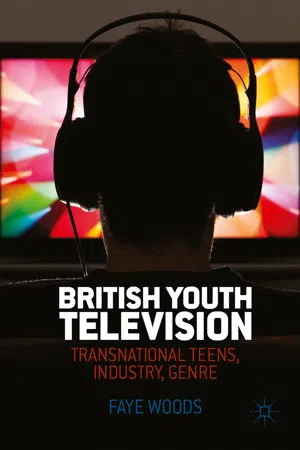
In this book, Faye Woods explores the raucous, cheeky, intimate voice of British youth television. This is the first study of a complete television system targeting teens and twenty somethings, chronicling a period of significant industrial change in the early 21st century. British Youth Television offers a snapshot of the complexities of contemporary television from a British standpoint — youth-focused programming that blossomed in the commercial expansion of the digital era, yet indelibly shaped by public service broadcasting, and now finding its feet on proliferating platforms. Considering BBC Three, My Mad Fat Diary, The Inbetweeners, Our War and Made in Chelsea, amongst others; Woods identifies a television that is defiantly British, yet also has a complex transatlantic relationship with US teen TV. This book creates a space for British voices in an academic and cultural landscape dominated by the American teenager.
- English
- ePUB (mobile friendly)
- Available on iOS & Android
eBook - ePub
About this book
Information
Framing
© The Author(s) 2016
Faye WoodsBritish Youth Television10.1057/978-1-137-44548-3_11. Made in Britain: Mapping British Youth Television
Faye Woods1
(1)
University of Reading, Reading, Berkshire, UK
Three young men – two white, one British-Asian – sit slumped in a bus stop shelter in long shot, surrounded by pouring rain and backed by identikit white-brick terraced houses. The screen splits and the right-hand side fills with a sunlit lakeside, packed with partying, laughing, tanned teenagers clad in shorts and bikinis. We cut to the right as the Brits crane forward and gaze in confusion and wonder at the mirage of American leisure. Their grey-toned, rainy image is framed between slender female dancing bodies saturated with colour. They rise and walk through the dividing border, gasping as they emerge from the rain into the bright sunshine. They smile broadly to each other as they wander through the mass of partying American youth. We cut back to the split-screen long shot to find an elderly couple installed in the bus shelter, an American female voiceover invites the audience to ‘Come on over to Beaver Falls, new British drama starts 27 July on E4’. Left is Britain: dull, grey, rainy, elderly. Right is America: youth, sunshine, leisure and the potential of sex. The trailer introduces Beaver Falls (E4, 2011–2012), a dramedy as ‘laddishly’ juvenile as the lazily punning title suggests, which follows a trio of British graduates working at a wealthy American summer camp. The trailer sets up a dichotomy between national representations of youth, British mundane realism and American utopian fantasy, suggesting that British youth television was able to breach the divide.
This book offers the first study of contemporary British youth television, mapping a broadcasting eco-system that emerged in the past 15 years through the rise of digital television and its migration across multiple platforms and screens. Presenting a British counterpart to the US-dominated field of teen TV scholarship, this study examines individual programmes, genres and trends. It considers their social and historical contexts and larger industrial frameworks, tracing commonalities across fiction and factual programming. ‘Teen TV’ has been used in scholarship as an umbrella term under which some international texts have been included (Davis and Dickinson 2004b); however, I follow Karen Lury (2001) in defining the national field as ‘British youth television’. This signals national distinction and reflects British programming’s embrace of both teens and twentysomethings, from the school uniforms of Some Girls (BBC Three 2012–2014) and The Inbetweeners (E4, 2008–2010) to the housemates of Being Human (BBC Three, 2008–2013) and Switch (ITV2, 2012).
By focusing on the past two decades, this book builds a case study of a significant period of change in British television, an era that Amanda Lotz defines as ‘post-network’ television in the US (2014) and James Bennett marks as ‘digital television’ (2011), where ‘various industrial, technological, and cultural forces have begun to radically redefine television, yet paradoxically, it persists as an entity that most people still understand and identify as “TV”’ (Lotz 2014, 7). This encompasses the growth of digital television in the UK and television’s spread across multiple streaming and download platforms, from the BBC iPlayer to Netflix to YouTube, as a medium accessed through a range of devices from DVRs to mobile phones. A revolution rather than a ‘death’, this is a landscape that encompasses both linear televisual flow and non-linear flexibility, professional and amateur production, where ‘digital media are increasingly less “new” and increasingly more “ordinary”’ (Lotz 2014, 15). British youth television is directly engaged in the challenges facing the British television industry as it negotiates its position in the international media landscape and chases the proliferated attention of youth audiences. This book traces its journey up to 2015 and contemplates where its future may lie.
This book expands the privileging of the US hour-long drama in previous studies of teen TV (Davis and Dickinson 2004b; Ross and Stein 2008b) to bridge divisions between the academic study of fiction and factual television. By bringing together My Mad Fat Diary (E4, 2013–2015) and Our War (BBC Three, 2011–2014), The Inbetweeners and The Only Way is Essex (ITV2/ITV Be, 2010–) in a single study I can chart continuities and thematic concerns across drama, sitcom, reality TV and factual storytelling, identifying British youth television’s preoccupations and its structure of feeling (Williams 1977). I build a comprehensive picture of the landscape of British youth television by integrating close analysis of televisual texts – form, aesthetics, tone and representation – with a charting of larger industrial frameworks. Woven through this analysis is the complex relationship with US teen TV, the push and pull of influence and distinction. British youth television follows a long history of the cross-Atlantic flows of pop cultures, blurring yet also defining national identities. Borders are rendered permeable in the age of digital media, with television circulating internationally via streaming platforms, peer-to-peer sharing and remakes. This transatlantic exchange shapes the televisual diet of British youth audiences, which is heavy on US content. 1 It also shapes British youth television’s negotiation of its own territory and its relationship with public service broadcasting; 2 at times, it is in thrall to US television, while at others, it is eager to assert its national difference.
The late 2000s saw US television coalesce around the ‘millennial’ as a target of its teen programming. ABC Family rebranded in 2007 as a millennial-targeted cable channel (Stein 2015) and in 2008 MTV began a large-scale market-research project on the demographic that influenced its programming and branding decisions (Pardee 2010; Stelter 2010). ‘Millennial’ referred to the demographic born between 1982 and 2004 and combined the lucrative teenage and young adult consumers. It was defined and disseminated by William Howe and Neil Strauss’ book Millennials Rising (2000) with the help of the influential Pew Research centre (Stein 2015, 3). Louisa Ellen Stein argues that like all generations, the ‘millennial’ is a discursive construct, crafted by marketers, consultants and industry discourse, an ‘evolving, self-defined culture’ (2015, 7). In contrast, British industrial discourse has never been as clearly defined around the figure of the millennial, tending to prefer ‘youth’ as a signifier of the 16–34-year-old demographic.
As Simon Frith argues, ‘youth’ itself is a discursive construct which in the 1980s ‘became a category constructed by TV itself, with no other referent: those people of whatever age or circumstance who watched “youth” programmes became youth’ (1993, 64). British press discourse in the 2010s has labelled the demographic Generation Y (Browning 2014; No author 2014), Millennials (Bulkley 2013; Sanghani 2014; Chamorro-Premuzic 2014) and at times Generation Rent to reflect a coming of age during the economic downturn (Osborne 2015). My use of ‘youth’ over ‘teen’ or ‘millennial’ feels both nationally appropriate and positions my study as a continuation of Lury’s foundational work. Lury argues that ‘youth’ is ‘not determined by age, but relates to a historical and mediated construction of “youth” or “youthfulness” as an attitude, or a series of traits, habits, and beliefs’ (2001, 126). I use youth to describe the demographic category of those aged 16–34 – one used within the television industry – and a televisual construct defined by tone, address and its location within defined youth spaces in the schedule and channel line-up.
It is only in the early years of the twenty-first century that British youth television has found its feet, following sporadic bubbles of youth provision throughout the first 50 years of British television (J. Hill 1991; Osgerby 2004a; Moseley 2007; Lury 2001). It is a form shaped by the narrowcast digital television channels developed by both commercial television and public service broadcasters ahead of the digital switchover in 2012. British television is distinct from the US system that dominates existing discussions of teen TV and is shaped by a blend of public service broadcasting and advertising. It is made up of five main channels that combine publicly owned and commercial broadcasters, which have various levels of public service remit. 3 They range from the licence-fee funded, publicly owned BBC One and BBC Two to the commercially funded and publicly owned Channel 4, to the commercially funded ITV and Channel 5, which maintain minimal public service content. Before the 2012 switchover to digital television, all five main channels were delivered terrestrially, free-to-air. Alongside these sit a swathe of commercially funded cable and satellite channels, with BSkyB, Virgin Media and recently BT competing as the primary distributers of these channels. The first decade of the twenty-first century saw the arrival of a range of digital television channels delivered free-to-air via set-top boxes, with the Freeview platform becoming the dominant distributor. Each of the existing main channels has a parcel of digital ‘sister channels’, and a range of other digital channels owned by commercial media companies target different niche audiences. Thus, the British system offers five main channels, a range of channels delivered via cable and satellite, and a range of free-to-air digital television channels. The latter is the space of British youth channels.
Public service broadcasting plays a central role in the formation, maintenance and distinctiveness of British youth programming, as the provision of programming for young people (along with children) forms part of the public service objectives set out by the 2003 Communication Act. 4 Yet the importance of public service broadcasting is challenged by the increasing ambivalent attitude towards its value amongst its target demographic (Born 2003; Ofcom 2015). The traditionally low viewing rate of the 16–34-year-old demographic, particularly the younger end of those aged 16–24, makes them important for public service broadcasters and advertising-funded commercial channels alike (with the advertising-funded public service broadcaster Channel 4 straddling both). Their status as hard-to-reach has seen provision for youth audiences form part of the BBC and Channel 4’s public service remits, with particular focus on education and citizenship. In turn, their elusiveness combines with a reputation for high leisure spending to make them the most coveted demographic for advertisers. The competition for ...
Table of contents
- Cover
- Frontmatter
- 1. Framing
- 2. Fiction
- 3. Factual
- Backmatter
Trusted by 375,005 students
Access to over 1.5 million titles for a fair monthly price.
Study more efficiently using our study tools.
Frequently asked questions
Yes, you can cancel anytime from the Subscription tab in your account settings on the Perlego website. Your subscription will stay active until the end of your current billing period. Learn how to cancel your subscription
No, books cannot be downloaded as external files, such as PDFs, for use outside of Perlego. However, you can download books within the Perlego app for offline reading on mobile or tablet. Learn how to download books offline
We are an online textbook subscription service, where you can get access to an entire online library for less than the price of a single book per month. With over 1.5 million books across 990+ topics, we’ve got you covered! Learn about our mission
Look out for the read-aloud symbol on your next book to see if you can listen to it. The read-aloud tool reads text aloud for you, highlighting the text as it is being read. You can pause it, speed it up and slow it down. Learn more about Read Aloud
Yes! You can use the Perlego app on both iOS and Android devices to read anytime, anywhere — even offline. Perfect for commutes or when you’re on the go.
Please note we cannot support devices running on iOS 13 and Android 7 or earlier. Learn more about using the app
Please note we cannot support devices running on iOS 13 and Android 7 or earlier. Learn more about using the app
Yes, you can access British Youth Television by Faye Woods in PDF and/or ePUB format, as well as other popular books in Social Sciences & Film & Video. We have over 1.5 million books available in our catalogue for you to explore.