This revelatory study explores how Scottish history plays, especially since the 1930s, raise issues of ideology, national identity, historiography, mythology, gender and especially Scottish language. Covering topics up to the end of World War Two, the book addresses the work of many key figures from the last century of Scottish theatre, including Robert McLellan and his contemporaries, and also Hector MacMillan, Stewart Conn, John McGrath, Donald Campbell, Bill Bryden, Sue Glover, Liz Lochhead, Jo Clifford, Peter Arnott, David Greig, Rona Munro and others often neglected or misunderstood.
Setting these writers' achievements in the context of their Scottish and European predecessors, Ian Brown offers fresh insights into key aspects of Scottish theatre. As such, this represents the first study to offer an overarching view of historical representation on Scottish stages, exploring the nature of 'history' and 'myth' and relating these afresh to how dramatists use – and subvert – them. Engaging and accessible, this innovative book will attract scholars and students interested in history, ideology, mythology, theatre politics and explorations of national and gender identity.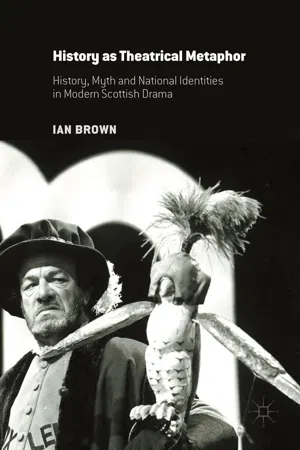
eBook - ePub
History as Theatrical Metaphor
History, Myth and National Identities in Modern Scottish Drama
- English
- ePUB (mobile friendly)
- Available on iOS & Android
eBook - ePub
History as Theatrical Metaphor
History, Myth and National Identities in Modern Scottish Drama
About this book
Information
Subtopic
Performing Arts© The Author(s) 2016
Ian BrownHistory as Theatrical Metaphor10.1057/978-1-137-47336-3_11. Playwrights and History
Ian Brown1
(1)
Kingston University, London, UK
This chapter and the next consider how both playwrights and historians may fulfil an audience or readership’s needs and expectations at a given time in a given context. They consider differences between the relationships of the two types of writers to their audiences and readership and, in doing that, suggest that the ‘simply’ is misleading in the line Brian Friel gives Peter Lombard: ‘I simply fulfil the needs, satisfy the expectations—don’t I?’ 1 In fact, complex historiographical and dramaturgical processes are involved. History’s ‘great virtue’, in Peter Ustinov’s words, of adaptability engages questions of ideology, mythology, linguistics, politics, propaganda, and the interaction in different eras of all of these.
History as Eighteenth-Century Politics and Nineteenth-Century National Drama
During the first great wave of Scottish playwriting in the eighteenth century, there was interest in history as a theme. Then, partly as a long-term result of the Court’s 1603 move to London, when a theatre-loving royal patron went south to support Shakespeare and his contemporaries and to develop the English court masque under Inigo Jones and Ben Jonson, the Scottish playwright had two clear career lines. One was to head south and work for the London stage, close to the Court with several theatre outlets, even allowing for the restrictive impact of court officials and then the Patent Theatre system and Lord Chamberlain’s censorship introduced by the 1737 Licensing Act. The other was to work in Scotland. There, after a period when professional theatre, mainly centred in Edinburgh, had been under attack by the Evangelical wing of the Kirk in the early 1600s and was under intermittent pressure from the 1660 Restoration until the 1720s, professional theatre increasingly asserted itself. Alasdair Cameron has observed that in 1662 professional playhouse theatre
Further, as I have discussed elsewhere, 3 this playhouse development took place in a rich seventeenth- and eighteenth-century theatrical context which included school, amateur, closet, folk and touring professional drama in more than one language.in Scotland was limited to short seasons at the Tennis Court Theatre in Edinburgh; it was patronised only by the aristocracy, dominated by English plays and players, and under frequent attack from the Church. By 1800, there were nine permanent theatres [Aberdeen, Ayr, Dumfries, Dundee, Edinburgh (2), Glasgow, Greenock, Paisley] spread throughout Scotland, the theatre was becoming the most popular form of organised entertainment in the country and there were the beginnings of an indigenous tradition of playwriting, acting and management, which paved the way for the ‘National Theatre’ at the Theatre Royal Edinburgh in the early nineteenth century. 2
One of the earliest history plays with clear contemporary implications was Marciano, or The Discovery (1663) by the advocate William Clark or Clerke (fl. 1663–99?), the first post-Restoration play written in Scotland. Clark’s preface talks of ‘hell-hounds, assassinats of our liberties [who] snatch’d the very reins of Government [… and voted] down all Scenick Playes [… to suffer] in the same sentence with Monarchy’. 4 He links here royal and theatrical Restoration after hellish rebellion, presumably Cromwellian in nature. The play’s plot focuses on Barbaro’s fictional rebellion against Cleon, Duke of Florence, whose general—Marciano—Barbaro’s forces capture. Arabella, his beloved, wishes the restoration of the ‘lawfull Prince’ 5 and effects Marciano’s escape. She, though, is captured and condemned. However, Barbaro dies, Cleon is restored and Marciano and Arabella marry. This post-Restoration play’s themes address betrayal, loyalty and the need for order: Marciano says ‘When men begin to quarrel with their Prince, / No wonder if they crush their fellow Subjects’. 6 Strictly, this is not a historical play, though set in historical times, a distinction already made to which we will return, but it is an early Scottish example of the use of historical themes to address current political issues in a ‘history play’. Of course, Shakespeare, and his contemporaries, developed the use of drama for political nation-building and hidden political references, notably in his History Plays, and continued, but more discreetly, after the 1601 Essex rebellion; then the rebels watched scenes from Richard II on the eve of their rising. When directly political plays from English history were no longer likely to be approved for performance, Shakespeare moved to classical political material in, for example, Julius Caesar (?1599/1601) and Coriolanus (?1605/8), which deal with issues of power and the common good through historic exempla rather than recent history, while his colleagues more often worked with exempla from the history of Mediterranean countries. Marciano is not in any sense as developed as the works in that oeuvre, but it is a relatively early Scottish example of a historic period being used as the setting for an exploration of contemporary political concerns. It marks the earliest work of that kind written specifically for a Scottish stage, a forerunner of a canon that would lift off with a more Scottish focus in the next century.
Despite an active theatre scene in Edinburgh, the first substantial post-Restoration Scottish dramatists were presented in London. This may perhaps be because of the post-Restoration Edinburgh theatre’s class and ideological limitations, associated as it was with Stuart courts and the ‘prelatic’ Restoration Episcopalian settlement for the Scottish Kirk. Certainly, there was after 1688 Williamite reaction in Scotland against theatre, while Adrienne Scullion 7 identifies the first significant play of Catherine Trotter (1679–1749), born in London of Scots parents and later resident in Aberdeen, as performed in London. Agnes de Castro was probably played in 1695 and explores themes later developed by Jo Clifford in Ines de Castro (1989), although she writes a Restoration verse tragedy of misplaced love, jealousy, and betrayal and includes characters quite distinct from those Clifford later engages with. This was followed by non-historical plays, a verse tragedy Fatal Friendship (1698), a comedy Love at a Loss (1700) and another verse tragedy, The Unhappy Penitent (1701), before The Revolution in Sweden (1706). As its title implies, this explores the politics of revolution, but at a safe distance from any possible Scoto-British parallels. Other Scottish playwrights of the period like David Crawford (1665–1726) and Newburgh Hamilton (1691–1761) wrote Restoration comedies for theatres like Drury Lane and Lincoln’s Inn Fields, while Hamilton later wrote lyrics for Handel, including Samson (1743). Perhaps at this time—just before and after the 1707 Treaty of Union as the two branches of the Stuarts were still claiming the British throne—political caution seemed advisable. In any case, these Scottish playwrights were integrated into London theatrical practice. The next generation of Scottish playwrights, however, expatriate or Edinburgh-based, was more ready to engage with historical topics related to clear, and current, political concerns. These writers, who also wrote in other literary genres, included London-based James Thomson, David Mallet (Malloch), and Tobias Smollett, and Edinburgh-based Allan Ramsay.
It is easy to forget that Allan Ramsay’s The Gentle Shepherd (1725–9) is itself a historical drama. Famous as it is as a popular and much-produced pastoral ballad-opera whose events are fictional, their context is firmly rooted in specific historical fact. Concerned with true love in a pastoral context, it also explores issues of disguise, duty, and the re-establishment of order after social disruption. The play has a pro-Jacobite and anti-Calvinist inclination, but expresses that through its sense that, as with the restoration of the kingdom in the person of Charles II (and perhaps, potentially, the exiled Stuarts of Ramsay’s time), proper social order and hierarchy must be maintained. Sir William Worthy returns incognito after the Stuart Restoration and finds that his disguised son, the shepherd Patie, wants to marry Peggy. He announces he is Patie’s father, insisting his son’s choice is socially inappropriate. The lovers seem on the brink of final separation when, in the last act, it is revealed that Peggy is daughter to Sir William’s sister: the marriage will not disturb, but instead reinforce, social order, and Sir William re-establishes his seigneurial role by restoring ‘his father’s hearty table’. 8 Unlike his expatriate contemporaries, Ramsay’s political focus is clearly on Scotland’s post-Restoration, post-Union settlement: the play’s concern with exile and return, secret loyalties, revelation of incognito, discovery of hidden relationships and the need to preserve political order resonates with Scotland’s confused loyalties between two major Jacobite risings. And he uses Scots as a stage language, a topic whose ideological force Chap. 3 considers and is featured as a theme in some of Robert McLellan’s plays, discussed in Chap. 4.
By contrast, Thomson’s first play Sophonisba (1730), dedicated to Queen Caroline, is read by Terence Tobin and Adrienne Scullion 9 as contemporary political allegory in a British context: Tobin notes the ‘heroine’s dominant passion is to prevent her native Carthage (Britain) from becoming subservient to tyrannic Rome (France)’. 10 Its baroque bravura was satirized: the line ‘Oh! Sophonisba! Sophonisba! Oh!’ became the subject of much hilarity, but the play is important as a major example, after Marciano and Trotter’s two history plays, of a London-Scottish playwright addressing current political and ideological considerations through representation of historical events on stage. Drawing material from the classical period, specifically the Second Punic War (218–201 bc), is certainly some distance from using Scottish historical events for exploration of themes of particular importance to Scottish society and culture. Equally, however, it is clear that Thomson, working within the context of a newly conjoined Scotland and England, deals with a vision of British national unity faced with foreign danger, a theme resonating throughout the eighteenth century for Hanoverian supporters like him. Further, the education of any young Scot of this period was so imbued with classical study that a case can be made that classical history was in a real sense as much part of that educated Scot’s everyday understanding as the home community’s history.
Indeed, when Thomson returned to the stage, it was with Agamemnon (1738). 11 Dedicated to the Princess of Wales now rather than Queen Caroline, the play’s meaning in contemporary political discourse is evident. The Prime Minister, Robert Walpole, was perceived as the Queen’s agent in opposing Frederick, Prince of Wales, and his resistance to his father George II’s policies. The drama identifies Orestes, the true champion of his father’s memory, with Frederick, the vengeful Clytemnestra with Caroline, and the scheming Aegisthus with Walpole. It is surprising this play escaped censure under the new powers of the Lord Chamberlain. Thomson’s next play did not. Edward and Leonora (1739), dedicated to Frederick, after rehearsal at Covent Garden began, was banned for its implied references to the royal family’s civil war, though it was published. Thomson went on to achieve European fame with his greatest dramatic success: Tancred and Sigismunda (1745), a story of love and betrayal set in Sicily and dealing with a favourite theme of Thomson, conflict between public duty and private emotion.
David Malloch/Mallet’s Eurydice (1731) followed the practice of employing classical material to make contemporary points. Even within its classical cover, Mallet’s play was accused of coded Jacobite support. Certainly Malloch/Mallet’s Perthshire family background was of Catholicism and Jacobite sympathy. His name-change may, besides avoiding the ‘-och’ ending difficult for his English colleagues, have sought to mask this connection. However that may be, his next play Mustapha (1739) attacked by implication, in the same vein as Thomson’s Agamemnon, Walpole’s encouragement of George II’s hostility to Frederick, despite the potential for the Lord Chamberlain to have blocked it. It seems likely that Walpole was aware of the thrust of the plays’ meaning: Sandro Jung suggests the prime minister’s propagandists may lie behind the rumour of Mallet’s family Jacobitism. 12 In any case, by the mid-1700s Mallet was seen, in Jung’s words, ‘as a writer of the Patriot Opposition’, 13 which saw Frederick as political paragon of patriotic ‘non-partisan’ government.
While Jacobitism and Hanoverian court p...
Table of contents
- Cover
- Frontmatter
- 1. Playwrights and History
- 2. History, Mythology, and ‘Re-Presentation’ of Events
- 3. Language, Ideology, and Identity
- 4. The Creation of a ‘Missing’ Tradition: Robert McLellan and His Contemporaries
- 5. Revealing Hidden Histories: Seven Changing Perspectives
- 6. The Re-Visioning of History: Sue Glover and Liz Lochhead
- 7. Alternative Visions
- 8. Re-Constructing the Deconstructed: David Greig and Rona Munro
- 9. Conclusion: History as Theatrical Metaphor
- Backmatter
Trusted by 375,005 students
Access to over 1.5 million titles for a fair monthly price.
Study more efficiently using our study tools.
Frequently asked questions
Yes, you can cancel anytime from the Subscription tab in your account settings on the Perlego website. Your subscription will stay active until the end of your current billing period. Learn how to cancel your subscription
No, books cannot be downloaded as external files, such as PDFs, for use outside of Perlego. However, you can download books within the Perlego app for offline reading on mobile or tablet. Learn how to download books offline
Perlego offers two plans: Essential and Complete
- Essential is ideal for learners and professionals who enjoy exploring a wide range of subjects. Access the Essential Library with 800,000+ trusted titles and best-sellers across business, personal growth, and the humanities. Includes unlimited reading time and Standard Read Aloud voice.
- Complete: Perfect for advanced learners and researchers needing full, unrestricted access. Unlock 1.5M+ books across hundreds of subjects, including academic and specialized titles. The Complete Plan also includes advanced features like Premium Read Aloud and Research Assistant.
We are an online textbook subscription service, where you can get access to an entire online library for less than the price of a single book per month. With over 1.5 million books across 990+ topics, we’ve got you covered! Learn about our mission
Look out for the read-aloud symbol on your next book to see if you can listen to it. The read-aloud tool reads text aloud for you, highlighting the text as it is being read. You can pause it, speed it up and slow it down. Learn more about Read Aloud
Yes! You can use the Perlego app on both iOS and Android devices to read anytime, anywhere — even offline. Perfect for commutes or when you’re on the go.
Please note we cannot support devices running on iOS 13 and Android 7 or earlier. Learn more about using the app
Please note we cannot support devices running on iOS 13 and Android 7 or earlier. Learn more about using the app
Yes, you can access History as Theatrical Metaphor by Ian Brown in PDF and/or ePUB format, as well as other popular books in Media & Performing Arts & Performing Arts. We have over 1.5 million books available in our catalogue for you to explore.