- English
- ePUB (mobile friendly)
- Available on iOS & Android
eBook - ePub
About this book
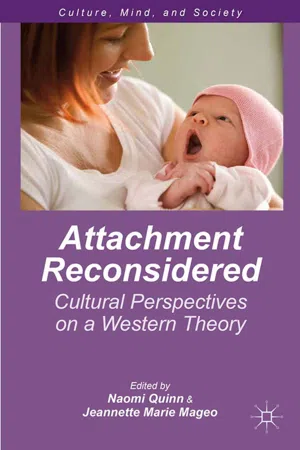
Since the 1950s, the study of early attachment and separation has been dominated by a school of psychology that is Euro-American in its theoretical assumptions. Based on ethnographic studies in a range of locales, this book goes beyond prior efforts to critique attachment theory, providing a cross-cultural basis for understanding human development.
Information
Part I
A Framework
Attachment and Culture: An Introduction
Naomi Quinn and Jeannette Marie Mageo
The fundamental argument that motivates this volume, namely that attachment theory’s claims and constructs suffer from profound ethnocentrism, is not new. A handful of cross-cultural researchers have raised these worries since the early days of attachment theory, for more than a quarter century now. Most of these earlier critiques questioned the cross-cultural applicability of a category system that designated children’s attachment to their caregivers as secure versus insecure, and measurement along this dimension by means of the Strange Situation (SS)—an experimental procedure for testing the child’s relative security through absenting its mother from the laboratory. The current volume expands this critique beyond questions of classification and measurement, to question the cultural assumptions behind such a category system and such an experimental design, and extends this line of questioning to ethnocentric concepts beyond insecure attachment.
On the one hand, the influence of attachment theory in contemporary American psychology would be hard to overstate. On the other hand, the anthropological criticism of ethnocentrism has wider implications for the discipline of psychology, which so often unintentionally introduces psychologists’ culturally biased assumptions into theory intended to be general, and is so devoted to culturally decontextualized experimental procedures that fail to challenge this ethnocentrism. Thus, we offer the current volume not only as a challenge to attachment theorists, but as an object lesson for psychologists of many other stripes.
Situating This Volume
Attachment theory, as is well known, originated with the work of John Bowlby. Bowlby was both a psychoanalyst and an evolutionary theorist. From the psychoanalytic study of human development, he took the foundational assumption that the infant’s earliest experiences are the most consequential and form the basis of an internalized working model of human relationships. Inspired by evolutionary theory, Bowlby tried to identify adaptive behaviors such as proximity-seeking, one item in an hypothesized attachment system postulated to have evolved to ensure infant survival.
The Strange Situation Procedure and Its Cross-cultural Critique
Bowlby’s colleague, Mary Ainsworth, took his ideas to Uganda in an admirable attempt to understand them in cross-cultural perspective. Ugandan infants, she discovered, were more or less constantly in contact with their caregivers, in sharp contrast to American infants. Upon her return to the United States, and to more conveniently analyze and classify infants’ attachment to their mothers, Ainsworth devised the Strange Situation (often referred to in the literature simply as the SS or the SSP, the Strange Situation Procedure), a method for assessing attachment relationships between 12 and 72 months of age, which has become the standard by which the security of an infant’s attachment is measured. As attachment theory became established, research within this paradigm came to be defined all too inflexibly by Bowlby’s theory and Ainsworth’s method.
The theoretical result was that an American cultural ideal of this period—the attentive, supportive stay-at-home middle-class mom—became a standard for promoting the psychological health of American children of all classes and subcultures, and indeed a standard for all the world against which the practices and norms of a vast variety of people were, we argue inappropriately, judged. The methodological result was no less inflexible. As Bretherton (1991:25) observed over two decades ago, and as is no less true today, with the proliferation of researchers trained in the tradition that Ainsworth had established, “Hundreds of studies using the Strange Situation appeared in print. Often it almost seemed as if attachment and the Strange Situation had become synonymous.” This confounding of theory with instrument persists to this day.
Ainsworth originally devised the SSP for a sample of Baltimore infants (LeVine and Miller 1990:73–75). The laboratory-based procedure is made up of eight three-minute episodes. In some of these episodes, the mother leaves the infant alone in the room, and in other episodes she leaves the infant in the presence of a stranger. The episodes are meant to mildly stress the infant in order to activate the attachment system, and the procedure is designed in such a way as to escalate the level of stress experienced as the episodes progress.
Upon each of the mother’s returns, a “securely attached” infant seeks proximity or contact with the mother and then resumes exploration of the environment, evidenced by play with the toys that are available in the room. An “insecurely attached” infant shows little or no tendency to approach mother on the mother’s return (labeled avoidant) or, alternatively, makes efforts to contact mother but also resists her (labeled resistant). An additional category, disorganized/disoriented, was later added to accommodate a minority of infants whose attachment behavior fit neither category (see Solomon and George 2008:386–387; Weinfeld et al. 2008:80–81 for fuller descriptions of these categories).1
Anthropologists and others whose research has immersed them in other cultures cannot help but see contemporary attachment theory as resembling a folk theory. A folk theory abstracts elements of experience in a culture to formulate a view the human condition that is regarded as universal and is held, implicitly or explicitly, by most group members but is in fact reflective of experience within the group. In more complex economically tiered societies, folk theories tend to take the experience of a hegemonic class or classes as universally representative and normative. Attachment theory, like a folk theory, draws upon the way many middle-class Americans, and to a lesser extent members of this class in other Western and Western-influenced societies, think they should care for infants and small children, including ideas about how child-caregiver attachments are formed and fostered. Because this theory is so naturalized in American thinking, it can seem self-evident. Folk theoretical thinking often creeps into academic and other expert theories especially, as we have noted, when an academic psychology is based nearly exclusively on research in the United States and other Western countries and excludes the intercultural variation introduced by non-middle-class and minority populations in these countries. So it has been with the history of attachment theory and its methodological proxy, the SSP, which fail to assess very much about infant-caregiver relations cross-culturally.
In a 1990 commentary on the articles in a special topics issue of Human Development, Robert LeVine and Patrice Miller argue that culture-specific patterns of child care, in particular the frequency of maternal comings and goings, the length of these separations from mother, and the infants’ familiarity with strangers, would influence responses to the SSP. Thus, Takahashi (1990:25) observes that the separation protest evinced by Japanese babies was so intense that the “infant-alone” condition had to be curtailed for fully 90 percent of subjects in her study. LeVine and Miller speculate that this effect, resulting in the classification of many Japanese infants as insecure-resistant, was due to the fact that these infants were so infrequently separated from their mothers in daily life. LeVine and Miller point out that Ainsworth herself had interpreted the difference between the Ugandans and her Baltimore sample similarly, with the American babies being accustomed to their mothers’ frequent but brief absences, while the Ugandan babies had built up expectations that when their mothers left they would be gone, and inaccessible, for much longer periods.
Driven by field circumstances to an even more radical stance, Courtney Meehan and Sean Hawks (chapter 3) describe the impracticality of implementing the SSP altogether, in another, very different, cross-cultural setting. When Meehan arrived at her field site in 2000, she was planning to administer a culturally modified SSP. However, as Meehan and Hawks (chapter 3) report,
While she could serve the role of stranger in the procedure, a variety of children’s caregivers were always close by and often within the visual range of the focal child during the procedure. Isolating Aka children with her or a field assistant was not always an option. During the recordings there were often multiple individuals present and children crawled, scooted, or walked over to another caregiver; others stayed and signaled for someone to come to them.
Meehan could never be sure that interactions during these episodes were strictly dyadic, or whether children were reacting to the presence, sensitivity, and interactional history of, say, a grandmother just out of frame. Moreover, the focal child would often go to another caretaker or signal for another caretaker to come to them right in the middle of a recording. To solve these problems, Meehan abandoned the standardized SSP altogether and instead collected extensive natural observations by a method described in their chapter, and analyzed mother-child separations that occurred naturally during allotted intervals. Indeed, this is how these researchers discovered that, even though mothers were the most frequent caregivers, the variable sensitivity of allomaternal care, not that of mother’s care, was what predicted the extent of children’s distress during maternal absence.
LeVine and Miller (1990:76–77) go on to make the larger point that the conditions surrounding infant-caregiver separation and reunion in the SSP are at least partly defined by “the meaning of the mother to the baby,” and that it is only possible to ignore this meaning “if one focuses exclusively on the reunion behaviors that are criteria for attachment classification and does not take into account the natural contexts that condition the child’s responses to the Strange Situation.” This point about the cultural meaning surrounding the child-caregiver relationship opens the way to further, more wide-ranging critiques of attachment theory, pursued in subsequent work by LeVine (LeVine and Norman 2001; LeVine 2009) and mounted in the ethnographic chapters to follow in this volume.
Positioning Ourselves
What unites the contributors to the volume is that every last one of us has conducted research in communities outside of Euro-America. In most cases, too, this research has taken us beyond the reach of industrialized society. These are important contrasts. One obvious example: the distinction between single and multiple mothering follows the fault line between postindustrial European and American communities and many other communities elsewhere in the world either that industrialization has not yet reached or in which, under industrialization, the extended family has not yet been rendered obsolete. In these societies unstudied by attachment theorists, there are routinely many child caregivers including, and often prominently, older children. Multiple caregiving patterns, described in chapters to follow, result in much wider variation in the forms of attachment than is captured in the contrast among Japan, the United States, and North Germany alone. More generally, and without exception, the communities in which we have worked and which we have grown to know present stark cultural contrasts to our own. All of us are attuned to the cultural meanings of attachment in these communities, which has given us a keen awareness of how profound the cross-cultural differences can be in the beliefs, values, practices, and institutions surrounding attachment.
Beyond these commonalities of cross-cultural experience and attention to cultural meaning, our contributors represent three different fields. The author of chapter 1 and the lead author of the afterword (about which no more will be said here, since it is, after all, an afterword) are cross-cultural developmental psychologists. Chapters 2 and 3 are the work of biocultural anthropologists (who also sometimes call themselves behavioral ecologists), and chapters 4 through 8 that of psychological anthropologists. Let us say briefly how these different disciplinary presences speak to one another and strengthen this volume.
What developmental psychologists add to this volume is their deep appreciation of attachment theory’s history in their discipline. The theoretical breadth of psychologist Suzanne Gaskins’s chapter derives from a background in and knowledge of contemporary work and past developments, positioning her to appreciate all that the field of psychology has to offer, and to recognize when psychological approaches require critique. Gaskins sets out a framework for the entire volume by asking how we can square the theoretical claim that attachment is a species-wide maturational process with the huge amount of cross-cultural variability in child care and the differing patterns of attachment that result. Her answer is that further investigation must sort out the two: the humanly universal from the experientially mutable and hence cross-culturally variable. Gaskins offers a preliminary sorting, and begins to illustrate her approach with analysis of her own Yucatec Maya research. Each of the volume’s successive ethnographic chapters adds to this story, considering how such culturally variable practices as the differential availability of multiple caregivers, or different cultural styles of mothering, or different objectives for raising children, can and do change the cultural meaning accorded to attachment, starting in infancy and extending over the life course. As Gaskins emphasizes, this is only the beginning of such investigations, and studies of attachment expressly designed to sort out what is universal from what is cross-culturally variable are much needed.
The biocultural and psychological anthropological chapters that follow have disparate although also complementary concerns. The biocultural anthropologists are closely focused on allomothering and its implications for attachment. The psychological anthropologists take up a wider set of questions revolving around the divergent meanings that attachment can take cross-culturally. These questions emerge from observations made on the basis of research that has typically not yet been originally designed to test attachment theory assumptions.2 In both cases, the aim is to refocus attachment observations to include phenomena beyond the behavior and values displayed by white Western middle-class mothers and infants and thus to provide a more adequate basis for future theory.
What the biocultural anthropologists in this volume (chapters 2 and 3) contribute to this nascent effort is to embark on the first half of Gaskins’s agenda, specifically, research into a fundamental human adaptation: cooperative child care. The Cooperative Breeding Hypothesis, on which the research reported in these two chapters rests, calls attention to the long period of human children’s dependency, due to their precocious birth and their extended maturation time. As a result, human mothers face the unusually high metabolic burden of having to care for as yet unweaned infants while simultaneously provisioning older but still immature children. This burden, coupled with the rest of a woman’s normal workload, should make it adaptive for human mothers to share child care in order to lighten their burden of care. The assistance of allomothers has the ultimate advantage that it “can help mothers return to ovulation more quickly” (Crittenden and Marlowe, chapter 2) and thus be more reproductively successful. By this theory, modern middle-class nuclear families in which the mother is the primary attachment figure and also the main if not the sole child caregiver, such as those found in the United States and other industrialized societies, are outliers and not the normative human state of affairs. Thus, these two chapters jeopardize a central assumption of attachment theory. Studying multiple attachment among nomadic foragers brings evolutionary considerations into attachment theory, better situating attachment processes in the “environment that gave rise to them” (Chisholm 1996:22).
The chapters by biocultural anthropologists not only establish a starting point in the task of untangling the humanly universal from the cross-culturally variant but they also serve to remind psychological anthropologists of the fundamental importance of this evolutionary point of departure for the study of child rearing in all human societies. Indeed, the influence of the Cooperative Breeding Hypothesis on psychological anthropologists’ thinking, especially as articulated in Sarah Blaffer Hrdy’s (2009) recent argument for the evolutionary functions of allomothering, strongly influences several of the later volume chapt...
Table of contents
- Cover
- Title
- Part I A Framework
- Part II Caregiving
- Part III Autonomy and Dependence
- Part IV Childhood-Adulthood Continuities
- Afterword: Cross-cultural Challenges to Attachment Theory
- Notes on Contributors
- Index
Trusted by 375,005 students
Access to over 1.5 million titles for a fair monthly price.
Study more efficiently using our study tools.
Frequently asked questions
Yes, you can cancel anytime from the Subscription tab in your account settings on the Perlego website. Your subscription will stay active until the end of your current billing period. Learn how to cancel your subscription
No, books cannot be downloaded as external files, such as PDFs, for use outside of Perlego. However, you can download books within the Perlego app for offline reading on mobile or tablet. Learn how to download books offline
Perlego offers two plans: Essential and Complete
- Essential is ideal for learners and professionals who enjoy exploring a wide range of subjects. Access the Essential Library with 800,000+ trusted titles and best-sellers across business, personal growth, and the humanities. Includes unlimited reading time and Standard Read Aloud voice.
- Complete: Perfect for advanced learners and researchers needing full, unrestricted access. Unlock 1.5M+ books across hundreds of subjects, including academic and specialized titles. The Complete Plan also includes advanced features like Premium Read Aloud and Research Assistant.
We are an online textbook subscription service, where you can get access to an entire online library for less than the price of a single book per month. With over 1.5 million books across 990+ topics, we’ve got you covered! Learn about our mission
Look out for the read-aloud symbol on your next book to see if you can listen to it. The read-aloud tool reads text aloud for you, highlighting the text as it is being read. You can pause it, speed it up and slow it down. Learn more about Read Aloud
Yes! You can use the Perlego app on both iOS and Android devices to read anytime, anywhere — even offline. Perfect for commutes or when you’re on the go.
Please note we cannot support devices running on iOS 13 and Android 7 or earlier. Learn more about using the app
Please note we cannot support devices running on iOS 13 and Android 7 or earlier. Learn more about using the app
Yes, you can access Attachment Reconsidered by N. Quinn, J. Mageo, N. Quinn,J. Mageo in PDF and/or ePUB format, as well as other popular books in Social Sciences & Personality in Psychology. We have over 1.5 million books available in our catalogue for you to explore.