- English
- ePUB (mobile friendly)
- Available on iOS & Android
eBook - ePub
About this book
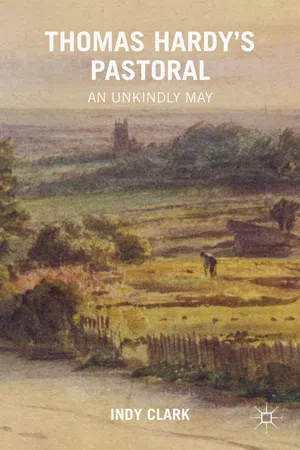
This book reads Hardy's poetry of the rural as deeply rooted in the historical tradition of the pastoral mode even as it complicates and extends it. It shows that in addition to reinstating the original tensions of classical pastoral, Hardy dramatizes a heightened awareness of complex communities and the relations of class, labour, and gender.
Information
1
Arcadia, Wessex, and the South Country
An Unkindly May
In 1927, Florence, the second Mrs Hardy, wrote as follows in her diary for 27 November:
T. H. has been writing almost all the day—revising poems. He showed me one at tea-time, about a bitter desolate spring day—and a shepherd counting his sheep and not noticing the weather.
The next few lines of Florence’s diary entry could be read as an encapsulation of Hardy studies over the past hundred years or so:
A good poem, but it had such a gloom. However, I did not care to tell him that…. Since writing the above I have been up to T. H.’s study to read the poem again, and like it much better. Its title is “An Unkindly May”—1877. (Hynes 3: 323)
Although Richard Little Purdy agrees with Florence in believing that the poem was ‘probably only revised’ at this time (Study 253), it is one of the last poems that Hardy worked on before his death on 11 January 1928. Having left behind its headnote of ‘1877’ on the holograph copy, the poem was first printed in the Daily Telegraph, 23 April 1928. It appears in Hardy’s final collection, Winter Words, published posthumously in October of that year:
A shepherd stands by a gate in a white smock-frock:
He holds the gate ajar, intently counting his flock.
The sour spring wind is blurting boisterous-wise,
And bears on it dirty clouds across the skies;
Plantation timbers creak like rusty cranes,
And pigeons and rooks, dishevelled by late rains,
Are like gaunt vultures, sodden and unkempt,
And song-birds do not end what they attempt:
The buds have tried to open, but quite failing
Have pinched themselves together in their quailing.
The sun frowns whitely in eye-trying flaps
Through passing cloud-holes, mimicking audible taps.
‘Nature, you’re not commendable to-day!’
I think. ‘Better to-morrow!’ she seems to say.
That shepherd still stands in that white smock-frock,
Unnoting all things save the counting his flock. (3: 174; 1–16)
‘An Unkindly May’ is remarkable for a number of reasons. First, it is an excellent example of the poetic vibrancy of Hardy’s later work. If not unique, it is certainly rare for a poet to write with the energy and purpose that Hardy summoned consistently, well into his eighties. For my purposes, the poem is most important for what it reveals about Hardy’s reading of the pastoral tradition. ‘An Unkindly May’ begins and ends with a consciously hackneyed image of the shepherd standing by a gate in stock smock-frock watching his flock. This image of the shepherd represents what had become traditional pastoral, although Hardy has him intently at work rather than in a state of otium. Between the artificial pastoral framing of the opening and closing couplets, there are twelve lines, also couplets, of startling imagery. As suggested by the title, this particular spring does not usher in a gentle, warm breeze; instead, the wind is ‘sour’, ‘blurting’, and ‘boisterous’ (3), bringing with it ‘dirty clouds’ (4). This being a Hardy poem, it is not too long before the focus is on the animals in the scene, but the pigeons and rooks are ‘dishevelled’ and look like ‘gaunt vultures, sodden and unkempt’ (6, 7), songbirds are unable to finish their songs and, despite their best efforts, buds fail to open. Separated from this section of the poem, the shepherd is, himself, a pastoral contradiction. In part, there is an insistence on work – he simply has to get the job done, regardless of the weather – but he is also a stock figure, unaware of the realities of nature. The image of the shepherd is evoked to question the pastoral tradition’s capability when it comes to describing the complexities of rural life. The buds attempting to open in line 9 anticipate Larkin’s ‘The Trees’: ‘The trees are coming into leaf / Like something almost being said’ (124; 1–2), and despite Hardy’s attempts at saying it, at depicting a harsh natural world, the sarcophagus of what had become traditional pastoral, represented here by the stock shepherd and the rigid, regular form of the poem itself, remains. In ‘An Unkindly May’, Hardy shows that the pastoral tradition is left wanting when it comes to representing a working farm and inclement nature.
The contrasts connoted by the figure of the shepherd and between the order of his point of view and the disorder of the representation of nature are just two examples of the importance of conflict in Hardy’s poetry of the rural. It is the dialectical relationships in Hardy’s pastoral that make his reading of the mode so complex; but pastoral conflicts are not, of course, exclusive to Hardy. In Pastoral Forms and Attitudes (1971), Harold E. Toliver foregrounds the contrasts inherent in the pastoral, noting, for example, a number of ‘dialectical pairings’ at work in Virgil’s Eclogues, such as the relative positions of Meliboeus and Tityrus in the first Eclogue – the former turfed off his land, the latter secure in his – or the many competitions that take place, of which the singing contest between Menalcas and Damoetas in the third Eclogue is just one example (1). For Toliver, the ‘idyllic element’ of the pastoral ‘habitually calls forth an opposite’; the pastoral environment, ‘is likely to be exposed to such things as industrialism, death, unrequited love, unjust property division, or merely an opposing idea of perfection’ (1). All of these are evident in Hardy’s work and, with the exception of industrialism, these seemingly counter-pastoral elements are also present in the classical pastoral of Virgil and Theocritus. These contrasts, and the tensions caused by them, are recognized by Raymond Williams in The Country and the City (1973). Using the fourth Eclogue as his example, Williams argues, like Toliver, that the ‘magical Utopian vision’ represented by the paradisal pastoral environment ‘includes within its celebration the consciousness of the very different present from which the restoration will be a release’ (18). Bakhtin also notes a critique of the present in his discussion of the idyll in the novel. What he reads as the ‘Rousseauan line of development’, sublimates ‘in philosophical terms the ancient sense of the whole’, which ‘makes of it an ideal for the future and sees in it above all the basis, a norm, for criticizing the current state of society’ (231). Similarly, Williams argues that even with ‘images of an ideal kind, there is almost invariably a tension with other kinds of experience’ (18). In his list of examples, Williams includes a few dialectical pairings of his own to complement those provided by Toliver: ‘summer with winter; pleasure with loss; harvest with labour; singing with a journey; past or future with the present’ (18).
In this reading of the pastoral, it is the contrast between what could be and what is that provides the tension central to many classical examples of the mode. Toliver suggests these ‘tensive structures’, ‘permeate the pastoral tradition from Theocritus to the eighteenth century’ (3), but does note that the contrasts and the resulting tensions are not explicit in all pastoral, leaving at one extreme the ‘pure idyll’ which ‘leaves it largely to the reader to remember whatever contrasts the normative world affords’ (4). The reader would, perhaps, need experience of these contrasts in order to remember them, and what is ‘normative’ to some could be considered quite idyllic by other members of the community. Williams is more direct about the ‘achievement’ of what he describes as the ‘Renaissance adaptation’ of classical pastoral, which finds the literary form separated from any experience of rural life, a process that continued well into the eighteenth century with the Augustans:
step by step, these living tensions are excised, until there is nothing countervailing, and selected images stand as themselves … Thus the retrospect of Meliboeus, on the life he is forced to leave, becomes the ‘source’ of a thousand pretty exercises on an untroubled rural delight and peace. (Country 18)
Through the process of selection recognized by Williams, the pastoral as a tradition becomes a polite mode of literary expression, with all contrasts and subsequent tensions removed. As will be shown, this elision is most evident in the representation, or otherwise, of the relations of labour and class. Much of what became known as counter-pastoral – work, death, and political themes like the threat of eviction – is found in the classical pastoral of Theocritus, Virgil, and Hesiod and only became counter to the mode between the sixteenth and eighteenth centuries. Despite this selective adaptation, some dissonant voices remain and they are clear in Hardy’s work.
In Literature and the Pastoral (1984), Andrew V. Ettin recognizes the contradictions at work in the ‘pastoral impulse toward containment’ which ‘involves holding contraries together in apparent unity, forged by art out of discordant emotions and perceptions’ (12). The apparent unity is the deliberate and artificial form of the poem, within which a number of conflicts take place: there are dialectical relationships between artifice and reality, form and subject, and between what has been read as the pastoral and the counter-pastoral. ‘An Unkindly May’ illustrates the importance of the apparent unity and the tensions that accompany it. Along with much of Hardy’s poetry of the rural, the poem exemplifies what Toliver describes as the ‘shifting relationship between the poetic enclosure and the exterior world’, between the poem ‘as a fictional construction’ – its very deliberate form – and the reality of its subject. The poem becomes its ‘own kind of transforming locality capable of reshaping nature in art’ (11–12). It is how nature is reshaped that is key to understanding the complexity of Hardy’s pastoral. Toliver argues that an ‘Arcadian retreat’, while not necessarily a ‘lyric sublimation of unpleasantries’, is ‘an image of nature so clearly artful as to suggest openly the poet’s inevitable improvements on it’ (12). In this way, the poem draws attention to its artificiality, emphasizing the distance between poetic enclosure and exterior world. Hardy, however, is doing something subtly different. Although the form of the poem – its shape, even its metre – represents order, Hardy ‘loved the art of concealing art’ (Later Years 78), and through his use of irregular rhythm, rather than offering up a kind of paradise, he appears instead to dismantle it.
Toliver uses an excerpt from Emily Dickinson’s ‘The Wind Begun to Knead the Grass’ to show how the ‘analogy between a poem and a perfect landscape holds to some extent even when the poet makes no explicit claim for it’ (12). Dickinson’s storm is described thus:
The leaves unhooked themselves from trees
And started all abroad;
The dust did scoop itself like hands
And threw away the road.
Toliver acknowledges that the ‘storm is scarcely gentle’, but argues that through personification and regular form, the ‘stanza cannot help taming its violence and suggesting a locus amoenus or pleasant place in spite of itself’ (12). According to Toliver, this example from Dickinson ‘humanizes the leaves and the dust’ which ‘appeases our desire to find correspondences between the human and the natural world’ (12). I would argue that in Dickinson’s poem that correspondence is hardly comforting, and the same can be said for the use of personification in Hardy’s work. Creeping late into ‘An Unkindly May’ at line 13, the speaker addresses Nature, but she only ‘seems to say’ that she will be ‘Better to-morrow’ (14). Elsewhere, it is the buds that correspond with the human world; but as this is Hardy’s human world, they have tried to open – to do what is expected of them – and yet they have failed, ultimately finding some solace in community as they pinch ‘themselves together in their quailing’ (10). There is a sense of failure, too, in the image of the songbirds that are given just enough agency to give up. Even the sun is frowning. The prosopopoeia does not, as Toliver suggests, ‘quiet discord and produce a pastoral harmony and transformation’ (13); instead it brings closer to the reader the violence and destruction of the natural world.
In these examples, the humanizing of various elements of nature and landscape does not suggest a locus amoenus but the regularity of form can hint at a possible paradise. The appearance of ‘An Unkindly May’ on the page seems to represent order: a neat block of twelve lines between two couplets with the metre controlling the length of the lines, keeping them within a couple of syllables of one another; but the poem is not nearly so regular as it may at first seem. Through the ‘cunning irregularity’ of what Hardy described in the Life as his ‘Gothic’ rhythm, he is able to point to the cracks in perfection (Later Years 78). The effect is illustrated when Hardy’s poem is, once again, compared with the extract from ‘The Wind Begun to Knead the Grass’, a poem that represents a poetic paradise through its formal harmony. As Toliver explains,
The two sentences develop in units of eight and six syllables in almost identical metrical arrangements, syntax, and grammar: the twenty-eight syllables move in exact formation, commanding the event to take part in their poetic ritual. (12–13)
Unlike Dickinson’s formal precision and order, which, it should be remembered, provide a tensive opposition to the violence of the storm, Hardy’s ‘metrical pauses’ and ‘reversed beats’ twist and often break the regularity of the metre (Later Years 79). Line 3 of ‘An Unkindly May’ reads as regular iambic pentameter: ‘The sour spring wind is blurting boisterous-wise’, but with the addition of an extra syllable in its couplet partner, the beat appears to be reversed in line 4, with the foot becoming trochaic: ‘And bears on it dirty clouds across the skies’. Elsewhere, additional syllables, changing stress, and caesurae all act to trip the metre from time to time, with the unconventional rhythm just about holding the whole thing together. As so often, it was in reaction to criticism that Hardy wrote in the Life the explanatory passage concerning rhythm. It is specifically concerned with the reception of Hardy’s first volume, Wessex Poems (1898), about which one critic lamented, ‘were the form equal to the matter, they would be poetry’ (Cox 321), but it also pertains to ‘later volumes’ (Later Years 78). Contemporary criticism of Hardy’s poetry is littered with references to his ‘woodenness of rhythm’ (Cox 325), ‘technical inexpertness’ (324), ‘clumsy metres’ (436), and ‘lack of metrical finish’ (324). His poetry is described as ‘slovenly, slipshod’, and ‘uncouth’, ‘poorly conceived and worse wrought’ (Cox 319). One anonymous reviewer of Hardy’s second collection, Poems of the Past and the Present (1901), complained, ‘Mr. Hardy has never written with flowing rhythms … his verse often halts, or dances in hobnails’ (Cox 331). With regard to form, ‘there was’, Hardy wrote with his customary passive aggression, ‘the inevitable ascription to ignorance of what was really choice after full knowledge’ (Later Years 78). In an attempt to show that his poetry was not simply the sudden and undoubtedly short-lived whim of an established novelist, Hardy states it was ‘Years earlier he had decided that too regular a beat was bad art’ (Later Years 78). His explanation draws upon his years of training and experience as an architect, which, according to Linda Shires, ‘was not merely a preliminary career but an important crucible for much of his art and labour to come’ (145). Hardy writes:
He had fortified himself in his opinion by thinking of the analogy of architecture, between which art and that of poetry he had discovered … there existed a close and curious parallel, both arts, unlike some others, having to carry a rational content inside their artistic form. (Later Years 78)
Recognizing this parallel, Shires asks for ‘a preliminary leap of imagination’ when she suggests that a set of poems can be compared to a building, ‘composed of parts, of temporal layers, of pieces’. In addition to a ‘strong skeletal design’, and ‘supports like arches and spaces’, this building also has ‘flying buttresses and, in Ruskin’s words … “ugly goblins, and formless monsters, and stern statues”’. From the imperfect fragments comes ‘some sort of totality’. This building, argues Shires, ‘is also the representation of a type of consciousness at work, doing emotional and rational labour’ (141).
The rational content to which Hardy refers in his statement from the Life reflects Ruskin’s view that Gothic is ‘the only rational architecture’ (123). In ‘The Nature of Gothic’ (1853), a copy of which Hardy kept in his study,1 Ruskin states that G...
Table of contents
- Cover
- Title
- Copyright
- Contents
- Preface and Acknowledgements
- Introduction
- 1 Arcadia, Wessex, and the South Country
- 2 Landscape, Nature, and Work
- 3 What About the Workers?
- 4 Pastoral and Modernity
- Conclusion
- Notes
- Works Cited
- Index
Trusted by 375,005 students
Access to over 1.5 million titles for a fair monthly price.
Study more efficiently using our study tools.
Frequently asked questions
Yes, you can cancel anytime from the Subscription tab in your account settings on the Perlego website. Your subscription will stay active until the end of your current billing period. Learn how to cancel your subscription
No, books cannot be downloaded as external files, such as PDFs, for use outside of Perlego. However, you can download books within the Perlego app for offline reading on mobile or tablet. Learn how to download books offline
Perlego offers two plans: Essential and Complete
- Essential is ideal for learners and professionals who enjoy exploring a wide range of subjects. Access the Essential Library with 800,000+ trusted titles and best-sellers across business, personal growth, and the humanities. Includes unlimited reading time and Standard Read Aloud voice.
- Complete: Perfect for advanced learners and researchers needing full, unrestricted access. Unlock 1.5M+ books across hundreds of subjects, including academic and specialized titles. The Complete Plan also includes advanced features like Premium Read Aloud and Research Assistant.
We are an online textbook subscription service, where you can get access to an entire online library for less than the price of a single book per month. With over 1.5 million books across 990+ topics, we’ve got you covered! Learn about our mission
Look out for the read-aloud symbol on your next book to see if you can listen to it. The read-aloud tool reads text aloud for you, highlighting the text as it is being read. You can pause it, speed it up and slow it down. Learn more about Read Aloud
Yes! You can use the Perlego app on both iOS and Android devices to read anytime, anywhere — even offline. Perfect for commutes or when you’re on the go.
Please note we cannot support devices running on iOS 13 and Android 7 or earlier. Learn more about using the app
Please note we cannot support devices running on iOS 13 and Android 7 or earlier. Learn more about using the app
Yes, you can access Thomas Hardy's Pastoral by Indy Clark in PDF and/or ePUB format, as well as other popular books in Literature & Literature General. We have over 1.5 million books available in our catalogue for you to explore.