- English
- ePUB (mobile friendly)
- Available on iOS & Android
eBook - ePub
About this book
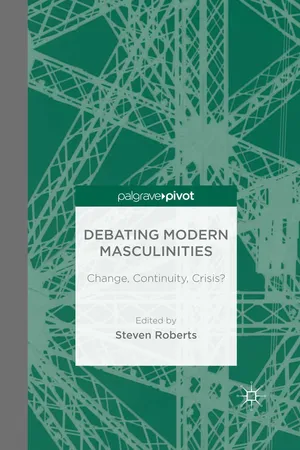
Masculinity, it seems, is in crisis, again. This edited volume critically interrogates the current situation facing contemporary young men. The contributors deconstruct and reject such crisis talk, with its chapters drawing on original research to present a more nuanced reality, whilst also developing a critical dialogue with one another.
Information
1
Introduction: Masculinities in Crisis? Opening the Debate
Steven Roberts
Abstract: This chapter outlines the concerns as set out by Diane Abbot’s speech in 2013 in which she suggested that contemporary young British men are facing a crisis of masculinity. Situating this view of masculinity as part of historical trend towards crisis tendency, the chapter sets the tone for the collection by offering an opening response to Abbott’s claims. Recent developments in the theorising of men’s lives are brought to attention – especially Anderson’s theory of inclusive masculinity – to help interrogate this crisis talk, at the same time setting up a critical debate among authors on the best way to theorise multiple, fluid and complex expressions of masculinity.
Keywords: crisis; Diane Abbott; inclusive masculinity; Masculinities
Roberts, Steven. Debating Modern Masculinities: Change, Continuity, Crisis?. Basingstoke: Palgrave Macmillan, 2014. DOI: 10.1057/9781137394842.0004.
Introduction
Following the emergence of critical masculinities studies in the late 1970s, academic research started to focus on men as gendered beings. The pioneering research of Raewyn Connell (1987; 2000) was central to such developments, with her theory of hegemonic masculinity being widely recognised as having an unparalleled influence on studies of men’s lives (Beasley 2012). Adopted by scholars across disciplinary boundaries, Connell’s conceptual framework provided researchers with a way to examine and document the negative components of masculinity, the existence of a plurality of masculinities (as opposed to a static, unitary form) and, importantly, the ways that men are hierarchically stratified within society, with the summit being occupied by those men who are ‘economically successful, racially superior, and visibly heterosexual’ (McDowell 2003: 11). In sharp contrast to previous studies of masculinity influenced by the field of functionalist sociology and sex role theory, Connell’s major departure was to locate a theory of power as a central focus to ensure a more thorough account and explanation for the intricacies of gender relations and the nature of intramasculine domination. Yet, despite the academic attention over a long period of time (e.g. Kimmel 1987, 2008; Hearn 1987, 2010; Messner 1994) given to the operation of power and the differences amongst men (as well as between men and women), public debates about whether masculinity is in crisis have often taken centre stage, especially in the popular press and in political debates. Such ‘crisis-talk’, and especially one particular recent rendition, serves as the key stimulus for this book.
In May 2013, as part of a lecture series for the Demos think tank, the Labour shadow public health minister Diane Abbott gave a speech entitled ‘Britain’s crisis of masculinity’. Abbott raised concerns about how rapid economic and social change has affected male identity and she suggested that this ‘crisis’ had created a number of largely unspoken problems.
Abbott’s sentiments, which were given wide print and broadcast media coverage, were met with a mixed reception. Critics from both the left and the right of the political divide were largely unified in criticising the comparisons she made with masculinity from a bygone era, an alleged ‘golden age’ when men, like her own father, ‘prided themselves on being providers – for their spouses, families and themselves’. Beyond this comparison, though, Abbott contended that the contemporary crisis includes some more widely accepted ‘inescapable truths’. These include:

Abbott also contended that there exists a lack of respect among men for women’s autonomy and a normalisation of homophobia.
This public discussion of the behaviours of boys and men points to a presumed need for policy intervention to act as a corrective to the apparent crisis in masculinity, which presents (young) men as both at risk and also a risk to others. In a way this follows developments where men have emerged from being the implicit and assumed recipients (and makers) of social policy, to being named explicitly as the concern of social policy (see for example Hearn’s 2010 account of men’s health, among other policy realms).
The claims made in Abbott’s speech, and the wider public concerns around boys, men and masculinity, then, are taken in this book as a first point of debate. Adopting a range of quantitative and qualitative methods, each chapter draws on empirical data exploring issues and performances of masculinities from a range of settings in order to critically interrogate the current public discourse that proposes that there is a crisis of masculinity.
Each chapter engages with and ultimately rejects the central thesis that pertains to masculinity in crisis. In building arguments to reject this position, the challenge for the authors is to spell out their view of how modern masculinities operate, how they are expressed and performed, and what consequences follow as a corollary. This, then, is the second point of debate with which this book concerns itself, and it is very much a debate about theorising modern masculinities. However, it is not the mission of this book to present a wide-ranging overview of the different ways in which masculinity/ies can be conceived, theorised or studied – plenty of good introductory (sometimes elaborate) texts exist to meet such a need (e.g. Reeser 2010; Kimmel et al. 2005; Whitehead 2002). Instead, taking a narrower focus, the collection is primarily concerned with a discussion, critique and advancement of work associated with the area of the field known as Inclusive Masculinity Theory. There are good and very specific reasons for this. The key recent work informed by these approaches, such as Inclusive Masculinity (2009) by Eric Anderson and The Declining Significance of Homophobia (2012) by Mark McCormack1 propose a very different world from the one espoused by Diane Abbott and others commentating on the issues affecting contemporary men. Where Abbott sees crisis, Anderson, McCormack and others document social change, and as such aim to make sense of such change(s) and outline the implications for the lives of boys and young men but also the implications for critical masculinities’ theoretical toolbox. Diverging from hegemonic masculinity theory, then, Anderson and McCormack emphasise the range of behaviours now open to contemporary young men and they highlight a need to fully re-examine what it is to be a man, and to develop our understanding of how masculinities are constructed, performed and consumed after a period of significant social, cultural and economic change.
The shifting and complex nature of masculinity as a gender category belies and unsettles fixed normative definitions of masculinity such as ‘having qualities appropriate to or usually associated with a man’. This requires that we explore the opening up of behaviours conducive with maintaining a heterosexual identity. This book, with contributions from established and newly emerging experts in masculinities, considers the questions that Anderson, McCormack and others have invited us to discuss, document and debate at a time when the subject matter has attracted heightened public interest.
Is masculinity in crisis?
Before proceeding to present the contents of the book, the chapter first provides a response to Abbott’s interjection. The decline of manufacturing and heavy industry, the increasing participation of women in the workforce and the relative underachievement of boys in school are, indeed, realities of life today. But does this really constitute or underpin a ‘crisis of masculinity’?
To begin with, it is worth noting that, far from being a novel concern, the ‘masculinity-in-crisis’ theme as promulgated by Abbott is well rehearsed, and has a long history. Both historians and literary scholars have identified historical periods, predating both the women’s movement and the development of the industrial order but also after, where masculinity can be deemed to have been in crisis (Beynon 2002). As an example, we can point to the discourse around a ‘crisis’ in masculinity that emerged in the 1890s. Stimulated by anxieties surrounding the losses of key battles across the empire, the rise of the US as an economic power and Germany’s imperial ambitions, this period emphasised concerns about the economic, the political, the social, the psychological and even the physical deterioration of English men (Kestner 2010). In terms of the latter, this period saw schools begin to focus not just on the cultivation of boys’ minds, but also on the development of their athleticism. This concern resulted in a moral panic over the supposed ‘softening’ of boys, and manifested itself in the British cultural obsession with competitive team sports that we now consider the norm.
Masculinity has also regularly been subject to ‘crisis talk’ as a result of changes to the nature and availability of work over the last 100 years. The 1930s Great Depression damaged many men’s efforts to be a breadwinner, while the development of Fordism and its associated simplification and standardisation of work practices had, by the 1950s, already started to undermine levels of skill and autonomy in the workplace. The de-industrialisation of the late 1970s and 1980s, with its peaks in unemployment and the start of an ongoing reduction of industrial and manufacturing based workplaces, also raised concerns for men and masculinity. In combination with the effects of some small victories for second-wave feminism in respect of women’s equality, this transition to a more ‘feminised’ service-based economy saw more women entering paid work – albeit often part-time work. Again, this brought with it concerns about the role of men in society. As noted earlier, during this period serious academic attention began to be given towards researching men as gendered beings, giving rise to the emergence of critical masculinities studies.
The more recent debates about the crisis of masculinity through the 1990s and much of the 2000s appeared to have taken the 1980s as a starting point and, quite often, emphasised similar concerns. But in addition, the mid-1990s witnessed a profound change in the level of political and research attention given to boys’ academic performance in the UK. This was stimulated, in no small part, by comparisons with the academic attainment of girls, who had by this time started to outperform boys at the aggregate level.
In this context, Mac an Ghaill (1994) critically interrogated the ‘crisis masculinity’ experienced by specific young men in his efforts to explore the insecurity faced by boys and men who considered their traditional masculine identity as being no longer relevant. Similarly, titled texts concerned themselves with whether boys were holders of ‘uncertain’ (O’Donnell and Sharpe 2002) or ‘redundant’ (McDowell 2003) masculinities. A host of other research attention has been given to the matter of masculinity and the school setting (inter alia, Gilbert and Gilbert 1998; Griffin 2000; Francis 2010; Renold 2001; Connolly 2004; Ringrose 2012). This body of work has done much to destabilise and deconstruct the simplistic ‘boys are losing out to girls’ rhetoric. It has revealed that this worry has been underpinned by a ‘discourse of crisis and loss’ (Griffin 2000), which has focused on particular representations of masculinity and femininity and simultaneously neglected the intersection of social class and race with gender (Ringrose 2012), and the associated complexities of educational outcomes. It has also sought to recognise the way power can be and is enacted by boys, even in these apparent times of crisis for masculinity (e.g. Ringrose & Renold 2010; Keddie 2007a). Here, feminist researchers have revealed the privileges that boys maintain in terms of attracting additional teacher attention – which is often at the expense of girls – as well as demonstrating boys’ intimidating behaviour towards girls and even female teachers (see e.g. Frith and Mahony 1994; Gilligan 1997; Keddie 2007b; Robinson 2000). With ‘boy code’ encouraging them to think that their natural position is one of power (Kimmel 2008), boys can attempt to ‘subvert the traditional adult/child/teacher/student power binary to undermine their female teachers’ (Keddie 2007a: 24). Meanwhile, the notion that an additional influx of male teachers might provide the answer has also been debunked, with feminist researchers pointing out that men sometimes support boys’ behaviour, deliberately or otherwise, because they bring their own masculinity with them (see Skelton 2001; Jackson 2010). Despite this critique, concerns about the implications of the feminised environment upon boys persist right up to the present day, with female...
Table of contents
- Cover
- Title
- 1 Introduction: Masculinities in Crisis? Opening the Debate
- 2 The Limits of Masculinity: Boys, Taste and Cultural Consumption
- 3 Degrees of Masculinity: Working and Middle-Class Undergraduate Students Constructions of Masculine Identities
- 4 Were Different from Everyone Else: Contradictory Working-Class Masculinities in Contemporary Britain
- 5 Oppression, Acceptance or Civil Indifference? Middle-Aged Gay Mens Accounts of Heterospaces
- 6 Brothers of Metal! Heavy Metal Masculinities, Moshpit Practices and Homosociality
- 7 Straight Guys Do Wear Make-Up: Contemporary Masculinities and Investment in Appearance
- 8 Theorising Masculinities in Contemporary Britain
Trusted by 375,005 students
Access to over 1.5 million titles for a fair monthly price.
Study more efficiently using our study tools.
Frequently asked questions
Yes, you can cancel anytime from the Subscription tab in your account settings on the Perlego website. Your subscription will stay active until the end of your current billing period. Learn how to cancel your subscription
No, books cannot be downloaded as external files, such as PDFs, for use outside of Perlego. However, you can download books within the Perlego app for offline reading on mobile or tablet. Learn how to download books offline
Perlego offers two plans: Essential and Complete
- Essential is ideal for learners and professionals who enjoy exploring a wide range of subjects. Access the Essential Library with 800,000+ trusted titles and best-sellers across business, personal growth, and the humanities. Includes unlimited reading time and Standard Read Aloud voice.
- Complete: Perfect for advanced learners and researchers needing full, unrestricted access. Unlock 1.5M+ books across hundreds of subjects, including academic and specialized titles. The Complete Plan also includes advanced features like Premium Read Aloud and Research Assistant.
We are an online textbook subscription service, where you can get access to an entire online library for less than the price of a single book per month. With over 1.5 million books across 990+ topics, we’ve got you covered! Learn about our mission
Look out for the read-aloud symbol on your next book to see if you can listen to it. The read-aloud tool reads text aloud for you, highlighting the text as it is being read. You can pause it, speed it up and slow it down. Learn more about Read Aloud
Yes! You can use the Perlego app on both iOS and Android devices to read anytime, anywhere — even offline. Perfect for commutes or when you’re on the go.
Please note we cannot support devices running on iOS 13 and Android 7 or earlier. Learn more about using the app
Please note we cannot support devices running on iOS 13 and Android 7 or earlier. Learn more about using the app
Yes, you can access Debating Modern Masculinities by S. Roberts in PDF and/or ePUB format, as well as other popular books in Social Sciences & Cultural & Social Anthropology. We have over 1.5 million books available in our catalogue for you to explore.