Based on extensive research in formerly secret archives, this volume examines the progress of Soviet industrialisation against the background of the rising threat of aggression from Germany, Japan and Italy, and the consolidation of Stalin's power.
eBook - ePub
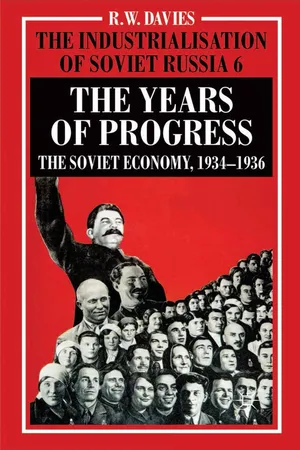
The Industrialisation of Soviet Russia Volume 6: The Years of Progress
The Soviet Economy, 1934-1936
- English
- ePUB (mobile friendly)
- Available on iOS & Android
eBook - ePub
The Industrialisation of Soviet Russia Volume 6: The Years of Progress
The Soviet Economy, 1934-1936
About this book
Information
CHAPTER ONE
THE XVII PARTY CONGRESS AND THE SECOND FIVE-YEAR PLAN
(A) THE BACKGROUND
The XVII party congress met in Moscow from January 26 to February 10, 1934. This was the end, or almost the end, of three years of severe economic and political crisis and disastrous famine, associated with rapid industrialisation; this crisis is discussed in volumes 4 and 5 of the present work. Though famine conditions continued in certain areas in the first six months of 1934 (see vol. 5, pp. 266–7, 411–12), the reasonable harvest of 1933, and the more moderate economic policies pursued in industry and elsewhere since the summer of 1932, brought to an end the worst of the famine. The currency was stabilised, and from the spring of 1933 industry began to develop more rapidly.
The second five-year plan began to be drawn up in a more or less realistic form at the beginning of 1933.The crucial problem was of course to determine a feasible rate of growth of industrial production and capital investment. Following the abandonment of the impossibly high targets of 1930–31, the central committee plenum of January 1933 had agreed that in 1933–37 the average annual rate of growth of industrial production should be planned at 13–14 per cent as compared with 21–22 per cent in the first five-year plan (see vol. 4, p. 332). No figure was included for capital investment. In further discussions in the first months of 1933, contradictory proposals about investment were put forward. The various commissariats sought as usual to increase the amount of investment they received, but on February 20, 1933, Mezhlauk on behalf of Gosplan sent a warning report to Stalin and Molotov pointing out that extra investment would require the allocation of additional food and other resources. The Politburo concurred with his objections, and on March 2, 1933, resolved in relation to the 1934 plan:
In view of the attempts of certain People’s Commissariats to fix the volume of capital investment at a higher level than that which corresponds to the total sum of 18,000 million rubles available for capital investment [in 1933], as was fixed by the January plenum of the central committee and the central control commission, the Politburo states that such attempts are unconditionally inadmissible.1
Encouraged by this prudent decision, the Mezhlauk commission resolved that the annual increase in production in 1933–37 should be limited to 13 per cent and that the plan for pig-iron production in 1937 should be reduced from 18 to 15 million tons.2 On May 28, 1933, Kuibyshev and Mezhlauk sent a letter to Stalin defending the figure of 15 million tons, and the associated figures for crude and rolled steel. Kuibyshev argued that a higher figure would involve increased investment in Narkomtyazhprom and would increase its annual growth of production to 16 per cent a year, and continued:
As the smelting of 15.2 million tons of pig iron and 11.6 million tons of rolled steel will satisfy other branches at the agreed rate of growth, and is sufficiently tense from the point of view of the new equipment required, especially for crude and rolled steel, Gosplan requests permission to carry out further work on the five-year plan on the basis of this limit.3
No reply to this letter has been traced, and the discussions in June and July 1933 in Gosplan continued to be based on the higher figure of 18 million tons of pig iron in 1937.4 It was this figure which was included in the directives to the XVII congress six months later.
Gosplan continued, however, to argue for a lower rate of investment. At the end of June 1933 it proposed that investment in 1933–37 should amount to a mere 97,000 million rubles as compared with the 135,000 requested by the commissariats.5 This was the lowest figure to emerge in the discussion, and assumed that annual investment during the five years would be only slightly higher than in 1933. But after further discussion within Gosplan, the proposed figure was increased to 120,000 million rubles.6 At a Gosplan meeting chaired by Kuibyshev on July 19, 1933, G. Smirnov, responsible for capital investment within Gosplan, sought to reduce it to 110,000 million, on the grounds that sufficient resources were not available to back up the higher figure.7 On July 26 a further Gosplan meeting adopted a ‘final’ compromise figure of 112,750 million rubles.8
It eventually emerged that this was by no means a final figure. On November 15, the Politburo decided to convene the XVII congress on January 15, 1934 (it eventually met on January 26). This meant that a decision about production and investment in the five-year plan could no longer be postponed. The Politburo discussion on Molotov’s and Kuibyshev’s reports to the congress was held on December 20, and considered a plan which was greatly increased as compared with the previous proposals. It included an annual growth of industrial production by over 18 per cent as compared with the previous 13–14 per cent, and a volume of capital investment in 1933–37 amounting to 133,000 million rubles as compared with 112,750.9
This decision was evidently taken by senior political leaders without consultation with the key departments within Gosplan. On December 20, the day on which the Politburo met, Lauer, the respected long-established head of the metals department of Gosplan, sent an angry letter to Kuibyshev, Mezhlauk and Petropavlovskii (the secretary of the Gosplan party cell):
I feel it necessary to draw your attention to the fact that work in Gosplan on finalising the second five-year plan has been organised in a completely unsatisfactory way, and will not enable the plans to be of good quality. We received an order to check the five-year plan tables and to return them with corrections in the course of one day. Some people received additional information from comrade Gaister about the changes you have made in the initial plan. But these changes are so serious that they affect all branches of the economy, and it is impossible simply to correct the tables, it is necessary to undertake a new interconnection of every sector (every branch) with the economy as a whole. As far as I know, the rates of growth of industrial production have been sharply changed (18 instead of 14 %), the relation of Group A and Group B has been changed, and capital investment in the final year has been sharply increased (34,000 million instead of 26,000 million). The output of machine-building has been sharply increased. This requires a new balance of building materials, a new metal balance, and different requirements of fuel and power.
After this diatribe, Lauer rather tamely requested five or six days rather than one day to do the job.10 Not surprisingly, the work took much longer. As late as December 31, Gaister reported additional changes to Stalin and the central committee, further complicating the work of the Gosplan staff. These included increases proposed by Stalin himself in the production of consumer goods by heavy industry and investment in the light and food industries (from 7,700 to 14,500 million rubles), and he also proposed an increase in the supply of locomotives and wagons to the railways.11
It was the more ambitious version of the plan which was submitted to the congress a month later. Industrial production would increase by 19 per cent a year, and investment in the five years would amount to 133.4 thousand million rubles.
(B) THE CONGRESS PROCEEDINGS AND THE FIVE-YEAR PLAN
The Politburo decided to present the congress to the public as a demonstration of the triumph of the Soviet system and of the economic policies of the past few years. On the first day of the congress, January 26, the main article on the front page of Pravda was headed ‘The Congress of Victors’, and the congress was known by this name throughout the Stalin period.
According to the party Statute, congresses were supposed to meet annually. But there had already been a two-year gap between the XIV congress (December 1925) and the XV congress (December 1927), and a two-and-a-half-year gap between the XV congress and the XVI congress, which convened in June–July 1930. Then the XVII congress was convened three-and-a-half years after the XVI congress. These delays were never explained.
The XVII congress was attended by 1,227 voting and 739 consultative delegates. The fate of most of the delegates was anything but victorious. A special commission reported at the beginning of 1956 that 1,103 of the total of 1,966 delegates had been arrested, mainly in 1937–38, and 848 of these had been executed. And of the 139 full and candidate members of the central committee elected at the congress, 101 were executed and five committed suicide.12
The publication of this tragic information in 1956 was used to suggest that the party and its leading members were the main victims of the repressions; the full story (to be discussed in vol. 7) was revealed only after the fall of the Soviet Union. These revelations also gave rise to the widespread notion that an attempt was made at the congress to replace Stalin as general secretary of the party.13 Many versions of this notion appeared at the time and later, based on rumour rather than hard evidence. The least implausible account was that during the congress some party leaders discussed the possibility of replacing Stalin by S. M. Kirov, but Kirov refused. According to this account, during the election of the central committee at the congress some 270–300 votes were cast against Stalin, who ordered the destruction of these voting slips. This account was used to claim that Kirov’s murder in December 1934 and the consequent execution of many of the congress delegates were carried out on Stalin’s direct orders.14 Many years after the event the papers of the election commission of the congress were examined and there was no evidence that more than three delegate...
Table of contents
- Cover
- Title
- Copyright
- Contents
- List of Tables
- Preface
- 1 The XVII Party Congress And the Second Five-Year Plan
- 2 1934: A Year of Relaxation: The Political Background
- 3 The Economy in 1934
- 4 1935: The Growing Threat of War
- 5 The 1935 Plan and the Abolition of Bread Rationing
- 6 ‘Continuous Advance’: January–September 1935
- 7 ‘Advancing to Abundance’, September–December 1935
- 8 1935 In Retrospect
- 9 The Ambitious 1936 Plan
- 10 The Political Context of Economic Change, 1936
- 11 1936: ‘The Stakhanovite Year’
- 12 The Successful Outcome of 1936
- Appendix A
- Appendix B
- Conclusions
- Tables
- Glossary of Terms and Abbreviations used in Text
- Bibliography
- Name Index
- Subject Index
Trusted by 375,005 students
Access to over 1.5 million titles for a fair monthly price.
Study more efficiently using our study tools.
Frequently asked questions
Yes, you can cancel anytime from the Subscription tab in your account settings on the Perlego website. Your subscription will stay active until the end of your current billing period. Learn how to cancel your subscription
No, books cannot be downloaded as external files, such as PDFs, for use outside of Perlego. However, you can download books within the Perlego app for offline reading on mobile or tablet. Learn how to download books offline
Perlego offers two plans: Essential and Complete
- Essential is ideal for learners and professionals who enjoy exploring a wide range of subjects. Access the Essential Library with 800,000+ trusted titles and best-sellers across business, personal growth, and the humanities. Includes unlimited reading time and Standard Read Aloud voice.
- Complete: Perfect for advanced learners and researchers needing full, unrestricted access. Unlock 1.5M+ books across hundreds of subjects, including academic and specialized titles. The Complete Plan also includes advanced features like Premium Read Aloud and Research Assistant.
We are an online textbook subscription service, where you can get access to an entire online library for less than the price of a single book per month. With over 1.5 million books across 990+ topics, we’ve got you covered! Learn about our mission
Look out for the read-aloud symbol on your next book to see if you can listen to it. The read-aloud tool reads text aloud for you, highlighting the text as it is being read. You can pause it, speed it up and slow it down. Learn more about Read Aloud
Yes! You can use the Perlego app on both iOS and Android devices to read anytime, anywhere — even offline. Perfect for commutes or when you’re on the go.
Please note we cannot support devices running on iOS 13 and Android 7 or earlier. Learn more about using the app
Please note we cannot support devices running on iOS 13 and Android 7 or earlier. Learn more about using the app
Yes, you can access The Industrialisation of Soviet Russia Volume 6: The Years of Progress by R. Davies in PDF and/or ePUB format, as well as other popular books in History & Business General. We have over 1.5 million books available in our catalogue for you to explore.