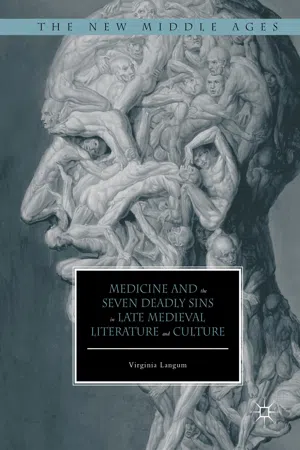
This book considers how scientists, theologians, priests, and poets approached the relationship of the human body and ethics in the later Middle Ages. Is medicine merely a metaphor for sin? Or can certain kinds of bodies physiologically dispose people to be angry, sad, or greedy? If so, then is it their fault? Virginia Langum offers an account of the medical imagery used to describe feelings and actions in religious and literary contexts, referencing a variety of behavioral discussions within medical contexts. The study draws upon medical and theological writing for its philosophical basis, and upon more popular works of religion, as well as poetry, to show how these themes were articulated, explored, and questioned more widely in medieval culture.
eBook - ePub
Medicine and the Seven Deadly Sins in Late Medieval Literature and Culture
- English
- ePUB (mobile friendly)
- Available on iOS & Android
eBook - ePub
Medicine and the Seven Deadly Sins in Late Medieval Literature and Culture
About this book
Information
© The Author(s) 2016
Virginia LangumMedicine and the Seven Deadly Sins in Late Medieval Literature and CultureThe New Middle Ages10.1057/978-1-137-44990-0_11. Introduction
Virginia Langum1
(1)
Umeå University, Umeå, Sweden
Medicine and sin might seem unlikely bedfellows, but they are persistently entwined in history. 1 Their relationship can be viewed as a medicalized morality whereby traditionally moral characteristics and behaviors are attributed to medical conditions. Alternatively, it can be considered a moralized medicine whereby certain diseases and conditions are loaded with moral freight.
Scholars often identify the origins of medicalized morality in the nineteenth century with the rise of psychiatry and the shift in responsibility over certain undesirable behaviors, such as alcohol consumption and deviant sexual activities, from church authorities to the field of medicine. 2 These newly pathologized categories typically followed the established norms of religion and society. In this sense, medicalized morality represented merely a shift in semantic domain or language: behavior and dispositions formerly described as virtuous or vicious might be newly accounted normal or pathological. Medicine provided new support for established ideas of good and bad behavior. Indeed, “modern science has proved just as ideologically malleable as the Bible when it comes to arguing either for or against such divisions.” 3
Moralized medicine occurs either explicitly, in the affiliation of certain behaviors and risk factors with specific diseases, or more implicitly, through metaphor and other types of figurative language. Studies of the figurative language attributed to diseases; for example, cancer, leprosy, and AIDS, argue that “nothing is more punitive than to give a disease meaning—that meaning being invariably a moralistic one.” 4 Other inquiries highlight the use of metaphors in science as vehicles for shaping social and moral values, including work on the use of religious imagery and symbols such as the “book of life” in genetics. 5
The intersection of health and ethics extends beyond verbal signifiers to other fundamental conceptual frameworks, such as the nature versus nurture debate. The question of how much control we wield over our environment and ourselves is current in arenas beyond the political and academic. The recent upsurge in depictions of zombies and vampires in films, novels, and television arguably reflects such concerns. The viruses that generate these plots may intimate a perceived vulnerability in the metaphorical body politic as well as the material threat of epidemics to individual bodies. Zombies and vampires represent extreme organic needs that are both biologically driven and beyond the desires of healthy humans. 6 Yet these popular cultural phenomena offer insight into what we might call the “bio-disaster” trend, with origins traceable to historical pandemics. 7 For example, analogues with the greedy, unthinking zombie have been located in the early modern plague literature in response to the rise of capitalism. 8
The appropriation of moral behavior and dispositions by medicine is not only a contemporary phenomenon, however. Across many cultures and periods, problematic, abnormal, or diseased bodies represented social anxieties and moral failings. 9 Although ancient in origin, images of a “body politic” whose diseases or disjointedness embody social problems that threaten the unity and functioning of the state have been used by thinkers throughout history, accompanied by notions of the human body as a microcosm. 10
This book investigates the medieval understanding of the interaction of medicine and morality, shaped by both the medical imagery used in religious and literary contexts as well as by the discussion of behavior and religious language in medical contexts. The study primarily concerns the period between the Fourth Lateran Council (1215), a significant event for pastoral reform and the textual production of works about confession and the sins, and the eve of the Protestant Reformation. The Lateran-inspired confessional literature places great emphasis upon the circumstances of sin—priests were required to know the particulars of both sins and sinners, including some knowledge of physiological predispositions and the passions. 11 At the same time, medical materials such as physiognomies, encyclopedias, surgical manuals, and recipe books were being circulated and translated into the vernacular on a much wider scale. England is a particularly interesting case, where the majority of university-trained physicians were in holy orders up to the late fifteenth century, and clergy generally undertook the translation of Latin medical texts into English.
The year 1500 also marks something of a shift in the period’s religious and medical mentality. Religious texts increasingly evinced a preference for the Ten Commandments over the sins on the basis of the former’s scriptural authority. Professional medical guilds took shape—albeit quite late in England compared with the continent. 12 In terms of changes in anatomical and physiological knowledge, in the beginning of the sixteenth century, thinkers began to significantly challenge the teachings of the ancient physician Galen (d. c. 210). The early modern physician Paracelsus (d. 1541) allegedly burned Galen’s books, and while less radical in the short term, Vesalius’ (d. 1564) human dissections had a more devastating influence on the tradition of Galenic medicine in the long term. Due to these and other movements, medicine lost something of its “homogeneity.” 13
On the other hand, the years 1215 and 1500 are porous bookends as will become clearer. The reforms of 1215 began before 1215; as, of course, did the translation and circulation of texts. Proto-Protestant movements that emphasized a return to scripture and literalism existed before 1500. 14 And while the shift to the Ten Commandments pre-dated the Reformation in learned and orthodox theological texts, certainly the sins do not disappear. 15 , 16 As for medical changes, the influence of Galenism did not really die out until the nineteenth century. 17
However, we can make some general observations about the interaction of religion and medicine in the later Middle Ages. Depictions of the vices in the later medieval period are more detailed and naturalistic than the earlier static allegorical representations, as remarked upon by literary and art historians. 18 This material often includes medical imagery, ranging in its allegorical quality, specificity, and vividness. 19 Although the Fourth Lateran Council explicitly prohibited clergy from practicing incision (i.e., the cutting of the body) and cauterization (i.e., the burning and sealing of wounds), priests undoubtedly practiced various forms of medicine in this period. 20 Beyond practice and regulation, clerics were involved in the transmission of its knowledge, as they translated and copied medical texts for charitable and compassionate reasons. 21 Such clerical translation was part of the larger phenomenon of the translation of technical texts into vernacular languages in the later fourteenth and fifteenth centuries. This vernacularization facilitated the “popular consumption” of specialized knowledge. 22 Despite uncertainty surrounding the ownership, audience, and use of these texts, we may infer a widespread familiarity with surgical and medical practice. 23
Concepts and Terms
Before delving into the primary material, it is worth exploring several viscous concepts and terms at the core of this book and in its title: medicine, the seven deadly sins, medieval, culture, and literature. The history of ideas and the more recent history of emotions offer several useful approaches to thinking about concepts in the past. As a branch of the history of ideas, conceptual history examines the development of thoughts and ideas by studying their linguistic and cultural contexts. Many potential problems in the study of medicine and religion in the Middle Ages arise from the assumption of equivalence: the suggestion either that a concept used in the Middle Ages means the same in our own age or that a word used in one medieval text means the same in another medieval text. The word “contagion” exemplifies the first type of false equivalence. In the twenty-first century, the use of this word implies knowledge of microbiology; in the fourteenth century, it did not, as will become clear in the discussion of plague. 24
The second type of false equivalence entails disregard for the multiplicity of meanings within medieval texts. For example, the word “vice” might conflate with “sin” in religious contexts, yet the same word might denote harmful treatments or bodily conditions in medical contexts. Given the crossover between the fields of medicine and religion, as outlined in more detail later, I tend to take a generous view of polysemy, or the multiplicity of meanings of words and phrases. However, some caution is required.
The study of the history of emotions also probes expressions and vocabularies. Viewing the body as a subject of historical analysis rather than a vehicle of timeless experience, historians of the emotions inquire into the extent to which emotions are sh...
Table of contents
- Cover
- Frontmatter
- 1. Introduction
- 2. Medicine, Sin, and Language
- 3. Pride
- 4. Envy
- 5. Wrath
- 6. Avarice
- 7. Sloth
- 8. Gluttony
- 9. Lechery
- 10. Conclusion
- Backmatter
Trusted by 375,005 students
Access to over 1.5 million titles for a fair monthly price.
Study more efficiently using our study tools.
Frequently asked questions
Yes, you can cancel anytime from the Subscription tab in your account settings on the Perlego website. Your subscription will stay active until the end of your current billing period. Learn how to cancel your subscription
No, books cannot be downloaded as external files, such as PDFs, for use outside of Perlego. However, you can download books within the Perlego app for offline reading on mobile or tablet. Learn how to download books offline
Perlego offers two plans: Essential and Complete
- Essential is ideal for learners and professionals who enjoy exploring a wide range of subjects. Access the Essential Library with 800,000+ trusted titles and best-sellers across business, personal growth, and the humanities. Includes unlimited reading time and Standard Read Aloud voice.
- Complete: Perfect for advanced learners and researchers needing full, unrestricted access. Unlock 1.5M+ books across hundreds of subjects, including academic and specialized titles. The Complete Plan also includes advanced features like Premium Read Aloud and Research Assistant.
We are an online textbook subscription service, where you can get access to an entire online library for less than the price of a single book per month. With over 1.5 million books across 990+ topics, we’ve got you covered! Learn about our mission
Look out for the read-aloud symbol on your next book to see if you can listen to it. The read-aloud tool reads text aloud for you, highlighting the text as it is being read. You can pause it, speed it up and slow it down. Learn more about Read Aloud
Yes! You can use the Perlego app on both iOS and Android devices to read anytime, anywhere — even offline. Perfect for commutes or when you’re on the go.
Please note we cannot support devices running on iOS 13 and Android 7 or earlier. Learn more about using the app
Please note we cannot support devices running on iOS 13 and Android 7 or earlier. Learn more about using the app
Yes, you can access Medicine and the Seven Deadly Sins in Late Medieval Literature and Culture by Virginia Langum in PDF and/or ePUB format, as well as other popular books in Literature & European Medieval History. We have over 1.5 million books available in our catalogue for you to explore.