Thestudy of religion and politicsis astrongly behavioral sub-discipline, and within the American context, scholars place tremendous emphasis on its influence on political attitudes and behaviors, resultuing in a better understanding of religion's ability to shape voting patterns, party affiliation, and views of public policy.
eBook - ePub
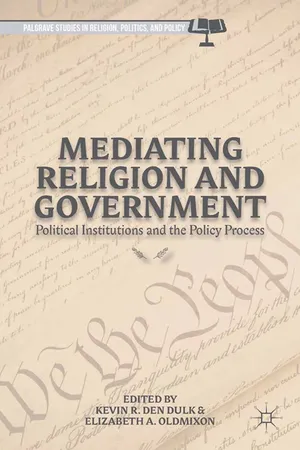
Mediating Religion and Government
Political Institutions and the Policy Process
- English
- ePUB (mobile friendly)
- Available on iOS & Android
eBook - ePub
Mediating Religion and Government
Political Institutions and the Policy Process
About this book
Information
1
An Institutionalist Perspective on Religion and Politics
Kevin R. den Dulk and Elizabeth A. Oldmixon
If you let me write the procedure and I let you write the substance, I’ll [beat] you every time.
Rep. John Dingell (D-MI)1
Rules matter. It appears a simple claim, but we often neglect its myriad implications for politics. In fact, our democratic impulses often push against a full recognition of the idea that rules shape our political decisions. After all, if democracy is “rule by the people,” we might expect that the people’s will ought to be translated into public policy through a process that does not alter their preferences. Yet we also know that elite and mass preferences do not and cannot directly translate into political outcomes, even when those preferences are rooted in convictions that are intensely experienced and widely held. The process of making a decision, which is necessarily defined by formal and informal rules, mediates between the citizen’s will and policy results.
This book examines how specific kinds of political preferences—those inspired by religious faith and/or mobilized by religious groups—interact with political institutions. While the influence of religion on political preferences is well documented among scholars, journalists, and pundits, the role of political institutions in shaping religiously inspired preferences receives less attention. Our goal is to shed light on this relationship by offering an institutionalist account of religion and politics. By political “institutions” we mean broadly the organized structures whose rules, processes, and norms are basic to political decision making itself. Each contributor to this book is interested in not only how religionists and religious groups attempt to influence political institutions but also how political institutions shape religion-based preferences and political advocacy.
Institutions in Context
This relationship of religion and political institutions always matters, but it has a particular resonance in the cultural skirmishes of recent years. Consider two illustrations: school prayer and legalization of same-sex marriage. In both cases, the intervention of institutions has led to policy results that polling data would not predict.
As of 2005, 76 percent of Americans supported a constitutional amendment allowing voluntary prayer in public schools. Support is even higher among Protestants and regular worship attenders.2 Not surprisingly, legislators routinely submit resolutions to the US Congress that would amend the Constitution to allow for such a practice. In the 113th Congress, for example, Rep. Nick Rahall (D-WV) introduced a resolution that reads as follows: “Nothing in this Constitution, including any amendment to this Constitution, shall be construed to prohibit voluntary prayer or require prayer in a public school, or to prohibit voluntary prayer or require prayer at a public school extracurricular activity.” The resolution has been referred to the House Committee on the Judiciary, where it will almost certainly die.
To the casual observer, this raises several questions. If prayer in schools is so popular, why is school-sponsored prayer not permitted? Would not that kind of prayer be the most democratic outcome? Why is an amendment necessary at all? And why will it inevitably fail? A clear part of the answer to all of these questions is the role of institutions. State-initiated or state-sponsored prayer is not permitted, because in the context of the constitutional separation of powers, the Supreme Court exercises judicial review. It has ruled repeatedly that state-initiated prayer in public schools violates the Establishment Clause of the Constitution. The Court has struck down school efforts to encourage students to participate voluntarily not only in state-composed prayer (Engel v. Vitale 1962) but also in state-mandated moments of silence (Wallace v. Jaffree 1985) and student-led prayer at public school functions (Sante Fe Independent School District v. Doe 2002). Moreover, the Constitution does not provide an easy legal structure for citizens to circumvent the Court’s directives; the Constitution contains no mechanism for a plebiscite or other form of direct democracy as a response to judicial review.3 To be sure, citizens have recourse to the amendment process. But that process is layered with such institutionalized complexity that only 27 amendments have been ratified out of thousands of proposals. In this gauntlet of decision rules and levels of government, it is no wonder that mass-level preferences are not clearly reflected in policy outcomes.
Institutional constraints similarly frame recent debates swirling around the legal status of marriage. Of all the issues that draw progressives and religious traditionalists into the public square in competition, perhaps none at the moment is more salient. While one side of this cultural debate emphasizes the centrality of civil equality and moral autonomy, the other embraces the long-established, religiously endorsed meanings of marriage and family. National-level opinion on this issue has changed dramatically in the last decade in a progressive direction. In the ten years from 2003 to 2013, support for same-sex marriage increased by nearly 20 percentage points, from 32 percent to 51 percent.4 Moreover, while the rates of increase have been uneven, support for same-sex marriage has increased in all major religious traditions over the last decade. Majorities of white mainline Protestants, Catholics, and the unaffiliated support the legal recognition of same-sex marriage, but support among white Evangelicals and black Protestants is still well under 50 percent.
In light of these changes in mass opinion, policy change would seem imminent—and, indeed, there have been significant policy developments. But the process of change happens through political institutions that mediate between opinion and policy. The most important institutional factor is America’s federal structure, which has traditionally given states the primary role in governing marriage. As a result, much of the policy churning has happened state-by-state. Even in the states, however, preferences do not translate directly to policy. Fifty-three percent of Wisconsinites, for example, support marriage equality,5 but Republican opponents control the legislature and governorship, and the state does not have an initiative process. The result is that at least for now, irrespective of preferences, the state will neither issue marriage licenses to same-sex couples nor recognize marriages performed elsewhere. In contrast, Wisconsin’s neighbor, Iowa, does recognize same-sex marriage, even though less than 50 percent of Iowans support the practice.6 How did this happen? In Iowa’s case, the answer lies with another institution: the courts. Iowa’s Supreme Court used the power of judicial review to rule that limiting marriage to male-female couples violated the Iowa Constitution. Here again, institutions structure outcomes so that they do not neatly track preferences.
Early Institutionalists
The framers of the US Constitution understood acutely that rules and institutions shape political outcomes. Their efforts at constitutional design were born out of hard experience and profound uncertainty. On the one hand, they feared the oppressive tendencies of centralized power, as epitomized in the British monarch. On the other hand, they were bruised by the decentralization of power under the Articles of Confederation, which led to unrelenting political and economic instability and eventually proved unworkable. But while these experiences recommended directions they ought to avoid, history did not provide a clear guide as to how they should balance diverse regional interests in a new and modern state. In considering earlier republics, for example, Hamilton worries in Federalist 9 that Greece and Italy “were kept in a state of perpetual vibration between the extremes of tyranny and anarchy.” While supporting the spirit of self-determination of democracy, the framers understood that whatever the preferences and impulses at the mass level, they would be mediated (and perhaps mitigated) by the political institutions through which they were distilled. Their goal, then, was to build institutions that promoted stability while allowing for some measure of democratic accountability.
Madison approached the process of institution building with the key underlying belief that people were acquisitive and factious. He feared that like-minded citizens would join together and use the machinery of government to advance their interests, as opposed to the public interest. The Madisonian solution to the problem was to structure government to contain these natural propensities; his strategy was to diffuse power through structures, notably the separation of “powers”, bicameralism, and federalism. In taking this approach, Madison was fundamentally an institutionalist. While one can argue about how well Madison’s vision has been realized, the basic constitutional structure has persisted as the underlying governing framework.
Madison’s perspective was imbued with a Lockean (and even Hobbesian) moral architecture, which assumed that individuals, in the exercise of their natural state of freedom, would be driven by passionate self-interest, even (in Hobbes’ view) to the point of violence. But Madison was also heavily influenced by Calvinist assumptions about human depravity (see Sheldon 2001). “If men were angels,” he famously declared in Federalist 51, “no government would be necessary.” The clear implication, of course, is that human beings are not angels, and so Madison proposed the “auxiliary precautions” of competing institutions to quell his distrust of those mere humans with power. While Jefferson did not share Madison’s Calvinist bona fides, he articulated a similar sentiment in the Kentucky Resolutions of 1789, arguing that “confidence in the men of our choice . . . is everywhere the parent of despotism. Free government is founded in jealousy, and not in confidence; it is jealousy and not confidence which prescribes limited constitutions, to bind down those whom we are obliged to trust with power.”
But few of the founders thought institutional design alone would be sufficient to address their concerns about human nature. In Federalist 55, Madison himself suggested that the institutions of self-government presuppose “sufficient virtue” in the citizenry. Several decades later, Alexis de Tocqueville would attribute the success of America’s governing institutions at least in part to the country’s religiosity. Widespread religiosity drew Americans into civic life in spite of cultural tendencies toward individualism. It taught Americans “the art of being free” by internalizing deeply helpful behavioral mores. Of course, the sociocultural importance of religion pre-dates both the founding and Tocqueville’s observations. The earliest European settlers understood their journey to the New World as the establishment of a covenant with God. As John Winthrop preached, the new community would be “a city on a hill,” and even now many Americans hold a deeply internalized sense of civil religion.
Political Science Perspectives
Like Madison, Hamilton, and other early institutionalists who understood themselves to be practicing a new “science” of politics, modern political scientists continue to be drawn to questions about the country’s institutional framework. Indeed, for political scientists of the early twentieth century, the study of governing institutions was the sine qua non of the discipline. The individual citizen was largely ignored; the formal legal processes of lawmaking were the name of the game (Sigelman 2006, 471). Through the middle part of the century, political scientific interest in formal institutions subsided with the so-called “behavioral revolution.” New substantive ideas (e.g., the socialpsychological dimensions of partisanship or citizen attitudes) and methodologies (e.g., mass-based surveys) took hold. But in the 1980s and 1990s, political scientists revived their formative curiosity under the banner of the “new institutionalism.” They brought to bear modern theories and techniques that allowed more systematic inquiry into the norms, rules, and processes that can catalyze or impede political behavior. Some new institutionalists defined those rules in rational choice terms: Institutions provide resources or constraints that political actors consider as they attempt to maximize their preferences (Shepsle and Weingast 1982; March and Olsen 1984). Others took an historical tack: Institutions define a path that develops over time, incrementally and often imperceptibility, and that can shape both decisions and preferences (Hall 1986; Pierson and Skocpol 2002; Steinmo, Thelen, and Longstreth 2002). Still others have sought a convergence of these institutionalist perspectives (Lowndes and Roberts 2013). But whether the orientation is rationalist, historical, or some combination, political science has reasserted a primary role for institutions in political life.
Yet while most scholars of religion and politics would likely agree with the general institutionalist argument, few have taken up the mantle to study the mediating role of institutions on religion-based beliefs and behaviors. While our cousins in sociology had been theorizing and investigating religion’s social significance for well over a hundred years, a focus on religion and politics did not mature among political scientists until the behavioral revolution was well underway.7 As a result, the burgeoning field of religion and politics tended to explore religiously motivated political behavior and underlying religious beliefs and affiliation.
Not only did the field emerge in the behavioralist milieu, but it also coincided with the religiopolitical convulsions of the 1970s and 1980s, which raised the salience of the topic. Internationally, the political violence between Protestants and Catholics in Northern Ireland, the rise of the mujahedeen in Afghanistan, and the durability of Christian Democratic parties in Europe all attested to religion’s social significance. On the home front, the political mobilization of Evangelical Christians was the clearest signal of religion’s political significance. And indeed, it was unforeseen. Wald and Calhoun-Brown (2011, 202) say it best: “Of all the . . . surprises in contemporary political life, none was so wholly unexpected as the political resurgence of evangelical Protestantism in the late 1970s.”
The scholarship coming out of this era made vital contr...
Table of contents
- Cover
- Title
- 1 An Institutionalist Perspective on Religion and Politics
- 2 Political Rhetoric and Institutional Structures: Religious Advocacy in the US Congress
- 3 Religious Market Interest Groups: Do They Sing with an Upper Class Accent?
- 4 Religion and Political Parties: Mediation in the Mass Party Era
- 5 Serving God by Shaping Law: Religious Legal Advocacy in the United States
- 6 Religion in the American Congress: The Case of the US House of Representatives, 1953–2013
- 7 The Importance of Religion to Understanding the Modern Presidency
- 8 Regulating Religion: Bureaucracies, Faith-Based Organizations, and Constitutional Limits
- 9 Religious Actors in State Political Institutions
- 10 Explaining Religious Violence across Countries: An Institutional Approach
- 11 Conclusion: Religious Politics, Pluralism, and the US Constitution
- Notes on Contributors
- Index
Trusted by 375,005 students
Access to over 1.5 million titles for a fair monthly price.
Study more efficiently using our study tools.
Frequently asked questions
Yes, you can cancel anytime from the Subscription tab in your account settings on the Perlego website. Your subscription will stay active until the end of your current billing period. Learn how to cancel your subscription
No, books cannot be downloaded as external files, such as PDFs, for use outside of Perlego. However, you can download books within the Perlego app for offline reading on mobile or tablet. Learn how to download books offline
Perlego offers two plans: Essential and Complete
- Essential is ideal for learners and professionals who enjoy exploring a wide range of subjects. Access the Essential Library with 800,000+ trusted titles and best-sellers across business, personal growth, and the humanities. Includes unlimited reading time and Standard Read Aloud voice.
- Complete: Perfect for advanced learners and researchers needing full, unrestricted access. Unlock 1.5M+ books across hundreds of subjects, including academic and specialized titles. The Complete Plan also includes advanced features like Premium Read Aloud and Research Assistant.
We are an online textbook subscription service, where you can get access to an entire online library for less than the price of a single book per month. With over 1.5 million books across 990+ topics, we’ve got you covered! Learn about our mission
Look out for the read-aloud symbol on your next book to see if you can listen to it. The read-aloud tool reads text aloud for you, highlighting the text as it is being read. You can pause it, speed it up and slow it down. Learn more about Read Aloud
Yes! You can use the Perlego app on both iOS and Android devices to read anytime, anywhere — even offline. Perfect for commutes or when you’re on the go.
Please note we cannot support devices running on iOS 13 and Android 7 or earlier. Learn more about using the app
Please note we cannot support devices running on iOS 13 and Android 7 or earlier. Learn more about using the app
Yes, you can access Mediating Religion and Government by Kenneth A. Loparo, E. Oldmixon, Kenneth A. Loparo,E. Oldmixon,Kevin R. den Dulk, Kevin R. den Dulk, E. Oldmixon in PDF and/or ePUB format, as well as other popular books in Politics & International Relations & European Politics. We have over 1.5 million books available in our catalogue for you to explore.