- English
- ePUB (mobile friendly)
- Available on iOS & Android
eBook - ePub
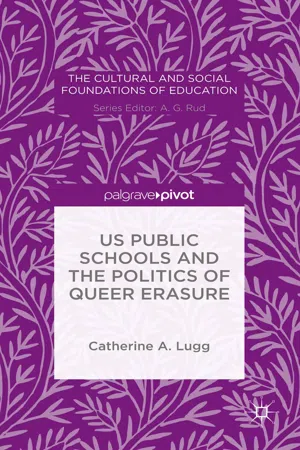
US Public Schools and the Politics of Queer Erasure
About this book
This book presents a history of queer erasure in the US public school system, from the 1920s up until today. By focusing on specific events as well as the context in which they occurred, Lugg presents a way forward in improving school policies for both queer youth and queer adults.
Information
Topic
Ciencias socialesSubtopic
Administración de la educación1
Before the American Psychiatric Association (APA)
Abstract: Chapter 1 highlights the long hostility towards queer people and information about queers, including sweeping witch-hunts of suspected queer public school personnel from the 1920s through to the 1960s. I also discuss how efforts to offer sexuality education were fraught with political controversy, only some of which was related to sexual orientation.
Lugg, Catherine A. US Public Schools and the Politics of Queer Erasure. New York: Palgrave Macmillan, 2016. DOI: 10.1057/9781137535269.0006.
Many contemporary historical accounts of queer life typically contain a section or chapter discussing “life before Stonewall,” the bar fight turned queer rebellion that serves as the marker for the current era of queer liberation. Yet, US public schools and school districts, as well as educational state policies guiding both, are conservative—by design. Hence, a bar fight is probably an inaccurate, and surely incongruous, historical point of demarcation from which to begin a discussion about queer rights and public schooling. However, since “mentally ill” people during this era were banned from obtaining teaching and administrative certificates, the de- pathologization of “homosexuality” and “bisexuality” by the American Psychiatric Association in late 1973, early 1974 provides an excellent historical marker.
In this chapter, I present an historical overview of the status of queer people, students, educators, and other adults, and how public schools have both shaped and been shaped by the larger cultural politics of the times. I also explore the medical pathologization, criminalization, and supposedly heretical threat of queer identity and how this unholy trinity of stigma was used to argue that queers presented an existential threat to the well-being of public school children—and to the larger nation-state. Given the stigma involving “queerness,” I also discuss how efforts to expand sexuality education could be politically sabotaged by the invocation of the “homosexual menace.”
Criminalization, medicalization, and certification
It is not to be wondered that a priest, a legislator and a psychoanalyst should be interested only in their dogmas. The priest is as much convinced of his sin theory as the legislator is sure that prison is the cure of crime, and the psychoanalyst, not a bit less, is certain that his therapy will bring back the erring homosexual to the normal fold. (Parisex [Henry Gerber], 1932)1
Prior to the 1920s, the US general public had very little knowledge regarding sex, much less sexual identity—scholarly or otherwise. That said, US criminal law had long penalized same-sex erotic behavior, especially between men. These laws reflected the religious ethos of literalist Protestant Christianity, which predominated across the United States. Yet, “the homosexual” (or “the bisexual,” for that matter) as a distinct and recognizable identity simply did not exist.2 However, in the aftermath of World War I, much of the work of the early sexologists found its way into the American public consciousness.3 Thanks to the rise of popular magazines, films, theater, and radio, as well as to a burgeoning interest by the medical community, the notion of “the homosexual” as a distinct and troublesome personal identity began to form.4
Concurrently, the American public high school became ubiquitous, with even tiny communities boasting of their very own high school. Meanwhile, the urban areas of the United States rapidly expanded because of immigration, urbanization, and industrialization as waves of newcomers moved to the cities for both economic and social opportunities. Many US cities could scarcely keep up with the public’s demand for greater schooling opportunities. Teacher shortages became chronic, school buildings were crammed with students, and public school administrators devised various schemes to maximize the use of both the available labor and buildings to minimize the escalating costs.5
Local communities had long held their public school teachers to exacting codes of personal conduct, with many expecting teachers to attend local Protestant churches in communities where Protestants dominated, and to attend Mass where Catholics dominated.6 Districts also typically maintained a clause stating that teachers were to uphold and/or exemplify the moral standards of the community. This policy tended to include bans on drinking alcohol (either in public or in private), and even on smoking and dancing. Such a broad-brush approach to “morality” gave local adults nearly carte blanche to peer into the private lives of their public school teachers.7 Many teachers resented this public gawking and referred to it as “snoopervision.”8 Public education work also became increasingly stratified by the 1920s. White women, black men and black women served as teachers and remained in that job category. By contrast, white men and the rare African-American man, might begin careers as a teacher, but they were strongly encouraged to move into administration as quickly as possible, since teaching was deemed to be “unmanly work.” Public school administration was becoming a bona fide profession, but because it was a profession, it was in most locales open only to white men.9
With the boom in public-education enrollment, states revisited their licensing standards for public school educators. Normal schools became state teachers’ colleges, as states sought to enhance the status of these mainly local institutions while increasing the educational requirements for aspiring educators. This move from requiring a two-year certificate to requiring a four-year bachelor’s degree to be eligible for initial teachers’ certification marked a dramatic ratcheting up of requirements.10 But individual states set the standards for licensure, and they varied considerably across all 48 and, eventually, 50 states. This variation also occurred by grade level. High-school educators faced far more stringent licensure demands than did elementary educators. Furthermore, each state demanded that educator preparation programs ensure their teacher and administrator candidates be of the highest moral caliber.
As the morality and educational requirements evolved, becoming increasingly codified in law and policy, so did the standards concerning sexuality and gendered expression. Thanks to a growing awareness of homosexuality, gender conformity was taken as a proxy for sexual orientation—and laws against cross-dressing were added to the criminal code.11 So not only was queer identity (or suspected queer identity) criminalized as codified in state laws banning all forms of same-gender consensual sodomy, but cross-dressing was also banned in order to ensnare suspected queers.12 Additionally, homosexuality was becoming “medicalized.” Medical doctors, and particularly psychoanalysts, were increasingly on the prowl for patients who demonstrated what was considered a “poor development outcome,” at best—and in some quarters a dangerous mental disorder.13 For those who worked in the schools, they had better be gender-conforming and, if male, married. While there was a fair amount of public anxiety regarding “spinster teachers,” unmarried female teachers remained prized for their economic efficiency. Despite the nettlesome “snoopervision” by community members, during an era of restricted job opportunities for women, teaching was one of the few employment avenues open to single educated women. Additionally, school districts did not have to pay women anywhere near the salaries that they paid their male counterparts. They were not obligated to pay a living wage to female teachers. So, while social commentators might lament the possible corrosive effects that unmarried female teachers might have on their male charges, their fiscal utility usually far outweighed any social concerns.14
The increased awareness regarding sexuality, coupled with the change in laws and licensure requirements, meant public school students, and especially students attending the extremely popular public high schools, were nascent targets for possible corrective actions.15 As Agnes Conklin noted in 1927, regarding the “new” high school students:
Some will have, or will develop, sexual maladjustments—failure to pass through puberty successfully, hangovers of homosexuality, persistence of infantile dependencies, and a host of warped viewpoints due to improper knowledge vicariously acquired.16
By the late 1920s, it was th...
Table of contents
- Cover
- Title
- Introduction
- 1 Before the American Psychiatric Association (APA)
- 2 Liberation and Restigmatization
- 3 The Turbulent 1990s and 2000s
- 4 Coming Out into a Hostile World: The Politics of Adult Queer Visibility and Power
- 5 Does it Get Better? The Ongoing Political War against Queer Youth with Jason P. Murphy
- 6 Life after Obergefell: Will Queers Finally Become Visible within Public Schools?
- Index
Trusted by 375,005 students
Access to over 1.5 million titles for a fair monthly price.
Study more efficiently using our study tools.
Frequently asked questions
Yes, you can cancel anytime from the Subscription tab in your account settings on the Perlego website. Your subscription will stay active until the end of your current billing period. Learn how to cancel your subscription
No, books cannot be downloaded as external files, such as PDFs, for use outside of Perlego. However, you can download books within the Perlego app for offline reading on mobile or tablet. Learn how to download books offline
Perlego offers two plans: Essential and Complete
- Essential is ideal for learners and professionals who enjoy exploring a wide range of subjects. Access the Essential Library with 800,000+ trusted titles and best-sellers across business, personal growth, and the humanities. Includes unlimited reading time and Standard Read Aloud voice.
- Complete: Perfect for advanced learners and researchers needing full, unrestricted access. Unlock 1.5M+ books across hundreds of subjects, including academic and specialized titles. The Complete Plan also includes advanced features like Premium Read Aloud and Research Assistant.
We are an online textbook subscription service, where you can get access to an entire online library for less than the price of a single book per month. With over 1.5 million books across 990+ topics, we’ve got you covered! Learn about our mission
Look out for the read-aloud symbol on your next book to see if you can listen to it. The read-aloud tool reads text aloud for you, highlighting the text as it is being read. You can pause it, speed it up and slow it down. Learn more about Read Aloud
Yes! You can use the Perlego app on both iOS and Android devices to read anytime, anywhere — even offline. Perfect for commutes or when you’re on the go.
Please note we cannot support devices running on iOS 13 and Android 7 or earlier. Learn more about using the app
Please note we cannot support devices running on iOS 13 and Android 7 or earlier. Learn more about using the app
Yes, you can access US Public Schools and the Politics of Queer Erasure by C. Lugg in PDF and/or ePUB format, as well as other popular books in Ciencias sociales & Administración de la educación. We have over 1.5 million books available in our catalogue for you to explore.