- English
- ePUB (mobile friendly)
- Available on iOS & Android
eBook - ePub
About this book
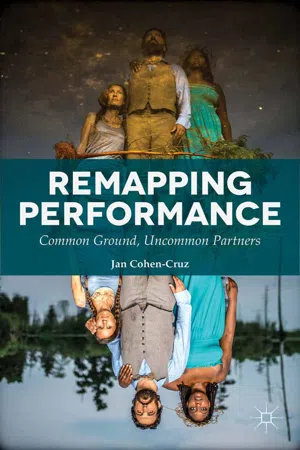
Completing a trilogy of works by Jan Cohen-Cruz, Remapping Performance focuses on the work of artists and experts who collaborate across fields to address social issues. The book explores work of a range of artists who employ artistic training, methodologies and mind-sets in their work with experts from other sectors such as medicine and healthcare and from other disciplines, to draw an expanded map of performance platforms including university/ community partnerships, neighbourhood-bases, and cultural diplomacy. Case studies include ArtSpot Productions/Mondo Bizarro's Cry You One about climate change in southern Louisiana, incorporating theatrics and organizing; Michael Rohd/Sojourn Theatre's social and civic practices; Anne Basting's University of Wisconsin-Milwaukee-based integration of performance and creative aging; and the collaborative cultural diplomacy experiment, smARTpower. Short companion pieces add expertise from Helen Nicholson, Todd London, Julie Thompson Klein, Nancy Cantor, Maria Rosario Jackson, and Penny Von Eschen. Jan Cohen-Cruz ends with suggestions for fully integrating performance in cross-sector initiatives. This latest book by a leading figure in engaged/ applied theatre and performance builds on its predecessors by offering a future-oriented perspective, a vision of art and performance interacting with a range of social sectors and with an emphasis on HE in such partnerships, and will be a 'must-read' for all students and scholars working in this field.
Information
Subtopic
Art GeneralGrounding
Introduction: A Vibrant Hybridity
The best collaborations emerge from the recognition of some kind of common grounding between uncommon partners.
– Pam Korza (qtd in Bartha et al. 2013), co-director, Animating Democracy
Where does the stage begin and end?
– Melanie Joseph (2014 interview), director, Foundry Theatre
The focus of this book is partnerships between people from performance and other fields, when neither collaborator’s goals are attainable by their expertise alone. They are what Pam Korza calls uncommon partners, brought together by commitment to a common, social concern. When performance is part of such projects, they may or may not include the creation of a show, take place on a stage, direct themselves to established audiences, or even be recognizable as performance, but they rely deeply on aesthetic training, methodologies, and mindsets. The context of such work is not art but a larger, social frame.
By social, I mean the systems we inhabit with other people to acquire basic human needs such as food, shelter, clothing, employment, education, health, peaceful coexistence, meaning, and recreation. While artistic responses to the social world are often the subject of performance, I focus on collaborations in which the artist is part of initiatives not of their sole devising and whose products are not only art. In such instances, the frame is as likely to be the social context as art.
Art as part of social initiatives in the US emerged out of multiple traditions, with one strong root being community arts. The sense of the issue as the frame for such practice was articulated at a 2004 gathering of longtime practitioners convened by the directors of the Community Arts Network (CAN). For a decade, CAN had been the primary online source of essays by and about US artists working in community contexts, that is, grounded in affinities of place, tradition, or spirit (deNobriga 1993, p. 13). The resulting CAN Report emphasized the shift from art-centered projects to cross-sector collaborations incorporating the arts:
The most significant discovery ... was the emergence of a new energy: a vibrant hybridity, an accelerated fusion of community-based arts and other fields of activity, such as community development, activism, education, aging, civic dialogue, cultural policy and globalization. The center of activity is not a “field,” but an intersection of interests and commitments ... While these practitioners have always collaborated across disciplines and outside the arts, they have tended to identify primarily as arts-centered, hence the need to describe the work as its own field. There is now a hunger to do more. (Burnham et al. 2004)
Community-based theater’s integration of performance professionals with people who have relevant lived experience of the subject extends naturally to people whose pertinent insights come from other disciplinary expertise. That is, the sense of “something new” articulated at the CAN gathering went beyond underrepresented people telling their own stories, as valuable as that is, to people with professional expertise around the issue contributing as well. Each in its own way provides rich content, grounds the work concretely, and expands the potential venues, publics addressed, and array of strategies so that the work usefully effects the issue.
An example of the move from community-based performance to the use of performance in uncommon partnerships is artist Marty Pottenger, in her integration of creative engagement into the practice of government in Portland, Maine. In 2004, Bau Graves of Portland’s Center for Cultural Exchange approached Pottenger to facilitate a participatory cultural response to federal government raids targeting immigrants and refugees. Over the course of nearly a year, she made monthly trips to Portland, interviewing a range of people impacted by the raids, and then writing, casting, rehearsing, and producing a play entitled home/land/security. The cast included local people in a range of circumstances: a homeless man, a French Canadian union organizer/retiree, a leader of the local Sudanese community, a Mic’maq/Native American college student, the mayor, the state senate president, Portland’s fire chief, and the director of Maine Emergency Management.
Pottenger was so effective in using performance tools to bring diverse people together that the city manager and mayor invited her to move to Portland and set up an office in city hall through which to use the arts to deal with entrenched challenges around race, community relations, labor issues, and diversity within the city’s police, public services, and health and human services departments. She took them up on the offer, relocating to Portland. There she used artistic tools not to create a play but as the basis for workshops within city agencies through which workers could get to know each other in a different way, contributing to a municipal culture more experienced with and inclusive of difference. Pottenger’s focus is identifying opportunities waiting to be seized and using art techniques to those ends, not beginning by inviting people into an art project per se. Pottenger’s work manifests being moved to collaborate with people because of their indispensable lived knowledge, as well as with those whose formal knowledge of the subject matter renders the art more useful systemically.
Another source of cross-sector art is that which takes into account the artist’s own multiple passions. Being an artist need not mean abandoning one’s other concerns, be they the environment, international relations, or education. Just as theater-in-education is a respected method of embedding the arts in non-arts curricula, and drama therapy is an established field of its own, art has long been integrated into efforts including community organizing, conflict resolution, humanizing medicine through narrative, and expanded methods of educating communities about their legal rights, to name just a few.
Then, too, many performers do extensive non-arts research in the course of making work, so much so that the project brims over the boundary of conventional theater. This may reflect, in addition to a personal impulse, the orientation of artists training less frequently in independent studios and more in universities, where many study ideas and theories at the same time as they learn aesthetic practices. Particularly experimental artists who already question, like Melanie Joseph in the epigraph above, where the stage ends, are predisposed to exploring with whom, where, and for what purposes they are making art.
Some art that extends beyond aesthetic boundaries into social territory is called civic practice, which director Michael Rohd, a strong practitioner of such projects, defines as “an activity where an artist employs the assets of his/her craft in response to the needs of non-arts partners as determined through ongoing relationship-based dialogue. The impulse of what to make comes out of the relationship, not an artist-driven proposal” (Rohd 2012). Civic projects draw on many of the same dramaturgical techniques that he and his company, Sojourn Theatre, have honed in the creation of original plays. An example of art as civic practice is the community-building workshops Sojourn facilitated in response to an invitation from Catholic Charities, a national anti-poverty organization, to apply its theater-based techniques to their 2012 national conference.
Rohd distinguishes civic from social practice, the term he uses for initiatives that artists generate:
Social Practice ... initiates with an artist’s desire to explore/create a conceptual event or moment of their design. The design and/or execution may engage non-artists in any number of ways: it may leverage non-arts partners and community resources, it may intend to specifically impact the social or civic life of the context in which it occurs in measurable ways, or it may intend to exist as an aesthetic interruption from which impact is to be derived in an open, interpretive manner. But alongside whatever social or civic needs the project addresses, the leading impulse and guiding origin energy is from the artist. (Rohd 2012)
An example of social practice is Sojourn’s How to End Poverty (2013), which while combining elements of a play, a participatory workshop, and a lecture, and drawing heavily on conversations between Sojourn and anti-poverty organizations and policy thinkers, was initiated by Rohd and the company.
More has been written about social practice in the visual arts than in performance, although the latter is equally robust and long-standing. This may be because more of such performance projects have been situated in communities to which the artists are committed than in art world spaces, and use the language of “community-based,” whereas the language of “social” is more art world-palatable.1 More familiar to visual artists may be critic Andy Horwitz’s description of art as social practice as that which
enlists “non-artists” in the creation and development of a project and has as a goal some kind of awareness-raising or social impact. This doesn’t preclude aesthetic considerations or the possibility for the realization of a singular artistic vision, but it implies a set of conditions that are outside of more traditional artistic practices. (Horwitz 2012)
Social practice within the visual art world largely aligns with one of two formats, as theorized most prominently by art historians Grant Kester (2004) and Claire Bishop (2006). Kester distinguishes between “collaborative, ‘dialogic’ works and projects based on a scripted ‘encounter’” and Bishop identifies “an authored tradition that seeks to provoke participants and a de-authored lineage that aims to embrace collective creativity” (Finkelpearl 2013, p. 4).
Numerous initiatives promote both performance and visual art as social practices. Artists-in-Context, for example, was founded in 2009 “to support the research-based, multidisciplinary, embedded practices of contemporary artists and other creative thinkers who seek to invent alternative approaches to existing societal challenges” (Artists-in-Context n.d.). Many of the participating artists in the cultural diplomacy initiative smARTpower (Chapter 5), grounded in the visual arts, used performance in their collaborative projects. Other artists conversely begin in performance and extend into the visual arts. Shannon Jackson insightfully addresses the complexities of artistic forays into other media in Social Works: Performing Art, Supporting Publics (2011).
Jackson’s understanding of the avant-garde adds art world credibility to her critique of “models of political engagement that measure artistic radicality by its degree of anti-institutionality”; and her familiarity with social reform, as manifested in her publication about Chicago’s Hull-House settlement, Lines of Activity (2000), situates her authoritatively to address the equal importance of “art forms that help us imagine sustainable social institutions” (S. Jackson 2011, p. 14). She continues: “When a political art discourse too often celebrates social disruption at the expense of social coordination, we lose a more complex sense of how art practices contribute to inter-dependent social imagining” (p. 14). Jackson exemplifies the importance of critics in this field allied with both art and social institutions to affirm as well as question aesthetics that engage with the social.
New York City Department of Cultural Affairs Commissioner Tom Finkelpearl (2013) sees artists working with people outside of the art world but not letting go of the dominant vision, hence calling the practices cooperation rather than collaboration.2 The performing artists I write about often shape the vision of the overall project with their cross-sector partners even while providing aesthetic leadership. Journalist Scott London’s description of collaboration and why it is important captures why I gravitate towards that term:
[C]ollaboration can be a powerful alternative to conventional mechanisms for effecting change ... [which] tend to be structured vertically. Decisions are made at the top and people derive their influence and authority from their positions within the hierarchy ... Collaborative groups, by contrast, are structured horizontally. Leadership ... is broadly distributed. Job titles and professional affiliations fade into the background and people derive their influence from having their ears to the ground, from being well-connected in the community, and from being engaged in a multiplicity of projects. Membership usually spans silos and divisions in the community, processes are guided by norms of trust and reciprocity, and communication is more personal, more conversational, more exploratory than in formal settings. (London 2014)
Horizontal collaboration3 across sectors presumes that both parties need to learn something about how knowledge emerges, is activated, and spreads in each other’s contexts. Rooting such partnerships in all collaborating sectors increases the likelihood that art’s contributions will be useful and sustainable in contrast to artists working in a sector without equal engagement from someone from the other knowledge-area. (London 2014)
A recurring thread in much socially oriented performance is the intersection of commitment to place and to locally significant action. In the US in the early twentieth century, for example, civic leaders involved performance makers in efforts to either absorb immigrants into US culture, on the municipal level, through the creation and performance of giant pageants, or preserve their relationship to their natal culture even as they “became Americans,” often through neighborhood-based settlement houses. The 1930s, given the extremity of the Depression, was a period of extraordinary social art, as government supported artist employment in the general effort to get people back to work. Hallie Flanagan’s account of directing the highly decentralized, government-supported Federal Theatre Project, in her book Arena, recounts its experiments with regional specificity and diverse social purposes of art.
Performance accompanying political movements is another kind of social practice. In 1963, for example, John O’Neal, an aspiring actor and playwright of color, was about to move from his Illinois home to New York City to begin a career in the theater. But the civil rights movement was heating up in the south. O’Neal reasoned that he needed to give the movement one year, after which things would surely have improved and he would embark on his long-sought theatrical profession. He moved south and co-founded, with Doris Derby and Gil Moses, the Free Southern Theater (FST), which worked closely with SNCC, the Student Nonviolent Coordinating Committee. The FST was a cultural wing of civil rights in the south – contributing theater-generated activities to lead people to greater consciousness about the struggle. The umbrella under which the FST operated was the movement, not theater per se. O’Neal did not leave after one year, though in 1985 he and the company “buried” the FST in a full-out New Orleans jazz funeral in recognition that with the end of the movement, it had no reason to continue to exist. Out of its ashes, O’Neal immediately launched Junebug Theater, which continues to this day. O’Neal never made his theater career in New York City, never had to; all he needed was in the south.
Art in uncommon partnerships also emerges in response to multidisciplinary local efforts. The Local Initiatives Support Corporation (LISC) “help[s] community residents transform distressed neighborhoods into healthy and sustainable communities of choice and opportunity” (Local Initiatives Support Corporation n.d.). Mobilizing corporate, government, and philanthropic support, they build on neighborhood assets of all sorts, including artistic. For example, Franklin Avenue in Minneapolis was designated as the American Indian Cultural Corridor, and features a Native American gallery and coffee shop. Arts workshops now animate what were empty storefronts in North Minneapolis, “conceived ... to boost community engagement and economic development. The Springboard for the Arts’ Irrigate project funded more than 100 art projects in six inner city St. Paul neighborhoods to create ‘a unique sense of place’ along the Central Corridor.” Local LISC deputy director Erik Takeshita explains: “The arts can help people love a place ... and make [it] more welcoming to others ... both qualities you find in places that thrive” (qtd in Walljasper n.d.).
The above examples point to the book’s title, Remapping Performance. I am not describing wholly new performance phenomena. Rather I am articulating their place on a map of where art actually takes place, a much broader terrain than where plays and other more recognized aesthetic artifacts are presented. This map is not centered in New York and other large cities because uncommon partnerships are broadly dispersed across the country (and world). The larger map supports two theses of this book: that one can make a life that is committed to both art and to a social issue/s; and that all the partners, from the various fields, stretching beyond their base in service of a shared goal, have much to gain from such collaborations. Innovation in the theater emerges not only in specialized districts such as where John O’Neal imagined he needed to go to make an artistic life, but also in places where the need to create something different than exists propels artists to new explorations, audiences, and partners. These ...
Table of contents
- Cover
- Title
- Copyright
- Contents
- List of Illustrations
- Acknowledgments
- Notes on Contributors
- List of Abbreviations
- Part I Grounding
- Part II Platforms
- Coda: The Future of Performance with Uncommon Partners
- Notes
- Bibliography
- Index
Trusted by 375,005 students
Access to over 1.5 million titles for a fair monthly price.
Study more efficiently using our study tools.
Frequently asked questions
Yes, you can cancel anytime from the Subscription tab in your account settings on the Perlego website. Your subscription will stay active until the end of your current billing period. Learn how to cancel your subscription
No, books cannot be downloaded as external files, such as PDFs, for use outside of Perlego. However, you can download books within the Perlego app for offline reading on mobile or tablet. Learn how to download books offline
Perlego offers two plans: Essential and Complete
- Essential is ideal for learners and professionals who enjoy exploring a wide range of subjects. Access the Essential Library with 800,000+ trusted titles and best-sellers across business, personal growth, and the humanities. Includes unlimited reading time and Standard Read Aloud voice.
- Complete: Perfect for advanced learners and researchers needing full, unrestricted access. Unlock 1.5M+ books across hundreds of subjects, including academic and specialized titles. The Complete Plan also includes advanced features like Premium Read Aloud and Research Assistant.
We are an online textbook subscription service, where you can get access to an entire online library for less than the price of a single book per month. With over 1.5 million books across 990+ topics, we’ve got you covered! Learn about our mission
Look out for the read-aloud symbol on your next book to see if you can listen to it. The read-aloud tool reads text aloud for you, highlighting the text as it is being read. You can pause it, speed it up and slow it down. Learn more about Read Aloud
Yes! You can use the Perlego app on both iOS and Android devices to read anytime, anywhere — even offline. Perfect for commutes or when you’re on the go.
Please note we cannot support devices running on iOS 13 and Android 7 or earlier. Learn more about using the app
Please note we cannot support devices running on iOS 13 and Android 7 or earlier. Learn more about using the app
Yes, you can access Remapping Performance by Jan Cohen-Cruz in PDF and/or ePUB format, as well as other popular books in Media & Performing Arts & Art General. We have over 1.5 million books available in our catalogue for you to explore.