eBook - ePub
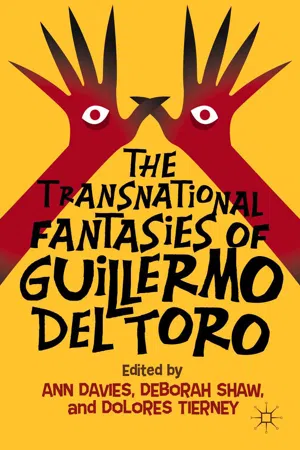
The Transnational Fantasies of Guillermo del Toro
- English
- ePUB (mobile friendly)
- Available on iOS & Android
eBook - ePub
The Transnational Fantasies of Guillermo del Toro
About this book
Offering a multifaceted approach to the Mexican-born director Guillermo del Toro, this volume examines his wide-ranging oeuvre and traces the connections between his Spanish language and English language commercial and art film projects.
Information
Subtopic
Art GeneralPart I
Del Toro’s Principles and Practices
Chapter 1
“There Is No Such Thing”: Del Toro’s Metafictional Monster Rally
Glenn Ward
The October 2013 edition of the annual The Simpsons Treehouse of Horror boasted a credit sequence conceived and guest-directed by Guillermo del Toro. The opening “couch gag” of Matt Groening’s long-running series has often displayed the show’s irreverent brand of intertextuality, but del Toro’s contribution was a three-minute master class in playful pastiche, quotation, and self-reference. Del Toro’s fans could spot cartoon versions of Prince Nuada and the forest god from Hellboy II: The Golden Army (2008), a gargantuan monster and robot fight in the style of Pacific Rim (2013), Marge in the shape of a monstrous cockroach from Mimic (1997), Homer’s face erupting gruesomely into that of a Reaper from Blade II (2002), the Cronos (1993) device, Mr. Burns reconfigured as the Pale Man from El laberinto del fauno/Pan’s Labyrinth (2006), and Lisa Simpson dressed as Ofelia (from El laberinto), falling down the 1951 Disney version of Alice’s rabbit hole and confronting the Hypnotoad from Groening’s Futurama series. Creature feature aficionados could revel in shared genre knowledge by sighting—among many others—intertextual references to Ray Harryhausen’s skeletons from Jason and the Argonauts (Don Chaffey 1963), Elsa Lanchester as the bride from The Bride of Frankenstein (James Whale 1935), The Car (Elliott Silverstein 1977), several incarnations of The Phantom of the Opera and The Day the Earth Stood Still (Robert Wise 1951), The Creature from the Black Lagoon (Jack Arnold 1954), The Shining (Stanley Kubrick 1980), Nosferatu (F. W. Murnau 1922), The Fly (Kurt Neumann 1958), Alien (Ridley Scott 1989), and Freaks (Tod Browning 1932).
Perhaps it is perverse to open a discussion of del Toro with a description of a mere footnote in his career, but it is a revealing footnote because it distills the sometimes neglected carnivalesque aspects of del Toro’s work. Its parade of fantastic beings draws eclectically from (mainly Hollywood) cinema history, as figures from classic films like The Birds (Alfred Hitchcock 1963) jostle with B-movie and poverty-row beings, like Ro-Man from Robot Monster (Phil Tucker 1953). As well as mixing arcane and common cinema knowledge, and “high” and “low” genre sources, the sequence refers to real-life authors of fantastic literature: eagle-eyed viewers can identify cartoon cameos by Richard Matheson, H. P. Lovecraft, Stephen King, Ray Bradbury, and Edgar Allan Poe. Some of these nods are doubly referential since del Toro has nodded to them before. The Hellboy films borrow from Lovecraft and pay homage to Harryhausen’s stop-motion animation; Jack Arnold’s aquatic Gillman, in addition to informing the design of Hellboy’s Abe Sapien, makes a fleeting appearance on a TV screen in Hellboy II, as does James Whale’s Bride. As a short animation for a television series, Treehouse demonstrates the ease with which del Toro crosses media and comically summarizes an approach to cinematic monsters that is allusive to the point of excess. The Treehouse monster mash-up suggests links between Lovecraft and H. R. Giger’s Alien, for example, or between del Toro’s Cronos device and Harryhausen’s “dynamation.” In doing so it embodies the sheer diversity of genre sources and discursive constructions in most of del Toro’s work, where science fiction meets supernatural fantasy, horror meets the fairy tale, children’s fiction meets adult fiction, vampires meet cyborgs, the Bible meets the Cthulhu mythos, the marvelous meets the uncanny, gothic historicism meets digital hypermodernity, skepticism collides with belief, metacinematic smartness runs headlong into childlike wonder, and history and fiction crash into each other.
This chapter argues, then, that del Toro’s seamless cinemacraft belies a discursive heterogeneity, which includes disparate “theories” of monstrosity, its cultural and psychological significance, and its origination. These theories play off and undermine each other as much as they interweave and cohere. I therefore look at some of the strategies, both cinematic and extracinematic, through which del Toro tries to keep semiotic mayhem at bay. Del Toro’s films recognize that fantastic cinema foregrounds hermeneutic dilemmas in the very act of representing nonexistent entities; if monsters mean anything, his films ask, where are those meanings to be found, and what and where is the referent? One answer is that they refer to nothing pretextual and have no foundation beyond their own circulating signifiers of difference. I argue that this poststructuralist possibility is clearly flagged in del Toro’s films and that it has particular significance in relation to those films’ elements of historicism. Monsters have long suffered—or enjoyed—a legitimation crisis and as “signs of the superficiality, deception, and duplicity of narratives and verbal or visual images” (Botting, 1996, 14) Gothic tropes have always problematized the referent. Other answers approach the fantastic text through hermeneutic depth models, which read it symptomatically for signs of underlying malaise. In some of these accounts, historical trauma—psychological, historical, or both—is the privileged signified that makes the monstrous meaningful. Indeed, in some cases, trauma stands for a presymbolic, unmediated “real” that lends the gothic and fantastic credibility. This possibility, too, is flagged up in del Toro’s plurally coded films. The films therefore oscillate continually between these positions: on the one hand, they present notions of personal, historical, and generic pastness as legitimizing foundations for their fantastic imagery; on the other hand, they use many forms of reflexivity, metaenunciation, and metafiction to foreground the surface play of signs and interrogate those foundations. In these ways del Toro’s treatment of pastness brings the fantastic mode together with “the self-conscious, self-contradictory, self-undermining statement” of postmodern textuality (Hutcheon, 1989, 1) and problematizes its own nostalgia for an unattainable real.
Del Toro’s Simpsons Halloween special is a monster rally in miniature. By “monster rally,” I mean a text in which diverse monsters from disparate sources share a diegetic space. Often jocular, self-parodying, or camp in attitude, monster rallies may involve various beings encountering one another at social gatherings or assembling in opposition to common enemies. Examples include The Monster Club (Roy Ward Baker 1980) and the animated children’s film Mad Monster Party (Jules Bass 1967). The motley families in texts such as The Addams Family television series (1964–66) or Spider Baby (Jack Hill 1964) are variations on the theme. Pacific Rim was influenced by the “meets” or “versus” variant, which features a clash of movie titans taken from two different film series or cycles. Among the many examples are King Kong vs. Godzilla (Ishiro¯ Honda 1962), Santo and Blue Demon vs. Dracula and the Wolfman/Santo y Blue Demon contra Drácula y el Hombre Lobo (Miguel M. Delgado 1973), and Alien vs. Predator (Paul W. S. Anderson 2004). As several of the above examples suggest, the monster rally also has an association with family entertainment; in different ways, Ghostbusters (Ivan Reitman 1984) and Monsters, Inc. (Pete Docter 2001) are monster rallies. Some of del Toro’s set pieces are monster rally interludes. One example is the multispecies “troll market” deep beneath Brooklyn bridge in Hellboy II, a hybrid of Christina Rossetti’s Goblin Market (1862), cinematic representations of the North African bazaar, and the Mos Eisley cantina in Star Wars (George Lucas 1977). In the same film, the corridors of the Bureau of Paranormal Research and Defense, quite deserted in the first Hellboy film, are brimful of sundry bizarre beings and suited government agents, in the mold of Men in Black (Barry Sonnenfeld 1997). Such imagery encapsulates the ever-expanding, overloaded del Toro “cosmos.”
Although monster rallies are an established part of horror and fantasy culture, they are somewhat disregarded in horror film histories because of their lack of gothic seriousness and frequent “failure” to frighten. For some critics and fans, they may typify generic descent from classicism to trivial, self-conscious mannerism; not unlike sequels, franchises, and series, they appear minor because their shuffling of iconography seems parasitic on more innovative originals and far removed from the generic “core.” Because the monster rally is high on genre-bending waywardness but low on cultural anxiety, psychological dread, or allegorical depth, it seems to offer little for horror theorists to deconstruct. Indeed, the monster rally is the genre deconstructing itself. It is a genre rogue that relies upon and challenges the intended audience’s horizons of expectation by playing fast and loose with gothic and fantastic protocols. Since monsters are always assembled through “a process of fragmentation and recombination” (Cohen, 1996, 11), monster rallies lay bare the genre’s mechanics by dragging and dropping icons from one context to another, cheerfully treating fantastic entities as freely transferable signs, permutating them in pursuit of new possibilities, and serving as a model of the lively resourcefulness of popular genericity. Thus the monster rally, like the Treehouse of Horror sequence, is a useful metaphor for all of del Toro’s films, even the “serious” ones, and even when they do not literally appear to be instances of the type. To take just one example of the combinative process, according to the “creators’ commentary” on the bonus disc accompanying the Hellboy DVD, the titular antisuperhero (Ron Perlman) is a demonic blend of Boris Karloff’s Frankenstein’s monster and a King Kong–like gorilla; his fight with the hellhound Sammael was influenced by a scene in King Kong (Merian C. Cooper and Ernest B. Schoedsack 1933) where the giant ape prizes a Tyrannosaurus rex’s jaws apart; Sammael’s pounding on the floor is an homage to Harryhausen’s effects work on Mighty Joe Young (Ernest B. Schoedsack 1949) cut to the rhythm of Warner Brothers cartoons. Del Toro professes to have made the film out of admiration for how Mike Mignola’s original Dark Horse Hellboy comics fused superhero themes with gothic imagery. A detailed comparison between the print and screen versions of the Hellboy universe is beyond the scope of this chapter. However, in their DVD commentary, del Toro and coproducer Mignola stress that although Hellboy’s world is Mignola’s creation, the screen adaptation is very much del Toro’s responsibility. This is visible in aspects of the production design, which clearly echo del Toro’s other films. As author of the screenplay and coauthor of the screen story, del Toro also embellishes Mignola’s characters according to his own interests, for example by fleshing out the romantic relationship between Hellboy and Liz Sherman (Selma Blair), while making Liz far more anxious and much less self-assured than she is in the comics. The first Hellboy film also plays on the idea that the title character works for a secret government agency, battling monsters that do not officially exist, while in the world of the comics, supernatural beings are publicly accepted as everyday phenomena. On the same commentary, Mignola and del Toro discuss how their individual contributions drew on a shared love of H. P. Lovecraft and of what Mignola describes as “old folklore, legends . . . ghost stories . . . and old monster comics,” thereby reminding us that the film is built on a dense accumulation of intertexts.
Del Toro attempts to ground this monstrous intertextuality partly through recourse to autobiographical self-presentation. Broadcast three months after the release of Pacific Rim (2013), Treehouse of Horror was part of a publicity push for del Toro. Perhaps because he had been involved in production (such as Don’t Be Afraid of the Dark [Troy Nixey 2010]), screenwriting (The Hobbit: The Desolation of Smaug [Peter Jackson 2013]), and coauthoring novels (The Strain, with Chuck Hogan, 2009), del Toro had not directed a feature since 2008’s Hellboy II. With its irresistible invitation to reference-spotting, the extravagant intertextuality of the Simpsons sequence generated much online discussion and thus bolstered the market presence of the del Toro “brand” in the lead-up to Christmas. Indeed, the Blu-ray and DVD release of Pacific Rim in Britain took place a few days after Treehouse was shown on the Fox Network and just over a week before the publication of the book Guillermo del Toro’s Cabinet of Curiosities: My Notebooks, Collections, and Other Obsessions (Titan Books, 2013). As the title suggests, this lavish hardback monster rally in print was marketed, not as an insight into the practices of a shrewd media industry operator, but as an opportunity to gain privileged access to the “private collection” and imagination of a visionary. Mainly comprising miscellaneous reproductions of del Toro’s elaborate drawings and notes for his cinematic creatures and mechanisms, the cabinet also included photographs of his home and office, Bleak House. Bleak House itself resembles a magnified cabinet of curiosities stacked high with books, horror cinema memorabilia, props from his own films, and a life-size statue of H. P. Lovecraft; images of del Toro in this setting closely recall images of Forrest J. Ackerman, the editor of Famous Monsters of Filmland, showing off his memorabilia-filled “Ackermansion.” Well-heeled fans and collectors could also buy—for around £500—a signed, limited edition of the book, this time fashioned as an aged wooden portable cabinet containing, along with the book itself, “art prints” of previously unpublished sketches, four facsimiles of pages from the Book of Crossroads in El laberinto, a replica of the Cronos device (complete with pages from its instructional manuscript), and a replica rosary and amulet from Hellboy.
Clearly intended for enthusiastic collectors not unlike del Toro himself, the Cabinet is positioned ...
Table of contents
- Cover
- Title
- Copyright
- Contents
- List of Illustrations
- Foreword
- Acknowledgments
- Introduction
- Part I: Del Toro’s Principles and Practices
- Part II: Del Toro’s English-Language Works
- Part III: Del Toro’s Spanish-Language Works
- Notes on Contributors
- Index
Trusted by 375,005 students
Access to over 1.5 million titles for a fair monthly price.
Study more efficiently using our study tools.
Frequently asked questions
Yes, you can cancel anytime from the Subscription tab in your account settings on the Perlego website. Your subscription will stay active until the end of your current billing period. Learn how to cancel your subscription
No, books cannot be downloaded as external files, such as PDFs, for use outside of Perlego. However, you can download books within the Perlego app for offline reading on mobile or tablet. Learn how to download books offline
Perlego offers two plans: Essential and Complete
- Essential is ideal for learners and professionals who enjoy exploring a wide range of subjects. Access the Essential Library with 800,000+ trusted titles and best-sellers across business, personal growth, and the humanities. Includes unlimited reading time and Standard Read Aloud voice.
- Complete: Perfect for advanced learners and researchers needing full, unrestricted access. Unlock 1.5M+ books across hundreds of subjects, including academic and specialized titles. The Complete Plan also includes advanced features like Premium Read Aloud and Research Assistant.
We are an online textbook subscription service, where you can get access to an entire online library for less than the price of a single book per month. With over 1.5 million books across 990+ topics, we’ve got you covered! Learn about our mission
Look out for the read-aloud symbol on your next book to see if you can listen to it. The read-aloud tool reads text aloud for you, highlighting the text as it is being read. You can pause it, speed it up and slow it down. Learn more about Read Aloud
Yes! You can use the Perlego app on both iOS and Android devices to read anytime, anywhere — even offline. Perfect for commutes or when you’re on the go.
Please note we cannot support devices running on iOS 13 and Android 7 or earlier. Learn more about using the app
Please note we cannot support devices running on iOS 13 and Android 7 or earlier. Learn more about using the app
Yes, you can access The Transnational Fantasies of Guillermo del Toro by A. Davies, D. Shaw, D. Tierney, A. Davies,D. Shaw,D. Tierney in PDF and/or ePUB format, as well as other popular books in Media & Performing Arts & Art General. We have over 1.5 million books available in our catalogue for you to explore.